


Every profitable business in the world has Chinese people involved | Brother Dong's Dinner Party Episode 120


Source: Dongge Notes
Author: Li Chengdong
- The following content has been desensitized and contains no sensitive information
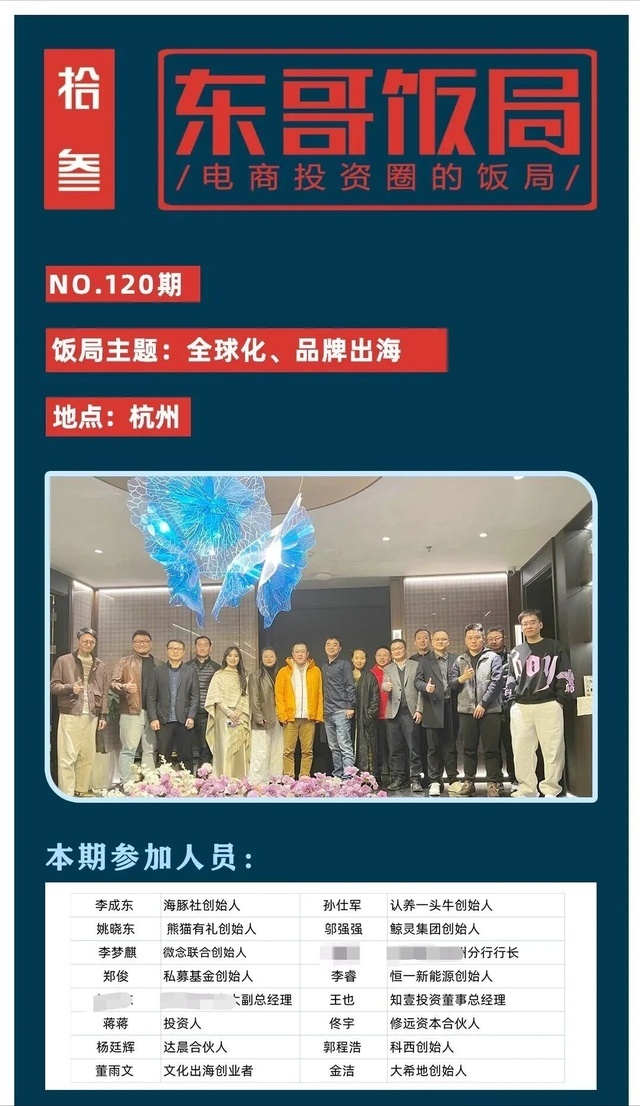
The 120th session of Dongge's Dinner Gathering (Hangzhou Station) focused on globalization and brand expansion overseas.
Topics included: Risks and opportunities in Southeast Asia, the trillion-dollar e-commerce market in Russia, resource dividends and chain opportunities in Africa, the quiet rise of the domestic economy for the elderly, investment, and entrepreneurship.

Expanding to Southeast Asia: Opportunities and Risks
The Southeast Asian market has huge potential but also comes with multiple risks such as security, policy, and cultural challenges. Entrepreneurs need strong localization capabilities and risk awareness.
Around Jakarta, the capital of Indonesia, there are "drug villages" where police find it difficult to enter. There have even been cases where Chinese entrepreneurs had their phones stolen and had to exchange them for "equivalent weight in drugs" to get them back.
Vietnam is relatively safe due to its police-state nature, while Thailand poses personal risks due to high civilian gun ownership and intense price negotiations.
J&T Express's rapid rise in Southeast Asia can be summarized in two key strategies: First, replicating OPPO's mature local agent network—selling Brand A or Brand B makes no difference to agents, but J&T pays more. Second, leveraging capital advantages to make massive investments in brand momentum, quickly raising industry barriers.
Beyond physical goods, Chinese internet and service companies are accelerating their presence in Southeast Asia. Tencent and ByteDance are expanding e-commerce and content platforms in Vietnam and Thailand. A global recruitment platform founded by a former JD.com HR executive has established operations in over 30 Southeast Asian countries, serving the localization hiring needs of new energy, automotive, and other industries, with a 70% month-on-month growth.

Expanding to Russia: Energy and E-commerce as Breakthroughs
Affected by Western sanctions, Russia's reliance on Chinese supply chains in energy, metals, e-commerce, and other fields has surged. Filling the void left by Western withdrawal has become a core opportunity.
Commodities
Russia is a major global supplier of metals such as aluminum, copper, nickel, tin, and gold, as well as a major energy exporter. Due to Western sanctions and the civil war in Myanmar (a former key supplier of zinc ingots), global shortages of zinc and tin ingots have expanded, leading to significant price increases. One company completed over a billion dollars in tin and zinc ingot purchases in a year by partnering with Russian financial groups.
E-commerce Market
Russia's e-commerce market is worth over $120 billion, with more than 90% of goods sourced from China, totaling over 500 billion RMB annually. Unlike Southeast Asia, Russia's e-commerce relies more on "bulk standardized products + brand OEMs." For example, one company achieved annual revenue of 5-6 billion RMB on Russian e-commerce platforms through a "private label + influencer marketing" model. After international platforms like Amazon exited, Chinese cross-border e-commerce companies quickly filled the gap, improving logistics efficiency with "Southeast Asia routes + localized Russian warehousing."
Expansion Advice
Prioritize government-backed projects: Focus on energy, metals, and other heavily sanctioned sectors, and introduce them through Sino-Russian government cooperation channels to reduce policy risks.
Avoid sensitive industries: Steer clear of military-civil fusion, high-tech, and other sanction-prone areas. Focus on energy, consumer goods, e-commerce, and other livelihood-related industries to ensure compliance and safety.

Expanding to Africa: High Risk, High Reward—Resources, Chains, and Infrastructure as Main Themes
Africa is the last major market with a demographic dividend, featuring fast population growth (3% annually in some countries) and abundant resources. However, issues like conflict, corruption, and poor infrastructure are prominent.
Resource Development
The cost of acquiring resources like gold and coal is extremely low. Entrepreneurs from Shanglin, Fujian, extract placer gold in Ghana and Sudan, where 100 million RMB can leverage gold mines worth billions of dollars. The key is low resource valuation and offering 15%-20% dry shares to tribes and governments.
One team improved exploration efficiency through "Qimen Dunjia (a Chinese divination method) + master cross-verification," achieving annual profits in the tens of millions. Despite passport restrictions, they continue operations using localized identities.
Consumer Market
Leshushi diapers have an annual scale of 3 billion RMB with net profits of 500-600 million RMB, thanks to designs tailored for African babies and a low-price strategy.
A 2,000㎡ home appliance chain in Kenya became a market leader in one year by leveraging Chinese supply chains and local low prices, undercutting European and American brands by 30%.
A Fujian team set up nine factories in an African industrial park, covering food processing and catering supply chains, with annual revenue exceeding 1 billion RMB.
Infrastructure and Services
Africa's weak infrastructure presents opportunities for Chinese companies in railways, ports, and power. One company participated in the "African Leaders Visit China" program, facilitating cooperation in new energy, robotics, and agriculture to help Chinese companies establish factories in Africa.

Consumer Market: A Tale of Two Extremes—The Rise of the Elderly Economy
Domestic consumption is generally sluggish, but structural opportunities remain, with the elderly market emerging as a new blue ocean.
Downgrading Trend in Basic Consumption
Consumer demand is closely tied to employment. After the decline in migrant workers in manufacturing hubs like Dongguan and Kunshan, demand for basic goods like milk and daily necessities has significantly dropped.
Young people are becoming more conservative in spending, with real estate pressures limiting their purchasing power. Non-essential spending (e.g., high-end cosmetics, affordable luxury) has contracted.
Growth in Affordable FMCG and Healthy Food
Essential and high-value products perform well. For example, a biscuit company in China achieves annual revenue of 2 billion RMB with a "low-margin, high-volume + sinking market" strategy, maintaining over 10% growth for three years. Budget tea brands like Mixue Bingcheng and Guming continue expanding in third- and fourth-tier cities, targeting the 5-10 RMB price range to match mass affordability.
Post-pandemic health awareness has boosted demand for low-sugar, low-fat, and organic foods. A shelf-stable milk company saw 20% annual sales growth via online channels, while "low-fat chicken breast" and "organic vegetable meal kits" in the prepared food sector grew 30% year-on-year.
Strong Elderly Spending Power
The elderly (55+) demographic grows by 20 million annually, mostly free of mortgage pressure and with stable pensions. Health supplements, elderly care services, and online social courses are growing rapidly. Companies in elderly universities, financial planning for seniors, and senior-friendly robotics have already reached scales of over 10 billion RMB.

Chinese Brands Going Global: From Affordable Alternatives to Outperformance
Evolution of Brand Globalization
Chinese brands are shifting from a "value-for-money" approach to a new phase of "product superiority + pricing confidence." The new generation of global brands no longer relies on low-price competition but leverages technological and functional advantages to price above international competitors, demonstrating strong brand confidence.
Under-the-Radar Brands as Key Players
Beyond well-known brands, many "underwater players" dominate niche markets globally. Examples:
- A premium phone case company with 9 billion RMB annual revenue and ~500 RMB average unit price.
- A Yiwu razor brand replaced Philips in Mexico, Southeast Asia, the Middle East, and Russia in just three years.
- Shenzhen e-cigarette company AiQiji earns over 30 billion RMB annually, with 99% exports and profits far exceeding peers.
These companies thrive on solid supply chains and localized channels without relying on funding or marketing.
Explosive Growth of F&B Brands Abroad
Single-store efficiency crushes competitors, supply chain advantages shine. Chinese F&B brands are emerging as global forces, achieving "high revenue + high profits" overseas. Examples:
- A bubble tea brand in North America hits $500K monthly revenue per store, surpassing Chagee.
- Zhu Guangyu Hotpot's Kuala Lumpur outlet earns 15 million RMB annual net profit. Key advantages: localized supply chains (lower overseas meat costs), and the scarcity of hotpot/bubble tea abroad aligns with local demand for novelty.

Cultural Expansion: Daoism, Tai Chi, and Eastern Wisdom
Cultural exports have become a national strategy, with Daoism as a local IP going global through content, products, and events.
China promotes "Eastern Wisdom Global," with Wudang Mountain, Qingcheng Mountain, and other IPs co-managed by companies and the Ministry of Culture to develop cultural, wellness, and incense products. Overseas, "Daoist Master IPs" spread Tai Chi and traditional Chinese medicine, building cultural influence. Unlike Confucius Institutes, Daoist culture is more easily accepted through soft approaches like "fitness" and "mystical wisdom."

Investment and Entrepreneurship: Survive, Then Go Global
Pure domestic consumer investment has frozen; surviving firms pivot to "globalization + tech" dual drivers. Entrepreneurs must be pragmatic, with global vision and cash flow awareness.
Investment Shift: Focus on "Global + Tech"
Investors are collectively shifting to "globalization + tech." One VC revealed that nearly all portfolio companies in their new fund are expanding overseas, many targeting global markets from day one. Tech (especially AI applications for global markets) is booming, with projects going from zero to tens of millions in annual revenue.
Consumer sector investments are now pragmatic, favoring cash flow-positive models like cross-border e-commerce and overseas brand incubation to ensure survival in the current climate.
Entrepreneurial Rules: Go Global Pragmatically, Cash Flow Is King
Entrepreneurs must abandon domestic "involution" for global markets, prioritizing cash flow.
Cross-border e-commerce is the top choice, leveraging China's supply chain to incubate brands in Europe, the US, and Southeast Asia. Light models and fast payments yield better cash flow than domestic ventures.
Successful global entrepreneurs need technical expertise, precise market insights, and execution power to seize opportunities. Avoid "heavy-asset, long-cycle" models—test waters via platforms first. Respect local rules; don't copy-paste domestic tactics.

A-Share Philosophy: It’s a Money Game, Not Value Investing
In A-shares, fundamental analysis usually fails. This is a market driven by policy, sentiment, and capital flows—retail investors face extreme hardship.
"90% of A-share value investors are here to lose money," bluntly said a veteran trader. "Technical patterns are just traps set by big players. You see a breakout, jump in, and they dump all their shares on you."
Retailers’ flaw is "chasing rallies and selling lows," while pros "preempt capital flows." Sector rotations (e.g., defense, semiconductors) are fast and fleeting.
Advice to retail: "If you have a job, don’t trade A-shares (short-term). It demands hours of screen time and analysis. The real money is in ultra-short trades—exiting is the only win."

The Next Decade: Chinese Entrepreneurs Reshaping Global Business
From Southeast Asian e-commerce to African mines and chains; from Western consumer brands to Latin American fintech—Chinese business power is reshaping global markets with unprecedented depth and breadth.
Wherever there’s money to be made, you’ll find Chinese people.
This is no metaphor but reality. From gray-area P2P lending to hyper-localized gold mines and casinos, Chinese entrepreneurs show astonishing adaptability and money-making grit. Their footprints span the globe, carving out mature business models in high-risk, rule-gray zones.
Efficiency Gaps Are Opportunities
Globally, huge inefficiencies persist in manufacturing, distribution, marketing, and management. Chinese entrepreneurs, battle-hardened in domestic red oceans, wield overwhelming advantages. Mature supply chains, hyper-efficient online tactics, and agile org models can be replicated worldwide. Wherever inefficiency lurks, they’ll monetize it—victory is just a matter of time.
Older generations exported goods or opened factories; the new wave exports brands, channels, supply chains, and capital ecosystems. Some don’t even hire Chinese executives—they manage foreigners to run global businesses.
Conclusion
China’s next business chapter lies not in involution but globalization; not in scraping leftovers but seizing growth.
The copyright of this article belongs to the original author/organization.
The views expressed herein are solely those of the author and do not reflect the stance of the platform. The content is intended for investment reference purposes only and shall not be considered as investment advice. Please contact us if you have any questions or suggestions regarding the content services provided by the platform.
