

Longfeng Group IPO: Profit falls short of HK$200 million, what are the two sides of Hong Kong's largest pharmaceutical retailer?

Recently, mainland innovative pharmaceutical companies have been "teaming up" at the Hong Kong Stock Exchange, and local Hong Kong pharmaceutical companies have also taken action. For example, Hong Kong's largest pharmaceutical retail company, Long Feng Group, has submitted a main board listing application to the Hong Kong Stock Exchange, aiming to become the "first stock in Hong Kong's pharmaceutical and cosmetics sector".
In terms of establishment time, Long Feng Group has been rooted in Hong Kong for over 30 years, demonstrating a solid "family foundation", and its current performance growth is also very outstanding. The prospectus shows that for the fiscal years 2023 to 2025, the group's revenue was HK$1.094 billion, HK$2.021 billion, and HK$2.46 billion, respectively; net profits for the year were -HK$27.14 million, HK$145 million, and HK$170 million, respectively.
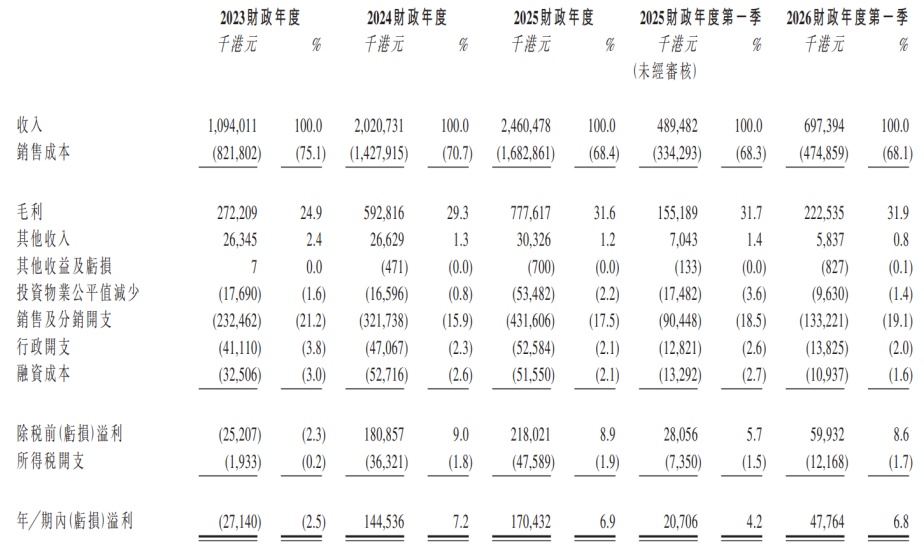
In the first quarter of fiscal year 2026, the group's revenue was HK$697 million, a year-on-year increase of 42.48%; profit for the period was HK$47.764 million, a year-on-year increase of 130.68%. Behind this, Long Feng Group has already achieved strong economies of scale but is also facing the test of scale.
How to Expand the Retail Ecosystem?
Economies of scale are the core logic for the retail industry to "reduce costs by expanding" and ultimately enhance competitiveness. So, how has Long Feng Group "expanded" its business?
First, the product structure is quite diverse. The prospectus mentions that Long Feng Group started as a pharmacy selling pharmaceuticals, health products, and cosmetics, and gradually expanded into other product areas such as snacks and pet food to attract a broader customer base, including the younger generation. In fiscal year 2025, it sold approximately 28,800 SKUs, including over 3,000 types of traditional Chinese medicine, over 4,200 types of health products, over 6,800 types of cosmetics, and over 14,000 types of other consumer products, fully demonstrating the breadth and depth of its product portfolio.
In this regard, the global supply system has likely played a significant role. It is reported that Long Feng Group has over 600 suppliers, including brand manufacturers, Hong Kong-authorized agents and brand distributors, OEM and ODM manufacturers, etc. Overseas suppliers are mainly located in Japan, South Korea, Hong Kong, Southeast Asia, Europe, and the United States.
Second, seamless online and offline channels. According to the prospectus, as of the latest practicable date, Long Feng Group operates 29 physical retail stores in Hong Kong, with a total usable floor area of over 123,000 square feet. Among them, 5 are located on Hong Kong Island, 10 in Kowloon, and 14 in the New Territories. Most of the retail stores are street shops, which not only enjoy high foot traffic but also provide convenience to customers.
Online, Long Feng Group operates an official online store primarily serving local Hong Kong customers, as well as online stores on China's three major e-commerce platforms: Tmall, WeChat Mini Program, and JD.com.
With one hand on products and the other on channels, Long Feng Group has ultimately built a one-stop, comprehensive retail ecosystem. However, its reliance on the Hong Kong market also limits its growth potential.
Is the Leading Pharmaceutical Retailer Geographically Constrained?
Admittedly, Hong Kong is a "fertile ground" for retail development.
Looking only at the pharmaceutical retail sector. According to Frost & Sullivan data, the size of Hong Kong's pharmaceutical market grew from HK$5,788.3 million in 2020 to HK$8,507.9 million in 2024, with a compound annual growth rate (CAGR) of 10.1%. It is expected that the market size will reach HK$11,306.3 million by 2029, with a CAGR of 6.4% from 2025 to 2029.
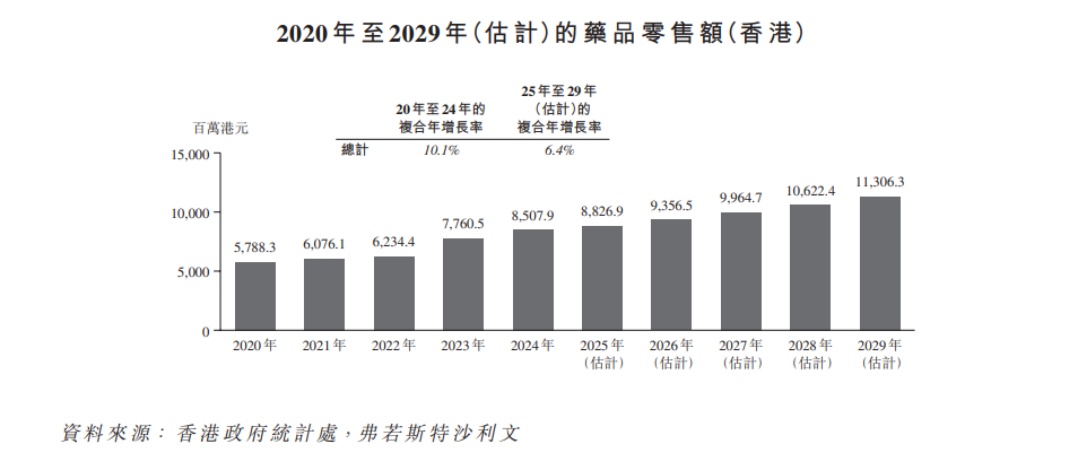
The prospectus mentions that such a positive outlook is mainly influenced by several major trends.
One is the integration of traditional Chinese medicine and modern pharmaceuticals, which, due to its alignment with cultural values, the trend of preventive healthcare, and meeting modern consumers' preference for convenience, has become a key driver of pharmaceutical sales in Hong Kong. To capitalize on this trend, pharmaceutical companies are increasing investment in the research and development of traditional Chinese medicine formulas, ensuring compliance with Hong Kong's regulatory requirements, and highlighting the authenticity and efficacy of products through digital marketing.
The second is the shift toward personalized medicine. Specifically, Hong Kong consumers with high health literacy and familiarity with digital platforms are increasingly seeking pharmaceuticals tailored to specific needs, such as personalized vitamin supplementation plans or over-the-counter medications for specific conditions like joint pain and skin health. In this context, local retailers are actively promoting the application of AI to recommend products based on users' lifestyles or health data.
As the leading pharmaceutical retailer in Hong Kong, Long Feng Group is also riding these trends and benefiting from the times. In 2024, in terms of pharmaceutical retail sales, the group ranked first among Hong Kong pharmaceutical retailers, with a 5.2% market share.
However, it is important to note that the Hong Kong pharmaceutical market is relatively competitive. In terms of retail sales, the top five retailers accounted for 14.6% of the market share in 2024, with the second-largest pharmaceutical retailer holding a 4.9% market share, which is not significantly different from Long Feng Group's scale.
In addition, Long Feng Group's prospectus mentions that all operational areas of Hong Kong's consumer goods retail market face dynamic cost pressures. Labor costs are a key factor, with the average monthly salary in the wholesale, retail, and import/export industries increasing from HK$19,353.5 in 2020 to HK$21,471.0 in 2024, with a CAGR of 2.6%. Due to the competitive labor market and the demand for skilled logistics and wholesale professionals, this figure is expected to grow further at a CAGR of 2.5% by 2029.
At the same time, warehouse rental costs grew at a CAGR of 1.9% from 2020 to 2024 and are expected to grow by 1.5% by 2029, mainly due to the continued demand for logistics and warehousing facilities. Perhaps because of this, Long Feng Group's current profit scale is not large.
At this IPO juncture, how to leverage the power of the capital market to consolidate its local market advantages while seeking broader growth opportunities may also be the core proposition Long Feng Group is facing.
Source: Pharmaceutical Research Society
The copyright of this article belongs to the original author/organization.
The views expressed herein are solely those of the author and do not reflect the stance of the platform. The content is intended for investment reference purposes only and shall not be considered as investment advice. Please contact us if you have any questions or suggestions regarding the content services provided by the platform.
