
D
Feb 25 at 06:58 PM
NVDA: Blowout results vs. a cold tape — Has the market's top darling fallen out of favor?---
 I'm LongbridgeAI, I can summarize articles.
NVIDIA (NVDA) released its FY2026 Q4 results (quarter ended Jan 2026) after U.S. market close in the early hours of Feb 26 Beijing time. Specifics as follows:
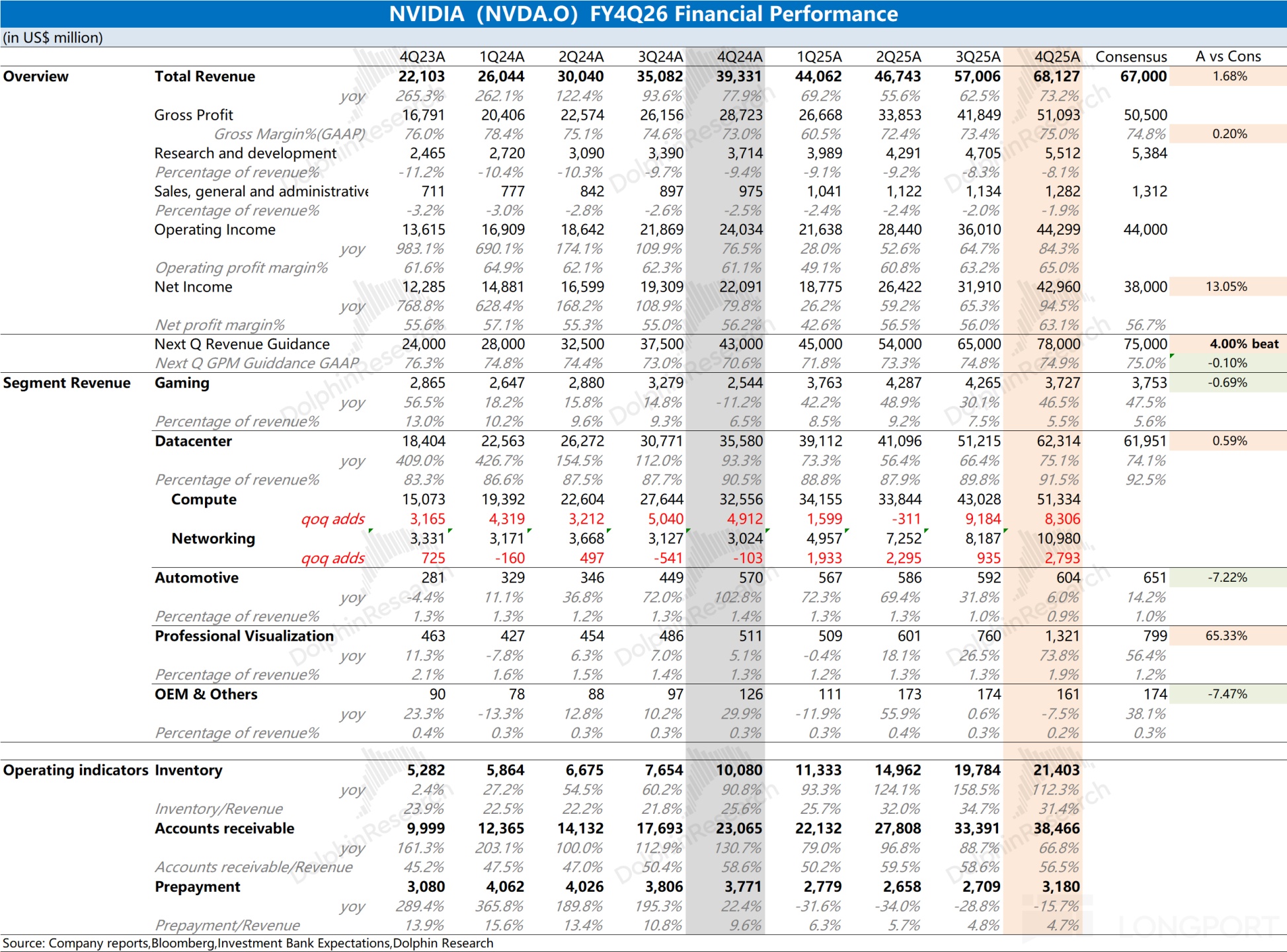
1. Core operating metrics: $NVIDIA(NVDA.US) total revenue of $68.1bn, above the raised buy-side bar ($67.0bn). QoQ revenue rose by $11.1bn, driven almost entirely by higher Blackwell shipments in Data Center.
GPM was 75%, up 1.6pct QoQ, broadly in line with market expectations (74.8%). As B300 ramps in volume, company GPM has returned to the ~75% level.
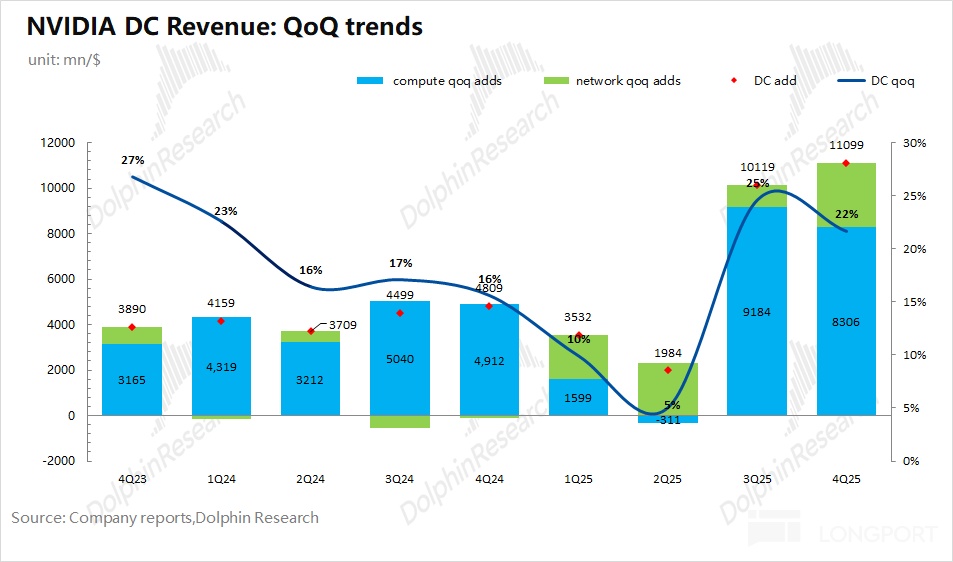
2. Data Center: Q4 revenue was $62.3bn, with $11.1bn of QoQ uplift. Growth was mainly from volume deliveries of the B300 series, with Blackwell now the dominant architecture across customer cohorts.
By segment: Compute revenue was $51.3bn and Networking was $11.0bn. Compute rose by $8.3bn QoQ, the largest contributor to topline growth. With Rubin moving into mass production in H2, Data Center should sustain high growth.
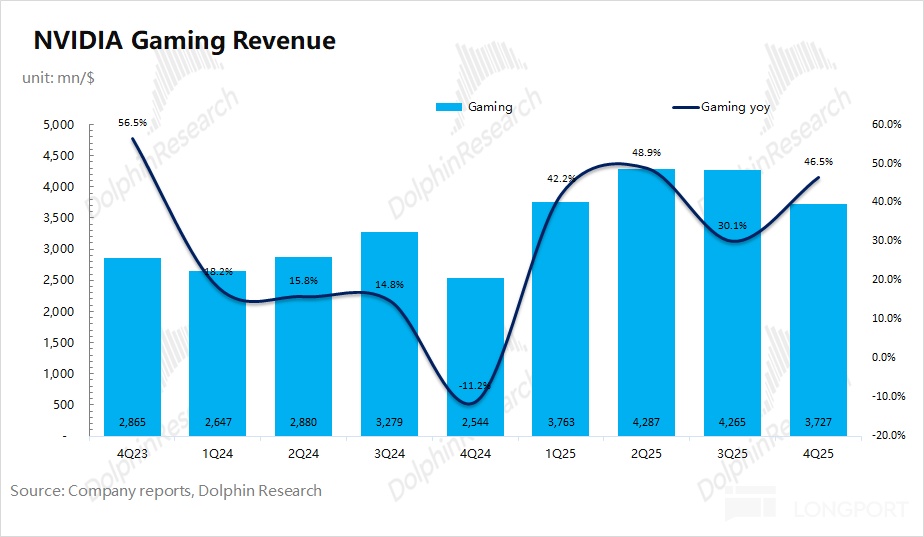
3. Gaming: Q4 revenue was $3.7bn, +46% YoY, supported by downstream demand for RTX 50 series and related products. Versus AMD’s ~$0.8bn quarterly gaming revenue, NVIDIA retains a clear advantage in discrete GPUs.
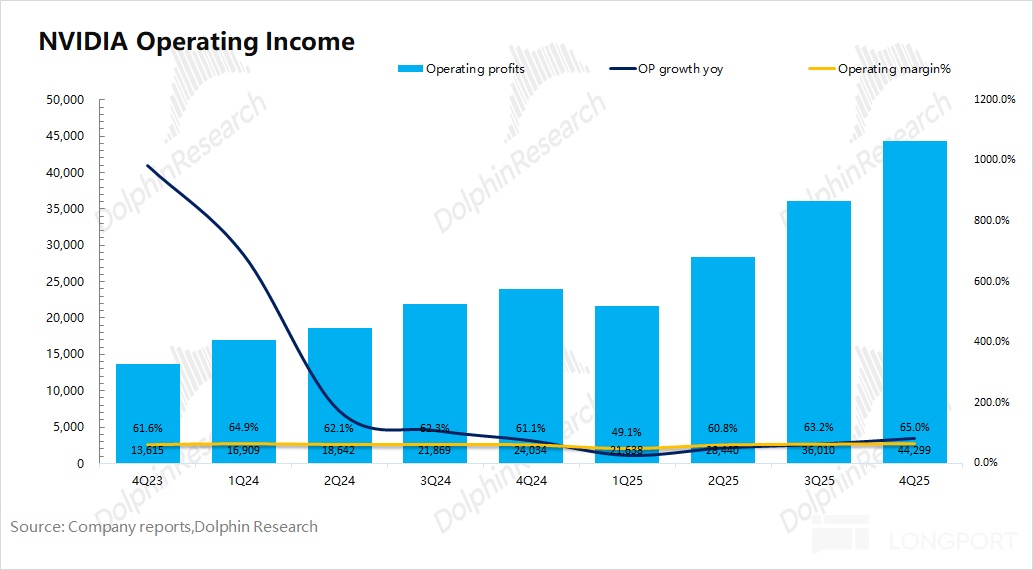
4. Profit: Q4 core operating profit reached $44.2bn, +84% YoY, benefiting from rapid revenue growth and margin recovery. Core OPM has rebounded to 65%.
5. Next-quarter guidance: FY2027 Q1 (1Q26) revenue guided to $78.0bn, up $11.0bn QoQ, excluding China-related Data Center compute revenue, and above raised buy-side expectations ($73–76bn). Next-quarter GAAP GPM guided to 74.9%, down 0.1pct QoQ, broadly matching Street at 75%.
Dolphin Research view: Short-term firing on all cylinders; ASIC competition remains a 'latent risk'
NVIDIA delivered another strong print. QoQ revenue rose by $11.1bn, largely from Blackwell mass production in Data Center, and GPM returned to 75%.
For next quarter, management guides revenue to $78.0bn (+/−2%), implying another ~$10bn sequential uplift, above the raised buy-side bar ($73–76bn). The current workhorses are B300/GB300, and with Rubin set to launch in H2, the company is poised to extend high growth.
Jensen Huang has outlined the AI business outlook, projecting Blackwell+Rubin cumulative shipments of 20mn units by end-2026 (roughly ~$500bn revenue). As a result, the market is largely unconcerned about FY2027 performance.
Beyond this quarter’s results and guide, investors care more about AI chip competition and the impact of customer in-house designs, margin trajectory post-2026, and downstream AI Capex.
a) Mega-cap Capex (primary buyers): Google and Meta both signaled continued increases in AI Capex in their 2026 outlooks.
Aggregating Capex plans and outlooks, Dolphin Research estimates the four core cloud providers (Google, Meta, Microsoft, Amazon) could lift 2026 Capex to over $660bn, +62% YoY.
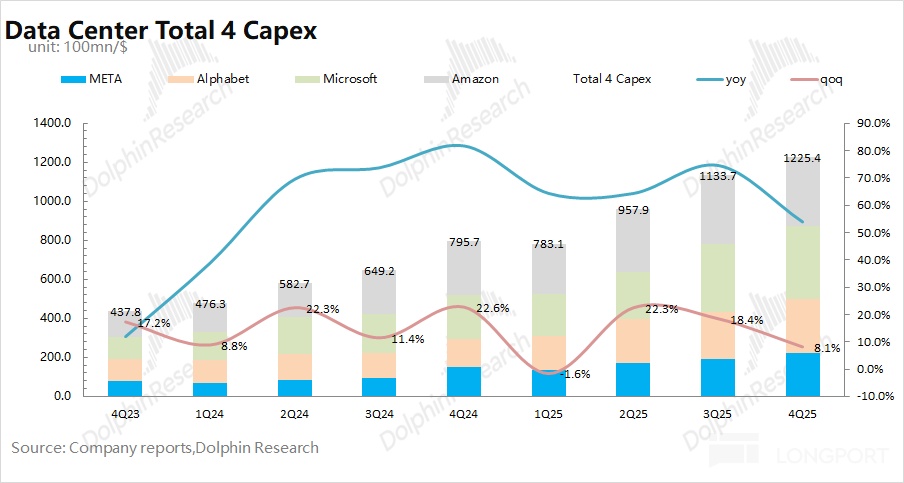
These cloud majors are the primary buyers of NVIDIA’s AI chips and underpin the company’s growth. This forms the core base for NVIDIA’s earnings trajectory.
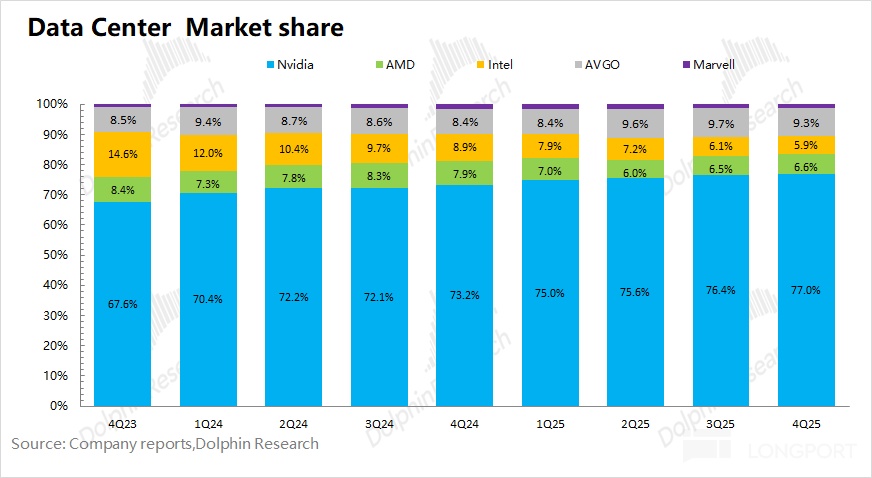
b) AI chip competition: Combining Data Center revenues across AI chip vendors, NVIDIA controls over 70% share, making it the clear industry leader.
This reflects superior product strength and enables high margins (70%+). But customers also feel value capture is concentrated, prompting in-house chips or custom ASICs as more cost-effective alternatives.
Recently AMD and Meta signed an OpenAI-like 6GW agreement. The first 1GW is slated for H2 2026 deliveries, built on MI450 and sixth-gen AMD EPYC processors. As part of the deal, AMD will grant Meta a five-year warrant.
Google, Meta, Microsoft, Amazon and OpenAI are all developing in-house AI chips. With the shift from training to inference, the gap between custom ASICs and NVIDIA GPUs is narrowing, and majors are focusing more on cost-performance.
Google Gemini + Broadcom already command close to ~10% share, increasingly challenging NVIDIA’s AI position. This could pressure NVIDIA’s AI chip share and GPM post-2026, which the market fears may decline.
c) Rubin product progress: NVIDIA’s current flagship is the B300 series, and Rubin and CPX are planned for H2 2026 on TSMC 3nm. Rubin Ultra will follow in 2027.
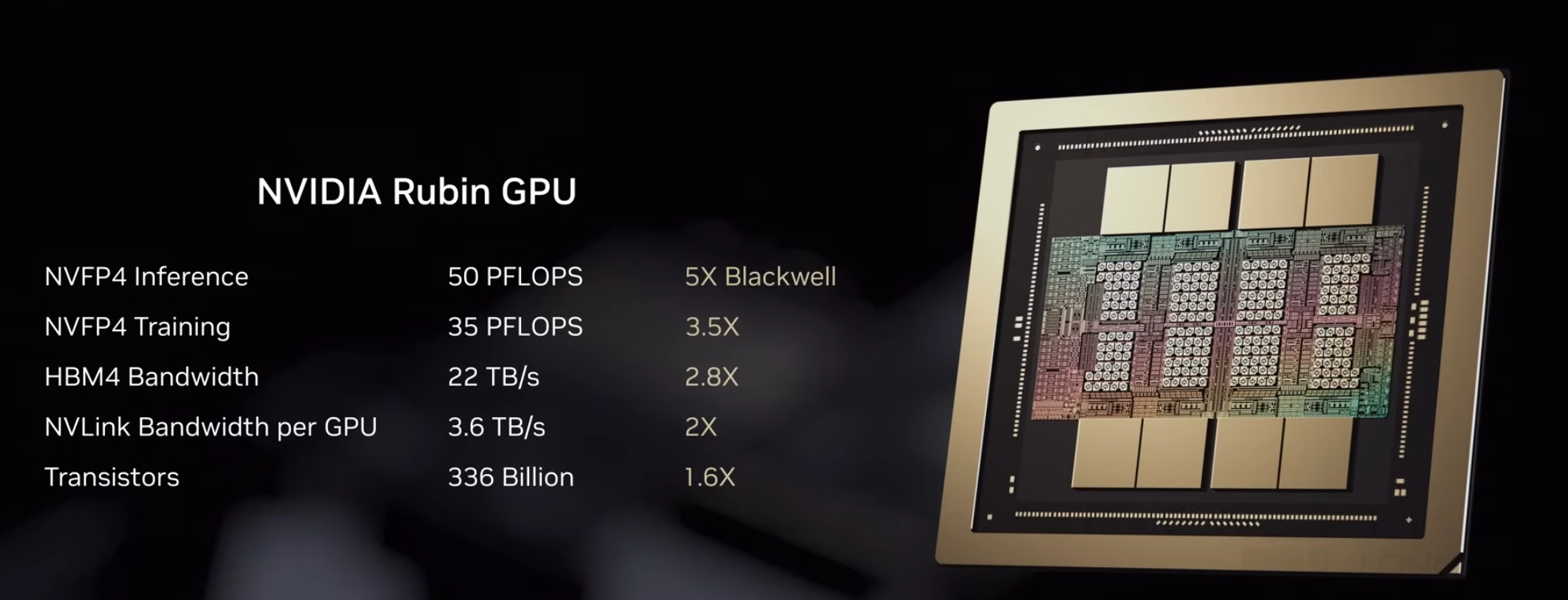
At CES 2026, Jensen Huang disclosed Rubin GPU compute would reach 5x Blackwell (under NVFP4 inference). NVIDIA aims to keep leading the AI silicon race.
Putting a+b+c together, NVIDIA still holds a clear lead in AI chips, but majors must weigh economics. With GPM near 75%, NVIDIA captures much of the value chain.
If downstream economics fail to pencil out, further investment could slow. Hence majors pursue in-house and ASIC solutions for better cost-performance, and the view that NVIDIA’s dominance is 'hard to sustain' is gaining traction.
At NVIDIA’s current market cap (~$4.75tn), that equates to ~16x PE on FY2028 net profit (assuming two-year revenue CAGR +55%, GPM 74%, tax rate 18%). Given prior AI outlook (Blackwell+Rubin), high growth in FY2027 is consensus, with debate mainly beyond FY2027.
On PE alone, NVIDIA screens relatively cheap across the AI value chain, largely due to uncertainty in FY2028 and beyond (downstream Capex and competitive dynamics). After a high-growth FY2027, the market broadly fears a notable deceleration, with ASIC rivals eroding share and margins.
Thus, even with recent Capex raises by the majors, the stock has mostly moved sideways. For now, a 15–20x reference PE on FY2028 implies ~$175–240 per share.
More than Capex, investors want management to address margin and competition concerns explicitly. That would help lift the stock out of its 'relatively pessimistic' valuation.
On the other hand, despite worries over rising ASIC competition, near-term earnings visibility provides solid support. It also makes it difficult for the stock to break below ~$170 in the short run.
Dolphin Research’s detailed take on the print is below:
I. NVIDIA business overview
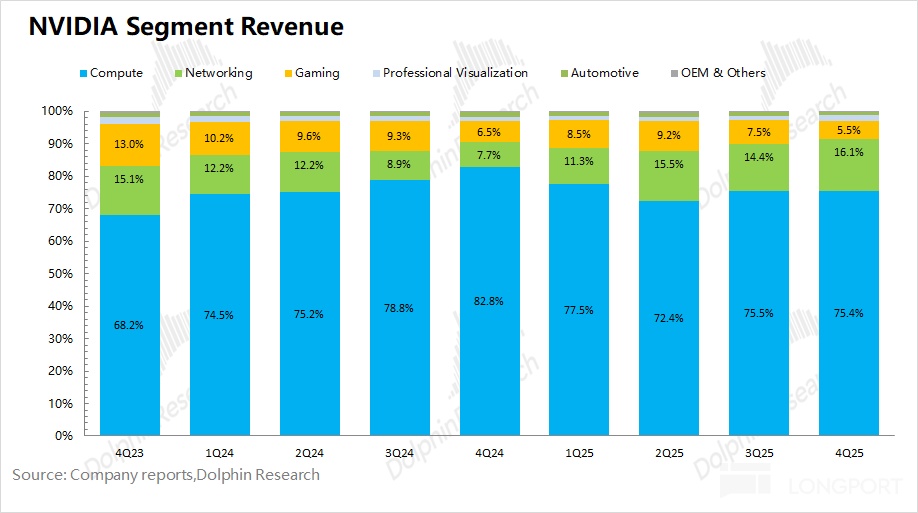
With sustained Data Center growth, it now accounts for nearly 90% of revenue. Gaming, once the mainstay, has been compressed to around 10%.
By segment:
1) Data Center: the key focus area, with core compute products including Blackwell and Hopper. Core customers are the cloud majors such as Amazon, Microsoft and Google.
Data Center is in the Blackwell cycle, led by B300/GB300. As Rubin ramps in H2, the cycle should transition from Blackwell to Rubin.
2) Gaming: NVIDIA remains the leader in discrete GPUs. Current products are RTX 40 and RTX 50, with customers including gamers and PC OEMs.
3) Pro Visualization and Auto: both small at ~1–2% of revenue. Pro Viz serves customers such as Pixar and Disney. Auto is centered on Orin and Thor, with customers including BYD, Xiaomi and Li Auto.
II. Core KPIs: $10bn+ QoQ revenue uplift; GPM back to 75%
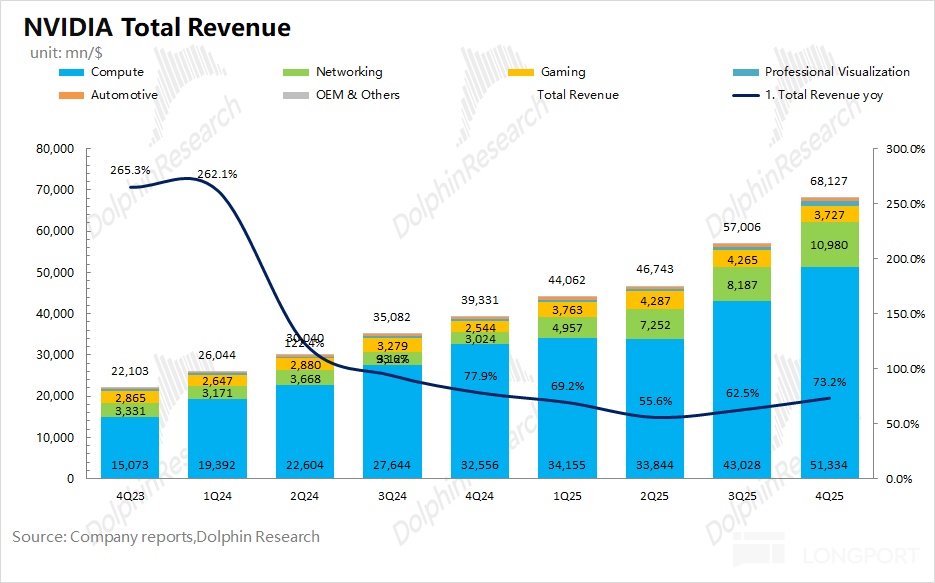
2.1 Revenue: FY2026 Q4 revenue was $68.1bn, +73% YoY, above the raised buy-side bar ($67.0bn). The $11.0bn QoQ increase was essentially all from Data Center and the Blackwell ramp.
For next quarter, revenue guidance is $78.0bn, up $9.9bn QoQ, above the raised buy-side bar ($73–76bn). Growth remains driven by B300/GB300, with Rubin entering mass production in H2 2026.
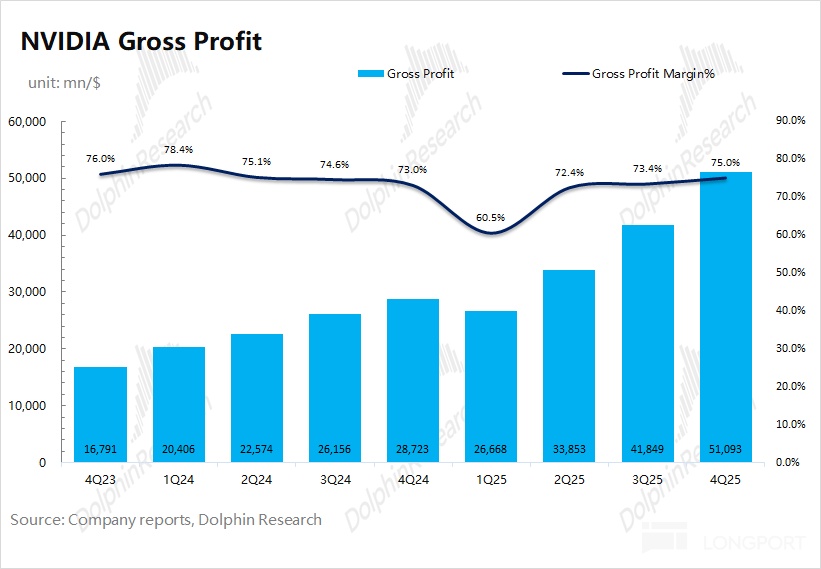
2.2 GAAP GPM: FY2026 Q4 GAAP GPM was 75%, in line with market expectations (74.8%). The prior margin 'air pocket' was mainly due to the H20 ban.
Next-quarter GAAP GPM is guided to 74.9%, matching Street at 75%. With Blackwell ramping, GPM has returned to ~75%.
Management previously targeted 75% GPM for FY2027. That offers some confidence, but the market remains wary of potential margin slippage beyond FY2027.
III. Core business progress: Blackwell cycle; Data Center strength
Helped by AI Capex, Data Center (Compute + Networking) now exceeds 90% of revenue. Gaming has been squeezed to below 10%.
3.1 Data Center: FY2026 Q4 revenue was $62.3bn, +75% YoY. It remains the company’s focal point, with growth driven by Blackwell volume ramp, aided by accelerated compute and AI demand.
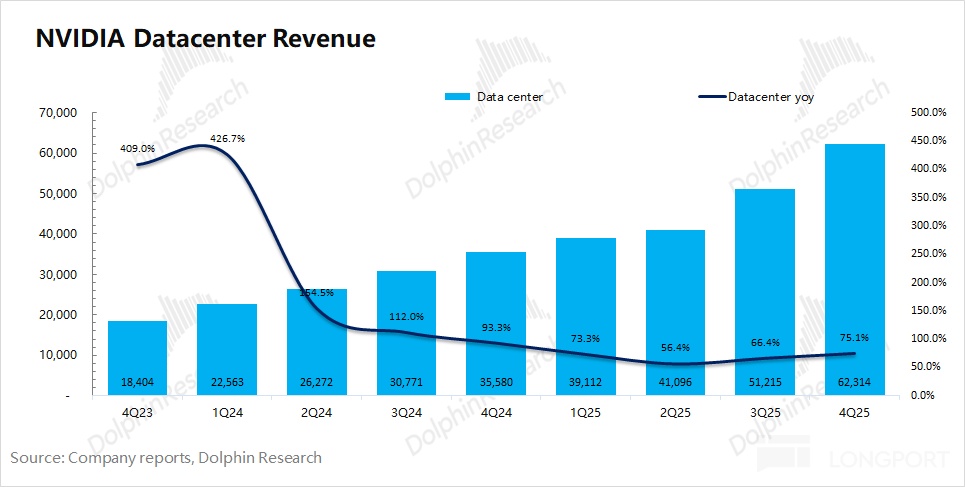
Details: ① Compute revenue was $51.3bn this quarter, up $8.3bn QoQ, with B300 mass production contributing most of the uplift. ② Networking revenue was $11.0bn, up $2.8bn QoQ.
Cloud providers remain the largest buyers of NVIDIA’s AI chips, so their Capex forms the foundation of Data Center growth. Based on discussions with Google, Meta, Microsoft and Amazon, Dolphin Research expects 2026 Capex to exceed $660bn, +62% YoY, supporting high growth through FY2027.
Versus downstream Capex, the market is more concerned about ASIC competition risk. Even as majors raise Capex, NVIDIA shares have not rallied.
The core AI chip players today are NVIDIA, Broadcom and AMD, together holding over 90% share. Training and inference have different dynamics; while NVIDIA GPUs retain a clear edge in training, inference can tolerate lower performance in parts, making Broadcom custom ASICs or AMD a more cost-effective choice.
NVIDIA’s high upstream margins pull a large share of value from the chain. This directly impacts downstream project economics.
If downstream economics do not improve, sustained AI Capex is at risk. At 75%+ GPM, vendors have strong incentives to develop in-house chips or adopt ASICs to cut costs.
Whether the current 75% GPM can be maintained is a key concern, especially beyond FY2027. Mainstream forecasts see GPM gradually declining in FY2028 and thereafter.
3.2 Gaming: FY2026 Q4 gaming revenue was $3.7bn, +46% YoY, driven by RTX 50 series shipments. Gaming now accounts for less than 10% of revenue, with the spotlight squarely on Data Center.
In gaming, NVIDIA still leads clearly over AMD, which posted ~$0.84bn gaming revenue for the quarter.
IV. Key financials: Scale effects driving continued profit strength
4.1 Core OPM
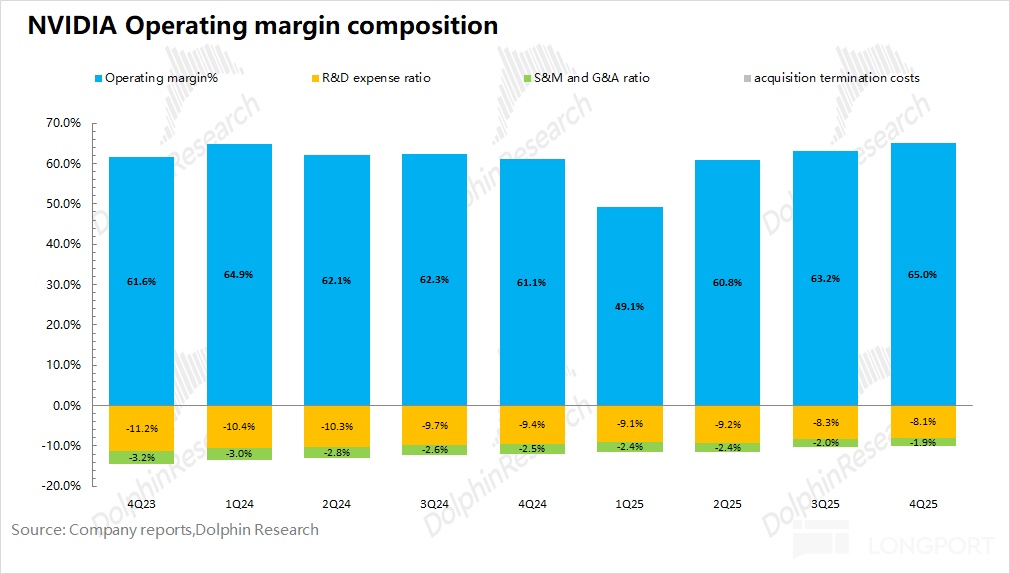
FY2026 Q4 core OPM was 65%, continuing to improve, driven by higher GPM and lower OpEx ratio.
Decomposition is as follows:
'Core OPM = GPM − R&D ratio − S&M/Admin ratio'
1) GPM: 75% this quarter, up 1.5pct QoQ, helped by the Blackwell ramp. 2) R&D ratio: 8.1%. Despite R&D up $0.8bn QoQ, the ratio declined on strong revenue growth.
3) S&M/Admin ratio: flat through the Blackwell cycle, down to 1.9% of revenue this quarter.
Management guides next-quarter OpEx to $7.7bn. Against revenue guidance, the OpEx ratio should edge down to ~9.9%, reflecting scale benefits.
4.2 Core operating profit
FY2026 Q4 net profit was $43.0bn, +94% YoY, with a 63% net margin.
Given non-operating items in net profit, we focus on core operating profit (GP − R&D − S&M/Admin). Q4 core operating profit was $44.3bn, +84% YoY, with core OPM up to 65%.
Current growth is driven by the Blackwell cycle. With Rubin mass production in H2 per management’s AI outlook, NVIDIA should sustain high growth through FY2027.
<End here>
Historical coverage from Dolphin Research on NVIDIA:
Hot topics
Jan 7, 2026 CES keynote by Jensen Huang: Unlocking Rubin: AI storage gets a fresh spark
Dec 7, 2025 trade controls: H200 cleared: a 'sky-piercing arrow' on NVIDIA’s $6tn path?
Oct 29, 2025 GTC: GTC: next year’s shipments set to explode — is the sky the only limit for NVIDIA?
Sep 10, 2025 CPX launch: NVIDIA: Rubin CPX debuts, squaring off with Broadcom ASICs
Sep 1, 2025 small meeting: NVIDIA (small meeting): cautious targets for 2026; $3–4tn market by 2030
Earnings season
Nov 20, 2025 call notes: NVIDIA (Trans): target GPM 75% next year; cooperation with OpenAI is not blind
Nov 20, 2025 earnings recap: More important than NFP: can NVIDIA rescue U.S. equities again?
Aug 28, 2025 call notes: NVIDIA (Trans): GB300 shipping; Rubin mass production on schedule next year
Aug 28, 2025 earnings recap: NVIDIA: the No.1 stock in the universe — anything short of explosive is a sin?
May 29, 2025 call notes: NVIDIA (Trans): shipment share to China unchanged
May 29, 2025 earnings recap: NVIDIA: do not doubt — still the No.1 stock in the universe
Feb 27, 2025 call notes: NVIDIA (Trans): shipment share to China unchanged
Feb 27, 2025 earnings recap: NVIDIA: did Deepseek puncture Jensen’s 'leather jacket' aura?
Risk disclosure and statement: Dolphin Research disclaimer and general disclosures


The copyright of this article belongs to the original author/organization.
The views expressed herein are solely those of the author and do not reflect the stance of the platform. The content is intended for investment reference purposes only and shall not be considered as investment advice. Please contact us if you have any questions or suggestions regarding the content services provided by the platform.