
D
Mar 2 at 08:13 AM
LLM losses widened 360%, MiniMax still a 'darling'?
 I'm LongbridgeAI, I can summarize articles.
Old guard exits, new entrant takes the stage. Hong Kong’s latest 'hot stock' and China’s independent model vendor $MINIMAX-W(00100.HK) posted its FY2025 results.
However, vs. the 4.5x rally over two months, Dolphin Research’s Q4 estimates look softer. Let’s break it down.
I. Revenue: C slows, B accelerates — is the mix improving?
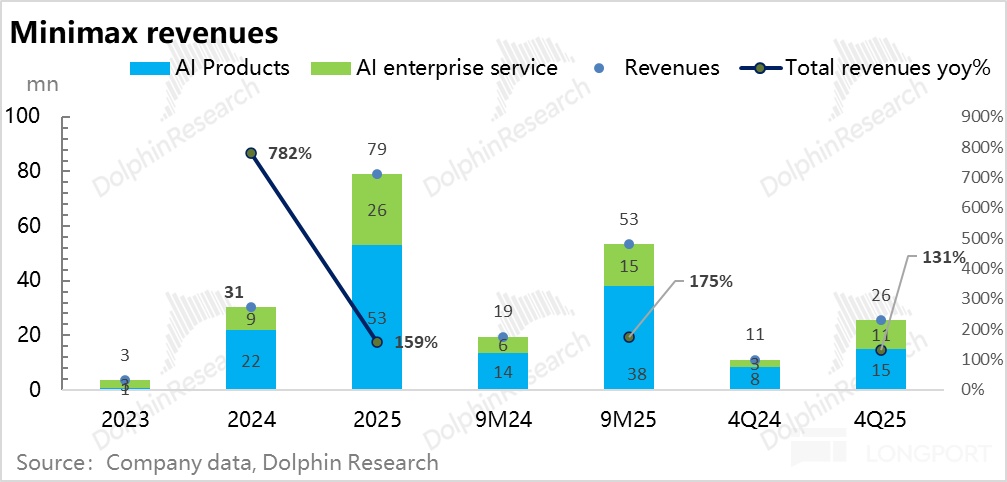
1) Revenue deceleration: FY2025 revenue came in at $79 mn (+~160% YoY), still surging. Based on disclosed Q1–Q3 revenue, Q4 was ~$26 mn, with YoY growth down from 175% in the first nine months to 130%.
2) C down, B up: is 'model = revenue' showing through?
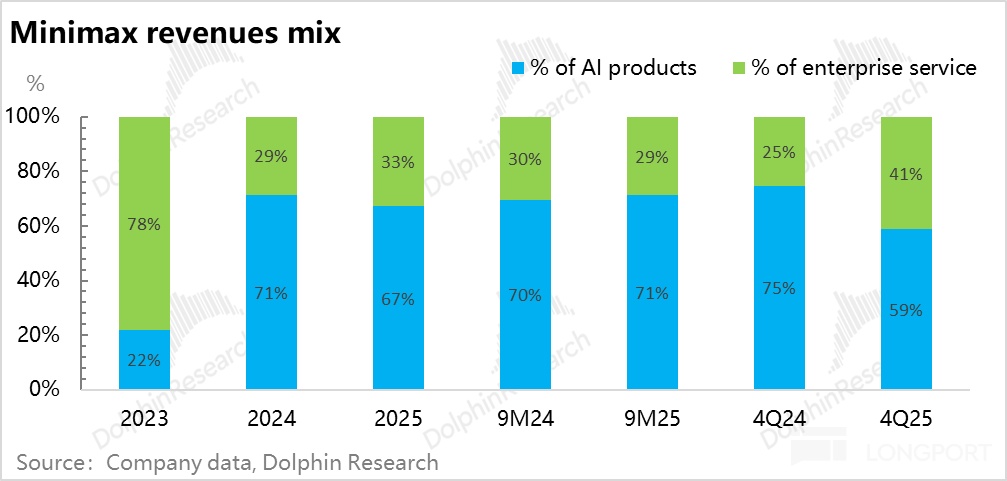
MiniMax is the only Chinese LLM player with broad C-side success but a relatively weaker B-side. Some questioned its competitiveness in 'model-as-product.' Q4 results suggest that with strong core model capabilities, both B and C monetization can scale.
a. MiniMax’s AI product suite (Minimax, video gen 'Conch AI', audio gen 'Minimax Audio', Talkie, with Talkie and Conch AI contributing most) delivered slightly over $15 mn. YoY growth halved from ~150% in the first nine months to 82%, driving the overall slowdown.
b. MiniMax’s API and enterprise services accelerated from ~160% to 278% YoY, with single-quarter revenue above $10.55 mn. As overall overseas revenue did not accelerate, it is reasonable to infer API calls are ramping with both domestic and international enterprise clients.
Since API revenue is essentially 'model-as-revenue,' faster growth indicates enterprises are paying up for the model’s value-for-money as a productized service.
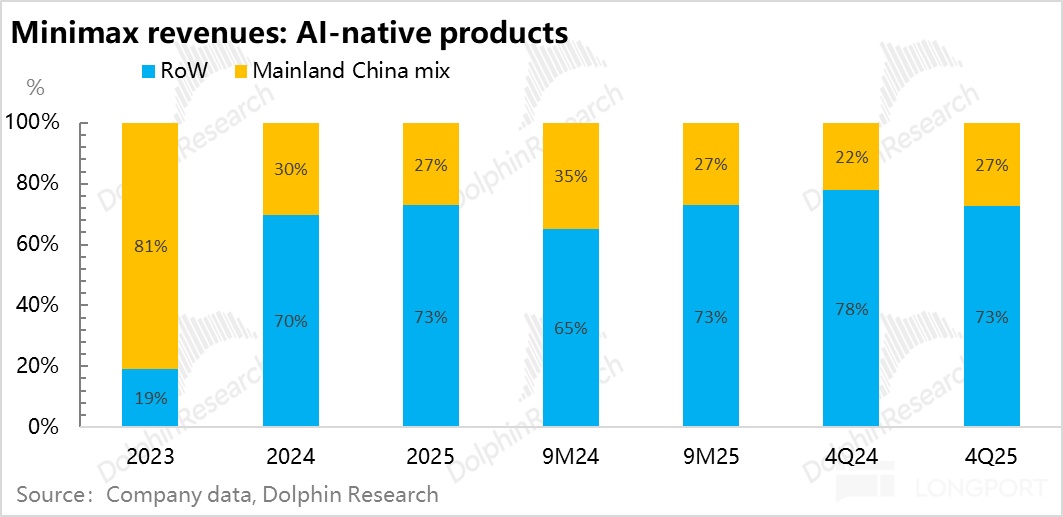
3) Overseas revenue mix steady at 73%: MiniMax’s overseas revenue is split roughly across the U.S., Singapore, and other regions. After Conch AI and others pushed the overseas mix up to 73% in the first three quarters, it held steady rather than rising further.
Even so, call volume on OpenRouter and the reported 73% overseas revenue share both suggest MiniMax is already a successful Chinese model exporter.
4) How much current-period revenue covers last-gen training spend?
Base models refresh annually, and a given year’s training spend typically yields about one year of service life. One way to assess model economics is to compare current-year direct and indirect revenue vs. the prior year’s training spend.
For MiniMax, despite rapid revenue growth, FY2025 revenue coverage of FY2024 training spend is actually declining. Until model evolution reaches a steady state, model vendors remain in a 'bleeding' race.
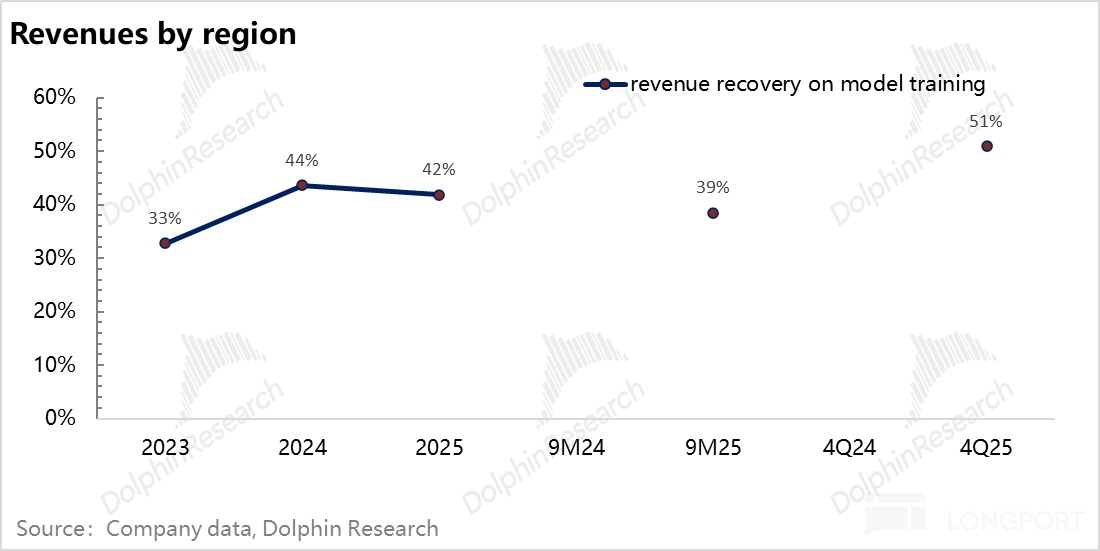
Financing can bridge the gap, but real-world deployment and monetization will matter more over time. Vendors must pull every lever to grow revenue faster and more stably than peers to prove model value.
Using Q4 vs. the average of the first three quarters, Dolphin Research estimates that if MiniMax adds ~$8 mn per quarter on top of Q4’s ~$26 mn, FY2026 revenue could exceed $130 mn. That would keep FY2026 revenue coverage of FY2025’s ~$250 mn R&D broadly around Q4’s ~50%.
II. Enterprise services: price cuts to win share?
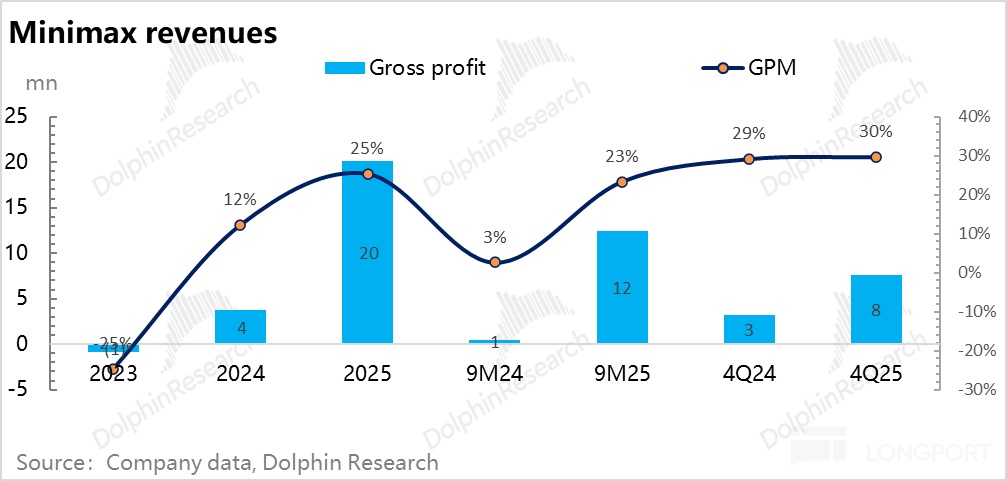
Enterprise services carry higher GP by design (token inference cloud costs vs. MiniMax’s token pricing). Enterprises generally pay for API access, putting GPM above 60%, and near 70% in the first three quarters.
Yet Q4 overall GPM did not jump with the higher enterprise mix. It recovered from 23% in the first nine months to 30%; full-year GP was ~$20 mn with GPM at ~25%.
As C-side paid rates rise, C-side margins should be improving. If we assume C-side GPM edged up from ~4.7% to ~5%, enterprise services GPM likely fell back toward ~65%.
The GPM decline suggests that post-listing MiniMax has begun commercializing APIs and related interfaces. Future MiniMax should run on both B and C legs.
III. $26 mn revenue, $92 mn loss — already a 'lower-loss' model playbook
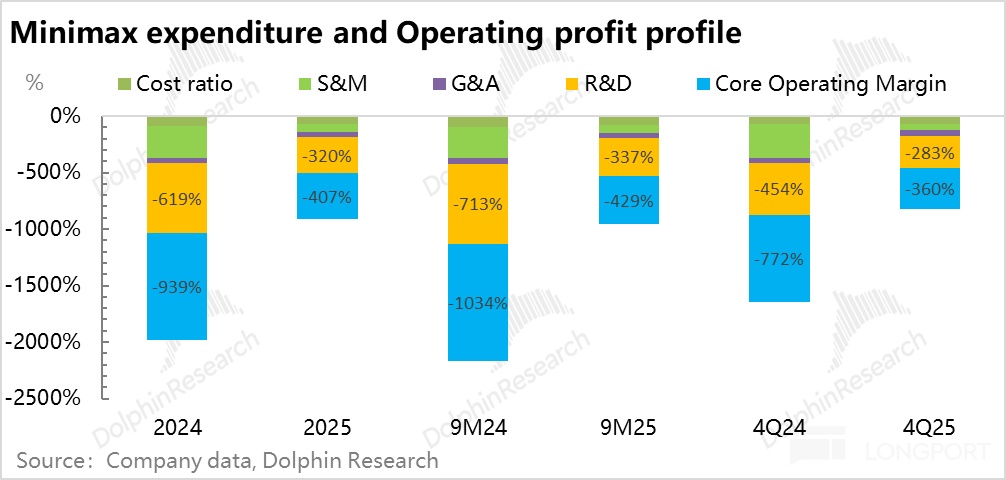
LLM businesses can show decent GPM because the biggest investment — training — sits in R&D. R&D often runs at 3–5x revenue, so as long as training iterates quickly, breaking even is nearly impossible (cf.).
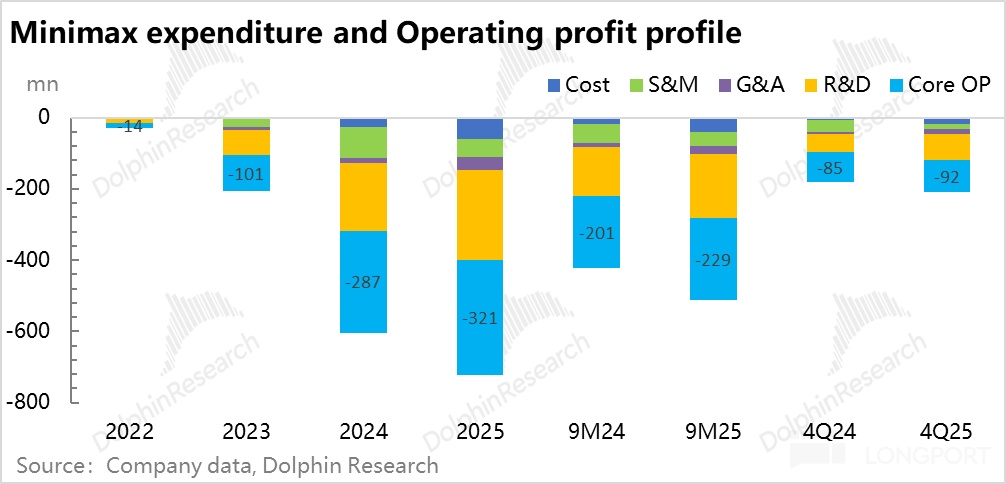
Q4 R&D spend (mainly training) was ~$72.5 mn, ~2.8x quarterly revenue. Sales expense fell sharply (-63% YoY), and admin was modest after adjusting out listing-related SBC.
These two items were ~70% of revenue, and OP loss was ~$92 mn, ~3.6x revenue. FY OP loss was ~$320 mn; excluding SBC and IPO costs, the loss was still ~$290 mn, with a loss ratio of ~370%, improving vs. the first three quarters’ ~429%.
Per Dolphin Research’s tracking, MiniMax already ranks among domestic LLM players with best-controlled losses and loss ratios. The media-reported ~$1.9 bn net loss is noise, largely an accounting effect from ~$1.6 bn loss at CB conversion upon listing due to valuation expansion.
Dolphin Research view: still attractive long-term
After doubling on Jan 9, 2026 and rallying another ~60% in Feb (CNY seasonality), MiniMax has surged to ~4.5x its IPO price within a quarter. Q4, behind the FY2025 prints, was not particularly stellar vs. the earlier disclosed Q1–Q3.
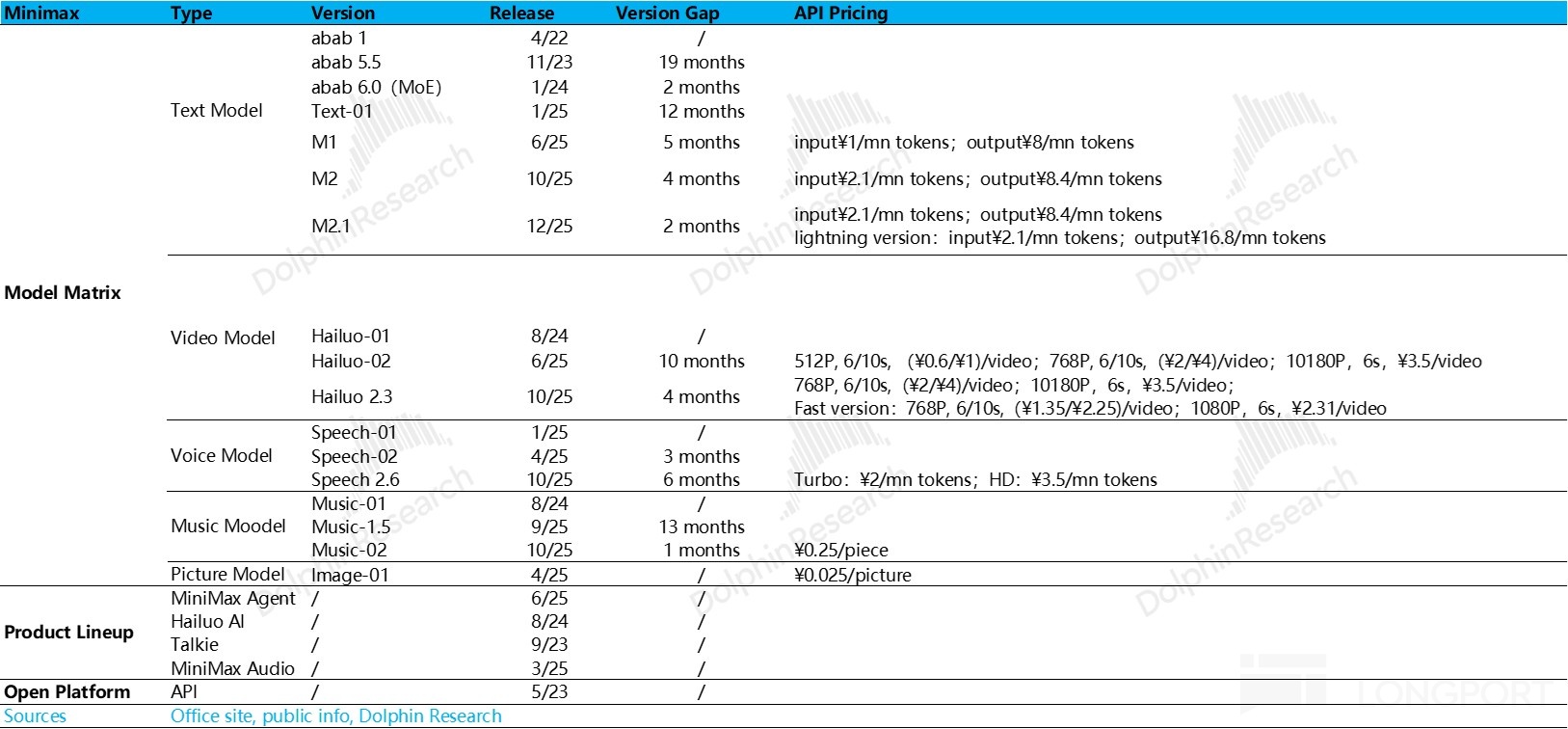
The structural bright spot is API/enterprise services, with an AI-to-C-centric company now pushing B-side hard. While some pricing concessions were made, the pace still shows strong value-for-money on 'model-as-product' that attracts enterprise users.
The main drag was the slowdown in AI product revenue. With no operating metrics disclosed in the annual report, Dolphin Research infers native C-side products like Talkie rely on major base-model iterations and breakout moments for scale, while Q4 saw no base-model-level upgrade and paid conversion did not spike.
By the pace of model releases, Q4 financials already lag fundamentals. Since Q4 2025, all modalities have iterated rapidly, with the Feb 2026 M2.5 base model highlighting Agent capabilities focused on coding, tool use, and office workflows.
The goal is to turn AI from assistant to 'AI co-worker.' The company also integrated the Agent 'rising star' OpenClaw, and token calls surged.
a. MiniMax M2 text model’s Feb Avg. daily token consumption rose to 6x Dec 2025.
b. Coding Plan token consumption rose to 10x Dec.
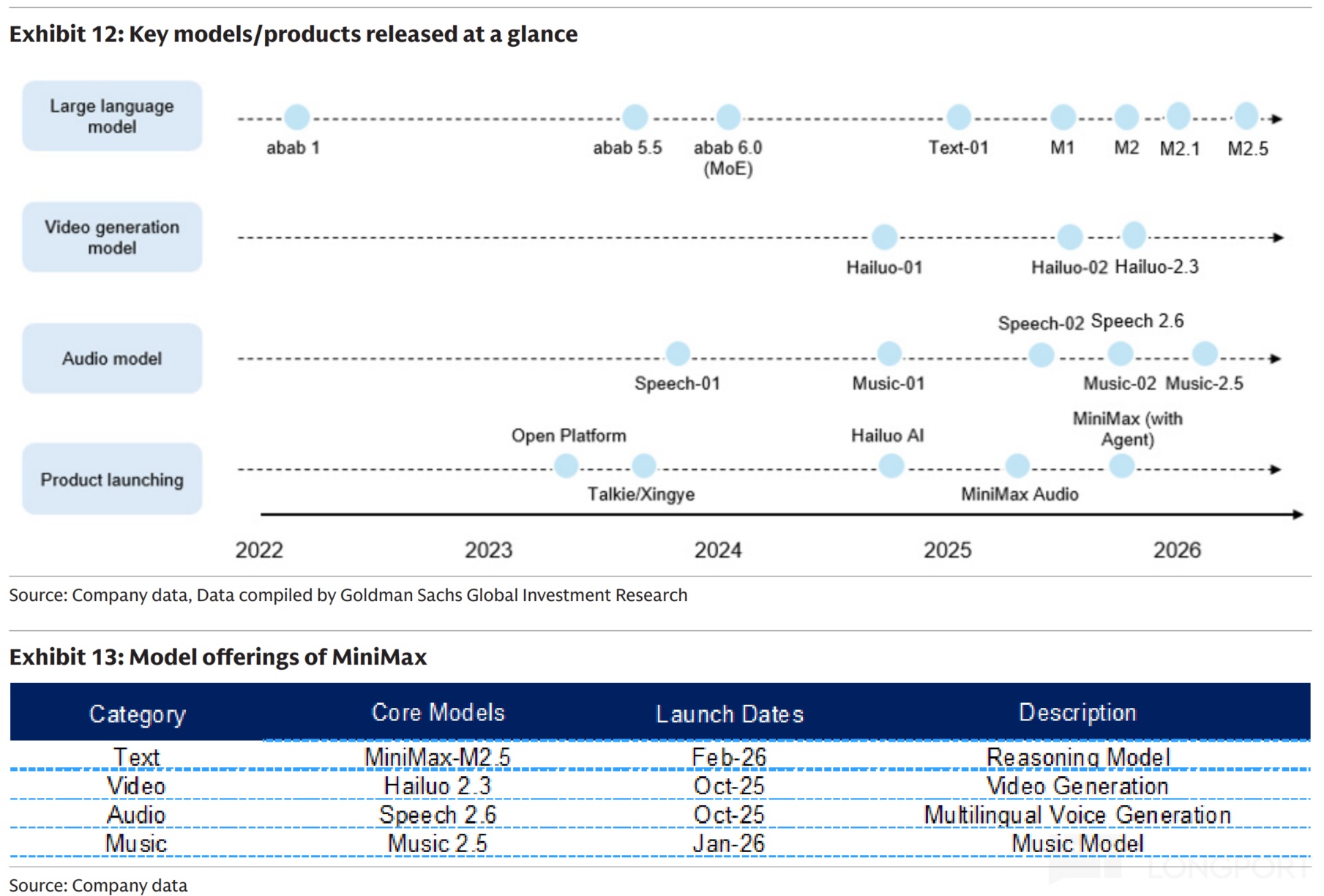
The Feb 2026 stock rally was largely driven by higher M2.5 consumption expectations. A 6x MoM token surge already indicates the new model’s success.
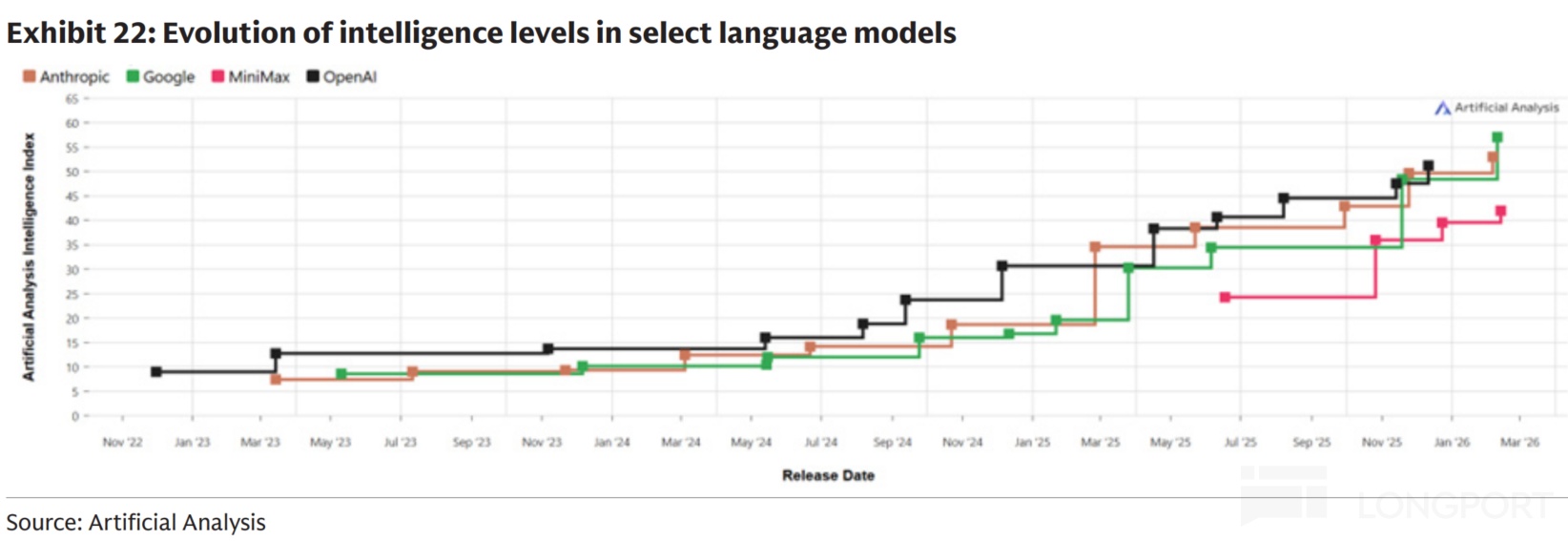
Near term, with the model just launched, shares have priced in this success. Open-source rival DeepSeek’s new base model is imminent, likely also leaning into coding and Agent functions, which could add pullback pressure for MiniMax.
For long-cycle endurance, beyond model intelligence, independent vendors compete on R&D efficiency, cash resilience, and product execution. On the 'cash to survive' front, IPO proceeds were ~$700 mn, and Q4-end cash and equivalents neared ~$1 bn.
With ~$250 mn training spend in 2025, even if next-gen training requires more, MiniMax is not short of funding. In 2025, with 428 employees, it spent ~$(Approx.) 250 mn on training to generate ~$79 mn revenue, delivering a globally competitive model.
Efficiency is outstanding, and it is one of the few Chinese model vendors advancing model iteration, monetization, and execution in tandem.
<End>
Related article:
Deep dive: MiniMax vs. Zhipu — LLMs, compute intensity, and financing stamina?


The copyright of this article belongs to the original author/organization.
The views expressed herein are solely those of the author and do not reflect the stance of the platform. The content is intended for investment reference purposes only and shall not be considered as investment advice. Please contact us if you have any questions or suggestions regarding the content services provided by the platform.