D
Mar 5 at 10:12 AM
JD (Trans): Electricals sales to improve in 1H26---
Below is Dolphin Research's$JD.com(JD.US) FY25 earnings call transcript. For our earnings analysis, see 'JD: Old timer crouching again? Hold on, the rebound is near'.
1) Key financial takeaways
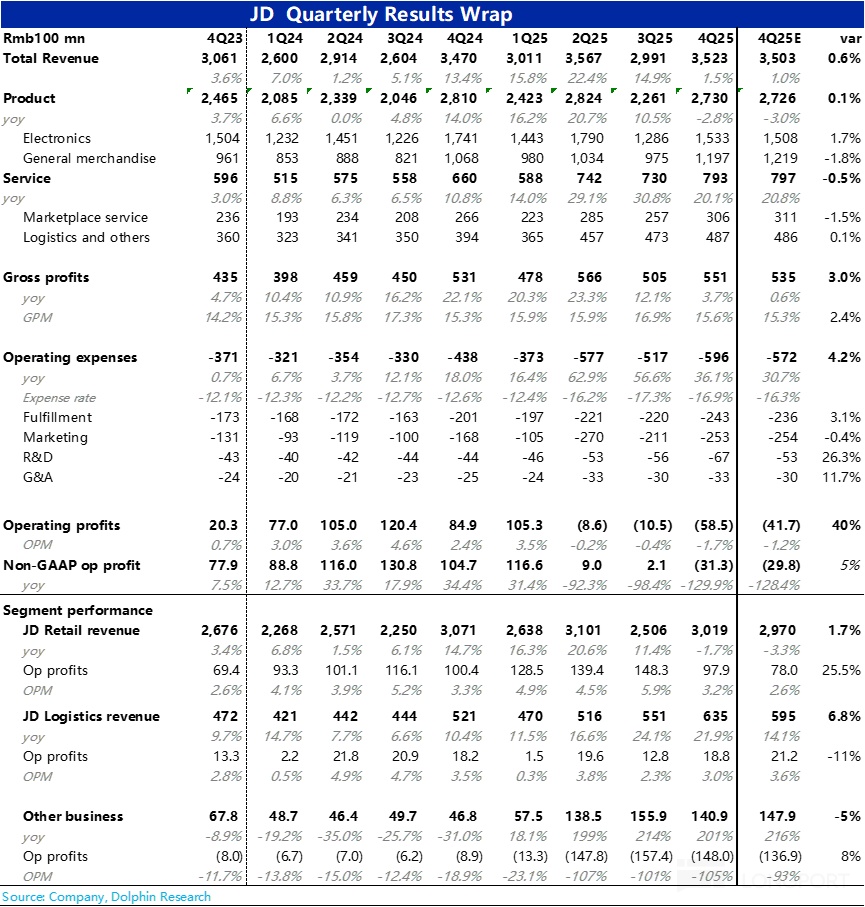
1. Shareholder returns
a. Dividend: The BOD approved a FY25 cash dividend of approx. $1.4 bn. This equals $1 per ADS.
b. Buyback: In 2025, JD repurchased ~6.3% of shares outstanding, totaling $3.0 bn. All repurchased shares have been cancelled.
2. 2026 outlook
a. Growth: YTD trends are up, with momentum sustained in Big Supermarket and ads. Early-2026 performance is tracking well.b. Profit: As investment in food delivery peaks and rolls off, and scale benefits in Supermarket kick in, group profitability has room to expand. Margins should see further release.c. Policy tailwinds: JD expects ongoing benefit from China’s 'trade-in' program through 2026. The demand lift should persist.
2) Earnings call details
2.1 Key management remarks
1) JD Retail
a. Overall: Retail returned to double-digit growth in 2025. OPM expanded for a sixth straight year to 4.6%.
b. Electronics & Appliances: Q4 revenue declined YoY due to a tough base. Management deliberately stepped up subsidies and price competitiveness, compressing GP expansion near term but winning share.c. Big Supermarket & Dept.: This is now a new growth engine. Q4 revenue rose 12.1% YoY, with full-year up 15.3%.Supermarket grew 18% for the year, with margin expansion in tandem.
d. Ads & commissions: Growth was strong, with Q4 revenue up 15% and full-year up 18.9%. With optimized traffic allocation and AI algorithms, budgets are tilting toward high-conversion, high-ROI platforms like JD.
2) New businesses
a. JD Food Delivery: Losses narrowed visibly, with Q4 loss down ~20% QoQ. Investment scale fell nearly 20% QoQ.Management reiterated 2025 as the investment peak, with spend to decline further in 2026. The trajectory is improving.b. Synergies: Food delivery contributed 2%–3% of Q4 incremental ad revenue. These users showed higher main-site purchase frequency and stronger cross-sell.c. Jingxi: Continues to penetrate lower-tier markets. Execution remains focused.d. Meanwhile, Europe online retail 'JoyBuy' will officially launch in Mar-2026. It will focus on same-day/next-day delivery.
3) JD Logistics
a. Revenue: Q4 revenue grew 22%, partly lifted by food delivery fulfillment demand. The linkage is evident.b. Global: JD rolled out its first highly automated facility in the UK. It supports the overseas '2-1-1' time-definite promise.
4) Tech & AI
a. JoyAI LLM: Now deployed across 1,000+ scenarios. Calls grew nearly 100x in 2025.b. AI Agent: User penetration topped 20% in 2025, with AAC >150 mn. The goal is to double this in 2026.
2.2 Q&A
Q: What is the 2026 growth outlook for JD Retail? Given the high base in 2025, how will growth cadence differ between 1H and 2H? Can Big Supermarket and other GM categories sustain?
A: General Merchandise is now JD Retail’s core growth engine. Its trajectory is healthy.Even excluding the trade-in lift to other categories, GM growth outpaced in 2025. Big Supermarket, fashion, and healthcare were standout sub-categories.
We are confident in sustaining momentum through 2026: Big Supermarket still has ample headroom in user penetration and category breadth. Fashion built key infrastructure such as merchant onboarding last year, and should enter a breakout phase this year.Healthcare will further reinforce leading mindshare with users.
For electrified categories (appliances, smartphones, PC/digital), the high base will weigh near term. While trade-in subsidies continue in 2026, note subsidy consumption in 1H25 was higher than 2H25, implying 1H26 pressure.We expect electrified categories to improve vs. Q4-2025 in 1H26, with a stronger recovery in 2H. Storage chip cost inflation is pushing handset and digital prices higher, which may cap volumes, but higher AOV should offset part of the impact.
For 2026 overall, JD Retail’s growth drivers will be more diversified. GM should stay solid, and services such as ads will keep growing fast.Electrified categories will accelerate in the back half after a base-driven 1H. With steady gains in traffic, user scale, and purchase frequency, we are confident in delivering high-quality growth for the year.AI-driven new product categories contribute modestly today, but are creating long-term structural opportunities via supply-chain synergies.
Q: How will JD Food Delivery and on-demand retail improve UE? How does JD leverage supply chain for differentiation vs. peers? Will industry regulation help margins?
A: 2025 was an investment and R&D phase for food delivery. In 2026, the focus is capability building, onboarding high-quality merchants, and orderly monetization.By providing services to merchants, we aim to grow revenue while improving operating efficiency at healthy scale. Total investment in 2026 should be lower than 2025, subject to competitive dynamics.
JD’s differentiation in food delivery rests on three pillars: a premium-quality positioning, full-time riders ensuring service quality, and deep integration with JD’s ecosystem to unlock strong supply-chain synergies.On UE improvement, the levers are clear: diversify revenue streams, optimize subsidy efficiency with precision targeting by user and region, and dilute fulfillment costs as order scale grows.Notably, the 'Qixian Kitchen' model is progressing well, expanding to 50+ sites by Feb.
Food delivery and on-demand retail are JD’s long-term strategies. 2025 data show food delivery is a strategic engine for customer acquisition and frequency uplift.In 2026, we will further tap cross-category cross-sell and ad revenue to unlock synergies. We welcome regulation that ensures fair competition, which supports healthy industry development.JD opposes ruinous 'involution' competition, and will drive high-quality evolution of food delivery through continued innovation in supply-chain models.
Q: In a uncertain macro, how will management balance investment and profitability in new businesses (overseas and Jingxi)? What is the 2026 investment scale and impact on group profitability?
A: We remain confident in the long-term prospects of China and our business. Based on opportunity assessment, we have made long-term strategic investments in international, lower-tier markets, and on-demand retail.We believe sustained investment in R&D and tech infrastructure, coupled with broader service coverage, will unlock new growth and drive long-term profitability. JD’s long-term target of 'high single-digit' margin remains intact.
At the retail level, we expect healthy profit growth in 2026 and to maintain the long-term high single-digit margin target. Drivers include better GP from stronger supply-chain capabilities, robust growth in high-GP businesses such as ads, and ongoing margin improvement in Big Supermarket and related categories.With deeper AI adoption, scale effects and operating efficiency still have room to improve.
For specific new businesses: food delivery narrowed Q4 losses by ~20% QoQ, improving efficiency while scaling. If competition rationalizes, 2026 investment should be lower than 2025.For international, we will step up investment in a controlled cadence while maintaining financial discipline. Jingxi focuses on lower-tier markets and non-brand goods, with strong penetration in Tier-6 and below cities, expanding our user boundary.We will slightly increase Jingxi investment in 2026, with UE expected to keep improving for healthy, sustainable growth.
Q: On overseas, can you share progress, timeline, and financial impact of the Economy deal (Currys’ ID Mobile or related retail business)? Strategically, how is JoyBuy positioned? What synergies exist across global retail, logistics, and supply chain?
A: The transaction is undergoing regulatory review. We will update the market as appropriate.JoyBuy is positioned as our all-category online retail platform in Europe, slated to go live in Mar-2026. Building an overseas supply chain is a long-term endeavor that takes time.
From trial operations, users have recognized JoyBuy’s service quality. The 'JD-grade experience' will be a core differentiator.On logistics, we are building a self-operated delivery network in Europe. Joy Express has launched, offering same-day and next-day delivery with doorstep service in major cities across the UK, Germany, France, and the Netherlands.
Synergies between overseas and the group span three areas:- Supply chain: This is a two-way enablement. We help Chinese brands go global, while introducing more high-quality overseas brands into China to broaden and deepen the global supply chain.- Logistics: As JoyBuy expands, synergies between overseas retail and logistics will strengthen. The commerce-plus-logistics combo will materially boost local competitiveness.- Tech: JD’s e-commerce tech stack and digital infrastructure will continue to empower international operations, ensuring efficient overseas execution.
Q: In a slower retail backdrop, what are JD’s GMV and revenue growth expectations for General Merchandise? How will JD sustain above-industry growth under fierce competition, and what are the differentiation levers?
A: Despite macro challenges, GM has been resilient. The category has delivered double-digit growth for five straight quarters, well ahead of the industry.We are confident in maintaining this healthy momentum in 2026, driven by three factors.
First, the market is large, with substantial penetration upside in Big Supermarket, fashion, and healthcare. Second, user scale is growing in tandem.New businesses like food delivery and Jingxi bring significant new traffic and high-frequency users, and we see pronounced cross-buying with core categories such as Big Supermarket.Third, supply-chain capability and user trust continue to strengthen.
JD’s 1P model is the core moat for differentiated competition. Strict quality control and more competitive pricing build strong user trust.JD Logistics’ speed, accuracy, and doorstep delivery are hard to replicate. For brands, JD is both the most stable nationwide daily marketing platform and the best arena for brand-building and full lifecycle ROI.This is attracting more fashion and sports brands to deepen partnerships, with Q4 outdoor/sports and apparel posting double-digit revenue growth.
Q: How does management view the challenges and opportunities from 'agentic e-commerce'? What are JD’s AI initiatives and use cases?
A: We see AI and agentic e-commerce as an evolutionary opportunity, not a threat. Regardless of how front-end traffic evolves, retail’s core is always experience, cost, and efficiency.As the industry enters the agentic era, JD’s deep supply-chain foundation will unlock stronger synergies and widen our moat.
We are accelerating tech investment with a dual-track approach: self-developed LLM plus open-ecosystem collaboration. Compared to pure platform models, JD’s self-operated retail and in-house logistics enable richer AI use cases.- Demand side: AI-driven search and recommendations reshape shopping journeys for precise personalization.- Supply side: AI is deployed at scale in procurement, pricing, and inventory to replace manual work and lift efficiency.- Physical world: AI is deeply integrated into automated fulfillment and after-sales.- Innovative consumption: We launched the hardware AI agent 'JoyInside', with products equipped with it seeing sales surge 20x during Double 11 vs. 618.
Looking ahead, we are confident AI will redefine our advantages. We aim to cement leadership in the wave of agentic e-commerce.
Q: Please update on shareholder returns (buybacks and dividends). Also, how is the current internet-platform regulatory environment evolving, and what is the impact on future operations?
A: Despite multiple long-term strategic investments in 2025, JD’s commitment to shareholder returns remains firm. We announced a FY25 cash dividend of $1 per ADS, flat YoY, totaling $1.4 bn.On buybacks, JD repurchased $3.0 bn of shares in 2025, ~6.3% of total share count at end-2024, and all repurchased shares have been cancelled.We will continue to balance business expansion, profitability, and cash-flow management to share JD’s long-term value with shareholders.
Regulators are promoting the normalization of platform-economy governance to ensure long-term sustainability. We view regulation as a catalyst for high-quality growth, not a constraint.Compliance is foundational at JD, and priorities such as antitrust, tax norms, and avoiding 'involution' align with our long-term philosophy.A normalized regulatory environment fosters fair competition and prevents bad money driving out good. JD’s compliant, sustainable model should be advantaged in long-term competition.
<End here>
Risk disclosure & statements:Dolphin Research disclaimer & general disclosures
Login to unlock12,855characters for free
This content is only available to signed-in users. Sign in to your Longbridge account to read the full post.