

LI (4Q25 Trans): 2026 target >20% delivery growth---
Below are Dolphin Research's notes from Li Auto's FY25 Q4 earnings call. For our earnings take, see 'LI: Auto biz 'hurting' — counting on robots as the 'lifeline'?'
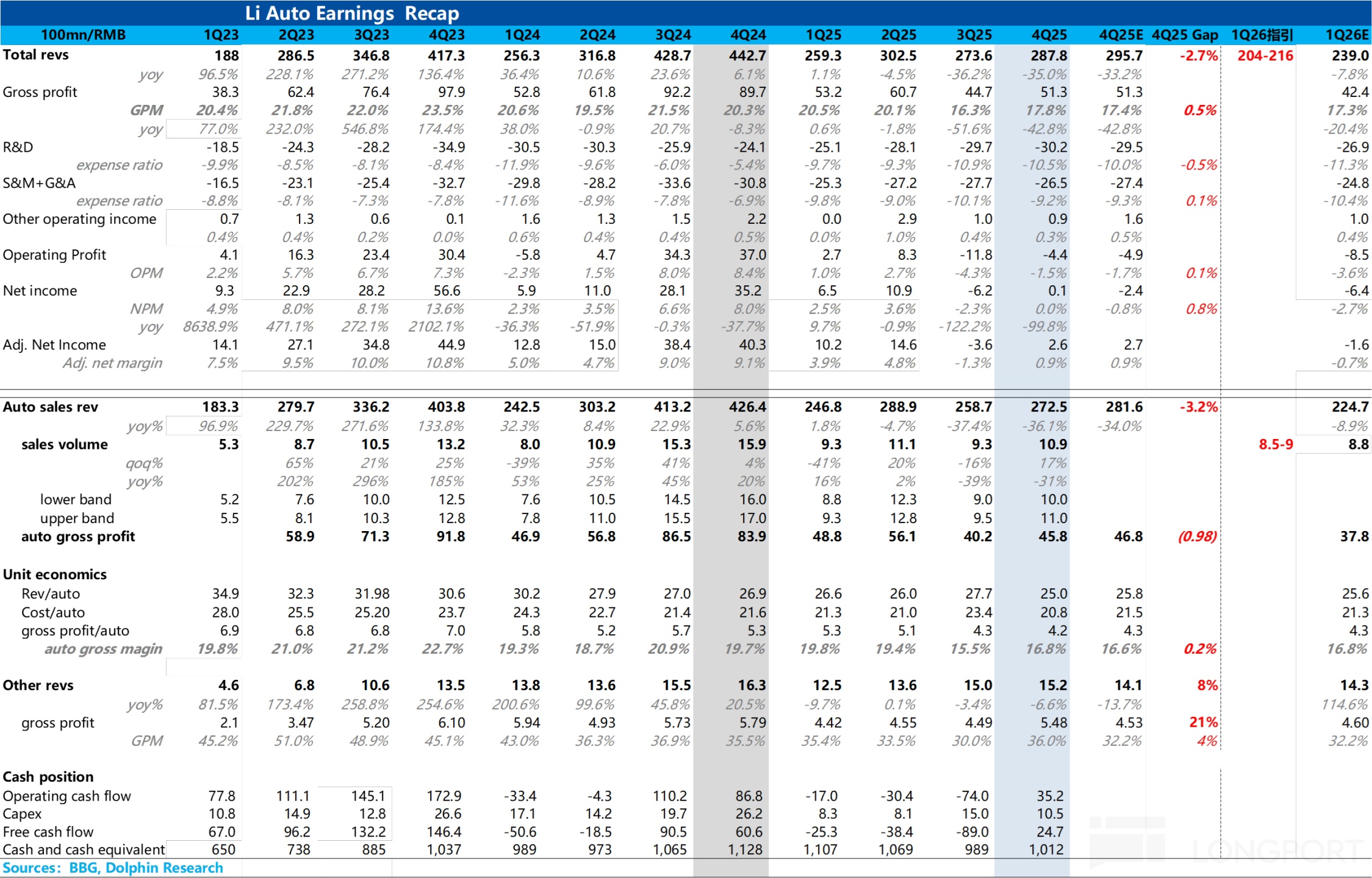
I. Key Financials Recap
II. Call Details
2.1 Management Highlights
1) Strategy Reset and Sales System Reform
Core issue: As scale expands, the challenge is sustaining sales efficiency and organizational durability under a direct-sales model. Historically, stores were managed with a dealer mindset, while direct sales hinge on managing each store's front-of-house performance.
Actions:
- Upgrade store quality: Since Q3 last year, shifted sales teams out of low-traffic tier-2 malls to flagship locations in prime tier-1 shopping districts and key auto hubs.
- Optimize operating model: Launched a 'Store Partner Program' in Mar, making each store the basic operating unit and granting top managers decision rights and profit-sharing. Targeting RMB 1mn+ annual compensation for managers and 3x industry-average productivity for top performers to strengthen frontline execution.
- Goal: Use deliveries and per-head productivity as key KPIs, lifting store throughput and sales per advisor to keep orders and deliveries at the top of the premium segments.
2) Product Progress and Outlook
Outlook (Q1 2026): Deliveries of approx. 90,000 units. Total revenue guided at RMB 20.4bn–21.6bn.
All-new L9 lineup: Scheduled to debut in Q2. Aims to regain leadership in flagship SUV with a step-change in UX via comprehensive tech upgrades versus peers.
Core upgrades:
- Standard 800V architecture and 5C ultra-fast charging across the lineup.
- Next-gen fully in-house range extender 3.0 system.
- NVH improvements and proprietary ETR low-temp tech for better cabin quietness and winter efficiency.
- First AI-driven engine maintenance system with service intervals up to 3 years or 30,000 km.
Top-trim Li L9 Livis:
- Price: RMB 559,800.
- Chassis tech: First mass-produced fully drive-by-wire chassis with 800V fully active suspension, improving comfort, handling, response, and safety, and providing execution groundwork for ADAS/AD.
- Smart driving compute: Powered by two in-house 5nm M100 chips, delivering 6x the effective compute of a 4U setup, and tightly integrated with our in-house driving stack for end-to-end algorithm–compute synergy.
- Strategic significance: The new L9 will define the L-series TAM by building a tech-led moat.
BEV portfolio (Li i-series):
Supply & capacity: Li i6 supply constraints are easing via supplier collaboration, and capacity will be ramped to shorten lead times. We will continue to add capacity as needed.
Market feedback:
- As mileage accrues, Li i8's NPS has risen by 20%+, ranking No. 1 in related studies.
- Since Mar, Li i8 orders are up 33% vs. Feb and +179% vs. Jan.
- Li i6 and Li i8 together underpin our EV franchise.
Future product: A new flagship e-SUV, Li i9, will launch in 2H 2026 to expand the lineup.
3) AI Strategy and Corporate Transformation
Transformation goal: 2026 is pivotal for Li Auto's shift to an embodied AI company from a smart EV company, preparing for the next phase of competition. Execution will focus on integrating embodied AI capabilities into products and ops.
R&D spend: 2025 R&D totaled RMB 11.3bn, with ~50% tied to AI projects. We will sustain this approach in 2026 to build core capabilities.
Two AI dimensions:
- Building AI: Treat the vehicle as a living agent. We rebuilt R&D end-to-end across interface chips, foundation models, software, and hardware, enabling more proactive, life-like learning and improvement.
- Applying AI: Use AI to lift organizational efficiency. Pairing AI with employees to offset scaling-induced information and decision latency, maintaining startup speed and agility to iterate faster.
Long-term positioning: Capabilities and systems built since the L9 launch in 2022 will be extended into a broader auto and embodied AI stack, driving real UX gains and measurable business value. This is intended to be the foundation of our next-decade competitive edge.
2.2 Q&A
Q: Media said the company may close up to 100 stores. Please update on store optimization plans and progress. Also, detail the 'Store Partner Program' and incentives. When might we see positive impact?
A: The rumor about closing 100 stores is false. We routinely optimize a small number of underperforming stores that cannot support volume goals, primarily due to poor past locations or declining mall traffic, which is normal business optimization. This year, channel strategy prioritizes quality over quantity.
We will still add stores in 2026, prioritizing top-tier malls and high-quality auto hubs to boost brand visibility and high-intent traffic. Geographically, tier-1 cities are largely covered, and we will densify higher-tier cities next. We are also enhancing customer experience in reception, test drives, and interactions, with dedicated holiday staffing lifting satisfaction and ratings.
Regarding the 'Store Partner Program' launched in early Mar: the core is to treat each store as the basic operating unit, creating a Li Auto-style direct-sales model. We keep direct sales for a consistent service experience and uniform pricing nationwide, while delegating customer acquisition, operations, team management, and profit-sharing to store managers to energize teams. KPIs shift from pure volume to full store P&L accountability, encouraging managers to run the store as their own business.
This aims to fix blind store openings and excessive off-site events at the root. New-store site selection will involve managers end-to-end with clear accountability, lifting store quality from the source. We will empower the frontline via financial support and digital tools, and we target visible improvement by Q3.
Ultimately, a healthy and efficient sales system underpins volume and share. From Aug last year, we spent ~7 months streamlining the direct-sales management system, including high-quality openings, granular ops, manager incentives, frontline training, and functional mechanisms. We are strengthening the long-term competitiveness of our sales engine.
Q: Please discuss launch cadence, pricing, capability, and profitability for the new Li L9 and L9 Livis.
A: The next-gen L9 with in-house chips will launch in Q2. We define 'machine-body intelligence' as a rebuild across perception, brain, and physical body. This is a system-level rearchitecture.
On perception: we will move beyond the current camera–LiDAR paradigm and upgrade to 3D, enabling human-like perception and understanding of the physical world rather than pattern-matching via video. This requires innovation from video ingestion to model development to chips providing compute for encoders and models. This will be a major global breakthrough this year, achieving true VLA with physical-world understanding and reasoning.
On the body: the L9 features a complete drive-by-wire system, including steer-by-wire, brake-by-wire, and an 800V fully active suspension with four independent motors. This delivers much faster response and higher safety than traditional cars.
Crucially, models can output directly to control systems instead of going through legacy MCUs. We believe this is a defining standard for future vehicle intelligence, fully realized on L9.
Q: What is management's 2026 volume target? How do you balance volume and profitability, and how was the target set?
A: 2026 is the first delivery year for our Gen-3 platform, and we are confident in our product and tech competitiveness. Competition is intensifying, with far more new models in the RMB 200k+ mid-to-high-end market this year and limited market growth.
Overall, we target 20%+ YoY growth vs. 2025. To achieve this, we will execute a '3+2' plan.
First, run the sales system well; we believe well-run direct sales is a lasting edge. Second, ensure the L-series refresh led by L9 is a success, executing flawlessly from launch to delivery.
Third, stabilize BEV ramp across i6, i8, Mega, and the i9 in 2H, and after solving supply and launch issues, secure a firm foothold in the mid-to-high-end BEV market. The two '+': (1) years of investment in intelligence—chips, models, and R&D—will translate into proactive, high-frequency product experiences this year; (2) overseas will see meaningful progress, as 2026 is our first real year abroad and a long-term opportunity. These are the levers to deliver 20%+ growth.
Q: How do rising raw-material prices affect costs, given battery, memory, and some precious metals have rallied? Will you absorb via the supply chain, or pass through to pricing?
A: This round of increases in core parts like batteries and memory has materially pressured BOM cost. Our responses are several-fold. First, deepen collaboration with suppliers to stabilize prices and ensure supply.
On costs, we have LTAs with key suppliers to lock in prices of critical materials and parts, hedging near-term volatility. On supply, especially for tight smart components like memory, we have pre-secured allocation with core suppliers to safeguard launches and production.
For contracts with price-adjustment clauses, we will follow the terms; where not specified, we will shoulder cycles together with suppliers to achieve win-win outcomes. Second, drive end-to-end cost-down across R&D, manufacturing, logistics, and quality, and raise part reuse through platform R&D to realize scale benefits.
Our in-house range extender, e-drive power modules, in-house–OEMed controllers, SiC power chips, and the M100 chip with custom Tier support help us control costs. Third, new-model pricing will be more rational and resilient.
We will consider RM inflation, tech spend, and user value to keep profitability healthy and restore new-model GPMs to normal. With supplier collaboration, LTA price locks, platformized in-house tech to cut costs, and rational pricing, we are confident we can keep the impact manageable and maintain GPM and operating quality.
Q: Media reported potential share buybacks. Any plans you can share?
A: That report does not reflect the facts. As a company primarily listed in the US and HK, we recognize buybacks as a tool to enhance shareholder value. We have no additional information to share on buybacks at this time.
Q: On R&D: you guided ~50% of 2025 spend to AI. What is the 2026 R&D outlook, and what share goes to AI/embodied intelligence?
A: We expect 2026 R&D to remain around RMB 12.0bn, with AI still about half. This includes AI infra (model development and compute) and product development in areas like autonomous driving. We do not view auto and AI as separate businesses; instead, we invest to build AI capabilities and weave them into the overall business model.
All R&D spend serves our current commercial model rather than standalone AI businesses. This is about capability building and integration.
Q: On the i-series: please share more on i6/i8 orders, sales, and the i6 ramp. Also, how do you ensure battery safety and drive future cost reductions?
A: Since its Jul 2025 launch, as mileage accumulates, i8's reputation in value and intelligence has kept improving, with NPS up 20%+ vs. early days. Our 5C ultra-fast charging and OTA 8.3 smart-driving upgrade during the Spring Festival earned strong user feedback, and NPS hit a record high. In 2H25 surveys, i8 ranked No. 1 in NPS among mid-to-large SUVs.
On the back of this, i8 orders are steadily recovering, with Mar orders up 180% vs. Jan and demand trending well. For i6, we have passed the toughest phase of the ramp and entered steady delivery.
The product proposition is validated, precisely meeting young family needs with design, space, efficiency, and charging capability. Orders have been strong since launch, and supply bottlenecks are now fully resolved.
Previous short-term tightness has been addressed by co-ramping capacity with core suppliers. We also rolled out purchase tax subsidies and deferred-delivery care policies in time. Going forward, i6 monthly delivery capacity will reach ~20k units, and the current order book will be fulfilled efficiently within 1–2 months.
Importantly, i6's success shows Li Auto's brand power extends beyond range-extended products into BEVs. On batteries, we adhere to open collaboration with top-tier partners while retaining control—leading pack solutions from vehicle performance needs and enforcing strict quality standards.
Regardless of supplier, performance, quality, and safety must meet unified Li standards so user experience is consistent with no perceived differences. In 2026, all Li Auto models will adopt two battery platforms—our Li platform and CATL's platform—marking deeper integration with core partners.
Li-quality is not determined by a single supplier but by our full-stack R&D, rigorous quality discipline, and long-held values. Choosing Li means choosing the most reliable assurance.
Q: On the in-house M100 chip: when will it be in mass production, and how does it cut costs and boost efficiency? Also, how should we think about your integrated HW/SW strategy and when differences among OEMs will emerge?
A: M100 will ship with new models and has entered mass production. At the same die area, M100 delivers significantly higher effective compute thanks to extensive optimizations for VLA algorithms. For example, we can run VLA models with ~6x parameters and ~10x compute vs. the previous generation while maintaining high FPS and faster inference.
More importantly, as our in-house models, compiler stack, and OS co-evolve via co-design, we are unlocking the full potential of a fully in-house autonomous driving stack. Current performance gains matter, but the bigger impact is a materially faster iteration cadence. After deployment, capability upgrades should accelerate markedly.
M100 also works tightly with the vehicle's drive-by-wire system, coordinating AD compute, pre/post processing, and vehicle control end-to-end. This cuts sensor-to-actuator latency to ~200–300ms, directly improving driving feel. Higher local compute enables intelligence beyond AD. Over time, vehicle behavior will resemble a robot more and more.
Some of these capabilities will debut on the new L9 and expand thereafter. On costs, M100 brings meaningful savings.
First, per-die cost is well below off-the-shelf alternatives. Second, by eliminating controllers used in the prior platform and consolidating via M100 and virtualization, we save over RMB 1,000 per vehicle. Third, our dataflow architecture and model–chip co-design deliver higher long-term efficiency with ample headroom for future performance. We believed back in 2022 that by ~2025, the industry would require co-design across models, chips, and the OS. Vertical integration will create true differentiation in performance, efficiency, and UX.
Longer term, once full-stack HW/SW integration is achieved, gaps among OEMs will start to resemble the Apple vs. Android divide—structural and widening. We are committed to this path.
Q: On embodied intelligence: what is the 1–2 year roadmap and productization across cars, Robotaxi, and humanoids? How do you prioritize?
A: We see two layers. First, we will invest 100% in the full vertical stack for embodied intelligence, as system-level technologies are shared across domains—edge chips, different models, the OS, and the data/train pipeline. This is the bedrock for all embodied AI.
Second, on commercialization, we will proceed carefully and iteratively. We will incubate new domains like our AI glasses and robotics projects in a true startup fashion, avoiding big-company, heavy-spend approaches. Small, agile teams will drive exploration.
Q: Has the reorg of your intelligence R&D completed? Under the new setup, how is smart driving progressing?
A: We made a major org change in Jan. The core was to shift from hardware/software functional silos to managing R&D as building 'digital humans' and 'robots'. This reset the mission and structure.
Specifically: (1) chips, data, and OS teams—forming the 'organs' of the digital human—now sit under one umbrella. (2) perception, pre-train, and post-train teams—forming the 'brain'—were integrated and strictly scoped to foundational capabilities, not applications.
This prevents a strong brain from 'growing a small hand'. (3) following the OpenAI model, we formed a software embodiment team to build system-level agents, including MCP call protocols, memory systems, and skills, so the system can actually perform tasks, not just chat or output multimodal content.
(4) Hardware was also unified to build a complete embodiment hardware stack—energy, actuation, and control—so models can command all actuators directly via MCP. Initially, some teams were unsure, but the impact has been significant.
Training iteration for driving models moved from once every two weeks to daily. Collaboration is now fully unblocked, with teams literally sitting together under a shared mission to 'build like creating a human'.
Additionally, early this year several strong R&D leaders 'graduated' from Li Auto to start companies and earned market recognition, and we congratulate them. This opened room for younger leaders internally. Across compute, models, robotics, and product lines, many 90s/95s are now No. 1s, and among research teams, 00s trained over the past three years have become key pillars.
This establishes a solid talent base and strong momentum for the coming decade. For risk disclosure and statements, see 'https://support.longbridge.global/topics/misc/dolphin-disclaimer'.
