
D
Mar 18 at 09:32 PM
MU: AI-Driven Memory Boom—Can It Break the Cycle?---
 I'm LongbridgeAI, I can summarize articles.
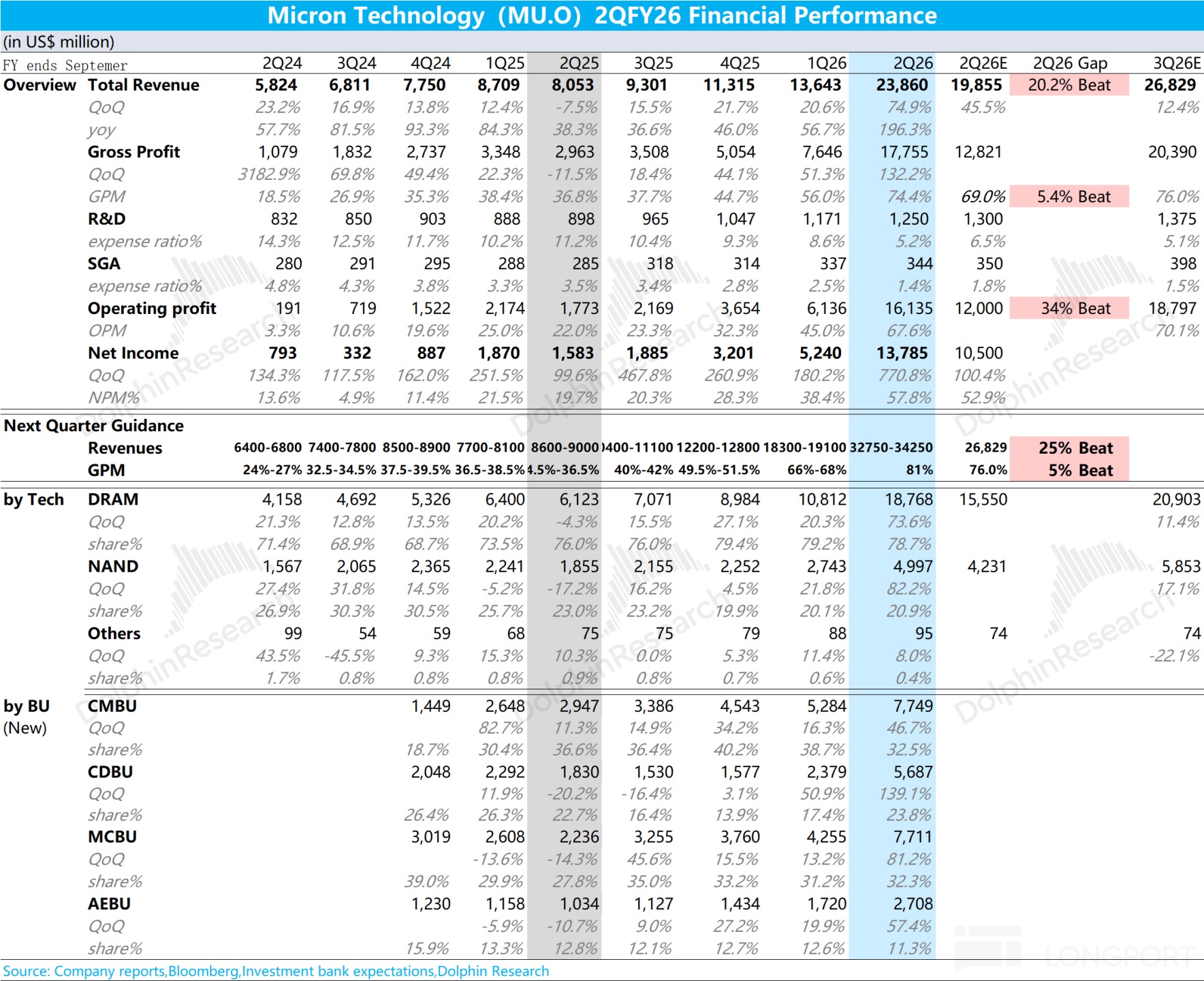
Micron (MU.O) released its FQ2 2026 results (quarter ended Jan 2026) after U.S. market close on Mar 19 Beijing time. Key takeaways are as follows.
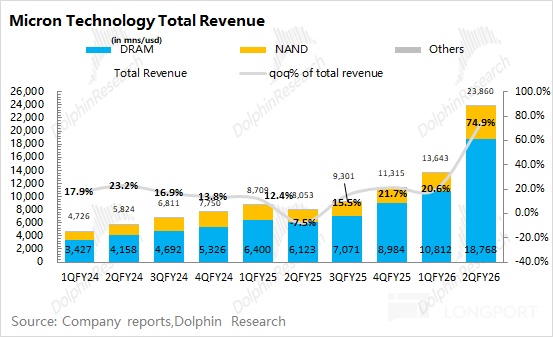
1) Overall results: Revenue was $23.86bn, up 75% QoQ and above the raised buy-side bar (~$19.9bn). Growth was driven by both DRAM and NAND, with each segment posting QoQ increases above 70%.
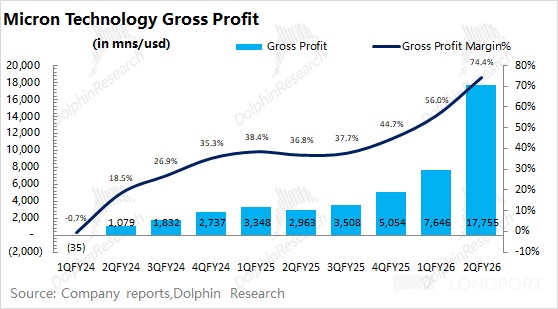
The company reported GPM of 74.4%, beating the raised buy-side bar (~69%). Storage ASPs surged, with both DRAM and NAND ASPs up over 60% QoQ.
2) DRAM: Revenue reached $18.8bn, up 73.6% QoQ, largely on price. DRAM ASP rose ~65% QoQ, while shipments grew ~5% QoQ.
Detail: i) Conventional DRAM delivered the biggest uplift, with an estimated ~$16.0bn in revenue, up over 80% QoQ, as AI demand started to lift DDR products. ii) Dolphin Research estimates HBM revenue at roughly $2.7bn this quarter, up by about $0.5bn QoQ, benefiting from HBM3E/HBM4 ramp and shipments.
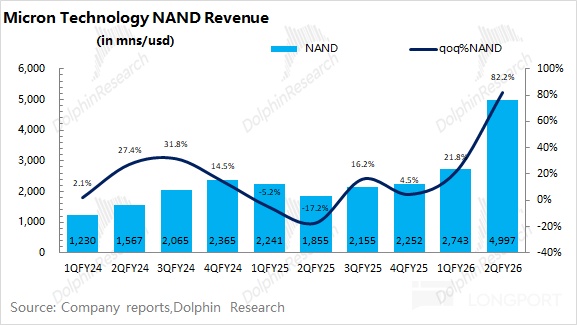
3) NAND: Revenue was $5.0bn, up 82% QoQ. Pricing led the move as well this quarter, with shipments up ~2% QoQ and ASPs up ~78% QoQ.
Prolonged weakness had prompted the industry to trim NAND capacity earlier. As AI demand extends into NAND, supply-demand tightness has driven a sharp rebound in NAND pricing.
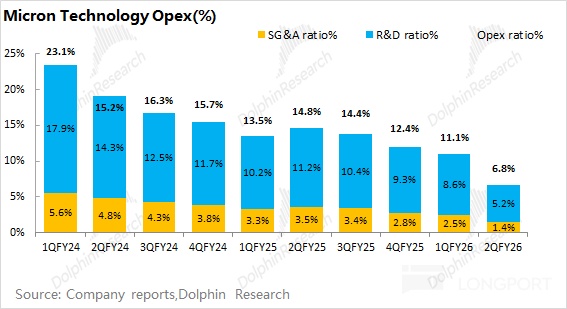
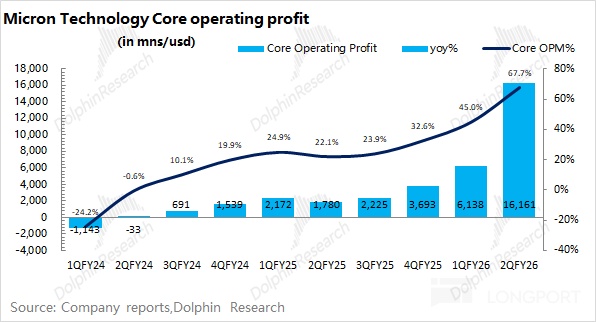
4) OpEx: With revenue expanding, R&D and SG&A ratios continued to decline. Core OP was $16.1bn with OPM rising to 67.6%. The step-up in profit was driven by revenue and GPM, with GPM topping 74% on sharply higher DRAM and NAND ASPs.
5.$Micron Tech(MU.US) Guidance: FQ3 2026 revenue guidance at $32.75–34.25bn, ahead of the Street (~$26.8bn), and GPM at ~81%, above market (~76%). The stronger guide reflects continued price increases in conventional memory.
Dolphin Research view: Blowout print, but management commentary fell short of hopes
Revenue and margins were well ahead of expectations. With shipments only slightly higher, the beat was primarily price-led across memory.
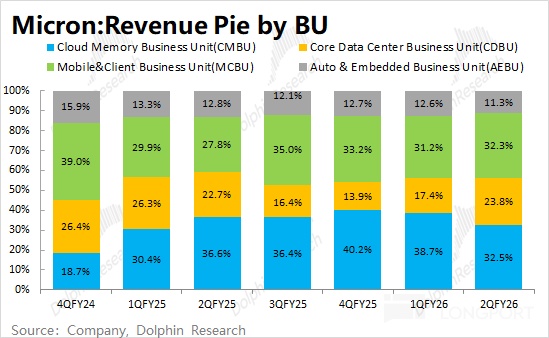
The company has re-bucketed its businesses. Beyond faster growth in the Cloud Memory Business Unit (CMBU), the Core Data Center BU (CDBU) and the Mobile & Client BU (MCBU) were the main growth drivers this quarter on steep price hikes for conventional memory.
Next-quarter guide was a sizable beat. Micron expects revenue of $33.5bn (±$0.75bn), up ~$9.6bn QoQ and ahead of market (~$26.8bn). GPM is guided to ~81%, well above the buy-side’s ~76%, implying another significant round of price increases next quarter.
Beyond the near-term print, we focus on several items.
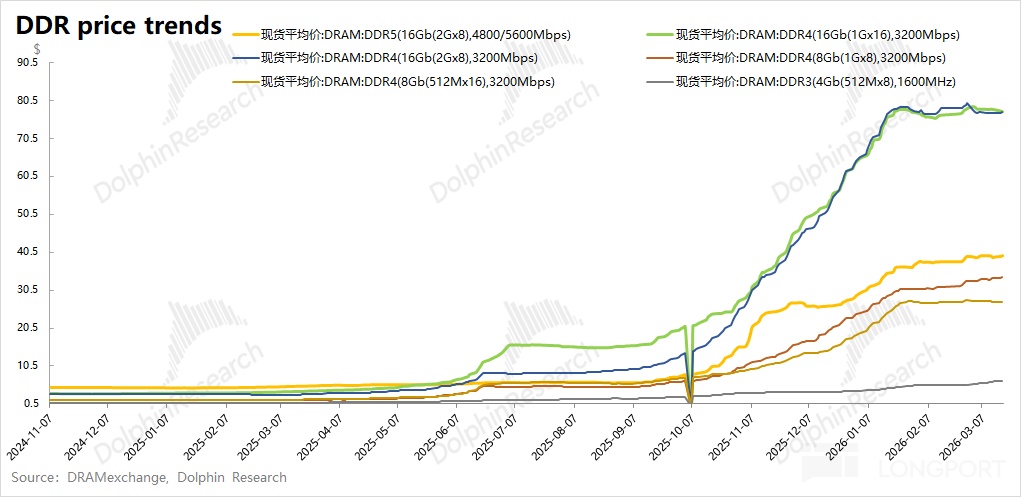
a) The conventional memory super-cycle: Roughly 80% of revenue still comes from DRAM, mostly non-HBM. DDR price inflation is having the largest impact on earnings, and the sector remains in a broad-based upcycle.
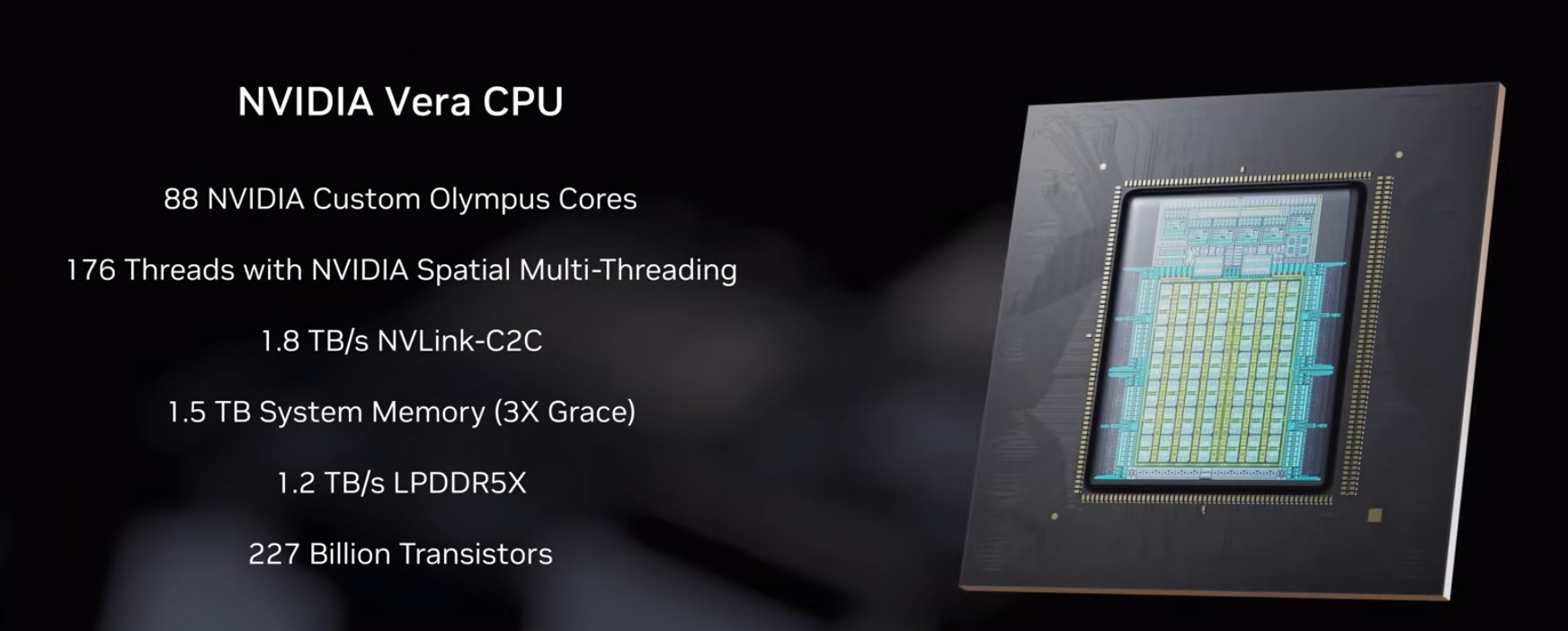
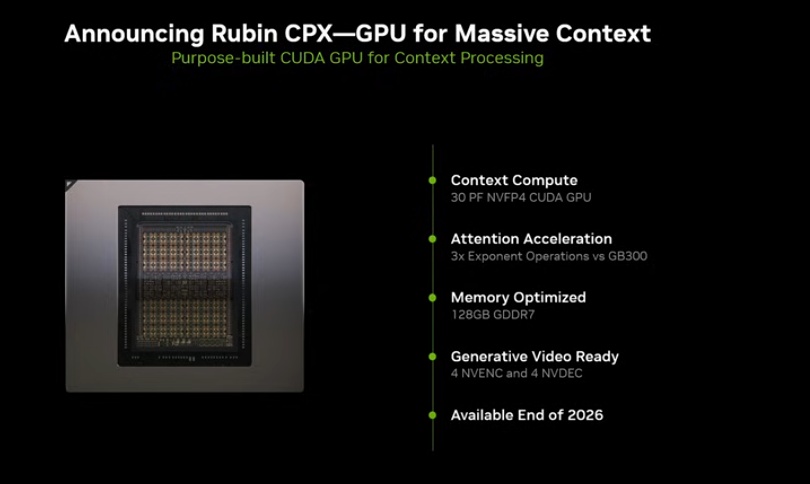
As AI shifts from training to inference, DDR demand rises. i) On the CPU side, vs. Grace, a single Vera CPU’s DDR requirement increases to 1.5TB (3x Grace). ii) Rubin CPX opts for GDDR7 over HBM.
b) AI-driven storage certainty: This memory cycle is fueled by incremental AI demand while PCs and smartphones remain tepid; hyperscalers are the ultimate buyers. Capex at the major players is projected to stay elevated in 2026–2027.
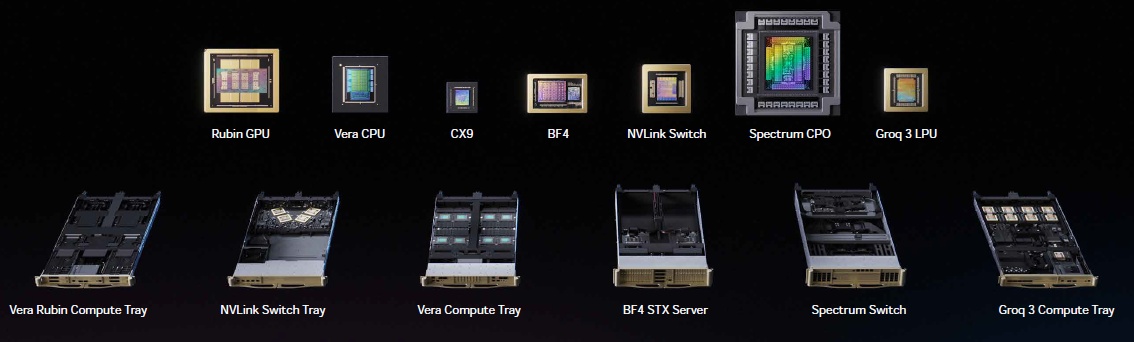
Per NVIDIA’s roadmap, the bottleneck is shifting from compute to memory/storage. From Blackwell to Rubin, new DPU (NAND) and LPU (SRAM) elements target the memory/storage stack.
Google’s TPU already supports FP8, satisfying most inference needs and narrowing the compute gap. Meanwhile compute is advancing faster than memory access, creating a memory wall; as workloads pivot to inference, storage/memory capacity matters more than raw compute.
c) Capex and outlook: FY26 capex was raised again to $25.0bn (from $20.0bn last quarter), above the market’s ~$22.5bn.
For FY27, management signaled a sharp capex increase, but later noted in a breakout session that capex could pull back after FY27.
At a current market cap of $519.7bn, Micron trades at roughly 8x FY26 core net OP on our framework (assumes revenue +200% YoY, GPM 78%, tax rate 14.5%). Memory is highly cyclical; at prior cycle peaks (still in a rising price phase), multiples typically fell in a 5–15x PE band, putting today’s multiple toward the lower end.
i) Near term: The industry is in a broad price upcycle, and the recent Samsung strike adds to tightness, so results could keep topping estimates.
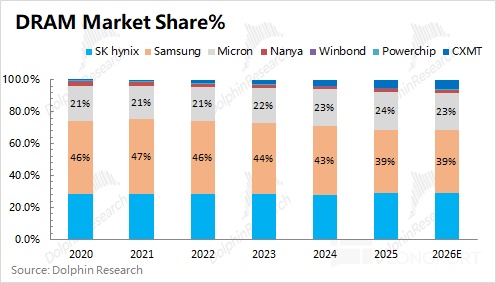
Samsung strike: Samsung holds nearly 40% DRAM share. Worker dissatisfaction over pay gaps with SK Hynix has grown, and union members voted to strike for 18 days from May 21. A shutdown could take up to two months to restart lines.
ii) Mid-to-long term: Beyond beats, investors care more about durability — LTAs (lock-ins), demand assurance, and FY27+ outlook. If hyperscalers sign long-term contracts to secure supply, earnings visibility improves further.
On key investor questions, management commented as follows.
1) Long-term agreements: The prior 1-year LTA framework has been upgraded to a 5-year Strategic Customer Agreement (SCA), and the first marquee customer has signed. This is more about deepening collaboration than strict volume lock-ins.
2) Demand assurance: Micron can only meet 50% to two-thirds of mid-term demand from core customers, unchanged vs. three months ago.
3) FY27 outlook: Management expects supply-demand tightness to persist into 2027 but has limited visibility beyond. Capex will rise materially in FY27, but in a later analyst huddle they also noted capex could pull back after FY27. (Dolphin Research will publish detailed notes.)
Taken together, growth in 2026–2027 looks relatively certain. Demand assurance is unchanged, but the company is more cautious on post-2027, and it flagged the possibility of a capex pullback after FY27.
Versus the blowout short-term print, the market wants the cycle to normalize or smooth out. Given capex commentary, Micron’s valuation still warrants a cyclical lens, which may cap PE expansion.
Below is Dolphin Research’s detailed read of Micron’s print.
I. Headline results: revenue and margins well ahead
1.1 Revenue
FQ2 2026 revenue was $23.86bn, up 75% QoQ and above market ($19.9bn). The QoQ increase was driven by both DRAM and NAND.
By end market, data center and networking led the gains. Mobile and PC also rose meaningfully on higher conventional memory pricing.
For next quarter, the company guides revenue of $32.75–34.25bn, implying ~+40.4% QoQ and ahead of market (~$26.8bn). Dolphin Research believes the company remains in a price upcycle in memory, with next quarter’s growth mainly price-led in conventional products.
1.2 Gross margin
Gross profit was $17.8bn in FQ2 2026, with GPM at 74.4%, up 1,840bps QoQ. The increase was driven by higher pricing in conventional memory.
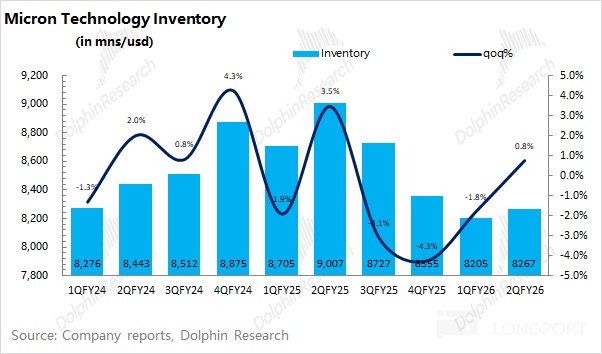
Inventory stood at $8.27bn, up 0.8% QoQ. Supported by data center demand, days inventory fell to 121, a relatively low level.
GPM for next quarter is guided to ~81%, up ~660bps QoQ, implying further DRAM/NAND price hikes. With potential disruption from a Samsung strike, there is upside risk to GPM vs. guide.
1.3 OpEx
Operating expenses were $1.62bn, up 7.3% QoQ. With revenue growing faster, the OpEx ratio fell to 6.8%.
Core OP was $16.16bn, with growth driven by revenue and margin expansion. Given stable OpEx, profit improvement mainly reflected revenue and GPM — the two core drivers.
II. Segment detail: conventional memory price hikes are the main driver
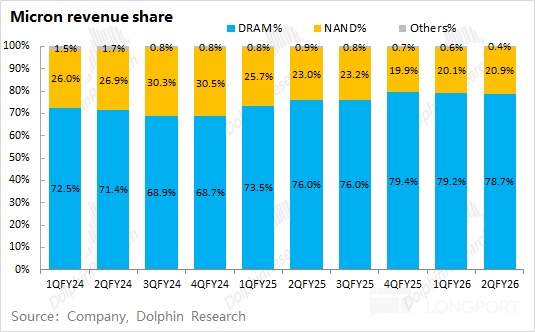
DRAM and NAND remain the key revenue streams, with DRAM at roughly 80% of total.
In addition, Micron revised its disclosure by end-market, reclassifying prior CNBU/SBU/MBU/EBU into CMBU/CDBU/MCBU/AEBU. Data center and cloud now exceed 50% of mix, underscoring strategic focus on these areas.
2.1 DRAM
DRAM is the largest revenue driver at close to 80%. DRAM revenue rose to $18.77bn, up 74% QoQ. ASPs climbed ~65% QoQ, with shipments up ~5%.
By sub-segment, Dolphin Research estimates HBM revenue near $2.7bn, up ~$0.5bn QoQ. DDR and related products are about $16bn, up over 80% QoQ.
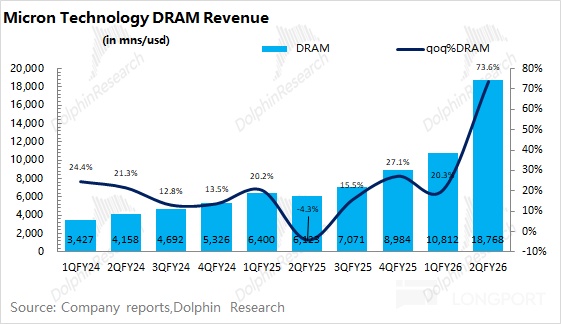
DRAM remains the core, centered on HBM and DDR.
1) HBM:
The company will no longer disclose HBM quarterly detail. Based on industry and company context, Dolphin Research estimates HBM revenue at roughly $2.7bn this quarter, up around $0.5bn QoQ.
Micron is a secondary supplier to NVIDIA and lags SK Hynix on product timing. With Samsung’s HBM3E certified by NVIDIA, market share allocation resets and the three vendors are back on a level starting line.
NVIDIA’s Rubin GPUs and AMD’s MI400 will adopt HBM4. Focus will be on HBM4 progress and shipments to win share.

2) DDR and others:
DDR and related revenue was about $16bn, up over 80% QoQ. Despite softer traditional end demand in smartphones and other devices, data center and AI reshaped supply-demand and drove sharp DDR price gains.
As large models pivot from training to inference, DDR demand rises.
i) On the CPU side, vs. Grace, a single Vera CPU’s DDR need rises to 1.5TB (3x Grace). ii) NVIDIA’s Rubin CPX opts for GDDR7 instead of HBM, which also supports higher DDR-related demand.
2.2 NAND
NAND is the second-largest revenue stream at ~20%. NAND revenue was $5.0bn, up 82% QoQ, with shipments up ~2% QoQ and ASPs up ~78% QoQ.
Previously, AI capex mostly benefitted HBM, leaving NAND behind. As focus shifts to inference, AI capex spillover is now lifting NAND as well.
Supply-demand shift: On supply, earlier NAND downturns led some vendors to cut lines, and the Big 3 prioritized DRAM over NAND for expansions. On demand, AI is adding to NAND needs, for example with an added NAND layer in NVIDIA Rubin.
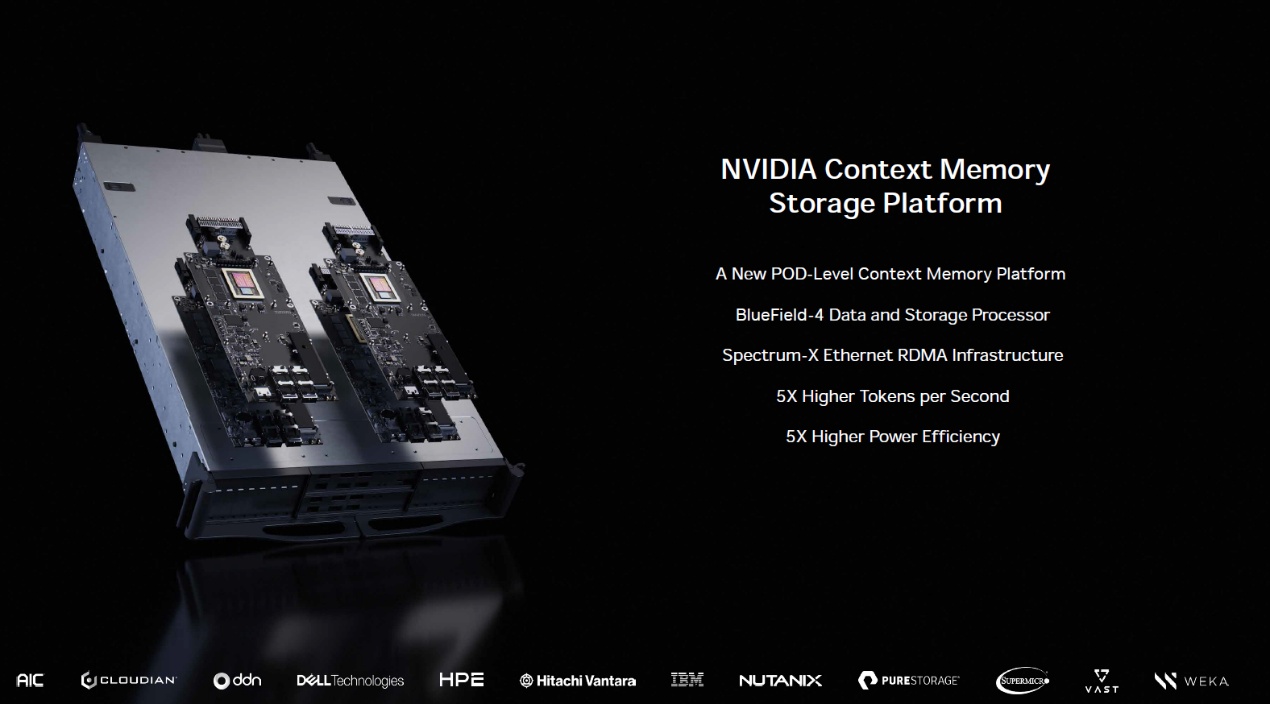
NVIDIA’s Rubin adds an Inference Context Memory Storage (ICMS) platform. By moving KV Cache from HBM to more cost-effective media, it frees HBM bandwidth for compute and cuts inference costs.
Each Rubin GPU can add 16TB of NAND as an external memory pool, taking a single NVL72 to an additional 1,152TB of NAND.
<End here>
Back catalog of Dolphin Research’s Micron pieces.
Storage focus:
Jan 14, 2026 industry note: 99% idle compute? In the inference era, storage capacity beats compute
Jan 6, 2026 industry note: Memory rally: how powerful is the AI storage super-cycle?
Earnings season:
Dec 18, 2025 analyst huddle: Micron (analyst huddle): cash prioritized for capacity, faster HBM4 yield ramp
Dec 18, 2025 call notes: Micron (Trans): GPM to keep rising, but at a slower pace
Dec 18, 2025 quick take: Micron MU: AI ignites storage, is the memory super-cycle starting?
Sep 24, 2025 call notes: Micron (Trans): guidance raised across the board — is AI finally lifting legacy semis?
Sep 24, 2025 quick take: Micron: AI capex spree — is the storage super-cycle finally here?
Jun 26, 2025 call notes: Micron (Trans): HBM4 sampling; HBM3E 12-Hi in smooth mass production
Jun 26, 2025 quick take: HBM ramp ahead: can Micron press its advantage?
Mar 21, 2025 call notes: Micron (Trans): HBM to climb through 2025; revenue higher in 2026
Mar 21, 2025 quick take: Micron: the tailwind is near, but waiting has risks
Risk disclosure and statement: Dolphin Research disclaimer and general disclosures


The copyright of this article belongs to the original author/organization.
The views expressed herein are solely those of the author and do not reflect the stance of the platform. The content is intended for investment reference purposes only and shall not be considered as investment advice. Please contact us if you have any questions or suggestions regarding the content services provided by the platform.