
D
Mar 24 at 09:44 AM
Xiaomi: Heaven to Hell — What Still Anchors Conviction?---
 I'm LongbridgeAI, I can summarize articles.
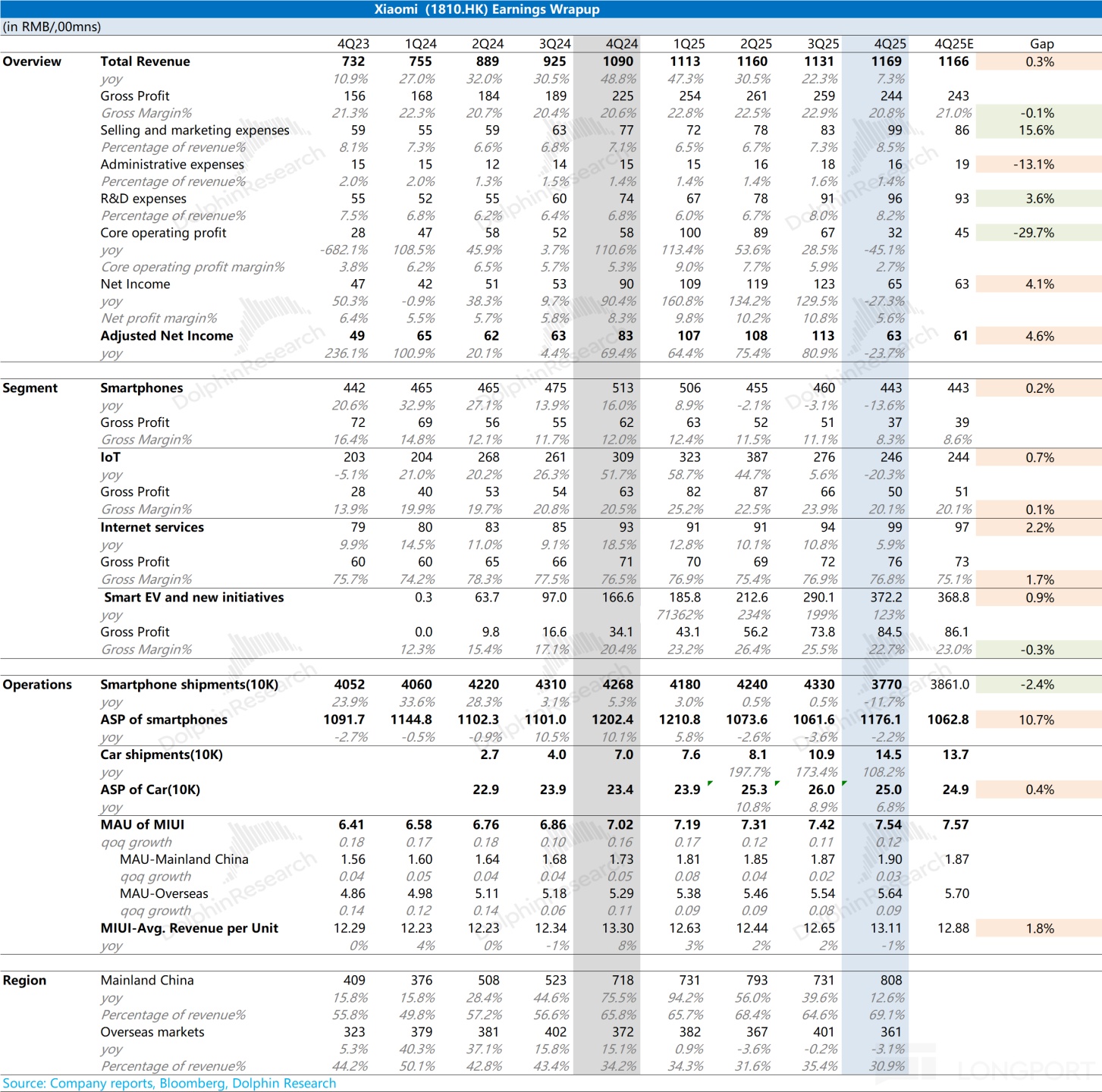
Xiaomi Corp. (1810.HK) released its Q4 2025 results (quarter ended Dec 2025) after the Hong Kong close on Mar 24, 2026 Beijing time. Key takeaways:
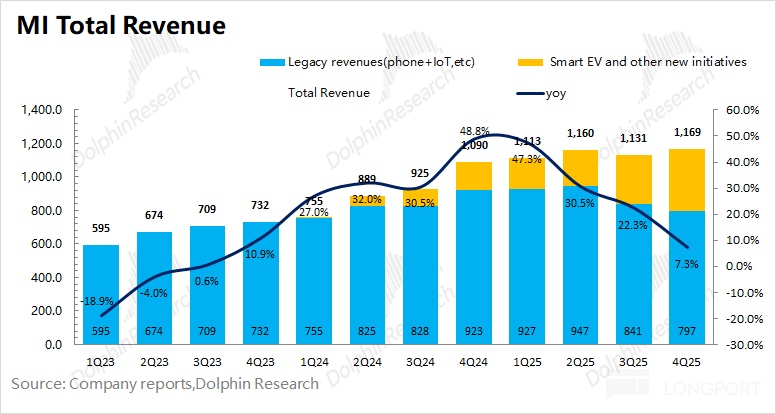
1. Headline results: revenue RMB 116.9bn, +7% YoY, with all growth driven by autos while legacy businesses (smartphones x AIoT) fell 13.7% YoY.
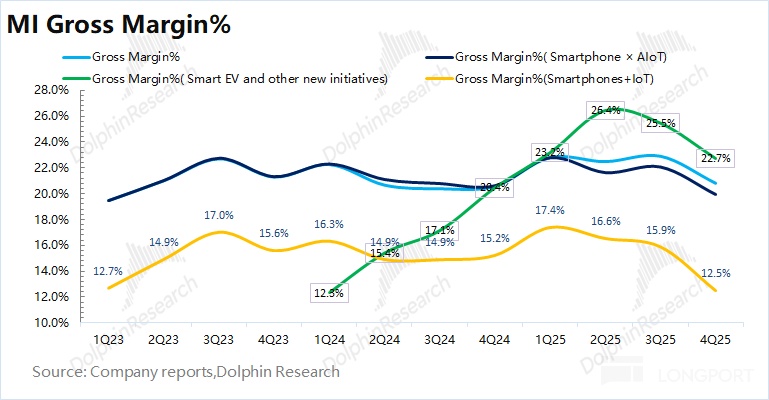
GPM slipped to 20.8%, mainly on sharply lower margins in smartphones and IoT, and auto margins also started to decline this quarter.
2. Autos: RMB 37.2bn of revenue this quarter, broadly in line. Shipments were 145k units, with ASP down to RMB 250k, largely as SU7 Ultra mix fell.
Auto GPM dropped to 22.7%, slightly below the street at 23%. Mix shift away from SU7 Ultra weighed on ASP, and the company cleared some display and in-stock vehicles. Dolphin Research estimates core OP from autos at RMB 1.05bn this quarter, marking a second consecutive profitable quarter.
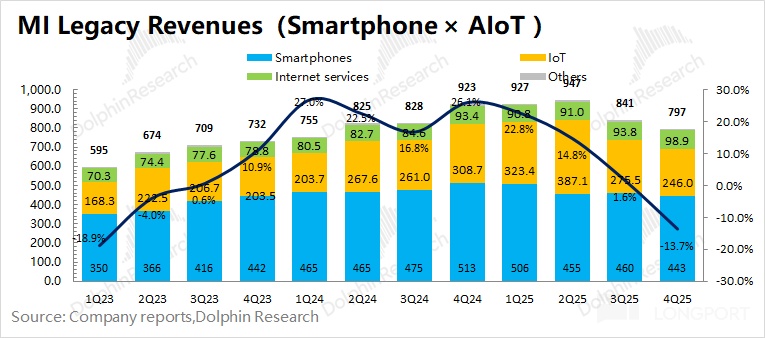
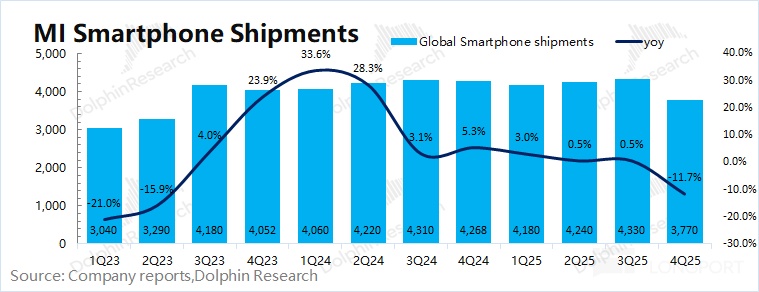
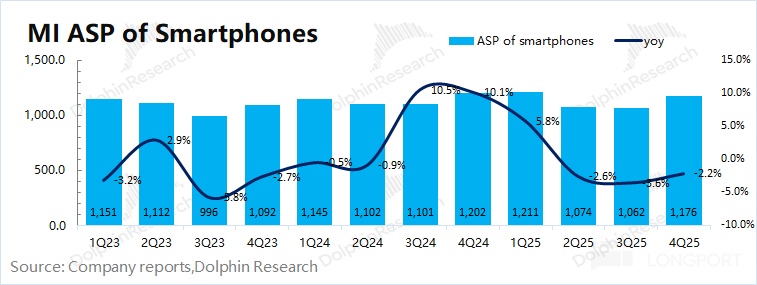
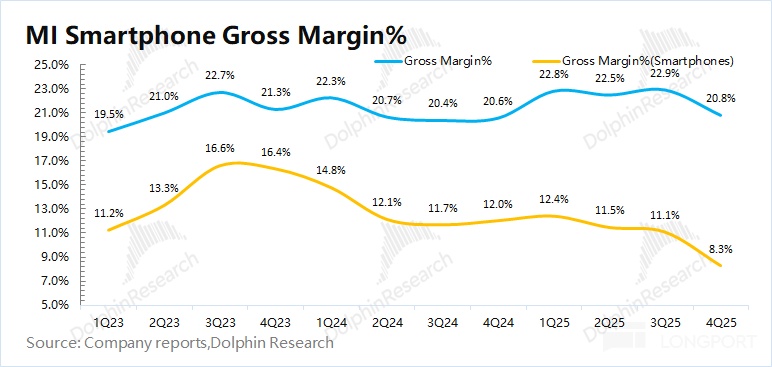
3. Smartphones: RMB 44.3bn, -13.6% YoY, in line with the street at RMB 44.3bn. Unit shipments fell 11.7% YoY and ASP declined 2.2% YoY. With tougher competition and tighter state subsidies, segment GPM dropped sharply to 8.3%.
By market: domestic smartphone shipments fell 18.2% YoY, while overseas shipments declined 8.8% YoY, with notably weaker performance at home this quarter. With memory prices still rising, smartphone GPM will remain under pressure.
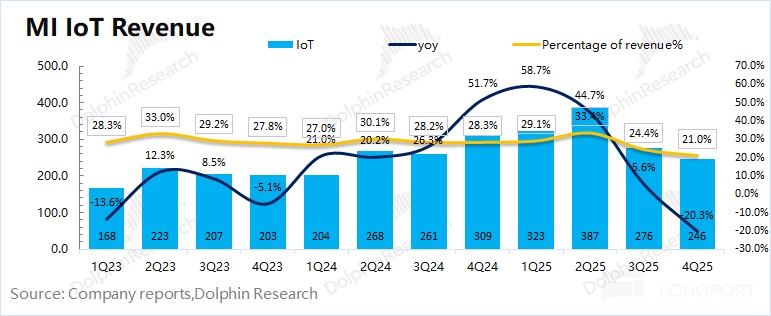
4. IoT: RMB 24.6bn, -20% YoY, in line with the street at RMB 24.4bn, mainly hit by tighter state subsidies and intensified competition. Big-ticket home appliances, more sensitive to subsidies (some products saw RMB 1–2k per-unit subsidies), fell 40% QoQ.
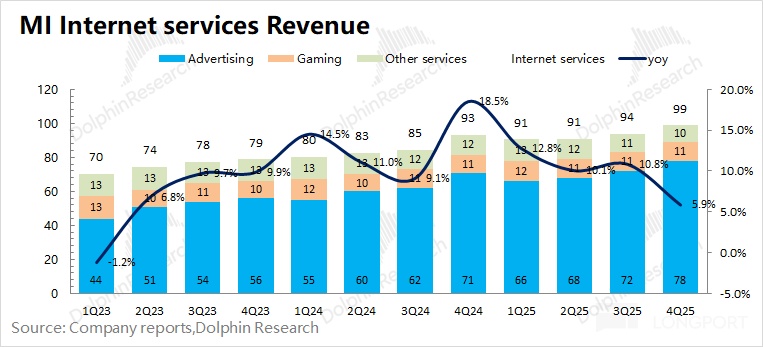
5. Internet services RMB 9.9bn, +6% YoY, slightly above the street at RMB 9.7bn. Growth was led by advertising, while value-added services edged down. MIUI MAUs rose 7% YoY, while ARPU fell 1% YoY.
By region: overseas internet revenue was RMB 3.66bn, while domestic internet revenue was roughly RMB 6.23bn, and MIUI users continued to grow both domestically and overseas.
6. Profit: core OP RMB 3.2bn, with adj. net profit RMB 6.3bn. Core OP for $XIAOMI-W(01810.HK) legacy businesses was ~RMB 2.14bn, while autos earned RMB 1.05bn this quarter.
$Xiaomi Corporation(XIACY.US) The decline in core OP this quarter mainly reflected smartphone margin erosion from memory inflation and a sharp IoT revenue drop as state subsidies faded, driving a 68% YoY slide in legacy profit.
Dolphin Research view: legacy under pressure; autos need stronger new models
Results were broadly consistent with our prior preview. All the revenue growth came from autos, while smartphones and IoT were clearly under pressure.
Data this quarter show mounting pressure on Xiaomi: (i) smartphone GPM fell to single digits; (ii) IoT saw a double-digit YoY decline; (iii) auto GPM fell as weekly orders also weakened.
With memory price inflation and tighter state subsidies, the stock slid from HK$60 to around HK$30, reflecting concerns about both autos and legacy businesses:
1) Autos: full-year target 550k units
Although Xiaomi delivered 145k units in Q4 2025, shipments plunged in the first two months of 2026, suggesting the backlog has largely been digested.
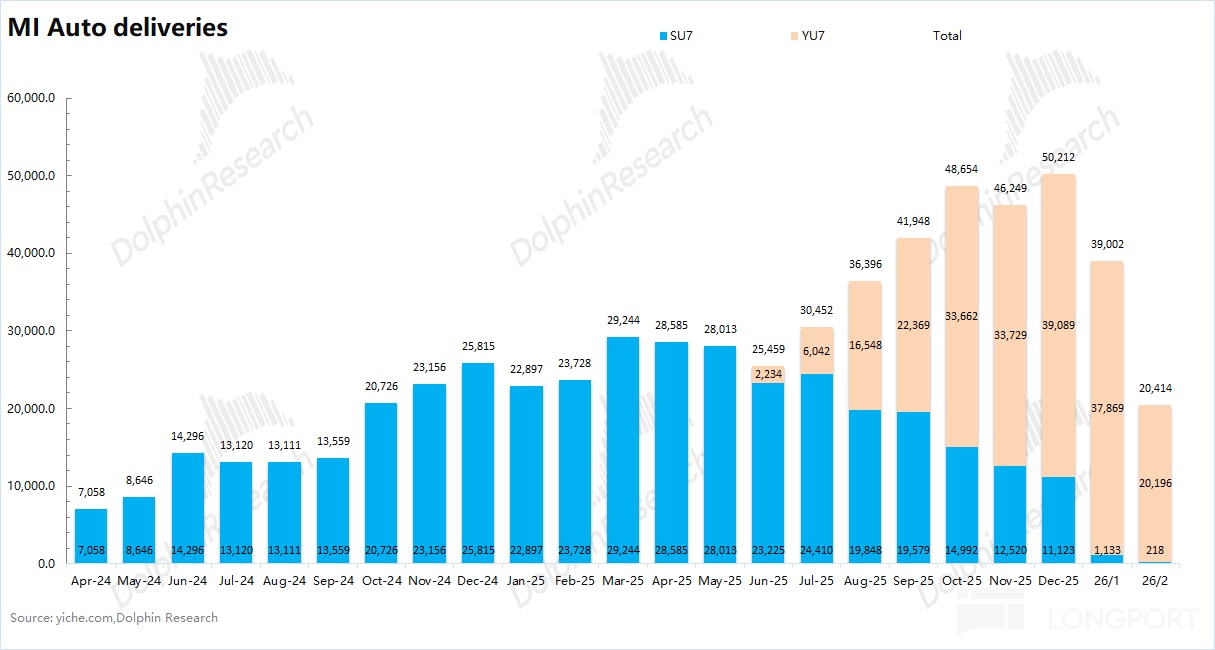
As we noted last quarter, weekly orders had slipped to 4–5k units then, implying fewer than 20k net new orders per month. Ahead of the new SU7 launch in early Mar, weekly orders fell to ~4k.
From another angle, YU7 delivery lead times on the website have shortened to ~10 weeks, near a normal wait time, indicating the backlog has been largely cleared. Supply-demand has flipped from undersupply to oversupply.
As for the latest SU7, the update is a mid-cycle refresh with limited exterior changes and modest hardware upgrades and price increases. With deliveries projected into May–Jun on the website, it is not shaping up as a blockbuster.
For 2026, the company still targets 550k auto sales. With YU7 weekly orders down to low-thousands and a lukewarm response to the refreshed SU7, hitting the target will require more compelling models, potentially the much-anticipated range-extended version.
b) Legacy (Smartphones x AIoT): dual headwinds from tighter subsidies and memory inflation.
(i) Smartphones: shipments and margins both fell sharply this quarter, driven by fiercer competition and higher memory costs.
Apple's iPhone 17 family adopted a spec bump at the same price, pushing Apple shipments in China up 20% YoY (market -0.8% YoY), while Xiaomi's China shipments dropped 18% YoY.
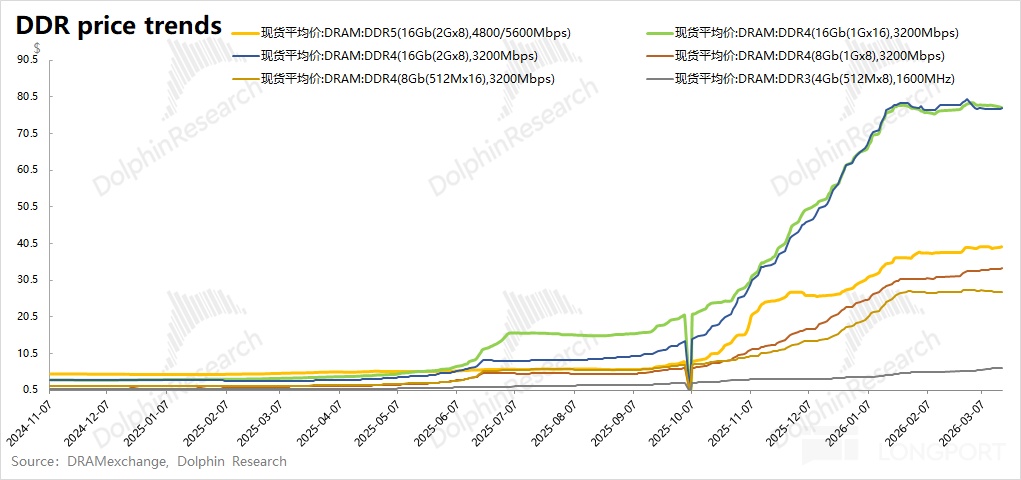
Separately, the jump in memory prices directly squeezed Xiaomi's cost structure. Per Qualcomm management commentary, 'price hikes' have escalated into 'shortages', which will directly affect handset shipments.
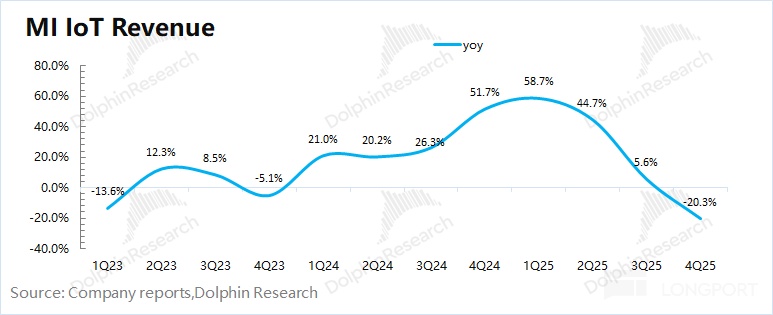
(ii) IoT: tighter state subsidies directly hit performance, with IoT down 20% YoY this quarter.
In H2 2025, many localities shifted to voucher grabs or lotteries, effectively tightening subsidies. Big appliances enjoyed subsidies of RMB 1–2k, and the tighter regime curbed end-demand, turning IoT from a growth driver into a drag.
In sum, legacy (smartphones and IoT) faces unavoidable headwinds, and memory inflation will keep margins under pressure. Only meaningful upside from new models can support earnings and the share price.
Under multiple pressures, the stock has continued to fall. At this stage, it is more important to triangulate a trough valuation.
Under a more bearish scenario (smartphone units -15% YoY and IoT down YoY), legacy revenue slips slightly, autos achieve the 550k target but with lower ASP and margins. We estimate 2026 legacy core after-tax OP at ~RMB 12.9bn (-46% YoY) and auto revenue at ~RMB 140bn (+32% YoY).
Using SOTP with 25x PE for legacy and 1.5x PS for autos (target shipments +34% YoY), we derive ~HK$600bn EV (HKD/CNY=0.88), or ~HK$23/share as a downside reference under a bearish case.
Given clear headwinds to legacy in 2026, if memory prices retreat, legacy earnings should recover and 2026 may prove trough-like.
Medium to long term, as hardware margins normalize, legacy core after-tax OP could return to ~RMB 20bn; at 20x PE (range 15–25x), that implies ~RMB 400bn for legacy. Adding autos at 1.5x 2026 PS implies ~HK$700bn (about HK$27/share). With some investors showing faith in Xiaomi, early positioning is possible.
Overall, Xiaomi faces multiple headwinds: memory inflation, tighter subsidies, intensified competition, and softer auto orders. But with the stock down from HK$60 to ~HK$30, factors like memory and subsidy tightening are partly priced in.
While a more bearish level sits near HK$23, potential catalysts such as new models and foundation models remain. Longer term, a safety margin may emerge below HK$25, contingent on memory stabilization and new model execution.
Below is Dolphin Research's detailed read of Xiaomi's results:
I. Overall results: autos are the main driver
With autos added, Xiaomi now reports in two buckets beyond 'Smartphones x AIoT': 'Autos and Innovation' and the legacy set.
Xiaomi's separate disclosure of 'Autos and Innovation' underscores the strategic focus. The prior break above HK$1tn market cap was also largely driven by auto expectations.
1.1 Revenue
Q4 2025 revenue was RMB 116.9bn, +7% YoY, in line with the street at RMB 116.6bn, with growth mainly from autos.
1) Legacy businesses — Smartphones x AIoT — delivered RMB 79.7bn, -13.7% YoY. Hardware was weak, with smartphones -13.6% YoY and IoT -20% YoY.
2) New businesses, including smart autos, delivered RMB 37.2bn, driven by higher YU7 shipments.
1.2 Gross margin
Group GPM was 20.8%, broadly in line with the 21% street view. Smartphone and IoT margins fell sharply, and auto margins also eased.
a) Legacy GPM was 20%, down 210bps QoQ, pressured by tighter subsidies and memory inflation; smartphone GPM fell to 8.3%.
Other legacy businesses posted a RMB 300mn GP loss, including air-con installation and related services. If allocated to IoT, IoT's 'true' GPM would be ~18.9%.
2) Autos and other new businesses posted 22.7% GPM, slightly below the 23% street view. Mix shift away from SU7 Ultra and sales of display/in-stock vehicles drove the decline QoQ
II. Autos: can they hit the 550k full-year target?
Auto revenue was RMB 36.3bn, plus peripherals to RMB 37.2bn, in line with the street at RMB 36.9bn.
Shipments of 145k were largely known, and ASP was RMB 250k, down RMB 10k QoQ, due to lower SU7 Ultra mix and sales of display/in-stock cars.
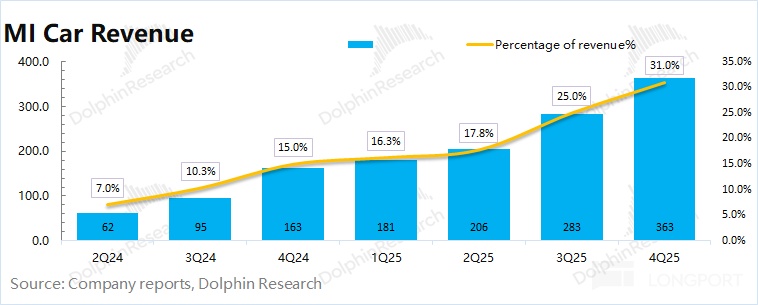
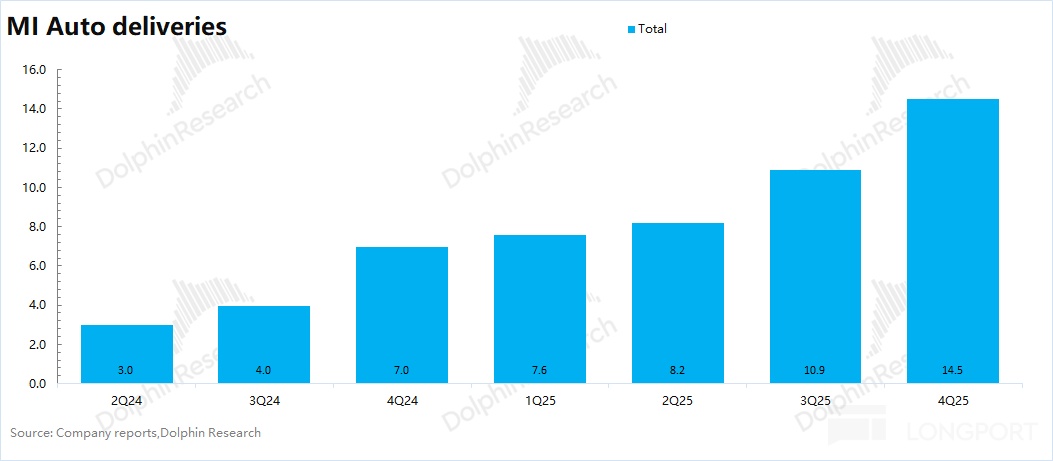
GPM was 22.7%, down 280bps QoQ. Lower SU7 Ultra mix and in-stock/display car sales weighed on ASP, and Phase II plant ramp added D&A, together driving margin pressure.
With shorter website lead times and shipment trends, the YU7 backlog has been largely cleared. The auto biz has shifted from undersupply to oversupply, so demand-side orders deserve closer watch.
Before the refreshed SU7 launch, weekly orders had fallen to ~4k, implying <20k per month. The current mid-cycle refresh shows delivery windows mostly in May–Jun, pointing to a lukewarm response.
Even so, management guided to 550k units for 2026. Based on current orders, this looks challenging and will likely require stronger new models, possibly a range-extended variant.
III. Smartphones: margin 'breakdown' and share losses
Q4 2025 smartphone revenue was RMB 44.3bn, -13.6% YoY, pressured by memory inflation, tighter subsidies and tougher competition.
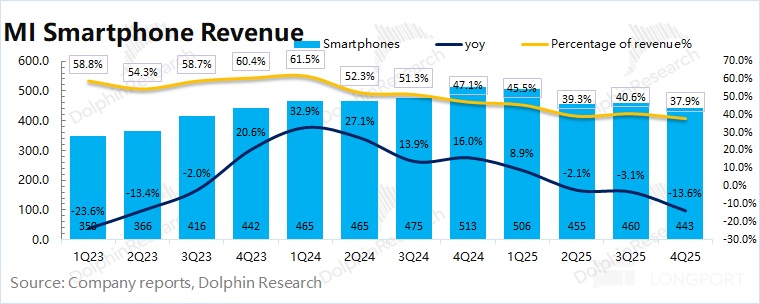
Dolphin Research splits the smartphone business into volume and price:
Volume: 37.7mn units, -11.7% YoY.
By market: (i) China share fell to 13.2% (down 2.8ppt YoY) amid tighter subsidies and intensifying competition; (ii) overseas shipments fell 8.8% YoY with share down 1.2ppt.
Price: blended ASP was RMB 1,176, -2.2% YoY, mainly on lower ASPs overseas.
Smartphone GPM was 8.3%, -280bps QoQ, reflecting weaker overseas ASPs, higher memory and other key component costs, and fiercer competition. With memory still rising, margins will stay under pressure.
IV. IoT: tighter subsidies turned it into a 'drag'
Q4 2025 IoT revenue was RMB 24.6bn, -20% YoY. Big appliances fell 40% QoQ amid tighter state subsidies, becoming a major drag on IoT.
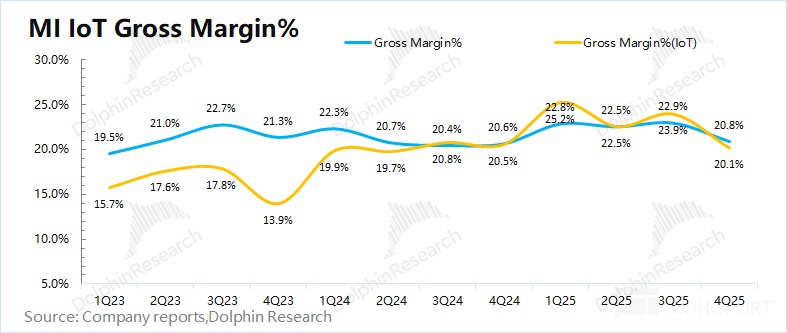
IoT GPM was 20.1%, -280bps QoQ, mainly on lower margins in China for smart big appliances.
V. Internet services: steady growth
Q4 2025 internet services revenue was RMB 9.9bn, +6% YoY, with ads the main driver this quarter:
a) Ads: RMB 7.8bn, +10.5% YoY. Core ad scenes are app distribution and pre-installs, effectively the distribution toll for most app publishers, with pre-installs being especially sticky.
b) Value-added: mainly game distribution, Youpin (e-commerce) and fintech. Revenue was ~RMB 2.1bn, roughly flat YoY, remaining stable.
Structurally, this business still relies on hardware shipments for scale. In the revised disclosure, Xiaomi classifies it broadly under Legacy. Only by combining hardware and software can a handset OEM continue to tell the internet monetization story.
VI. Overseas: software up, hardware still soft
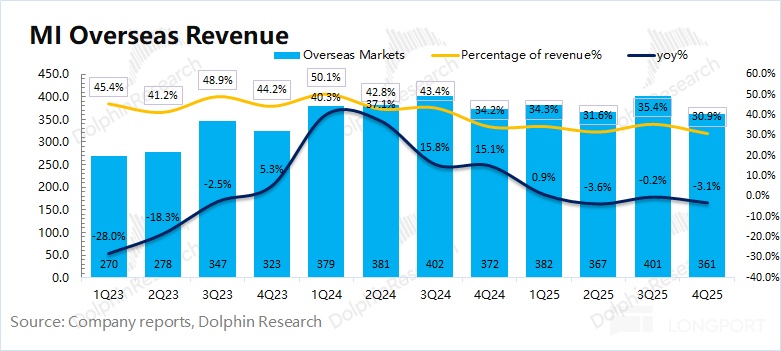
Q4 2025 overseas revenue was RMB 36.1bn, -3.1% YoY. With domestic autos growing, overseas now accounts for ~31% of revenue.
In detail, overseas internet revenue rose 18% to RMB 3.66bn, while overseas hardware fell 5% YoY for the third straight quarter, underscoring weak demand.
VII. Profit: legacy pressured; autos profitable
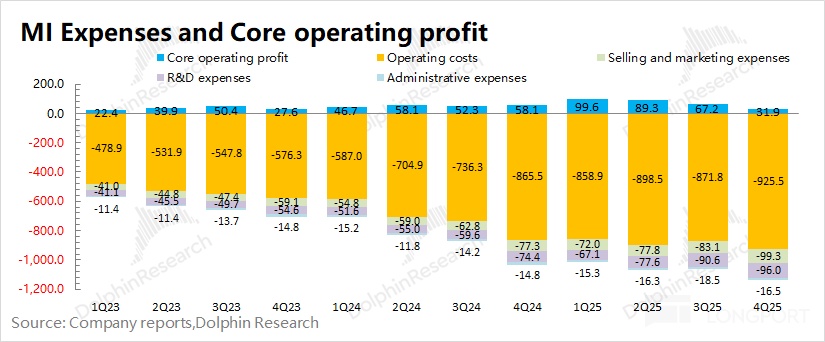
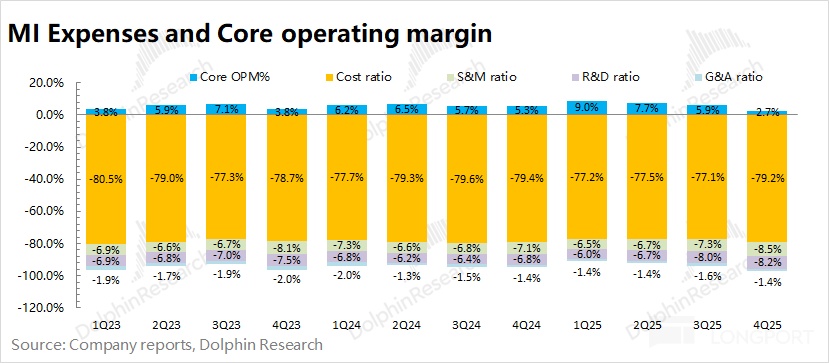
Q4 2025 opex was RMB 21.2bn, with opex ratio up to 18%. Part of the increase came from autos, where operating expenses rose to RMB 7.4bn.
Ex-autos, legacy opex was ~RMB 13.77bn, up YoY and QoQ. Legacy opex ratio rose to 17.3%, with R&D further increased.
Adj. net profit was RMB 6.3bn in Q4 2025, but Dolphin Research has long disagreed with Xiaomi's adjustment approach — financial income and investee dividends are not stripped out; even if sustainable, they are not core operations and do not reflect long-term earnings quality.
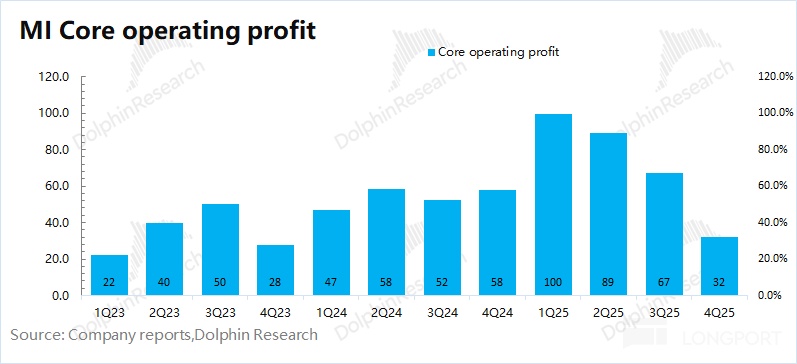
We focus on core OP (revenue - COGS - opex) as a better gauge of sustainable profitability.
Core OP was RMB 3.2bn, with a 2.7% core OPM, pressured by weaker hardware margins and higher opex. Specifically, legacy core OP was ~RMB 2.14bn, and autos ~RMB 1.05bn.
<End here>
Dolphin Research Xiaomi archive:
Product launches
Mar 20, 2026 SU7 refresh 'Xiaomi (Spring Event): SU7 gets a low-key refresh; MiMo free promo to climb the charts'
Sep 26, 2025 smartphone launch 'Xiaomi (with Trans): Fully taking on iPhone, spec bump at same price'
Jul 3, 2025 'Lei Jun roundtable: no low-price 'arms race'; targeting overseas in 2027'
Jun 26, 2025 YU7 launch 'Xiaomi Auto: YU7 bursts onto the scene — will it knock Tesla off the pedestal?'
May 22, 2025 YU7 teaser 'Xiaomi (Trans): 'Godfather of Domestic Brands' brings YU7 — is the 'foreign monk' Model Y in trouble?'
Earnings season
Nov 18, 2025 call 'Xiaomi (Trans): Memory inflation hits lower-ASP OEMs harder'
Nov 18, 2025 earnings take 'Xiaomi: with subsidies fading, can autos carry the banner?'
Aug 19, 2025 call 'Xiaomi (Trans): Smartphone target cut to 175mn, no auto price war'
Aug 19, 2025 earnings take 'Xiaomi: smartphones face another 'cold snap'; autos to the rescue?'
May 27, 2025 call 'Xiaomi (Trans): Full-year smartphone target stays at 180mn'
May 27, 2025 earnings take 'Xiaomi: one hand on autos, one on subsidies — time to win big?'
Mar 18, 2025 call 'Xiaomi (Trans): Smartphone goal 200mn; no strict profit target for autos'
Mar 18, 2025 earnings take 'Xiaomi: 'strongest ever' — as good as billed?'






The copyright of this article belongs to the original author/organization.
The views expressed herein are solely those of the author and do not reflect the stance of the platform. The content is intended for investment reference purposes only and shall not be considered as investment advice. Please contact us if you have any questions or suggestions regarding the content services provided by the platform.