D
Mar 24 at 10:22 AM
HSAI (4Q25 Trans): 2026 shipment guidance raised to 3.0–3.5 mn units---
Dolphin Research compiled the following transcript of $Hesai(HSAI.US)'s FY2025 earnings call. For our earnings take, see: Hesai: Afraid of ASP collapse? The 'Tesla castoff' wins on volume.
I. Key financial takeaways
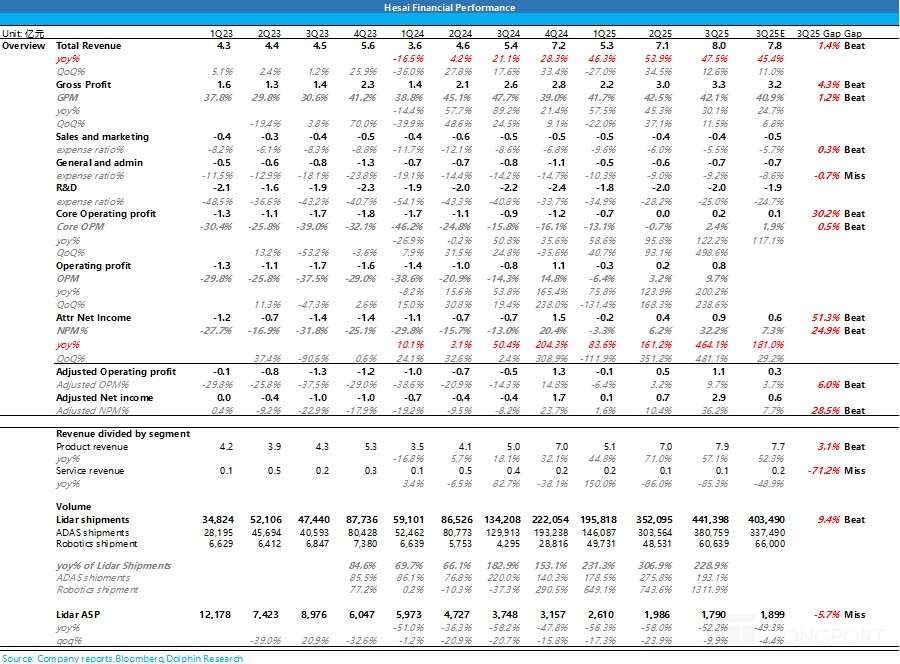
1. Profitability milestone: GAAP net income of RMB 436 mn for the year, making it the first lidar company globally to deliver full-year GAAP profitability. It posted three consecutive quarters of GAAP profit and five straight quarters of non-GAAP profit. Non-GAAP net income reached RMB 551 mn for the full year.
2. Outlook: Q1 2026 revenue guided to RMB 650–700 mn (+24%–33% YoY), with 400k–450k units shipped (incl. ~100k robot lidars). Full-year 2026 shipment guidance was raised to 3.0–3.5 mn units, with both ADAS and robot lidars expected to roughly double YoY. To comply with HK listing rules, the company will no longer provide full-year net income guidance, but remains confident in revenue, shipments and profit growth.
3. Key financial metrics: Full-year revenue exceeded RMB 3 bn (+46% YoY), a record high. Total shipments topped 1.6 mn units, up more than 3x YoY. GPM stayed above 40%. Operating expenses (ex other operating income) fell by RMB 88 mn YoY. Operating cash flow was RMB 117 mn, the third straight year of positive OCF, with net assets of ~RMB 9 bn.
4. Capital markets: Completed a US$614 mn dual-primary listing in HK, further strengthening the balance sheet.
II. Earnings call details
2.1 Management highlights
1. ADAS
a. Flagship ATX underpinned a leading >40% share in long-range in-vehicle lidar in China, per Gasgoo data. This solidified leadership in the segment.
b. Cumulative ADAS lidar shipments surpassed 2 mn units. This essentially achieved the decade-old goal of bringing 3D perception to 1% of vehicles globally.
c. Secured 2,026 program awards, partnering with Li Auto, Xiaomi, BYD, Great Wall and Changan, mostly as sole supplier. Won ADAS orders from China’s Top 10 OEMs, covering 40 brands and 160+ models.
d. Lidar is now 100% standard on Li Auto and Xiaomi best-sellers, and broke into sub-RMB 100k price bands via Leapmotor. It is migrating from high-end option to mainstream safety standard.
e. The upgraded ATX integrates the in-house FMC 500 SoC (MCU+FPGA+ADC) with up to 256 channels. Backlog exceeds 6 mn units, with SOP expected from Apr 2026.
2. L3 autonomy
a. China’s L3 regulation is at an inflection, with cities like Beijing and Chongqing approving L3 on public roads. Liability shifts from driver to OEM, making ‘zero failure’ a hard requirement.
b. L3 systems need more lidars for broader coverage. The FTX blind-spot sensor enables 360° perception, while ETX ultra long-range lidar doubles ATX detection range.
c. ETX is slated to start SOP in 2026. Multi-lidar awards were secured with Li Auto, Xiaomi and Changan (3–6 lidars per car), with SOP plans in 2026–2027.
d. Under multi-lidar configs, lidar content per vehicle can reach US$500–1,000. This materially lifts per-vehicle value.
3. Robotics
a. According to industry trackers, Hesai ranks No.1 across key robot lidar subsegments, including humanoid/quadruped, Robotaxi, autonomous delivery and robotic lawn mowers. This leadership spans China and Intl markets.
b. JT series exceeded 200k units in its first mass-production year. Robot lidar shipments were nearly 240k units in 2025, and are expected to at least double in 2026.
c. JT128 was deployed on Unitree’s humanoids for a large synchronized dance on the 2026 Spring Festival Gala, with peak viewership of 400 mn. This showcased range and reliability.
d. Robotaxi: the world’s largest Robotaxi lidar supplier, partnering with China’s leaders such as Pony.ai, WeRide, BIDU Apollo Go and Didi. Supply agreements are also signed with top AV players in N. America, Asia and Europe, with 5–10 lidars per vehicle.
e. Autonomous delivery: moving from closed campuses to complex urban roads, with the market expected to scale from tens of thousands to hundreds of thousands of units in 2026. Each vehicle uses 2–6 lidars, and Hesai is a core, often exclusive, supplier to global leaders.
f. Robotic lawn mowers: ~20 mn units sold globally per year, but lidar penetration is only 1–2%. Hesai signed milestone exclusive deals for 10 mn JT lidars with Dreame and MOVA.
g. New verticals: won an FTX lidar award for the next-gen two-wheeler at Sunra. China’s two-wheeler market sells over 60 mn units annually, representing a sizable TAM.
4. Intl
a. Formed a strategic partnership with Grab, which became Hesai’s exclusive regional distributor in SE Asia. This provides a scaled go-to-market channel.
b. Selected as a key lidar partner for NVIDIA DRIVE HYPERION 10, shifting from OEM-by-OEM expansion to a turnkey, scalable solution. This becomes a default gold standard for OEMs building autonomy on NVIDIA’s platform.
c. An exclusive multi-year award with a top European OEM is progressing well. Sample deliveries are on schedule.
d. Achieved a unified high-performance lidar architecture for China and global markets (ET series as a typical example). A single platform now scales globally.
e. Hesai is the only Asian lidar maker certified under Germany’s VDA 6.3 process audit. This underscores its manufacturing excellence.
5. New products/second growth curve
a. Two breakthrough products will launch in the coming months: the ‘eyes’ of physical AI (perception and situational awareness) and the ‘muscles’ (precision motion control). Each targets a trillion-RMB TAM.
b. Revenue contribution could begin in 2026. In five years, this may match or surpass the current lidar biz, and potentially 10x again over ten years.
c. ‘Eyes’ builds on world-class software and algorithm capabilities (winner at the SIGGRAPH challenge in Sep 2025). ‘Muscles’ extends core strengths in materials, simulation, design and precision manufacturing.
2.2 Q&A
Q: How do you see the outlook for Robotaxi, autonomous delivery and humanoid robots in 2026 and beyond?
A: As Jensen Huang noted at CES, 2026 is the ChatGPT moment for physical AI. Our lidars deliver sub-centimeter spatial accuracy, forming a crucial bridge between the carbon-based world and silicon-based intelligence. With this structural shift, our robotics biz is firing on all cylinders, and industry trackers show Hesai ranks No.1 across major robot lidar segments.
For humanoid and quadruped robots, we view this as a major long-term opportunity. Accurate perception and action are essential; lidar is a standard component for localization, navigation and obstacle avoidance. We currently rank No.1 in this niche, with orders from Unitree, Galbot, MagicLab and Zhipu Power, among others. We expect shipments to reach tens of thousands in 2026, and JT128 was chosen for the 2026 Spring Gala performance due to range and reliability.
In Robotaxi, Hesai is the largest lidar supplier globally. Our primary and blind-spot lidars are widely deployed by China’s leaders, and we have supply agreements with top AV companies across N. America, Asia and Europe. This essentially covers all key global players, a key differentiator. With 5–10 lidars per vehicle and large-scale deployments accelerating, we see exponential revenue potential.
In autonomous delivery, the sector is transitioning beyond closed parks to complex urban roads. With supportive policies and proven models, the market could grow from tens of thousands to hundreds of thousands of units in 2026. Each vehicle carries 2–6 lidars, and Hesai serves as a core, often exclusive, supplier to leading players.
For robotic lawn mowers, global annual sales are ~20 mn units, but lidar penetration is only 1–2%, implying a sizable runway. Since launching the JT 3D lidar series in 2025, cumulative deliveries exceeded 200k units. We recently signed milestone exclusive orders for 10 mn JT lidars with Dreame and MOVA.
Overall, robotics applications generally carry higher ASPs and margins than ADAS. We shipped nearly 240k robot lidars in 2025 and are confident this will at least double in 2026. Longer term, the robotics TAM could be multiple times that of ADAS — you can drive only one car, but you might have 10 robots working around you.
Q: A Hesai co-founder also invests in a robotics company. How do you define the relationship and collaboration opportunities, and what synergies might emerge in tech and supply chain?
A: Structurally, these are two fully independent entities with no equity subordination or operating control. The co-founder acts as a key shareholder and strategic advisor at that company, with no day-to-day executive role. Our full-time roles are CEO, CTO and Chief Scientist at Hesai, with full focus on Hesai. The other company has its own mature and independent team.
Looking ahead, we are open to strategic, commercially sensible collaboration that creates win-win dynamics. For example, as a robotics company, it could adopt Hesai products, while Hesai may deploy humanoids on automated lines as a hardware innovator. Its AI progress can broaden the founders’ and Hesai team’s perspective, potentially informing our long-term roadmap. Any cooperation would be on fair, market-based terms to maximize long-term value for Hesai shareholders.
Based on preliminary estimates of the humanoid market and Hesai’s growth, any such collaboration would represent only a small portion of our biz. We will remain focused on core strategy: consolidating lidar leadership, advancing next-gen ‘eyes’ and ‘muscles,’ and driving sustainable long-term growth.
Q: What are Q1 revenue and shipment guides? With OP margin improving QoQ for four quarters, how do you view Q1 and full-year GPM and OPM?
A: For Q1, we guide revenue of RMB 650–700 mn (+24%–33% YoY), with 400k–450k lidar units shipped, including ~100k for robotics. We have posted three consecutive GAAP-profitable quarters and five on a non-GAAP basis, and expect to sustain momentum. Given typical auto seasonality and holidays, Q1 shipments will decline QoQ from the Q4 peak, consistent with history. That said, 2026 demand is strong, and we expect revenue and shipments to build sequentially through the year.
For 2026 overall, lidar demand is robust across passenger vehicles and robotics, and we expect meaningful revenue growth. Shipment guidance is raised to a record 3.0–3.5 mn units, with both ADAS and robot lidars roughly doubling YoY.
On ASP, we advise not to over-emphasize blended ASP, as declines are mix-driven. ADAS lidars, which carry lower ASPs than robotics, are growing as a share, and within L3, FTX blind-spot sensors, priced below long-range ATX, are increasing. AT, FT and JT series typically price in the low hundreds of dollars.
While ADAS products follow the usual annual price-down cadence at large OEMs, ATX is expected to be ~US$150 in 2026, near its optimized cost structure. Further declines should narrow from here. Over time, multi-lidar configs, higher-priced L3 products like ETX, and Intl expansion will provide structural offsets.
On margins, we are highly optimistic on revenue and profit resilience with several catalysts in 2026–2027. First, lidar is moving from optional to standard and continues to penetrate models priced above RMB 100k. Second, L3 deployments lift per-vehicle lidar value to US$500–1,000. Third, overseas ADAS projects should start contributing in 2026, and Intl ASPs are typically higher. Fourth, robotics continues to grow with higher ASPs and margins than ADAS. Fifth, the new ‘eyes’ and ‘muscles’ products will be new growth engines. With ongoing in-house chip efforts (FMC 500 SoC) and supply chain/manufacturing cost optimization, we expect GPM to remain resilient in 2026.
Q: Will you provide full-year 2026 net income guidance?
A: Given differences between U.S. and HK market disclosure regimes — and our recent HK listing — we will not provide specific full-year net income guidance to align with best practices for dual-listed companies. This change does not signal any lack of confidence. With a strengthened customer base, established industry leadership and disciplined cost structure, we are confident in growth for revenue, shipments and profit in 2026. We also encourage investors to track our new initiatives, where we are investing strategically to build a second growth engine.
Q: What is the overall roadmap for new products (non-auto, non-lidar)? Can you share timelines and progress?
A: Our mission has always been ‘Enable Robots, Elevate Life,’ and we never defined ourselves as a pure lidar company. We believe 2026 is the ChatGPT moment for physical AI, when AI truly understands physical-world rules and interaction, catalyzing robot applications. The revolution is accelerating, but critical building blocks remain early — perception, motion control, AI decision integration and system orchestration. These gaps represent significant opportunities, and Hesai is repositioning as a key enabler of physical AI.
We will launch two breakthrough products in the coming months, each targeting a trillion-RMB market. The ‘eyes’ will push perception and situational awareness beyond current limits, while the ‘muscles’ will deliver precise, powerful motion control for robots and autonomous systems.
Financially, we expect revenue contribution starting in 2026. Within five years, the biz could match or exceed today’s lidar scale, and potentially 10x again over the next decade.
The ‘muscles’ advantage stems from a decade of work in materials, simulation, design and precision manufacturing, leveraging in-house chips, captive lines and rigorous quality systems to deliver reliability, scalability and peak performance. The ‘eyes’ advantage comes from world-class software and algorithms tightly integrated with hardware. Our years of 3D reconstruction research won at the SIGGRAPH challenge in Sep 2025, and we look forward to embedding these algorithms into upcoming hardware.
Q: How will the NVIDIA partnership progress, and what differentiates Hesai in this collaboration?
A: NVIDIA’s platform is not just hardware; it is a full-stack solution spanning hardware, software and data, and Hesai was selected as the lidar partner. This makes customer adoption much easier, even though final supplier choice rests with NVIDIA’s clients. Sensor-plus-compute is already a validated system, and selecting a non-listed supplier complicates validation. More importantly, model training, data collection and system validation are massive undertakings, and NVIDIA’s full-stack for OEMs and robot companies requires large datasets accumulated with Hesai lidars over years. Switching lidars would challenge compatibility with trained models and data — not impossible, but highly inefficient. Hence our excitement and honor to collaborate here. We are working closely with NVIDIA to promote a unified solution globally, certify across regions and accelerate both existing and new programs. The smartest path is not mixing components, but scaling a proven solution across customers, and we believe NVIDIA shares that vision.
Q: How do you view the ASP downtrend, and what are the levers to further reduce cost?
A: We caution against fixating on blended ASP, as declines are mix-driven. ADAS share is rising, and within L3, FTX blind-spot sensors gain share vs. long-range ATX — this is mix, not price erosion. ADAS follows the typical annual auto price-down. For example, ATX is expected at ~US$150 in 2026, near optimized cost; future declines should narrow. Longer term, multi-lidar per car, higher-priced L3 products like ETX, and overseas expansion provide structural offsets.
There are three clear and sustainable cost-down levers. First, scale: shipments rose 3x to 1.6 mn units in 2025, with 2026 guided at 3.0–3.5 mn, which spreads fixed costs and strengthens supplier bargaining power. Second, in-house chips structurally reduce BOM — 100% self-developed core modules, with FMC 500 SoC integrating MCU, FPGA and ADC into a single die to replace costly discretes, cutting cost while boosting performance; in-house PD integration is expected to scale in 2026 to further optimize cost. Third, highly automated captive manufacturing — standardizing core architectures and continuously improving yields compounds benefits. We expect to maintain healthy margins going forward.
Q: What is the outlook for operating expenses in 2026?
A: We are pleased with our expense management. In 2025, despite strong revenue growth, Opex fell by RMB 88 mn, reflecting strong operating leverage and disciplined cost control. A key driver is deep AI integration in our workflows — we believe any company not fully embracing AI in 2026 will be left behind. We will keep leveraging AI to raise efficiency, reinvent processes and improve profitability, with measurable savings of tens of millions of RMB already and a meaningful uplift in product capability.
Into 2026, we expect total Opex to rise by mid-teen percent YoY, mainly due to ~RMB 200 mn of investment in the new ‘eyes’ and ‘muscles’ products. Ex these new initiatives, Opex should be flat to down single digits YoY, demonstrating discipline and AI-driven productivity.
Login to unlock16,982characters for free
This content is only available to signed-in users. Sign in to your Longbridge account to read the full post.