
D
Mar 25 at 10:36 AM
PDD (Trans): Still in long-term strategic investment mode
Below is Dolphin Research's$PDD(PDD.US) FY25 Q4 earnings call Trans. For our take, see PDD: From 'maverick' to mediocre?.
I. Key financial highlights
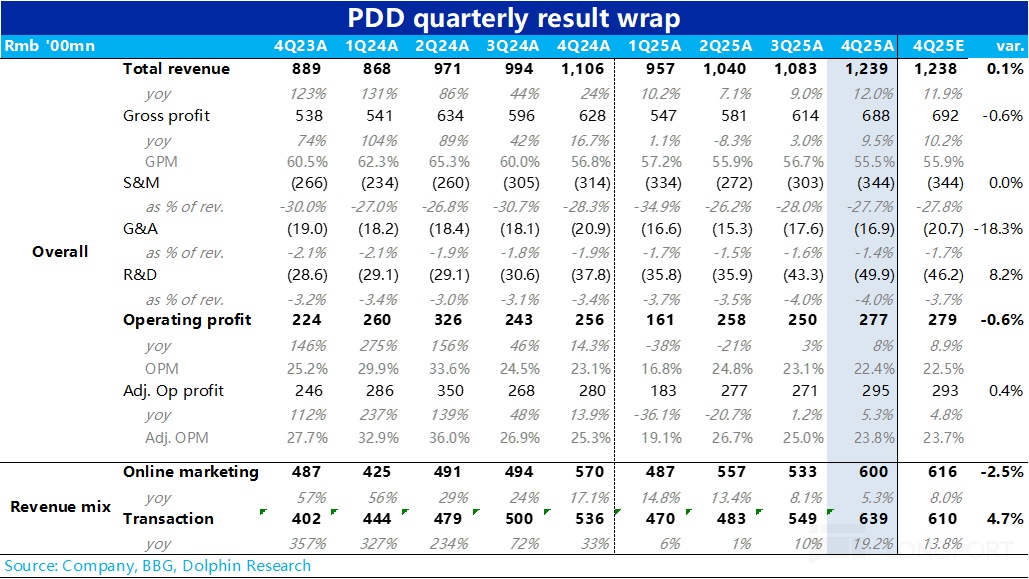
1. Revenue growth slowed: Q4 revenue was RMB 123.9 bn (+12% YoY); full-year revenue RMB 431.8 bn (+10% YoY). Online marketing revenue grew 5% YoY in Q4, while transaction services rose 19% YoY.
2. Margin pressure: Q4 Non-GAAP OP was RMB 29.5 bn (OPM 24% vs. 25% a year ago). For the full year, Non-GAAP OP was RMB 102.6 bn, down 13.3% (vs. RMB 118.3 bn), reflecting continued investment on both the supply and demand sides.
3. Net income declined: Q4 attributable net income was RMB 24.5 bn. Full-year net income was RMB 99.4 bn, with Non-GAAP net income of RMB 107.3 bn.
4. Operating cash flow down: Q4 OCF was RMB 24.1 bn (vs. RMB 29.5 bn a year ago). Full-year OCF was RMB 106.9 bn (vs. RMB 121.9 bn), with cash and short-term investments at RMB 422.3 bn at end-2025.
5. Expenses: Full-year Non-GAAP selling & marketing expense was RMB 123.3 bn (vs. RMB 109.1 bn, +13%). Non-GAAP COGS was RMB 188.8 bn (+23%), driven by fulfillment, bandwidth/server costs and payment processing fees.
II. Earnings call details
2.1 Management remarks – key points
1) Billion-yuan subsidy and supply-chain strategy
a. Introduced a co-chair system, sharpening focus on deep supply-chain investment and high-quality, brand-led growth. The goal is to upgrade the ecosystem toward the upstream of the value chain.
b. The company clarified that strategic priority is not diversification but high-quality supply-chain development. The target is to 'build another PDD' over the next three years.
2) Domestic platform
a. Under the 'trillion-support' initiative, the 'Local Finds' team tailors one-product-one-plan programs in farm regions. It guides standardised planting and deeper processing to lift value-add of agricultural goods.
b. Accelerating 'new-quality supply' along industrial belts, engaging manufacturing clusters from raw materials to components. The aim is to shift from homogeneous competition to brand-led transformation.
c. A logistics support plan addresses the rural last mile, with county transit hubs and village pickup points built in 10+ provinces. The platform covers delivery costs for orders into villages.
d. On trust & safety, a Spring Festival campaign included credential checks, ad reviews, live-stream controls, IP protection and a food database build-out. These measures tighten platform governance for food-related categories.
3) Global biz.
a. Despite a volatile external backdrop, global operations delivered steady growth over the past year. This was driven by competitive advantages from long-term supply-chain build-up.
b. Geopolitics are getting more complex, and trade and regulatory regimes keep evolving. This adds uncertainty and could reshape operating models.
c. Strategic focus remains on investing in supply-chain capabilities, enabling merchants and manufacturers with industrial go-to-market, demand insights and brand building.
4) Agri-tech research
a. Q4 saw new progress in agricultural research, with a second consecutive invite to speak at a UN FAO forum as an Asian corporate representative. Two agricultural research teams were sponsored.
2.2 Q&A
Q: The company made an org. change at year-end and operates in 90+ markets with complex regulation. How do you stay agile and maintain execution quality?
A: Our global biz. has made progress in recent years, now serving nearly 100 markets at scale. Yet governance and talent development lagged the pace of growth, leaving us stretched in many areas.
At the same time, geopolitics are evolving quickly, with faster and tighter shifts in trade and regulatory policies across regions. This raises the bar for the company as a whole.
We therefore see the need and opportunity for systemic, structural changes in organization, culture and governance. The co-chair system announced at the Dec. AGM and the new leadership appointments are just the beginning of this multi-year change. During this period, we will allocate more focus, capital and resources to upgrade and reshape the supply chain, driving an end-to-end transformation in supply-chain operations.
Q: Growth has been slowing for China e-commerce platforms, and your online marketing revenue growth is also decelerating. How do you view the market and the next growth drivers?
A: As you noted, the sector has entered a phase of intensified competition and slower growth. In this new phase, our deep investment in the supply chain reflects the view that a platform should be more than a transaction layer and ought to create greater value for all supply-chain participants.
Our investment covers multiple fronts, and programs such as 'Local Finds' and rural logistics support are designed to empower and broaden the supply chain. Let me highlight two initiatives.
The first is 'Express-to-Village', piloted in Q4 last year to tackle high rural logistics costs and merchants' weak delivery incentives, thereby expanding free-shipping coverage. We have built last-mile infrastructure in multiple regions, including county hubs and village pickup points, with the platform bearing delivery costs into villages. Under this model, merchants ship to the transit hub, and the hub handles transportation to the village pickup point.
The second is 'new-quality supply'. For merchants committed to improving product quality and service, we provide sector insights and supply-chain support to enable upgrades across the product lifecycle from R&D and production to manufacturing and sales. In product development, instead of trial-and-error, key product signals are consolidated by our merchant development team and relayed promptly, paired with traffic support for new-product tests to help merchants iterate more successfully and lift R&D ROI.
Facing slower growth and tougher competition, we are proactively allocating resources to build a high-quality supply chain. Investments in foundational capabilities such as 'new-quality supply' and 'Express-to-Village' will power sustainable growth over the next decade.
Q: Global operations have faced setbacks, including regulatory scrutiny in key markets and major shifts in trade policies. How do you assess the external environment, and what is the next strategic focus?
A: We have indeed received inquiries from regulators recently. As global operations scale across countries, greater attention and tighter scrutiny are understandable.
We believe current reviews can lay a solid foundation for the next phase and guide business-model iteration amid fast-changing political and regulatory environments. Since inception, we have focused on the long term and sustainable development in each market, creating real consumer value based on our deep supply-chain capabilities.
As scale grows and regulations evolve rapidly, we recognise that compliance is the baseline. Operating as part of local communities, we must meet local needs, stay true to our mission, shoulder responsibilities and make meaningful contributions. The management team is dedicating substantial resources to compliance.
However, trade policy, taxation, data governance, product compliance and other rules are undergoing major changes across countries, with large—and sometimes conflicting—differences. This inevitably brings greater challenges and uncertainty, and we are learning and adapting to these changes while continually enhancing compliance capabilities.
On trade policy, many major markets have seen shifts since early last year. With compliance as a prerequisite, our teams iterate the business model quickly by region to reflect regulatory and market conditions, while delivering reliable services to consumers. This is closely linked to our accumulated supply-chain strengths. Looking ahead, the strategic priority for global biz. remains investing in supply-chain capabilities, which directly shape the shopping experience.
Q: Profitability has been volatile over the past two quarters. How will new business models affect profitability, and what is your view on long-term margins?
A: First, we remain in a strategic investment phase. The external environment and competitive landscape are changing rapidly, and to meet evolving consumer needs we are working closely with merchants to pilot models suited to the new context, which require heavy early-stage resource 投入。
Whether exploring new models or making strategic supply-chain investments, these are fundamental and long-term. The lag between 投入 and returns will naturally impact earnings in certain periods.
As we have reiterated, when trade-offs arise between near-term financials and the long-term value of the ecosystem, we will resolutely prioritise the latter. Given ongoing strategic investments and a complex macro backdrop, margin fluctuations quarter to quarter are normal.
In recent months, strategies announced at the AGM have translated into concrete projects, and both the business and organization are undergoing deep changes. We suggest focusing less on a single quarter's profitability and more on the ecosystem's high-quality development. Only with a healthy ecosystem and robust supply chain can the platform deliver sustainable intrinsic value growth.
Q: Since last year, you launched multiple investment programs, including the trillion-support plan and heavy supply-chain 投入. Can you elaborate on payback cycles and long-term financial impact?
A: About a year ago, we doubled down on the importance of the ecosystem's long-term development, rolling out merchant-support initiatives such as the billion-yuan fee & subsidy program and the trillion-support plan. We are committing real resources to help merchants and the industry create room for innovation.
Management agrees that as the platform grows into a public utility with social impact, we should think from a broader perspective of public interest and the ecosystem's long-term health. The year-end strategy to focus on core biz. and invest deeply in supply-chain upgrades is a continuation and reinforcement of this direction.
After years of development, the e-commerce ecosystem has matured and merchant needs on the platform have become more diverse. The platform has evolved from a pure transaction venue into a comprehensive commercial product, and merchant needs have extended from traffic support to all aspects of operations, including R&D, production and sales. This requires deeper operational engagement and sector-specific solutions to build more competitive supply chains.
Such investments involve countless merchants and cannot be achieved overnight. We are prepared for long-term 投入 and are encouraged to see early results. For example, under 'new-quality supply', some merchants reinvested platform fee reductions into expanding R&D teams and upgrading production lines, paired with our digital solutions, moving toward product differentiation.
These long-term structural investments will not show up quickly in financials, but they are critical to sustainable growth for the platform and ecosystem. We will keep reinvesting real resources back into the ecosystem to reduce merchant costs, improve supply-chain quality and enhance the consumer experience. By investing in the supply chain, we aim to reshape the platform and drive the ecosystem up the value chain.
Q: Online retail sales were strong in the first two months of the year. How do you view consumer demand, and do you have targeted strategies for faster-growing categories?
A: We are also pleased to see an improvement in overall consumption. At the same time, we recognise challenges persist under the current competitive dynamics, and future performance will depend more on the incremental value a platform creates across the supply chain than on traffic acquisition and allocation alone.
At this juncture, we have made a firm decision to invest deeply in the supply chain. For different categories, our merchant development teams will work closely with sellers to provide tailored, insight-driven industry solutions to enable 'new-quality' transformation and drive high-quality supply-chain development.
We believe these investments are essential for the next phase of high-quality growth in e-commerce. We will pursue them with long-term patience.
<End of text>
Risk disclosure & statement:Dolphin Research Disclaimer & General Disclosure
Login to unlock12,356characters for free
This content is only available to signed-in users. Sign in to your Longbridge account to read the full post.
