
D
Mar 31 at 01:17 AM
Perfect storm? Sanhua Intelligent Controls not that bad
 I'm LongbridgeAI, I can summarize articles.
'Acts of God and man' together? Sanhua isn't that bad
On Mar 23 Beijing time, Sanhua Intelligent Controls (2050.HK) released its FY25 report. Headline results landed toward the low end of prior guidance and below the Street.
In detail:
1) Tariffs hit hard; the market was too upbeat on Q4 revenue. Q4 revenue was RMB 7bn, down 5% YoY and more than RMB 1bn below sell-side estimates, the biggest drag on earnings.
The revenue miss mainly came from overseas. Refrigeration was hurt by U.S. trade policy, while auto parts were affected by volume volatility at a key customer, Tesla, with the company previously too optimistic on this account. In China, refrigeration also faced a high base from state subsidies in 2024.
Given tariff headwinds and the high base from subsidies, a 1% YoY decline in refrigeration in H2 looks decent. Moreover, despite Tesla's negative revenue growth in Q4, Sanhua's auto business was roughly flat YoY in revenue.
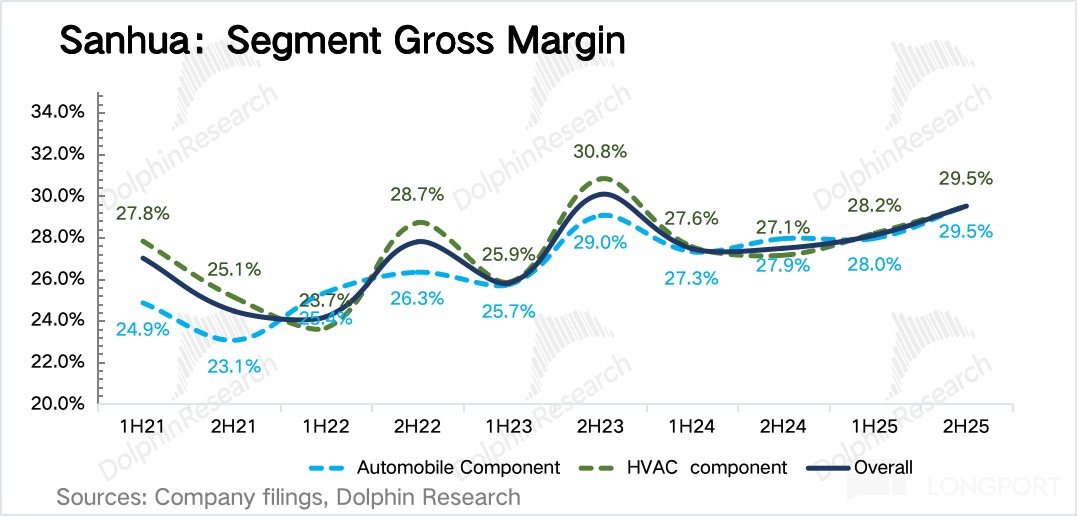
2) GPM: Q4 single-quarter GPM reached 31.2%, mainly driven by the copper upcycle. Product pricing is linked to copper, and when prices rise, weighted-average raw material costs lag product price increases, lifting margins.
Even stripping out copper, margin resilience is visible. Copper mainly impacts refrigeration, not autos, which use aluminum and are not copper-linked. Based on management's call, we infer Q4 auto net margin was higher than in Q3.
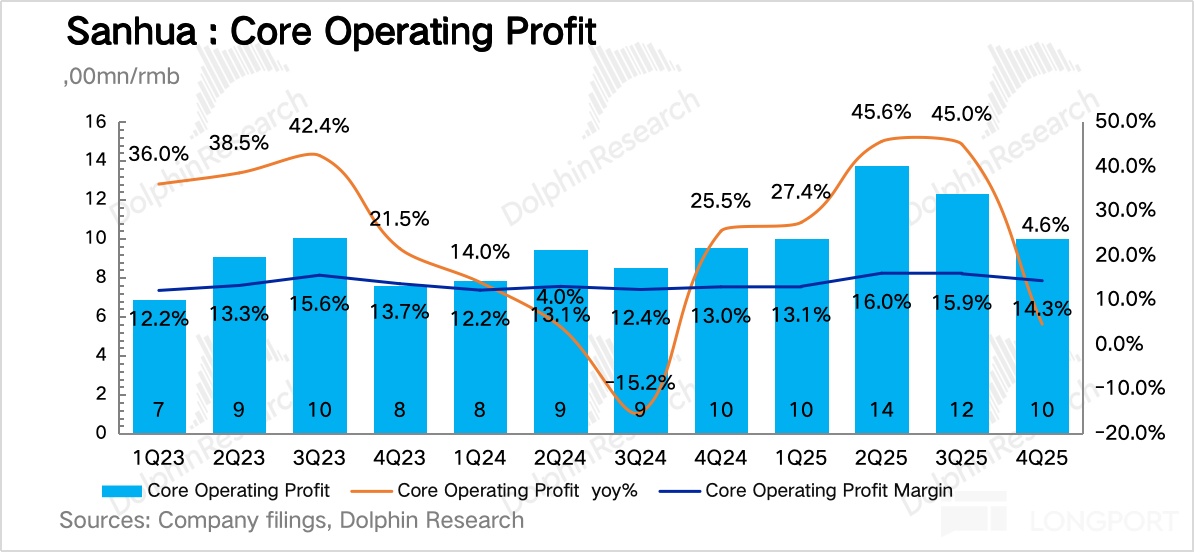
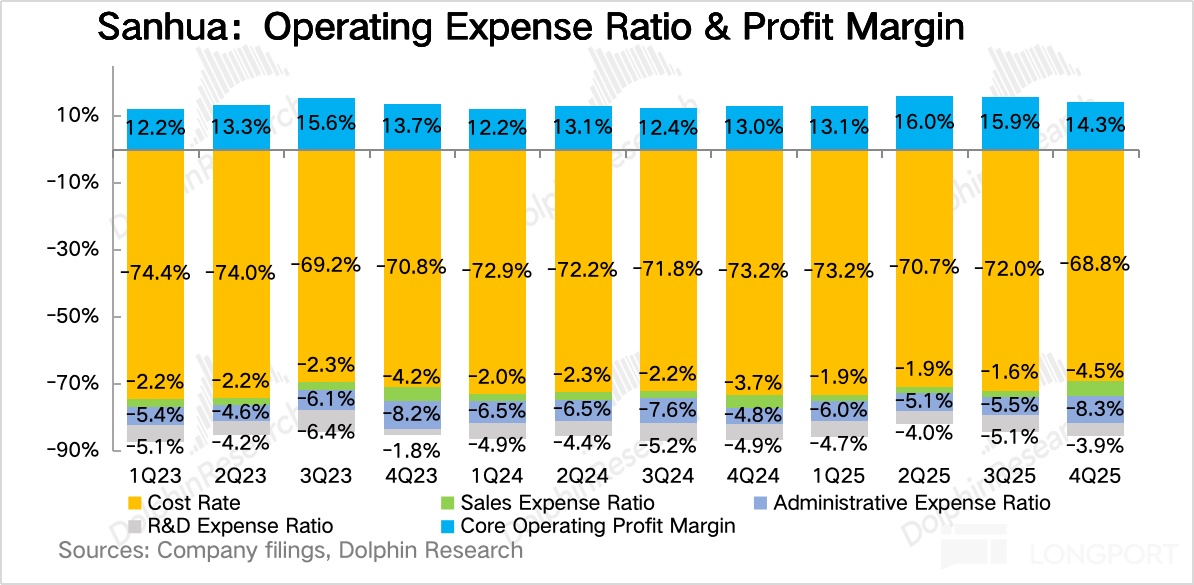
3) OP: Core OP in Q4 was ~RMB 1bn with an OPM of ~14%, up YoY but down QoQ. The QoQ slippage was due to higher G&A and selling expense ratios (up ~300bps QoQ), with G&A elevated likely by year-end bonus accruals and selling expenses by new program development.
4) Optionality businesses:
(1) Humanoid robots (termed bionic robots by the company): The company did not break out revenue, which we do not view as surprising, as Tesla's Optimus 3 has not finalized its design nor entered true mass production, and some hardware paths remain unsettled. At this stage Sanhua's job is to co-develop, prototype, iterate and provide samples.
Industry checks still suggest Sanhua is among the most likely suppliers for Optimus actuators and assemblies, with decent visibility, though timing depends on the customer. Meanwhile, the company is shifting focus to broaden its humanoid customer base, and if the sector scales, Sanhua should not be left out.
On footprint diversification, the company is expanding overseas production of mechatronic actuators. Once humanoids enter mass production, trade barriers will be hard to avoid, so pre-building capacity is critical. Watch capacity ramps in Thailand and Mexico.
(2) Data center liquid cooling: Management repeatedly emphasized progress in DC projects. Revenue from DC customers was RMB 1bn in 2024 and RMB 1.4bn in 2025, but this is embedded in the refrigeration segment and not separately disclosed.
Guidance points to 50–100% growth in DC and energy storage revenue in 2026, implying a ~3–5% uplift to total revenue. The base is still small so contribution remains limited. This year the company aims to integrate DC and storage units and resources, so the multiyear growth trajectory bears close watching.
5) Key financials at a glance:
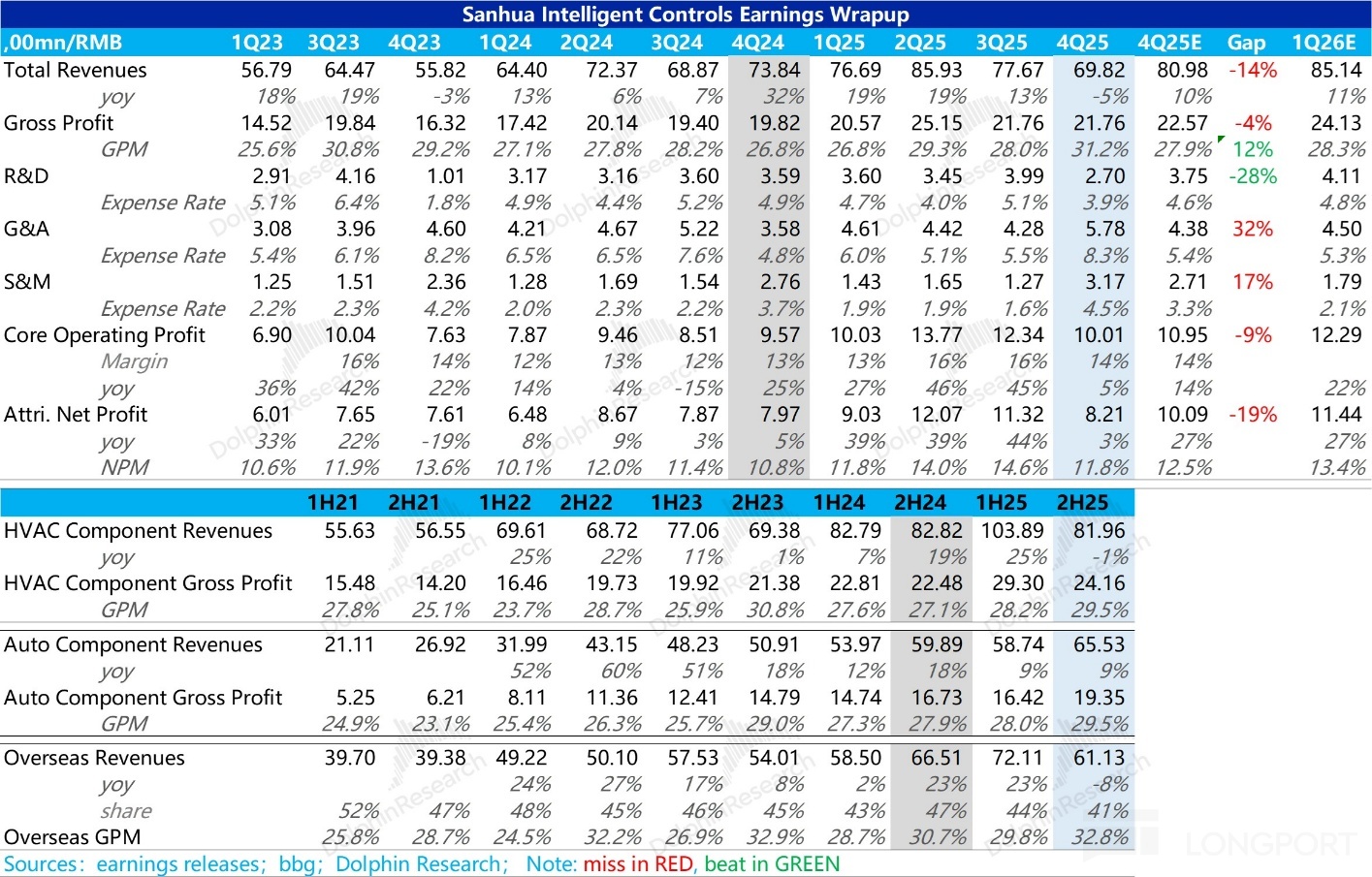
Dolphin Research view:
1) Q4 missed the Street, but external factors dominated: refrigeration was hit by U.S. tariffs, and auto by weaker volumes at a key customer. The effect was muted as auto customers are diversifying.
Looking ahead, the company must accelerate localized capacity and customer diversification. It is now in the growing pains of this transition.
2) More importantly, the ceiling in legacy refrigeration and auto is approaching, so progress in robots and data centers matters more.
Based on our prior work, Sanhua has room to grow in humanoid actuators/assemblies and in thermal components for DCs and other emerging areas. DC revenue is already scaling fast, though still small in base and contribution.
3) On valuation, concerns over humanoid timing have driven a pullback since 2026. Q4 signals no major change in product or competitive position; the miss reflects customer mix, industry cycle, and policy.
Despite soft end-demand, the company guides to positive growth in Q1. With the domestic refrigeration high base fading in H2, overseas capacity ramping, and a broader auto customer base, the full-year target of ~15% YoY net profit growth looks achievable.
We assume ~12% net profit growth in 2026, slightly below target, implying ~RMB 4.6bn; and 2027 normalizes with new businesses contributing, at >15% growth to ~RMB 5.3bn. At current market cap, A-share PE is ~34x; H-share market cap of ~HKD 120bn equates to ~RMB 110bn, or ~20x PE.
Given the potential in robots and DC, we see ~20x on A-shares as a reasonable floor. Accounting for a 15–20% liquidity discount in HK, even if H-shares pull back, downside looks limited to ~15–20%, and the name merits accumulation.
Detailed takeaways:
I. Core businesses
Sanhua operates two main segments: refrigeration components and auto components.
Refrigeration serves fridges and ACs, a mature, steady market with pockets of growth. Commercial refrigeration overseas still has runway, and the most watched area is valves/pumps for DC liquid cooling and storage thermal management.
Auto components focus on thermal management for NEVs. Tesla is the largest customer, but BYD and other domestic customers are growing fast. Per-vehicle content should keep rising with NEV thermal needs, though short-term volumes can fluctuate with key customers.
There is also a third pillar: strategic emerging industries, centered on DCs, storage, and bionic robots. DC and storage supply thermal parts and generated ~RMB 2bn in 2025, while robots focus on joint actuators; revenue is small given low industry volumes, but Sanhua is among the earliest aligned with a major North American customer and has leading tech and manufacturing, drawing market attention.
II. Results
1) Revenue miss: tariffs and a weak key customer
Q4 revenue was RMB 7bn, down 5% YoY and well below expectations, marking the first negative print in a year. U.S. tariffs weighed on appliance imports, and weak volumes at Tesla drove the decline in autos.
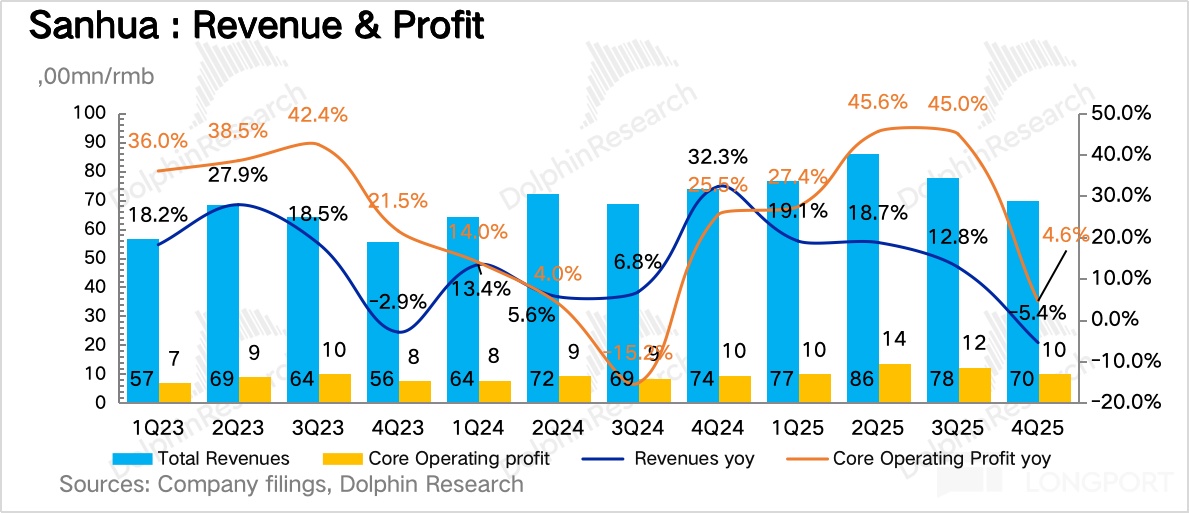
Profit was more reassuring: attributable net profit was RMB 800mn (+3% YoY). Core OP (revenue minus COGS, business taxes, SG&A and impairments) reached ~RMB 1bn (+4.6% YoY). The revenue decline with profit growth was driven by GPM strength, discussed below.
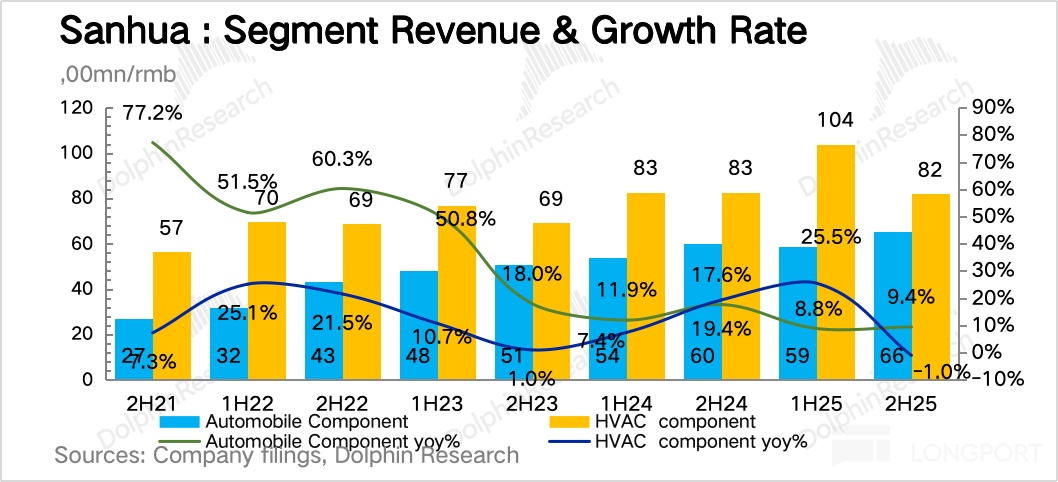
By segment:
a) Refrigeration:
In H2 FY25, refrigeration revenue fell 1% YoY. Momentum weakened from ~25% YoY in H1 to ~10% in Q3, then turned negative in Q4. We see two drivers:
(i) Overseas: U.S. tariff pressure. H2 overseas revenue turned down sharply, indicating tariffs as the main factor. In Jun 2025, the U.S. imposed special tariffs on 'steel derivative products' across eight categories, including refrigerators, freezers, dishwashers, stoves, washers, and dryers, key downstreams for Sanhua's refrigeration products. This materially impacted overseas, especially North America. Customs data show H2 2025 home appliance exports fell ~8% YoY.
Since 2026 YTD, appliance export growth has turned positive.
(ii) China: high base from state subsidies. Subsidies rolled out from Q3 2024, creating a high base in H2 2024, especially Q4. Stats show home appliance retail sales fell ~20% in each of the first two months of Q4 and ~15% in Dec. As an upstream supplier, Sanhua's growth decelerated less than retail.
State subsidies have since faded. The high base should persist through Q2 2026 and ease in H2 when the sector can return to positive growth.
Meanwhile, some refrigeration sub-segments posted solid results. Commercial: Zhejiang Sanhua Commercial Refrigeration Co. revenue was RMB 3.06bn in 2025 (+26% YoY) with net profit of RMB 588mn (+38%). DC liquid cooling: revenue was ~RMB 1.4bn in 2025 (+~40% YoY).
b) Auto:
H2 growth was modest at ~9% YoY, below the NEV industry, and Q4 likely trailed Q3. Customer mix was the key factor: Tesla's Q4 FY25 deliveries fell 16% YoY.
Even so, diversification is progressing. The top customer share fell from 12.6% in 2024 to ~11% in 2025.
Despite Tesla's decline, auto revenue still grew ~9% YoY in H2, similar to H1, showing diversification traction. The miss reflects overly optimistic guidance tied to Tesla.
BYD has become the second-largest auto customer with rapidly rising revenue. In addition, Geely, the Huawei ecosystem, and Xiaomi are likely increasing their shares.
2) Overseas: tariff drag, but record-high margins
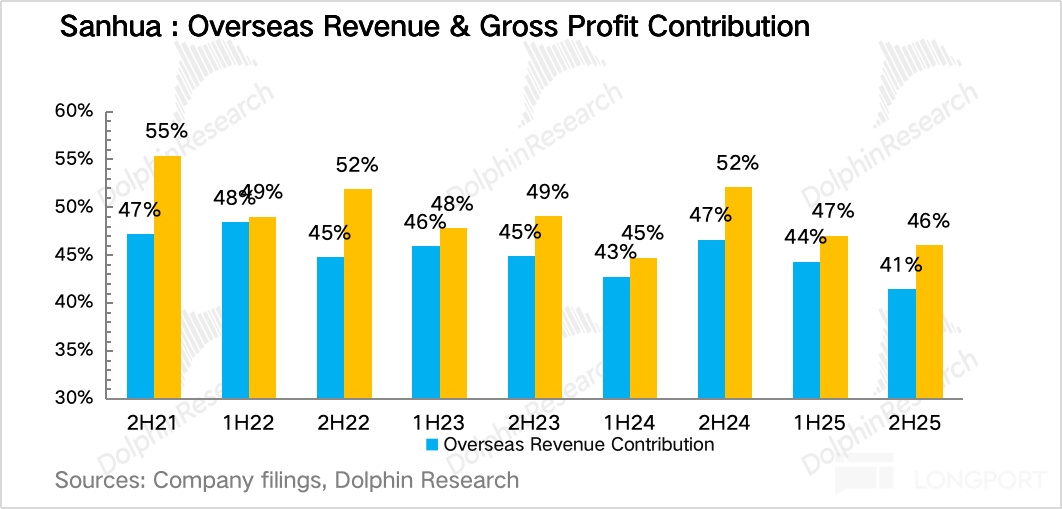
Overseas contributes just over 40% of revenue but nearly 50% of GP, underscoring Sanhua's global footprint. The ongoing decline in high-margin overseas mix raises the question of structural pressure on margins, which we will keep monitoring.
a) Revenue fell YoY due to U.S. tariffs
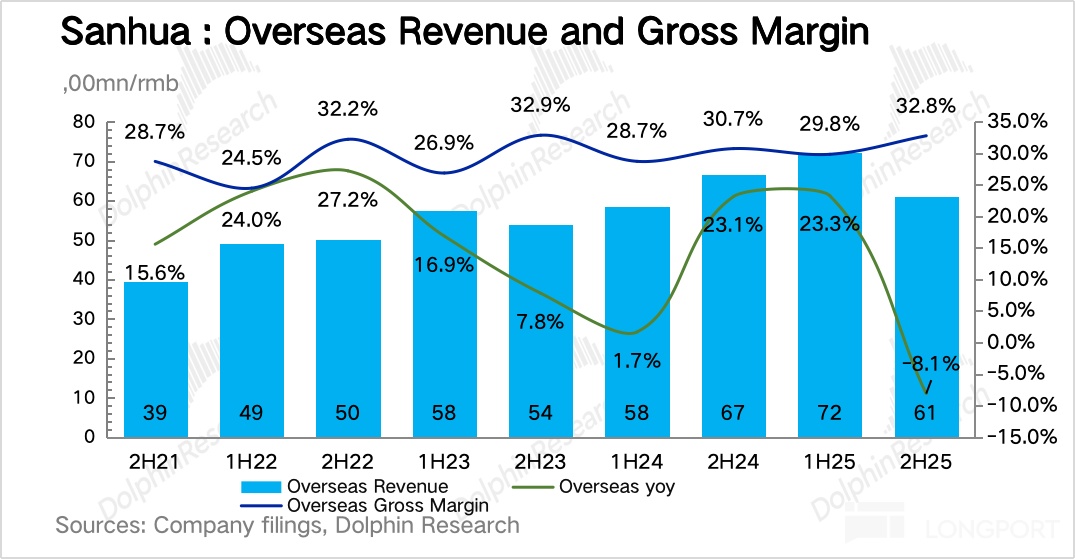
H2 FY25 overseas revenue was RMB 6.1bn, down 8% YoY, an absolute decline of ~RMB 600mn.
Overseas revenue is dominated by refrigeration, while autos mainly serve Tesla's Shanghai plant and domestic OEMs. Thus the overseas drop was primarily refrigeration tariff impact.
The North America-focused Sanhua International (U.S.) posted H2 FY25 revenue of RMB 1.7bn, down more than RMB 1bn vs. H2 FY24 and H1 FY25.
Excluding the U.S. unit, overseas revenue rose over 20% in FY25 and over 14% in H2, which is decent.
b) How to address U.S. market barriers?
Sanhua moved early on localization, with plants in Mexico and Poland for over a decade. Of the HK IPO proceeds, RMB 2–3bn went into Thailand and other overseas plants, and construction-in-progress at Mexico and Thailand is ramping fast.
c) How long will tariff pressure last?
Customs data show China appliance exports have turned positive YoY since 2026, suggesting easing policy impact. A re-escalation of trade frictions remains a risk, but diversified overseas capacity and staggered ramps should partially offset volatility.
d) Margins: H2 FY25 overseas GPM rose sharply on copper
Refrigeration relies heavily on copper, and pricing tracks copper up and down. When copper rises, product prices adjust immediately, while weighted-average accounting for inventories makes recognized cost increases lag, creating temporary GPM uplift.
By contrast, autos are mostly domestic, use aluminum, and do not flex pricing with raw materials; Sanhua primarily hedges, so auto GPM is less sensitive to raw materials.
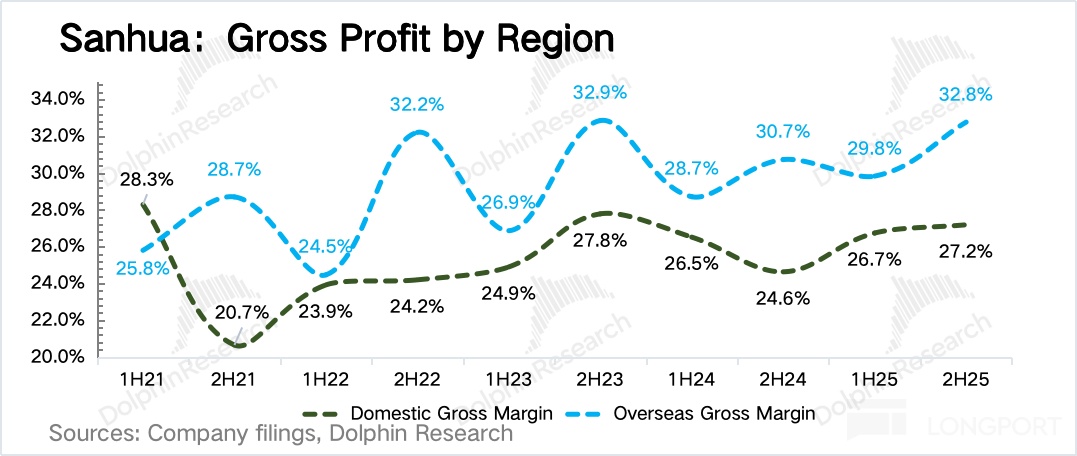
Overall, despite raw-material noise, overseas GPM structurally exceeds domestic, and as overseas stabilizes and expands, we see resilient and potentially improving profitability.
That said, trade policy risk injects uncertainty into overseas execution, the key risk to watch alongside plant ramp progress.
3) GPM: will it keep rising?
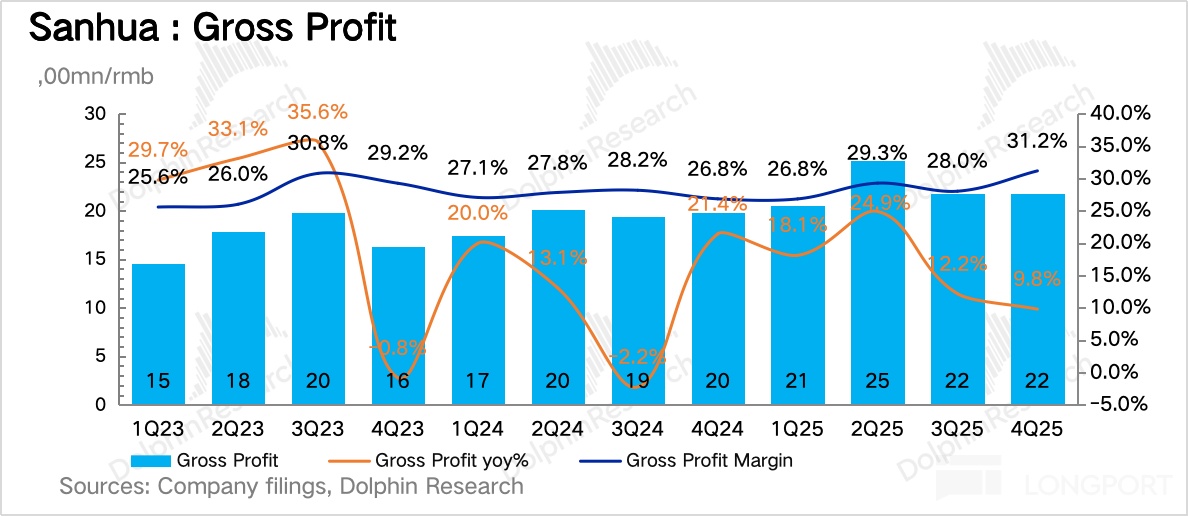
Q4 GP was ~RMB 2.2bn, below expectations due to revenue, but GPM hit a new high of 31.2%, up ~400bps YoY and ~300bps QoQ.
By segment:
a) Refrigeration: copper drove the step-up in Q4 GPM
As noted, copper was the primary driver of the Q4 refrigeration GPM gain.
In addition, mix helped as high-profit sub-segments rose. Commercial refrigeration grew fast, with the subsidiary posting ~19% net margin in 2025, which we estimate is ~700bps above the refrigeration average.
b) Auto: gradual improvement with scale-up
Auto relies on aluminum and does not reprice with raw materials, so GPM is generally stable.
With the end of the most aggressive capacity build-out, product mix upgrade and scale effects, plus some bargaining power, annual price-downs are smaller than typical auto suppliers. Hence, GPM has been on a slow uptrend in recent years.
Net-net, legacy margins should stay stable to slightly up, and overseas recovery can help, while early-stage new businesses may dilute margins. Overall, we expect largely stable GPM.
4) Opex: year-end bonuses temporarily lifted G&A
Total opex rose on year-end compensation and business development, diluting GPM gains. In detail:
a) G&A: Headcount in admin/finance fell in 2025, but G&A, especially compensation, rose, particularly in Q4, likely due to concentrated year-end bonuses.
b) Selling: Both YoY and QoQ increases in Q4. A new 'project development expense' line appeared in 2025, likely tied to early R&D, prototyping and sampling for humanoids, a necessary upfront investment for new businesses.
c) R&D: Down in Q4, stable for the year.
R&D staffing increased, with headcount rising from 3,578 to 3,671 in 2025, and higher education mix as master's holders rose from 723 to 785, showing continued R&D focus.

<End>
Risk disclosures and statements: Dolphin Research disclaimer and general disclosures



The copyright of this article belongs to the original author/organization.
The views expressed herein are solely those of the author and do not reflect the stance of the platform. The content is intended for investment reference purposes only and shall not be considered as investment advice. Please contact us if you have any questions or suggestions regarding the content services provided by the platform.