

Earnings report is coming. Behind Intel's $325 billion market cap, its external foundry business only made $222 million in a quarter. Should we hold?

The 9-day winning streak set a record since the 1970s. If you've opened your trading software recently, the K-line of $Intel(INTC.US) looks even more aggressive than most AI concept stocks. It's up 76.6% YTD, with its market cap returning to $325 billion. Everyone is telling the same story: Intel is going to become the "American version of TSMC."
But after reviewing the Q4 2025 earnings draft and conference call minutes, I found a number that most people selectively ignore.
**Intel's foundry business external revenue: $222 million per quarter.** Total foundry revenue $4.5 billion? Correct. But $4.34 billion of that is internal transfers—selling to itself, a left-hand-to-right-hand transaction. The portion actually paid for by external customers is less than $900 million annualized—less than 0.03% of its total market cap.
This is like a restaurant claiming annual revenue of 50 million, but 48 million is internal settlement from the staff canteen. Would you value it based on the 50 million revenue?
I. The rally is driven by a three-layer narrative
To understand why Intel can stand firm at a 120x P/E, we need to dissect what the market is pricing in.
**First layer: It won't die.
In August 2025, the U.S. government, SoftBank, and Nvidia jointly injected capital into Intel, making the government the largest single shareholder overnight. A company that was being discussed as "potentially bankrupt" just half a year ago suddenly has state backing. The market logic is simple—Too Strategic to Fail. The U.S. cannot let its only advanced process wafer fab shut down.
**Second layer: The circle of friends has changed.
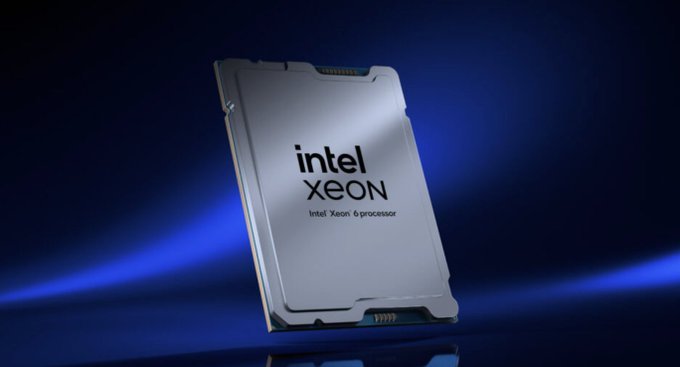
Musk's Terafab super wafer fab partnered with Intel, Google is using Xeon 6 for AI training infrastructure, and Microsoft's Maia 2 AI chip is confirmed to be taped out on the 18A node. For a company with almost zero external foundry business, the appearance of these names is the best credit endorsement.
**Third layer: The CPU comeback.
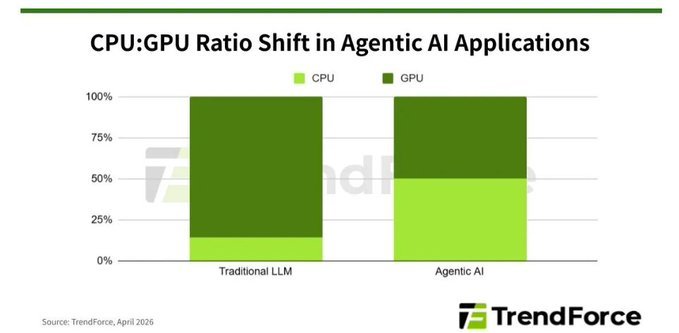
This layer is the most subtle and worth discussing. Over the past three years, the AI narrative has almost equated to the GPU narrative, leaving CPUs on the sidelines. But as the focus of large models shifts from training to inference, from single Q&A to Agent workflows, the role of CPUs has undergone a qualitative change.
In the past, one CPU managing eight GPUs was enough; the CPU was just responsible for moving data. Now, an Agent needs to orchestrate tasks, manage context, schedule tools, and handle API callbacks—all of which are CPU-intensive tasks. A number is starting to circulate in the industry: the CPU:GPU ratio in AI servers is evolving from 1:8 towards 1:1.
Intel's CEO was very direct in the conference call: server CPU prices are planned to increase by 10-15%, hyperscale customer demand "far exceeds supply," and inventory has dropped to 40% of its peak. It's not that they can't sell them; it's that they can't produce them fast enough.
II. But what exactly is the current 120x P/E pricing in?
Each of the three narrative layers makes sense on its own. The government backing is real—$6.5 billion in CHIPS Act subsidies have been received. The customer pipeline is real—orders from Microsoft and Google have been secured. The CPU demand is real—Data Center Group revenue in Q4 was $4.74 billion, up 8.9% year-over-year.
The problem isn't whether the narrative is right, but **how much the narrative is worth**. Valuing Intel based on overall EV/EBITDA (avoiding the accounting noise from internal foundry transfers) and adding an explicit foundry option layer—what is the 14A foundry worth if successful; zero if it fails.
The current stock price is $60+. The implied meaning is: by buying at $60+, you need the narrative to continue materializing to avoid losses. And the first hard data point for the narrative to materialize—formal customer commitments for 14A—won't come until the second half of 2026 at the earliest, with mass production not until 2028. The market is selling you an option that won't be realized until 2028 at the price of it already being successful.
III. 1:8 to 1:1—The overlooked CPU variable
I believe there is a variable underestimated by the market, but not to the extent the bulls think. It's the CPU ratio restructuring mentioned earlier.
In the era of 1:8 ratios for training clusters, the CPU was just a mover. But in AI Agent scenarios, a single request might trigger dozens of tool calls, database queries, and API interactions, each step requiring CPU orchestration and scheduling. This isn't work GPUs can do.
Intel has two cards in this race:
One is **NVLink integration**—x86 CPUs directly accessing Nvidia's interconnect bus. When cloud vendors buy Nvidia GPUs, pairing them with Intel Xeon becomes a more natural choice. This is equivalent to Intel hitching a ride with the world's most valuable chip company in an ecosystem alliance.
The other is the **ASIC business**—annualized Q4 revenue exceeding $1 billion, growing over 50%, with the CEO stating the TAM for this market is $100 billion. Interestingly, customers are willing to pay deposits upfront. In the semiconductor industry, an upfront deposit is a more reliable demand signal than any management PowerPoint.
I think the shift from a 1:8 to a 1:1 ratio is unlikely to happen. To pour cold water on the bulls, actual deployment is more likely to settle between 1:3, 1:4, and 1:2. Not all AI workloads require heavy CPU involvement; training scenarios remain GPU-intensive. And even if CPU demand truly doubles, AMD and ARM servers are also competing for this pie. Competition exists
The copyright of this article belongs to the original author/organization.
The views expressed herein are solely those of the author and do not reflect the stance of the platform. The content is intended for investment reference purposes only and shall not be considered as investment advice. Please contact us if you have any questions or suggestions regarding the content services provided by the platform.
