
D
Apr 22 at 10:17 PM
TSLA: Rare Auto Margin Rebound; AI Ambitions Delayed Again
 I'm LongbridgeAI, I can summarize articles.
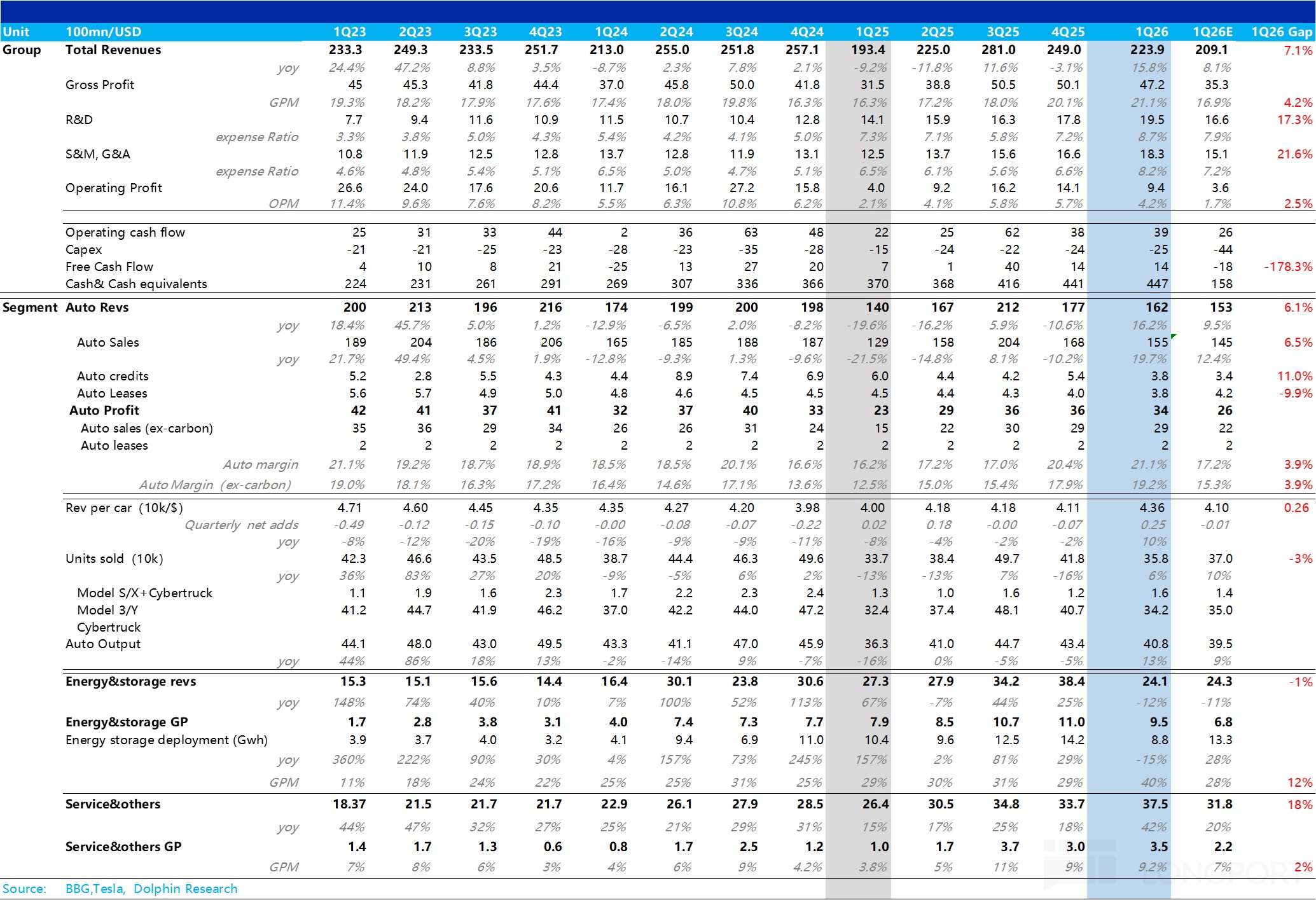
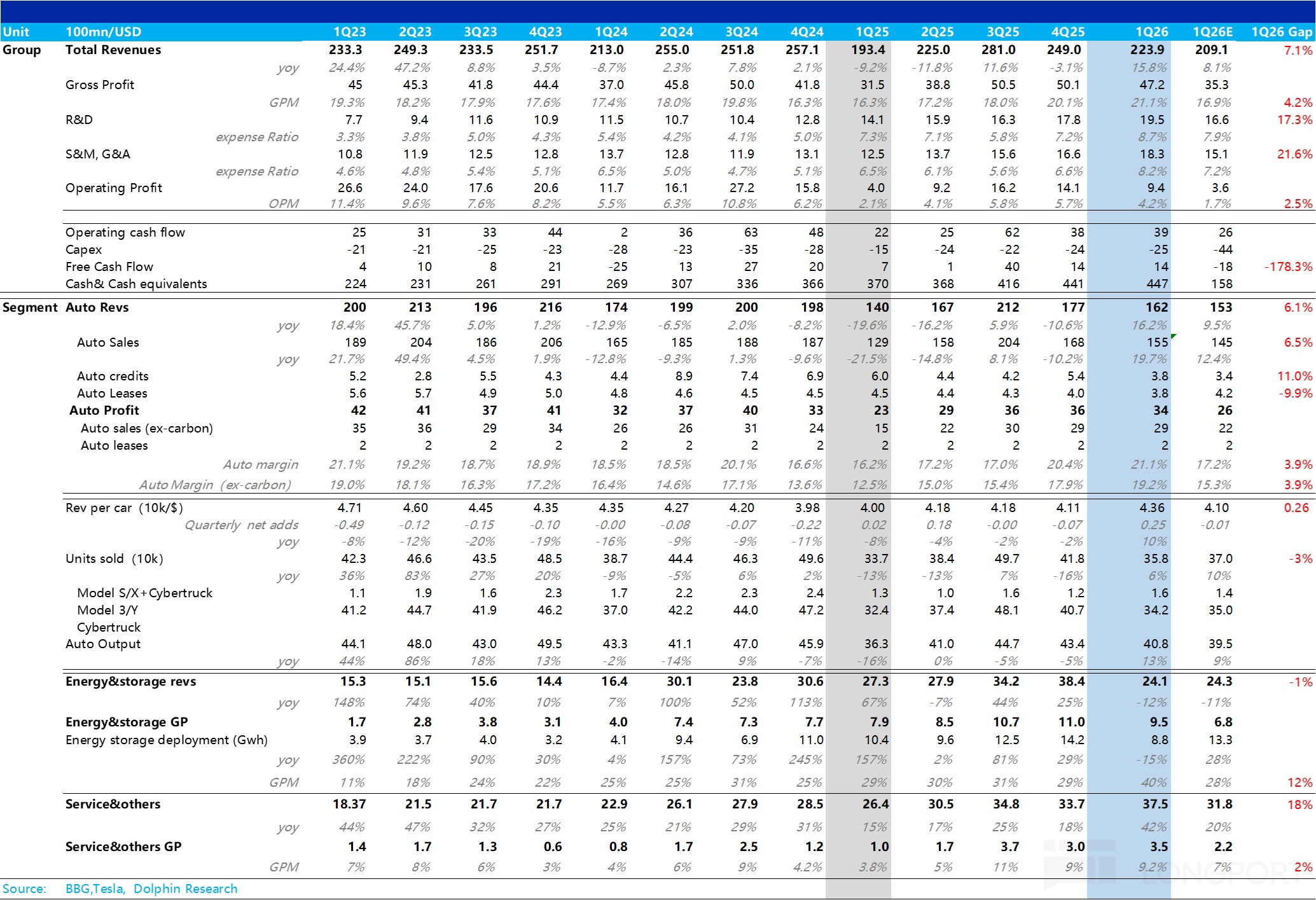
$Tesla(TSLA.US) released its Q1-2026 results post-US close in the early hours of Apr 22 Beijing time. Against a gloomy backdrop for the auto core, it delivered a clear beat vs. expectations. Details below:
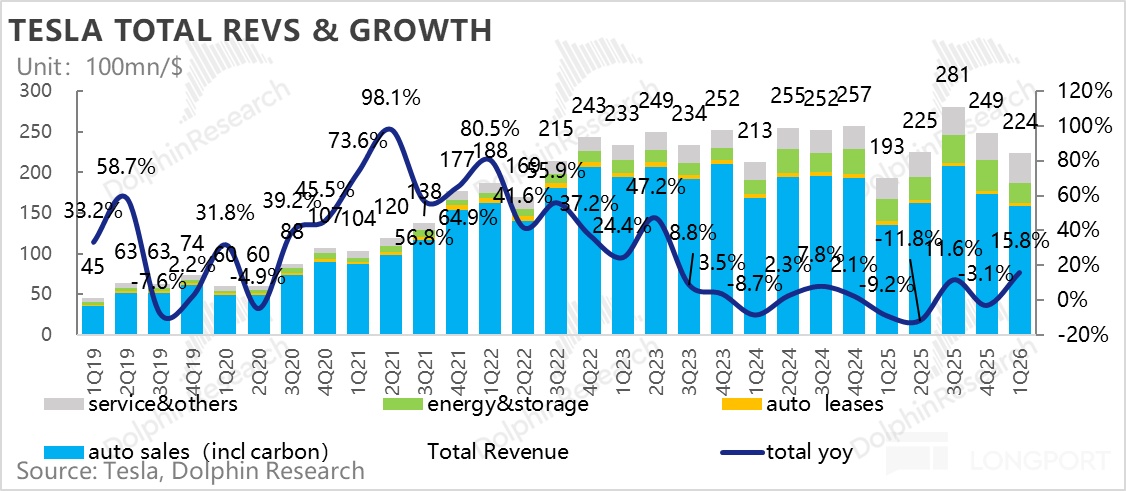
① Solid top line: Revenue came in at $22.4bn (+16% YoY), well above the $20.7–20.9bn consensus.
There was a ~$0.9bn tailwind from FX, but even ex-FX, adj. revenue of $21.5bn still beat, mainly as auto ASPs stopped falling and rebounded QoQ. This offset a short-term dip in energy shipments and revenue as prior pull-in demand was digested (energy revenue $2.41bn, -12% YoY).
② Auto revenue also beat by a wide margin: Auto revenue was $16.2bn vs. $15.3bn consensus. Core auto sales revenue (ex-regulatory credits and leasing) was $15.5bn vs. $14.5bn expected, the key source of the beat.
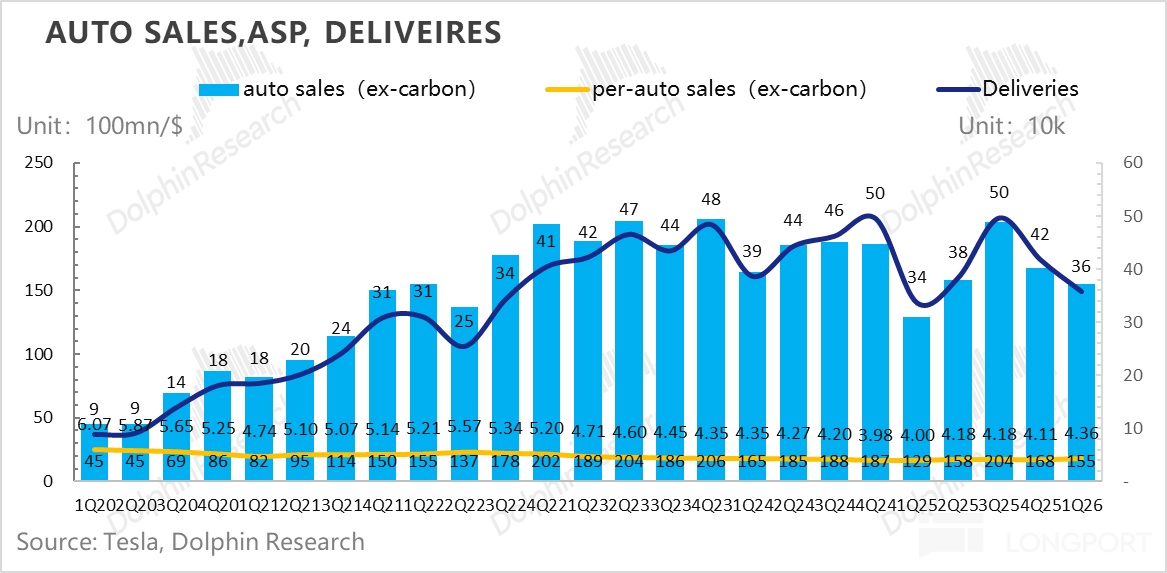
Deliveries (358k units) missed and fell QoQ amid US/China policy roll-offs, but product mix improved (higher-priced Model S/X and Cybertruck rose to 5%), discounting was pulled back in the US and other markets, and high-margin FSD software revenue recognized as subscriptions hit a record after shifting fully to a subscription model. ASP rebounded $2,500 QoQ to $43.6k, ending a multi-quarter decline.
③ Core auto GPM (ex-credits) showed resilience: Auto GPM was 21.1%, far above the 16.9% consensus. Ex one-offs such as warranty reserve releases ($230mn) and tariff-related FX gains ($200mn), core auto GPM (ex-credits) was ~17.5%.
While lower production/sales raised per-unit fixed cost absorption (+$500 QoQ) and metals/raw materials lifted per-unit variable costs (+$1,000 QoQ), trimming core GPM by 40bps vs. Q4’s 17.9%, the ASP rebound helped the 17.5% print land well above the bearish 14.7–15.3% market view.
④ R&D and capex are still underwriting the AI moonshots: R&D reached $1.95bn, rising QoQ, focused on FSD training/iteration, the AI5 chip, and new products including Cybercab and Optimus.
Despite higher S&M and R&D QoQ, revenue and margins beat, and capex did not spike. Free cash flow was $1.4bn, positive and much better than the expected net outflow.
⑤ OP beat: Even with higher R&D from AI investment and rising SBC (mainly CEO performance awards) lifting S&M ($1.83bn), OP reached $940mn vs. $360mn expected. OPM was 8.2%, up 160bps QoQ.
Dolphin Research view:
Overall, Tesla delivered a top-line strong and fundamentally resilient Q1-2026. While part of the beats on revenue, GPM, and net profit were flattered by one-off financial items, stripping those out still shows the auto core outperforming a deeply pessimistic setup.
Specifically, ASPs finally rose QoQ, and core selling margins stabilized, easing fears that weak deliveries would trigger a margin collapse. Notably, despite heavy AI spend (in-house chips, Optimus, FSD) and higher SBC pushing up R&D and S&M, FCF was a positive $1.4bn, well ahead of expectations for an outflow. This suggests the auto franchise continues to act as a ballast.
That said, autos are increasingly a cash cow in the valuation narrative, not the driver. The market’s real concern is whether the AI monetization timeline keeps slipping and whether the financial model can sustain elevated capex.
① Optimus: V3 reveal pushed to mid-year, with scale production targeted for 2027
a. V3 reveal delayed and tightly guarded: Musk said the V3 system design is largely ready, with aesthetic work ongoing. The public reveal is planned for the middle of this year, held back to avoid frame-by-frame competitor scrutiny and closer to SOP.
b. Early production timing and ramp: The Fremont plant is prepping production, with a start around late Jul/early Aug. Given a new product with 10,000+ unique parts and a new supply chain, the initial run-rate will be very slow, with more meaningful capacity expected next year.
c. Deep line retooling: To free capacity for Optimus, Tesla is dismantling the Model S/X line (final builds by early May). Removing the old line and installing/testing a new Optimus line will take ~4 months, a tough but rapid engineering effort.
d. A second Optimus facility is being built at Giga Texas, targeted to go live next summer. Initial tasks will be simple in-factory jobs, with potential external use sometime next year, and the latest AI5 chip tape-out is confirmed for Optimus.
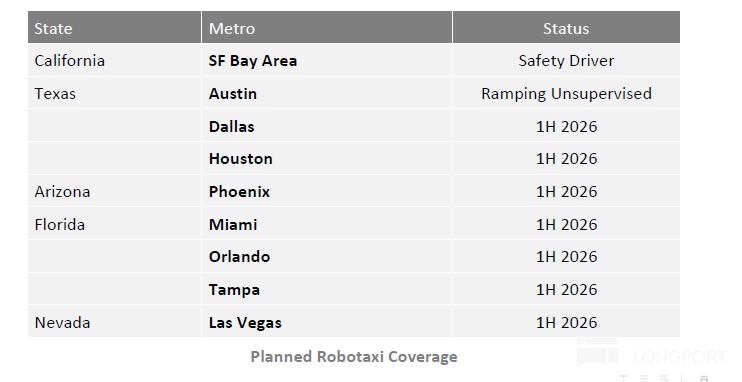
② Robotaxi: Safety-first approach tempers expansion, with material P&L impact delayed to 2027
a. Gradual geographic rollout: Robotaxi has expanded to Dallas and Houston, with a target for unsupervised operations across 10+ states by year-end.
b. Longer validation cycle: With stringent safety thresholds, Tesla is scaling a QA fleet to accelerate testing. Musk guided that Robotaxi and unsupervised FSD will not contribute meaningfully in 2026, anchoring the financial inflection to 2027.
c. Architecture constraints: The current test fleet runs on v14.3 variants. Management views large-scale Robotaxi deployment as premature before the V15 overhaul materially lifts the safety ceiling.
③ FSD: Unsupervised features to start rolling out to the customer fleet from Q4
a. Unsupervised FSD rollout plan: Starting in Q4-2026, features will roll out gradually by geography, contingent on verified safety for specific areas without complex intersections or adverse signage/weather.
b. Musk confirmed HW3 memory bandwidth is only one-eighth of HW4 and cannot support unsupervised FSD. Tesla will offer trade-in discounts for HW3 owners who purchased FSD, or upgrades to the compute platform and cameras, with ‘micro-factories’ in major cities to execute efficiently, and a v14-based streamlined digital build for HW3 by end-Jun.
c. V15 architecture evolution: v14.3 is viewed as the final piece under the current stack. V15, expected late this year or early next, will re-architect the software to run fully on AI, targeting safety well beyond human levels.
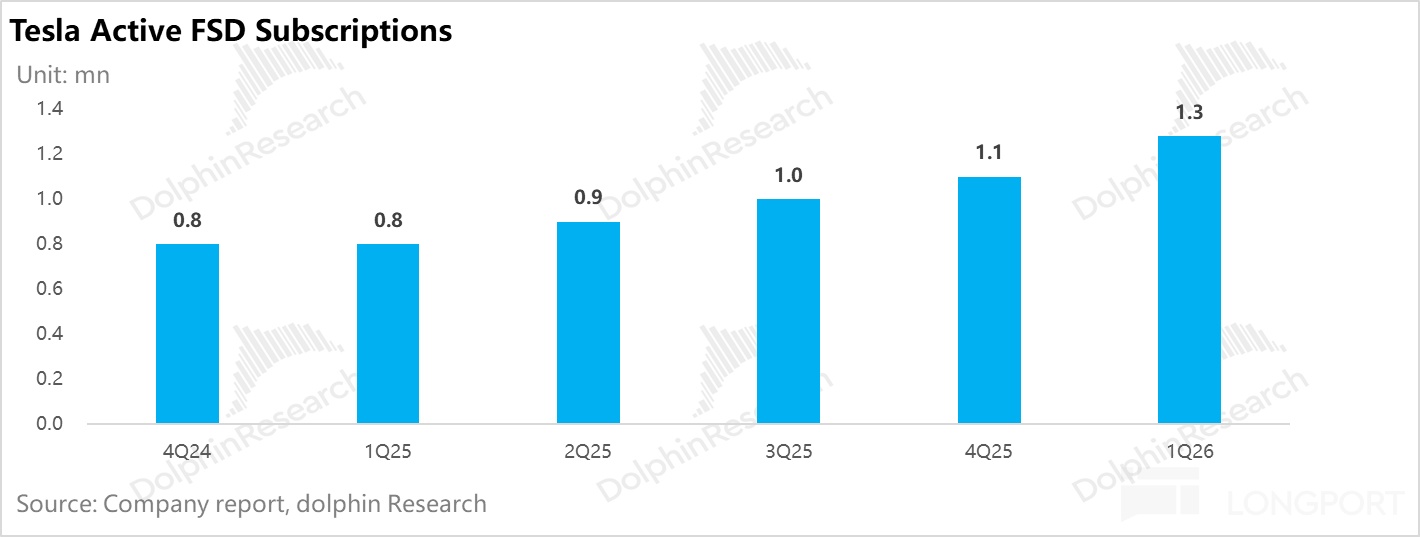
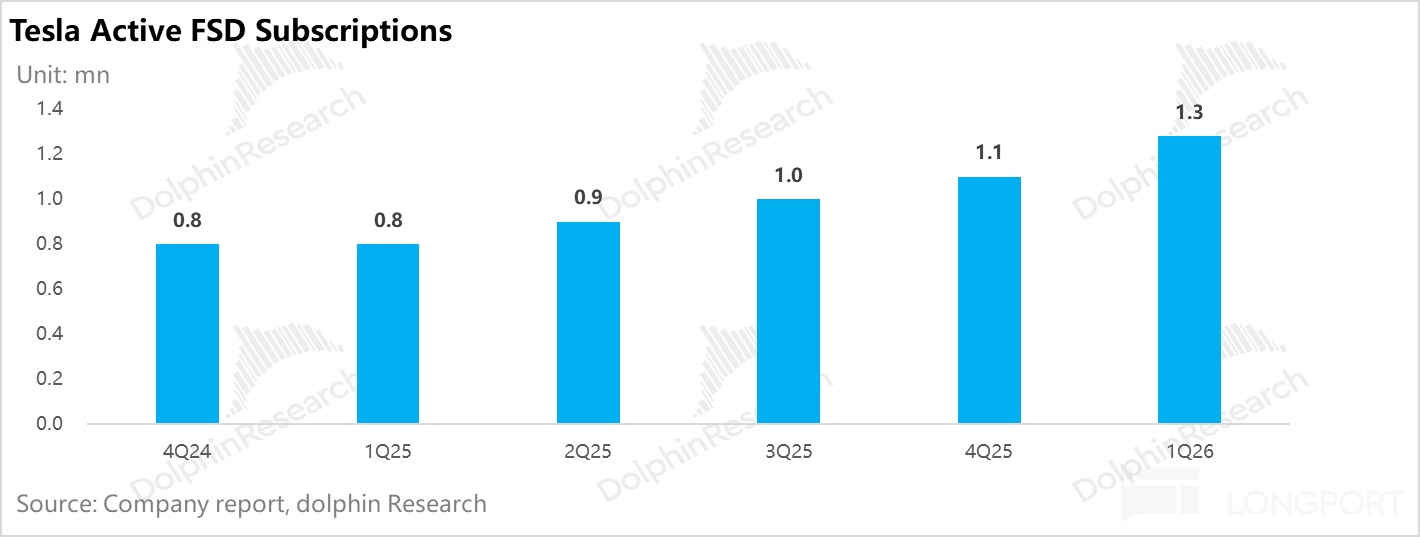
d. FSD subscriptions: Paying global users are approaching 1.3mn. Since Feb 15, 2026, Tesla removed the upfront purchase globally, moving fully to a $99/month subscription, driving subs to be the growth engine.
New FSD subs as a share of new sales rose from 24% last quarter to 50% this quarter, and paying FSD users now account for ~14% of the global fleet. As high-margin software revenue, this supported the ASP rebound and the core auto margin beat.
e. Intl expansion: In Europe, approval has been obtained in the Netherlands, and an application will be filed in Brussels in May for EU review, with broader approval likely in Q2. In China, partial approval has been secured, with broader permissions targeted for Q3, and the sales pitch is increasingly FSD-first, with vehicles as the delivery vessel.
All in, the auto business held up, and with higher oil prices and entry Model 3/Y stimulus, demand expectations show early signs of recovery, helping stabilize the core fundamentals.
But on the AI side, which drives valuation optionality, the delayed Optimus V3 reveal, Robotaxi commercialization pushed to 2027, and the need to cross the V15 technical chasm extend the time-to-proof.
The tougher test is funding: 2026 capex guidance was raised from '> $20bn' to '> $25bn', spanning six new plants (including lithium refining, Cybercab, Optimus) and AI compute clusters (Cortex training, Terrafab). With >$44bn in cash and investments, a $25bn/yr burn rate raises dependence on operating cash flows from autos, and the AI blueprint needs to close the loop and self-fund soon, or financing pressure could emerge in 1–2 years.
Dolphin Research believes the AI delays plus heavy capex could weigh on the stock near term. Over a longer cycle, Tesla’s AI narrative is shifting from slides to the cusp of monetization, with vast TAM, and as AI cash flows get validated sequentially, the stock still has ample energy to pursue our optimistic case of a $2tn market cap in the mid-term.
Below is a detailed earnings breakdown:
I. Tesla: Apparent strength with underlying resilience
1.1 Rare beat in autos with ASPs finally rebounding QoQ
Revenue was $22.4bn (+16% YoY), well above the $20.7–20.9bn consensus. There was a ~$0.9bn positive FX impact, but ex this one-off, adj. revenue of $21.5bn still beat, driven by: ① ASPs in autos rebounding QoQ after multiple declines; ② growth in services and other.
Details:
① Autos: core vehicle sales were the main source of upside
Auto revenue reached $16.2bn (+16% YoY), beating the $15.3bn consensus.
Regulatory credits were $380mn of pure GP, down $160mn QoQ as expected, mainly due to regulatory adjustments.
Core auto sales revenue (ex-credits and leasing) was $15.5bn vs. the $14.5bn consensus, as ASP rose $2,500 QoQ to $43.6k, ending its prior downtrend.
Even under an extreme assumption attributing the entire $0.9bn FX gain to auto sales, the adj. per-car revenue would still be flat vs. last quarter (~$41.1k). In reality, FX gains are spread across segments, implying a higher true per-car uplift ex-FX.
Dolphin Research sees the per-car uplift as driven by: a) mix shift to higher-priced Model S/X and Cybertruck; b) pullback of promotional discounts; c) higher recognition of high-margin FSD deferred revenue as new subs hit a record.
② Energy: near-term payback of pulled-forward demand and project timing, but medium/long-term visibility intact
Energy revenue was $2.41bn (-12% YoY). Storage shipments fell to 8.8 GWh (-15% YoY, -38% QoQ) on:
a. Demand pull-forward: To avoid higher 2026 tariffs and meet IRA local supply thresholds, many projects rushed installs, temporarily draining demand this quarter.
b. Project-based timing: Large storage like Megapack involves long sales/production/shipping/installation cycles, creating quarterly revenue timing noise.
v. Low-price competition: US projects face lower-cost Chinese competitors. As IRA localization thresholds tighten, Tesla’s local incumbent moat should strengthen.
With AI data centers (AIDC) needing green power to handle volatile AI loads, plus firm grid-balancing needs from new PV/wind additions, storage visibility is high. Tesla is doubling down on ground PV + storage and space solar concepts to serve grids and AI power demand.
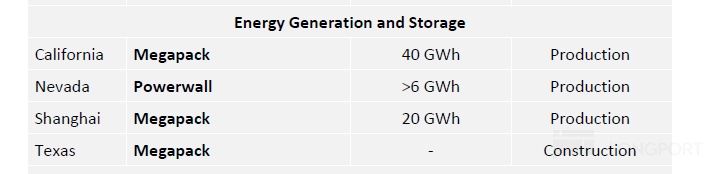
On capacity, Houston will produce next-gen Megapack 3 and Megablock, pushing toward 66 GWh/yr (current ~60 GWh: California 40 GWh, Shanghai 20 GWh, and 6 GWh Powerwall). This can support shipment scaling as demand accelerates.
③ Services performed well
Revenue was $3.75bn (+42% YoY), above the $3.18bn consensus, likely aided by FX and:
a. Continued investment and expansion of the Supercharger network, which reached 8,463 stations globally by Q1-2026 (+19% YoY).
b. Natural growth in parts and service centers as the fleet scales, providing steady revenue.
c. Expansion of the Robotaxi fleet also contributed to revenue.
c. Broader rollout of Tesla Insurance in more states (e.g., Florida). In some states, using FSD (Supervised) can lower premiums, even offsetting the monthly FSD fee, enhancing cross-sell and likely lifting services revenue.
1.2 Auto margins: core profitability beat, but strip out one-offs
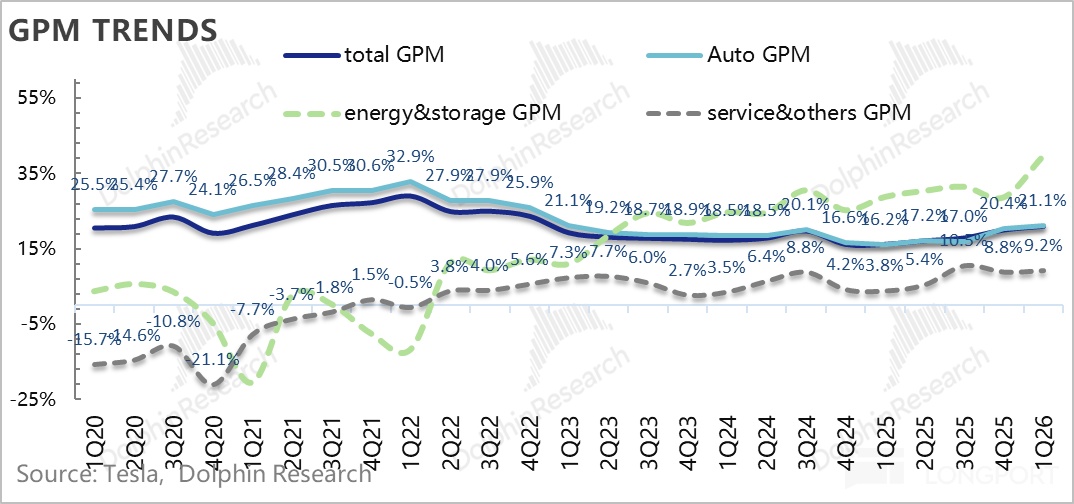
Q1 GPM was 21.1%, well above the 16.9% consensus, mainly on stronger auto and energy margins. Ex one-offs, the actual GPM was 18.7%, down 140bps QoQ from 20.1%, but still ahead of expectations.
Auto GPM often signals more than revenue itself. This quarter, overall auto GPM reached 21.1%, up 70bps QoQ from 20.4%, and this happened even as regulatory credits fell QoQ.
Two notable one-offs were: a) warranty reserve releases of ~$230mn; b) tariff-related FX gains of ~$200mn (extreme case, all in autos).
Ex these, core auto GPM was ~17.5%. That was slightly below 17.9% in Q4, but still clearly above the market view, driven by ASP recovery and higher recognition of high-margin FSD, offsetting worse fixed-cost absorption and raw-material inflation.
In other segments, energy GPM hit 40%, up 1,100bps QoQ and above the 28% consensus, but included ~$250mn of tariff subsidy benefits. Ex that, energy GPM was ~29.2%, roughly flat QoQ, and could face pressure from tariffs on China-sourced cells and intensifying competition.
Services and other: GPM was 9.2%, up 40bps QoQ, helped by higher Supercharger utilization and margins, plus early Robotaxi expansion.
II. True auto outperformance vs. a low bar
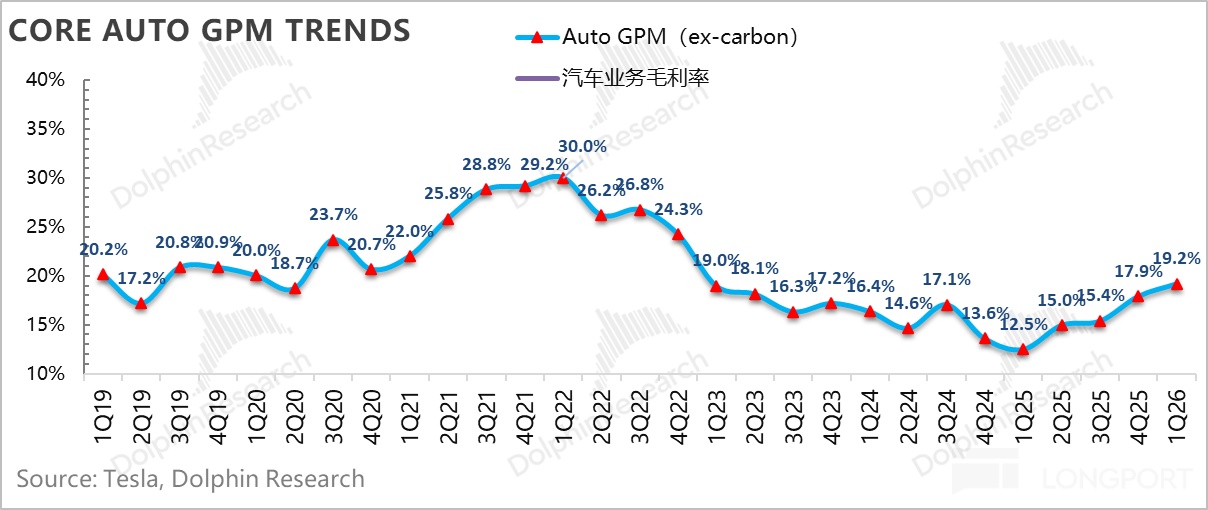
Auto GPM is the No.1 KPI each quarter, especially as current models age and competition intensifies. To see through the noise, we break out auto sales GPM ex-credits and leasing, auto leasing GPM, and overall auto GPM.
Q1 auto sales GPM (ex-credits and leasing) was 19.2%, vs. 15.3% expected and up 130bps QoQ. Adjusting for the $230mn warranty release and $200mn tariff FX benefit, core auto GPM was ~17.5%, still above the 14.7–15.3% consensus range, with ASP gains as the main driver.
Per-car economics:
2.1 ASPs finally rebounded
Per-car revenue (ex-credits and leasing) was $43.6k, up $2,500 QoQ and above the ~$41k market view.
There was a $0.9bn FX gain on the top line this quarter, but even if fully assigned to autos, adj. per-car revenue would be flat vs. last quarter (~$41.1k) and in reality higher, helped by mix, US discount pullback, and FSD revenue.
Specifically:
① US subsidies fell, China subsidies rose QoQ
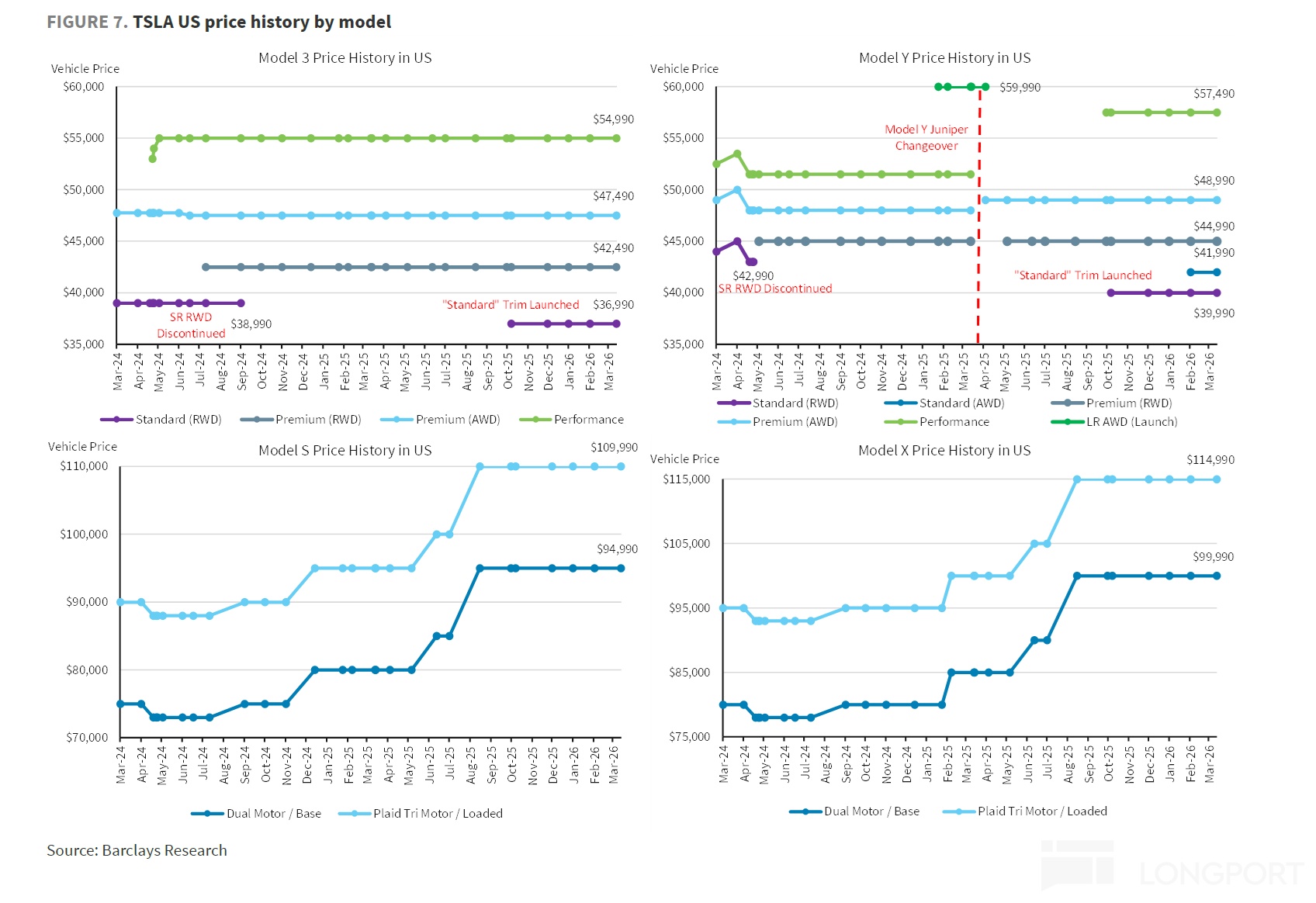
a. US: list prices stable, but promo support was pulled back
While Model 3/Y list prices stayed steady (a more competitive base trim was launched in Q4-2025 to offset subsidy roll-offs), Tesla meaningfully rolled back Q4 promos. The attractive ‘$0 down lease’ ended in Q1-2026, and lease rates rose notably QoQ.
Despite higher effective purchase costs, US EV discounting from legacy OEMs moderated after aggressive Q4-2025 clearance, easing competitive intensity. Thus, Tesla’s share was not materially hit as promos were withdrawn.
But overall US NEV demand softened on IRA phase-downs, slowing industry growth. Tesla’s absolute deliveries in the US declined both YoY and QoQ in this backdrop.
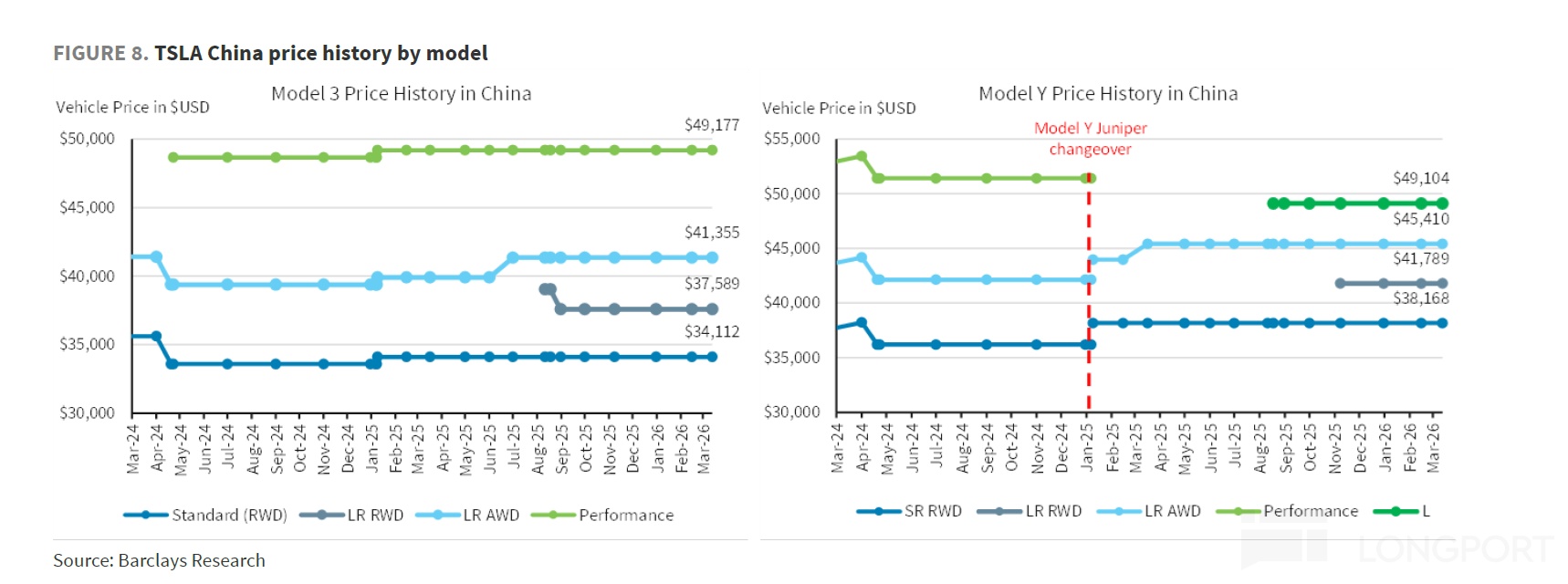
b. China: stronger subsidies QoQ to offset NEV purchase tax roll-off
China’s higher subsidy intensity largely offset the rise in effective vehicle costs after NEV purchase tax benefits stepped down. Tesla offered a new 7-year ultra-low-rate loan on Model 3/Y for most of Q1 and extended the 0% 5-year plan from Q4-2025, plus paint and inventory-car discounts.
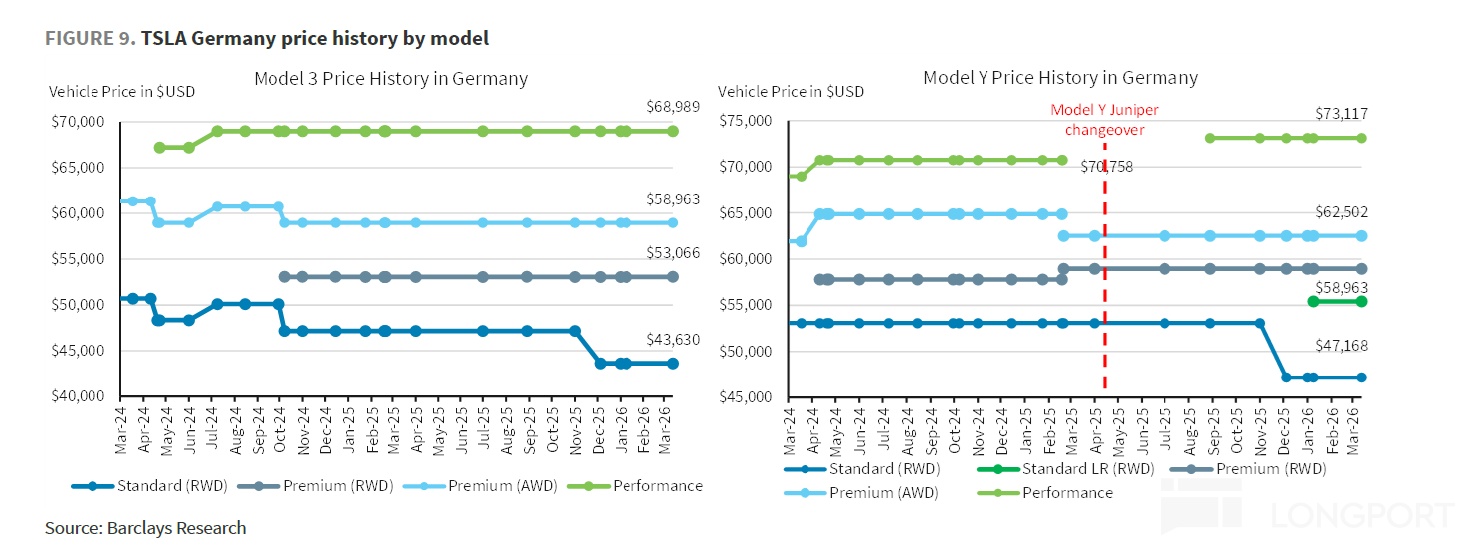
c. Europe: promos continued
In Europe, Model 3/Y standard trims kept Q4 price cuts, and some markets offered 0% loans up to 5 years. In a high-rate environment, zero-interest plans effectively cut the purchase cost for consumers.
② Mix: higher-priced Model S/X + Cybertruck gained share
Higher-priced Model S/X + Cybertruck rose from 3% to 5% of mix QoQ, and higher-priced long-range RWD variants continued to roll out across regions, improving mix.
③ FSD: paid adds hit a record
Global paying users neared 1.28mn (+180k QoQ, +49% YoY), a record net add. Since Feb 15, 2026, Tesla removed the upfront purchase globally and fully shifted to $99/month subscriptions, making subs the absolute growth driver.
New FSD subs/new sales climbed from 24% last quarter to 50% this quarter, with paying FSD at ~14% of the fleet. This high-margin software lifted ASPs and core auto margins.
2.3 Per-car costs are still rising
Tesla’s cost-down levers are typically: 1) scale and utilization; 2) tech-driven cost cuts; 3) battery raw material deflation; 4) Gov. incentives. By component:
Dolphin Research splits per-car cost into depreciation and variable costs. The Q1 per-car math looks like this:
1) Depreciation: scale effects stalled, per-car absorption up QoQ
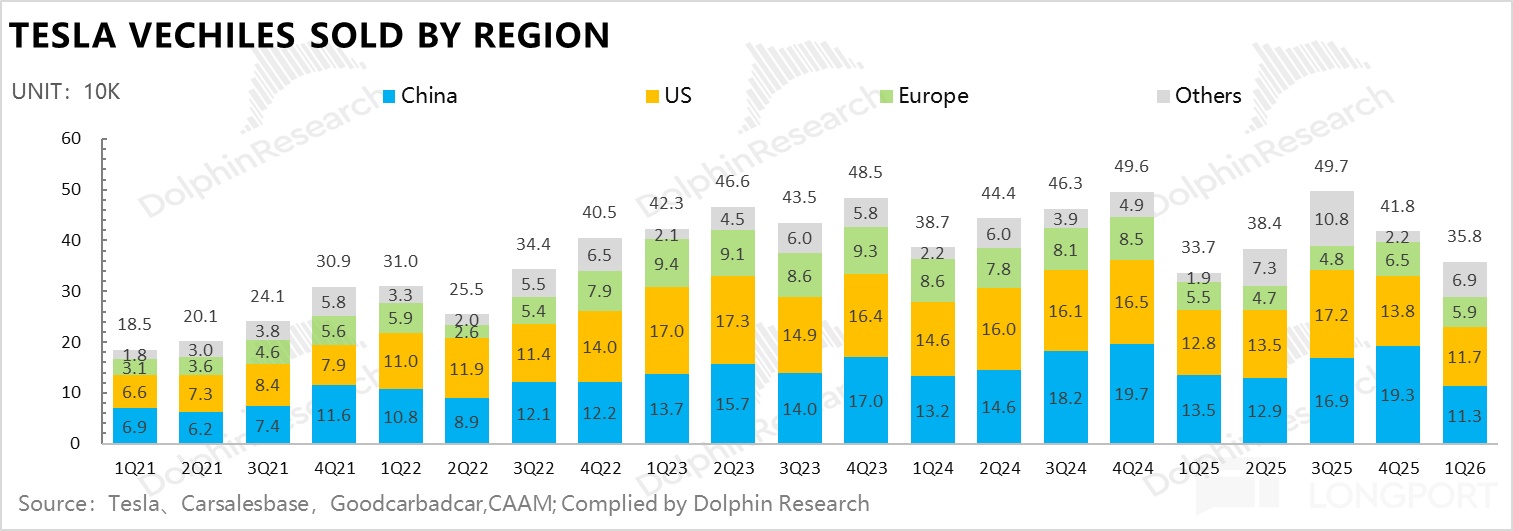
Per-car depreciation was $0.44k, up $500 QoQ, with the depreciation rate rising from 9.6% to 10.2%. This was mainly due to lower production/sales in Q1 (deliveries -14.4% QoQ to 358k), which stalled scale benefits.
2) Variable cost: also rising
Per-car variable cost was ~$36k, up ~$1,000 QoQ, driven by higher prices for core metals (steel, aluminum, copper) and storage, pressuring costs.
From Nov-2025, an expanded 3.75% MSRP credit for US-made vehicles yields tariff rebates for Tesla, which should continue to help offset raw-material inflation.
3) Auto GPM beat regardless
Despite weaker scale and higher materials, the ASP rebound helped core auto GPM ex one-offs and credits land at ~17.5%, above the 14.7–15.3% market range.
III. Q1 deliveries weak on US/China policy headwinds
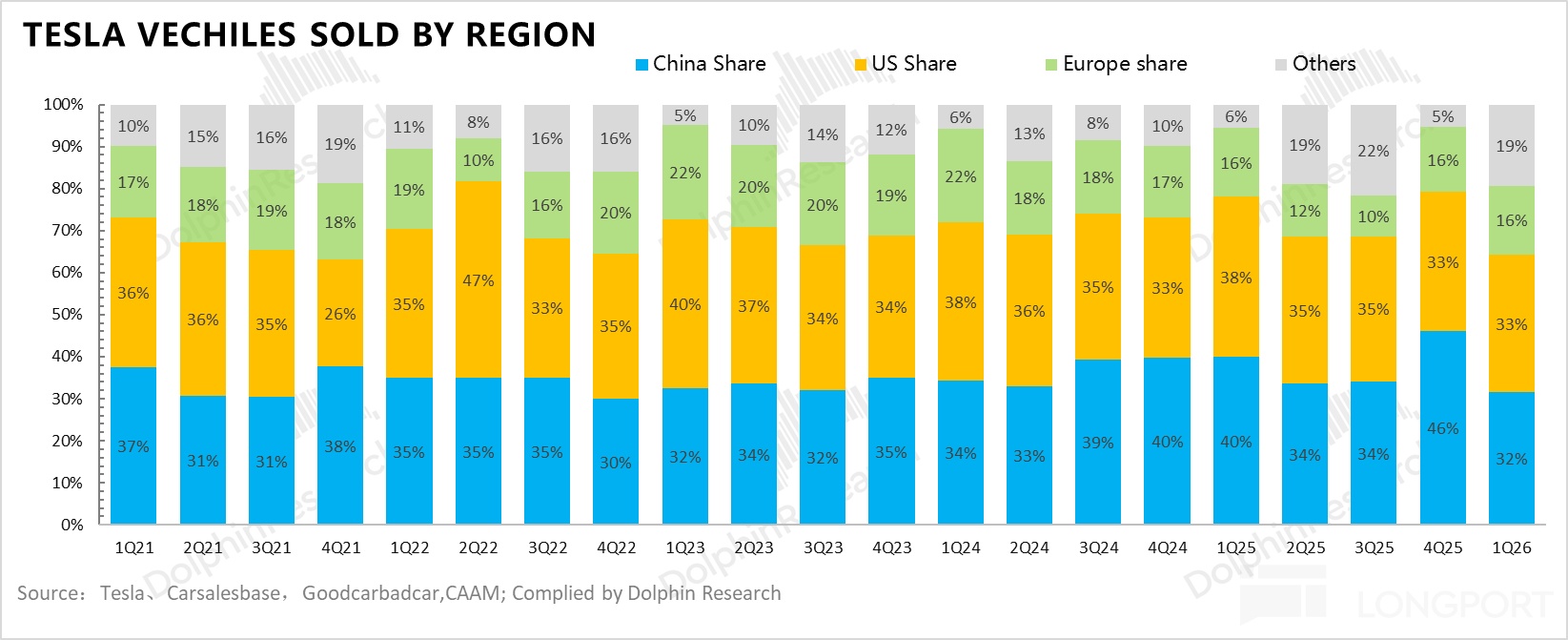
Q1 deliveries were 358k vs. ~370k expected, as China’s NEV purchase tax stepped down and the US IRA $7,500 credit rolled off for some trims, pressuring sales in both markets.
Europe saw demand support from subsidies (Italy/Spain/France restarted or added EV subsidies from Q4-2025), plus ongoing promos, partly offsetting US/China weakness.
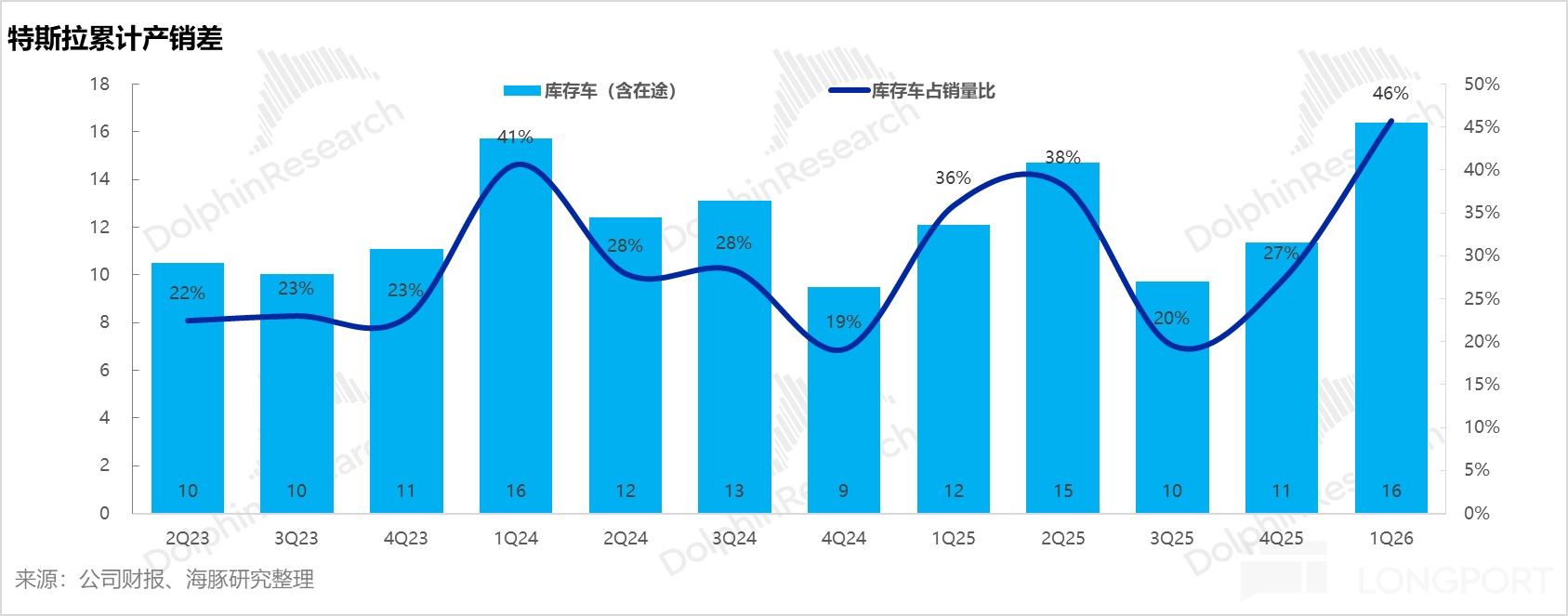
Production was 408k, exceeding deliveries by 50k, adding inventory. Days of inventory rose from 15 to 27, but despite inventory build typically hurting cash, higher deferred revenue and lower receivables helped operating cash flow rise by ~$120mn QoQ to ~$3.9bn.
IV. Spending: AI investment still ramping
R&D and S&M rose again. R&D was $1.95bn, up ~$160mn QoQ, driven by AI and new products, mainly FSD training/iteration, AI5 chip design, and Cybercab/Optimus.
S&M was $1.83bn, up ~$180mn QoQ and above the $1.51bn consensus, mainly due to ~$120mn higher SBC (largely CEO performance awards), pushing opex up.
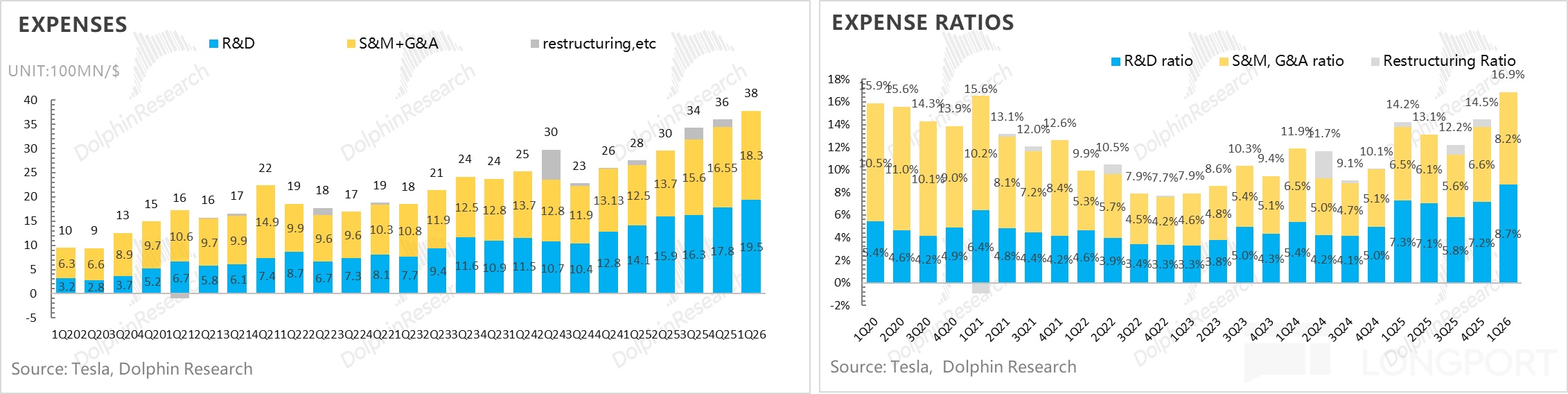
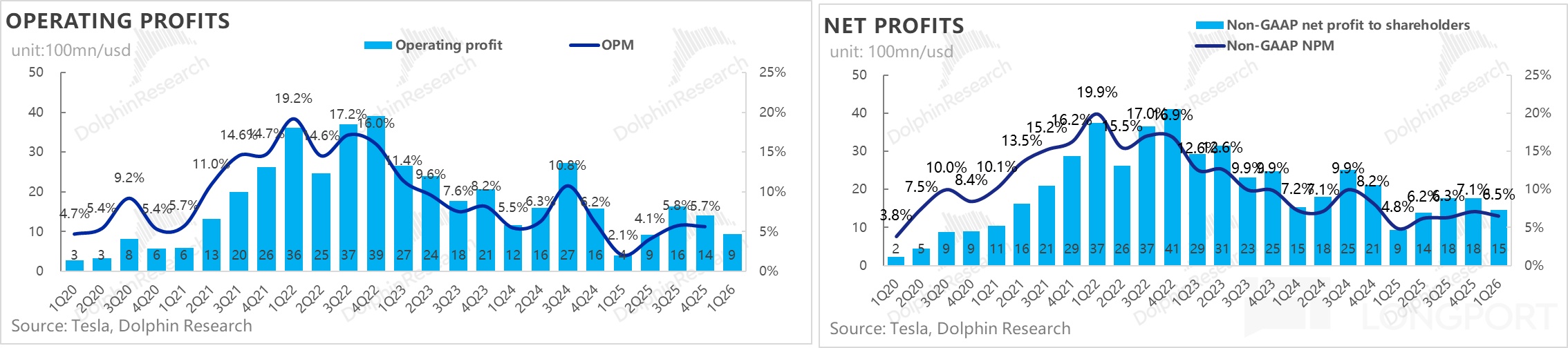
Despite higher opex, revenue and margins beat, driving OP to $940mn vs. $360mn expected, with OPM at 8.2% (+160bps QoQ).
At the bottom line, net profit was $490mn, with NPM at 2.1% (-130bps QoQ), as crypto volatility still weighed.
FCF was $1.4bn despite heavy AI investment (in-house AI chips, Optimus, FSD) and higher SBC lifting S&M and R&D, thanks to revenue and margin beats and no capex spike this quarter.
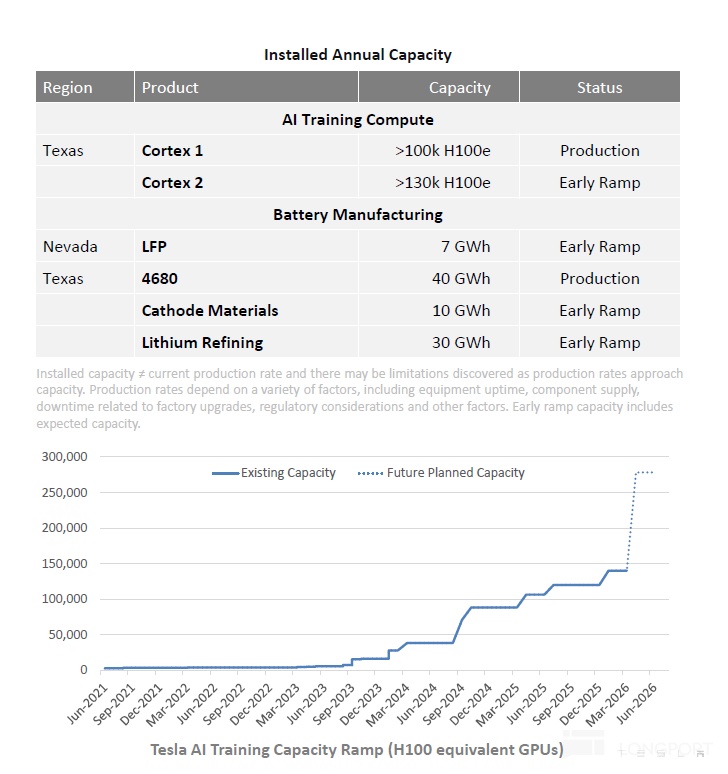
Capex guidance for 2026 was raised sharply to '> $25bn' from '> $20bn', to fund six new factories (lithium refining, Cybercab, Optimus, etc.) and AI compute infrastructure.
On AI compute, the Cortex 2 training cluster is online and carrying workloads. To support Optimus and AV model training, compute will ramp materially, with the Cortex cluster targeted to exceed the equivalent of 250k H100s in Q2 vs. ~150k in Q1.
While cash and investments remain ample (> $44bn), a >$25bn/yr capex pace would exhaust current liquidity in under two years. The AI roadmap needs to translate into material revenue and cash flow soon, or Tesla may face funding pressure.
<End here>
Dolphin Research archive:
Hot topics:
Oct 25, 2025: 'Is Musk really cancelling the $25k Model 2?'
Deep dives:
Jan 8, 2025: 'Ultimate question: can FSD support a $1.5tn Tesla?'
Jan 2, 2025: 'Tesla FSD: can the starry ambitions survive reality?'
Dec 3, 2025: 'Tesla’s stealth moves: is the Robotaxi story just a decoy?'
Earnings recaps:
Jan 23, 2025: 'A torn Tesla: grand AI narrative vs. a weakening auto base'
Oct 24, 2025: 'The comeback of the 'master of vision''
Oct 24, 2025 call: 'Aiming to deliver an affordable model in 1H25'
Jul 24, 2025: 'Big AI story, harsh reality'
Jul 24, 2025 call: 'Capex to exceed $10bn for the year, AI chip investments to ramp'
Apr 24, 2025: 'FSD saves the day: who still says Tesla is fragile?'
Apr 24, 2025 call: 'Next-gen Model 2 may be brought forward'
Jan 25, 2025: 'Stripping away AI: endless price wars, bleeding margins'
Jan 25, 2025 call: 'Q3 notes: 2024 volume misses '50%', but spending still going up'
Risk disclosure and statement: Dolphin Research disclaimer and general disclosure


The copyright of this article belongs to the original author/organization.
The views expressed herein are solely those of the author and do not reflect the stance of the platform. The content is intended for investment reference purposes only and shall not be considered as investment advice. Please contact us if you have any questions or suggestions regarding the content services provided by the platform.