
D
Apr 22 at 11:28 PM
TSLA (Q1'26 Trans): $25bn All-In Bet, When Will AI Monetize?
Below is Dolphin Research's transcript of$Tesla(TSLA.US) FY26 Q1 earnings call. For our take on the print, see 'Tesla: Rare Auto GP Rebound, AI Masterplan Slips Again'.
I. Key Takeaways
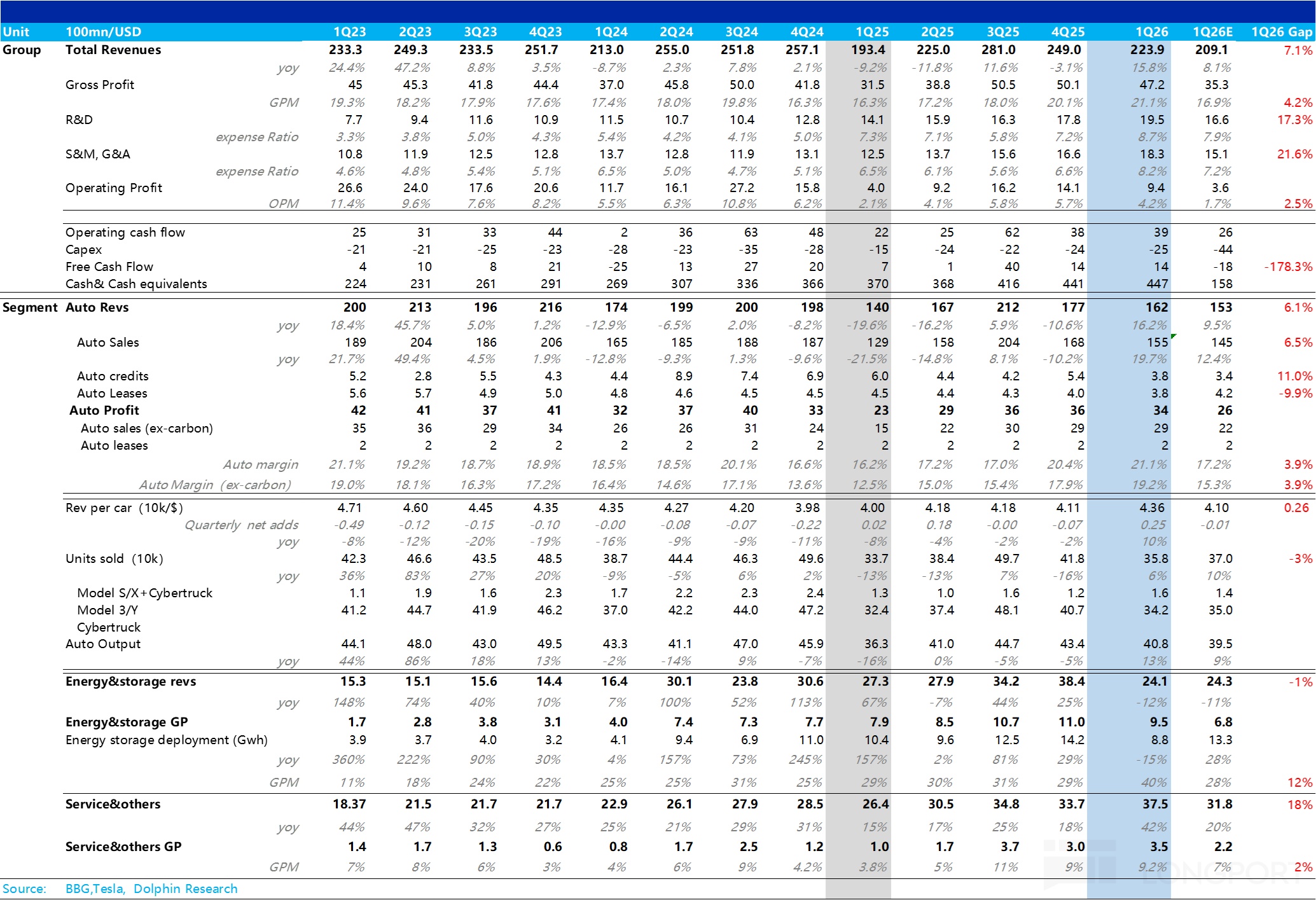
1. CapEx guide: FY26 CapEx is expected to exceed $25bn, funding six factories, AI infrastructure, and new product lines (Cybercab, Semi, Optimus, Megapack 3, etc.). Full-year FCF is guided negative given the investment cycle.
2. Auto GPM (ex-credits): GPM rose to 19.2% from 17.9% QoQ, but included a ~$230mn one-off warranty true-up and some tariff relief. Rate-subsidy costs were front-loaded; if rates keep rising, margin will remain under pressure.
3. Energy GPM: A record >39.5%, but included a >$250mn one-off benefit from historical tariff refunds. On a normalized basis, margins are expected to compress on tougher competition and tariff headwinds.
4. Free cash flow: Q1 at ~$1.4bn. The company is in a heavy CapEx phase that may last several years.
5. Net income hit by non-operating items: Mark-to-market on Bitcoin holdings (-22% QoQ) and FX swings (mainly from large intercompany loans) weighed on NI.
II. Earnings Call Details
2.1 Management commentary
1. Autos and demand
a. Europe rebounded strongly, with deliveries in France and Germany up >150% QoQ. APAC saw growth in Korea and Japan, while the U.S. posted modest QoQ delivery gains.
b. Q1 order backlog was the highest in over two years, with the improvement starting before the recent oil price rise. This points to a demand recovery independent of fuel-price tailwinds.
c. The Model 3 starting price is now below its level 10 years ago (inflation-adjusted ~$48,000). Product competitiveness has improved materially.
d. The Berlin plant hit a record >61,000 units in Q1. The company plans to keep lifting output across all factories.
e. Battery pack capacity remains the biggest growth bottleneck. Expansion is underway to ease the constraint.
f. Sales strategy shift — FSD is being positioned as the core product, with the vehicle as the delivery vessel. This reframes the value proposition around software.
2. FSD and Robotaxi
a. Quarter-end active FSD subscribers (mn): 1.28 in Q1 FY26, +51% YoY. FSD (supervised) is moving to subscription-only; both attach rate for new buyers and overall penetration are rising, with record net adds in Q1.
b. v14.3 is a major architecture update with a full improvement pipeline. The goal is unsupervised FSD wherever legally permitted globally.
c. v15 is slated for year-end or early next year, a ground-up rebuild that aims to exceed human safety by a wide margin. It represents a full software-architecture overhaul.
d. Robotaxi has expanded to Dallas and Houston using the same software as the Bay Area. To date, there have been zero accidents and zero injuries.
e. FSD has been approved in the Netherlands, with EU-wide approval possible in Q2. China has granted partial approvals, with broader approvals targeted for Q3.
3. Optimus (humanoid robot)
a. Optimus production will start this year at Fremont, repurposing the Model S/X line after it stops in May. The line conversion begins once S/X concludes.
b. A second Optimus plant is being built at Giga Texas, with production targeted for next summer. This adds dedicated capacity for scale-up.
c. The V3 Optimus design is near final and slated for a mid-year reveal. However, to avoid copycats that dissect frames, the unveil may be delayed closer to SOP.
d. Optimus could be used outside Tesla next year. Musk reiterated it may become the largest product ever.
4. Energy
a. Q1 deployments were 8.8 GWh, -38% QoQ, reflecting inherent volatility. Full-year deployments are still expected to exceed 2025 levels.
b. Megapack demand remains strong, and Megapack 3 will enter production this year at the new Houston plant. The product roadmap supports growth.
c. Cells are sourced primarily from China, making tariffs a significant headwind. This could pressure margins.
5. AI chips and semis
a. AI5 has taped out and is viewed as the best edge AI inference chip. AI6 development has started, and Dojo 3 is under discussion.
b. A research-grade chip fab (~$3bn) will be built on the Giga Texas campus, with groundbreaking this year. It anchors the in-house R&D stack.
c. The research fab will integrate mask-making, logic, memory and packaging in one site. This enables the fastest recursive R&D cycles globally.
6. Services & others
a. Services and other GPM improved from 8.8% to 9.2% QoQ. Efficiency gains and mix helped.
b. The Robotaxi fleet grew QoQ, with continued infrastructure investment. Scale will be gradual and safety-led.
c. Launched a solar leasing product plus in-house solar panels and install systems. This builds a fuller home-energy suite.
2.2 Q&A
Q: When will Optimus 3 be unveiled, and when does production start? What is the expected year-end run-rate and initial skill set?
A: Each reveal prompts competitors to frame-by-frame copy, so the Optimus 3 unveil may slip closer to volume production. Production is expected to start in late Jul to Aug.
The final S/X batch will roll off in early May, but dismantling the entire line starts upstream with cells, packs and motors, and ends at GA. Taking down a giant line takes at least months, then months more to install Optimus lines, wiring, comms and test rigs. If we can complete tear-down to SOP within four months post-stop, it would be unprecedented, and I do not think any other company has done it.
As for year-end volume, it is inherently uncertain with a brand-new product, line and 10,000 unique parts. Ramp rate will be gated by the slowest unlucky part at the start, then accelerate as issues across those 10,000 parts are cleared. Initial skills will be simple factory tasks, expanding over time.
Q: What are the milestones to expand unsupervised FSD/Robotaxi beyond Austin, and how do you drive recurring revenue?
A: We aim to operate unsupervised FSD/Robotaxi in ~12 states by year-end. Rollout is intentionally cautious — so far zero accidents and zero injuries, and we want to keep that record.
I do not expect meaningful unsupervised FSD or Robotaxi revenue this year. Next year should have a more significant P&L impact.
Q: When can unsupervised FSD be pushed to personally owned vehicles?
A: My guess is around Q4. We cannot flip it on everywhere at once; each region must be validated for idiosyncrasies like complex intersections, odd signage or severe weather.
We will roll out unsupervised capability gradually to the customer fleet, unlocking regions once safety is confirmed. A staged approach is the prudent path.
Q: Can Hardware 3 vehicles achieve unsupervised FSD?
A: Unfortunately, HW3 cannot deliver unsupervised FSD. We once thought it could, but HW3 has one-eighth the memory bandwidth of HW4, and bandwidth is the key bottleneck for AI inference, especially autoregressive transformers.
For HW3 owners who purchased FSD, we offer discounted trade-ins and an upgrade path, swapping the computer and cameras to move to HW4. To do this efficiently, we will set up micro-factory style upgrade centers in major metros, as service centers alone are too slow; over time it is reasonable to upgrade all HW3s to HW4 so they can join the Robotaxi fleet and run unsupervised FSD.
As a stopgap, we will release a distilled v14 for HW3 with the same features as v14 on HW4, allowing users to initiate driving from park. Target timing is end-Jun.
Q: Why did AI5 tape-out earlier than planned, and is AI5 removed from the vehicle roadmap?
A: It taped out early because the team worked flat out, weekends and holidays for six straight months, myself included. Luckily we avoided tape-out-blocking bugs.
AI5 will be used for Optimus and data centers. AI4 appears sufficient to deliver unsupervised driving well beyond human safety, so AI5 is not urgent on-vehicle; it will be adopted later.
We are planning an AI4 upgrade — AI4.1 or AI4 Plus — doubling per-SoC RAM from 16GB to 32GB (64GB across two chips), with ~10% compute uplift and higher memory bandwidth. Samsung will implement the changes, with production targeted for mid-next year, subject to Samsung's schedule.
Q: With FSD approved in the Netherlands and a Europe launch expected this summer, what is the Robotaxi strategy in Europe?
A: It may be premature to talk Robotaxi in Europe. Getting supervised FSD approved took a lot of time, and timelines are in regulators' hands; today only the Netherlands is approved, and more countries are expected, with supervised FSD submitted to Brussels in May for EU review.
As for unsupervised or Robotaxi in Europe, I cannot commit to a timeframe — it depends largely on regulators. On tech, we deploy the same architecture and training flow as the U.S., adding more European data; unsupervised will follow the same pattern.
Q: Given recent NHTSA incident-reporting, any update on Robotaxi safety data? Why not deploy thousands more cars to accelerate validation?
A: We are scaling the QA fleet and leveraging the customer fleet for safety metrics to ensure safe expansion. So far there are zero accidents, as NHTSA reports confirm, and the FSD customer fleet will cross 10bn miles in the coming weeks.
Beyond safety, we are tackling scale constraints like avoiding blocking intersections or inaccurate drop-off points. In parallel, we monitor safety across the U.S. customer fleet, grow the QA fleet for faster validation, and fix non-safety blockers.
Many scale blockers are convenience, not raw safety — when tuned for max safety, the car can get 'timid' and stuck, like hesitating at rail crossings or red lights that never turn green. A notable Austin case: a Waymo hit a bus that then stayed put, causing a line of Tesla robotaxis waiting to turn left.
We also saw literal 'infinite loops' where a car tries to turn onto a closed road, loops around, and tries again. Solving these convenience issues is as critical as safety for scale-up.
Q: Is v14.3 the last piece for large-scale unsupervised FSD, or do we need v15?
A: v14.3 is the final piece for unsupervised FSD, but the question is the safety level. We have known architecture upgrades that will materially raise safety probabilities.
Until those are implemented, validated and released, pushing to very large scale is not sensible. 'Large scale' is subjective — we are live in three cities now and plan to reach ~12 states later this year, but we will hold broader rollout until the pipeline lands.
Austin, Dallas and Houston are running v14.3 variants, and we will keep expanding on v14.3 until v15 launches. v15 will be a major upgrade.
Q: Plans for expanding the solar biz? With residential rooftops stagnant, will you pivot to regional solar+storage sites or utility-scale?
A: The U.S. residential solar market reset after homeowner tax credits ended last year, but demand is recovering in H2. This year we launched leasing, allowing Tesla to capture tax credits and offer homeowners competitive pricing.
We also introduced in-house solar panels and an installation system, creating a complete home-energy stack. We remain committed to growth in both residential and utility-scale solar+storage globally.
Q: In the Terafab project, what are the respective roles of Tesla, SpaceX and Intel?
A: In the near term, Tesla will build a research fab at the Giga Texas campus, budgeted at ~$3bn with monthly throughput of several thousand wafers. Its mandate is to trial technology concepts — both foundational chip-manufacturing innovations and new physics — and to validate process feasibility before mass production.
SpaceX will handle the initial build-out phase of Terafab's high-volume lines. Any cross-company cooperation requires both companies' BOD approvals, conflict-of-interest reviews and independent director oversight, a complex and time-consuming process; beyond that, the current split is Tesla on the research fab and SpaceX on Terafab's early HV lines, with other details still under discussion.
A defining feature of the research fab is co-locating memory, logic and mask-making, plus advanced packaging, in one facility to enable fast R&D iteration. To our knowledge, no one else integrates lithography masks, logic, memory and advanced packaging under one roof, which should yield the fastest cycles we can envision.
Q: What role does Intel play in Terafab?
A: Intel is excited to collaborate on core manufacturing technologies. We plan to use Intel's 14A node, its most advanced process, which is not fully complete yet but should be mature by Terafab's volume ramp.
14A looks like the right choice. Our relationship with Intel is strong, and we have high regard for their CEO, CTO and new team, so we expect a great partnership.
Q: With 180k new paid FSD users in Q1, is FSD penetration among North American HW4 owners near 30%–35%?
A: Your directionally is right. Also, churn among subscribers is falling, reflecting continuous product improvements.
We are seeing more FSD driving hours per user, which explains lower churn as people enjoy the product more. Personally, I press one button and the car goes — even parking is now hands-off — and we want everyone to have that experience, which is now showing up in the numbers.
Q: How is intelligence architected for Optimus — on-device vs. cloud inference — and how does it work with xAI/Grok?
A: We can put substantial intelligence on the robot. Optimus must work even with poor cellular or no Wi‑Fi, just as cars can drive safely with no connectivity.
Think of a 'manager' guiding Optimus at a high level; otherwise, it will continue its prior task. Grok fits well as the orchestration layer and as a low-latency voice AI for natural interactions.
Aside from voice and complex queries that need large models, Grok's interaction frequency is like a manager with a team member. Optimus can work autonomously for hours without supervision.
Q: Is Terafab partly about better chip economics in procurement?
A: No. Terafab is not about pressuring suppliers or gaining pricing leverage; the core is that industry supply will not keep up as AI logic — and even more so memory — scales, so we would hit a wall without our own capacity.
We also have high-risk, high-reward ideas that could fundamentally improve AI chip manufacturing, with step-change performance if successful. A research fab and process ownership make such experiments feasible, and longer term, for use cases like AI satellites, existing industry supply is wholly inadequate.
Q: Any change in thinking on new vehicle models? Are you considering a family or compact car?
A: Cybercab is the compact — a spacious two-seater — and since 90% of miles carry 1–2 people, we expect it to dominate long-term volumes.
The portfolio will transition to autonomous vehicles across sizes. The only manual-drive model long term will be the new Tesla Roadster, which we may showcase in about a month, pending extensive validation to avoid demo issues.
I think it could be one of the most exciting product reveals ever. While revenue impact is small, the demo could be among the most spectacular.
Q: Batteries were cited as a growth bottleneck — how do you solve it? In-house cells or external suppliers?
A: The current bottleneck is not cells but battery-pack capacity. We are expanding aggressively.
Specifically, Berlin started using in-house 4680-cell Model Y packs months ago, ramping well and supporting Europe's demand surge. Reno is being retooled after nearly a decade of pack production, installing more efficient lines to lift output.
In China, we are expanding in-house LFP module and pack capacity. These expansions were planned months ago to meet demand growth and are rolling out now and over the coming months.
Q: What are the key safety metrics for scaling Robotaxi, and where do they stand?
A: We track all cited safety metrics, such as miles per intervention and incident rates. A large QA fleet across the U.S. monitors potential interventions and runs counterfactuals in the real world and in a high-fidelity neural simulator.
We use these analyses to make scale decisions. So far, every expansion has met expectations.
Q: Has the direct-photon-counting fix for camera glare been deployed, given NHTSA's recent note of no updates?
A: We did swap cameras months ago and have deployed them, and NHTSA's filing refers to older vehicles. We are in direct contact with NHTSA on all their questions, supplying extensive information, and expect to resolve this and other probes soon.
We also added stricter camera-visibility checks in the latest software: if a camera cannot see clearly due to residue or other issues, FSD auto-disables. In short, keep the inside of the windshield clean.
<End of text>
Risk disclosure and statement:Dolphin Research Disclaimer & General Disclosure
Login to unlock16,655characters for free
This content is only available to signed-in users. Sign in to your Longbridge account to read the full post.

