
D
Apr 23 at 08:51 PM
INTC: Past the Darkest Hour, Old Guard Strikes Back
 I'm LongbridgeAI, I can summarize articles.
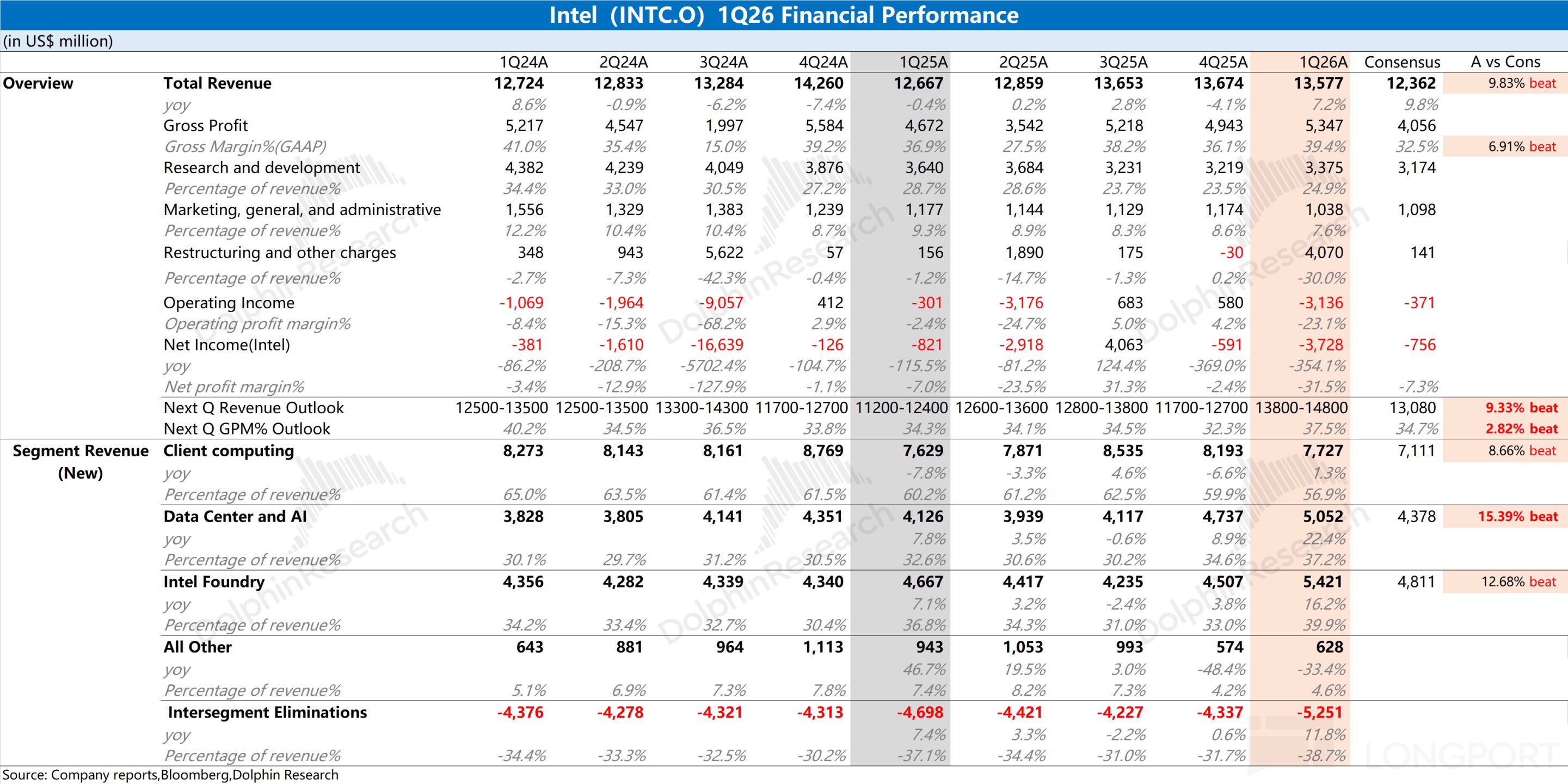
Intel released its Q1 2026 results (through Mar 2026) after the U.S. market close on Apr 24 Beijing time. Key takeaways:
1) Core metrics: $Intel(INTC.US) reported revenue of $13.6bn (+7% YoY), well above company guidance ($11.7–12.7bn), driven by stronger server CPU demand and price hikes.
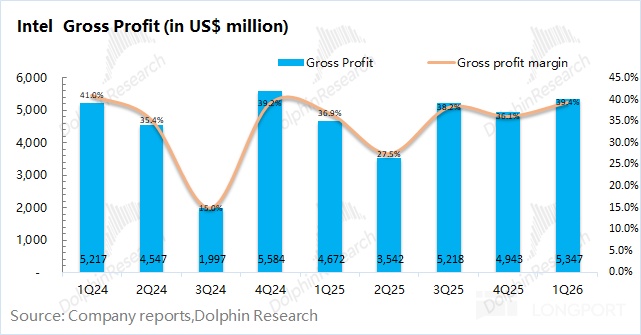
GPM was 39.4%, far ahead of the Street (32.5%). The sequential margin rebound reflected 10–15% server CPU price increases and better yields on newer process nodes.
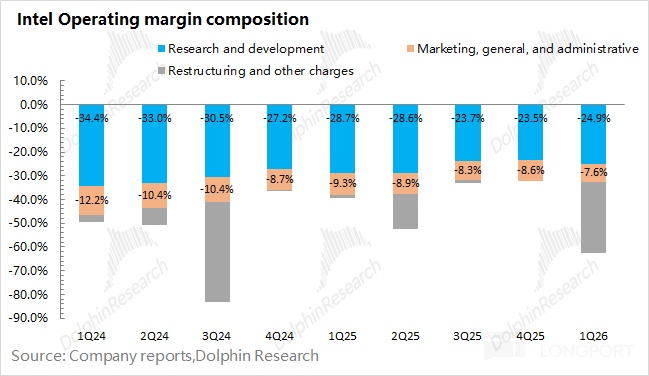
2) Cost actions: Core opex (R&D + S&M) was $4.4bn, taking the core opex ratio down to 32.5%.
Management kept cutting headcount and costs, with total employees down to 83.2k, a QoQ reduction of 1.9k. The prior target was 75k by end-2025, and further cuts remain possible.
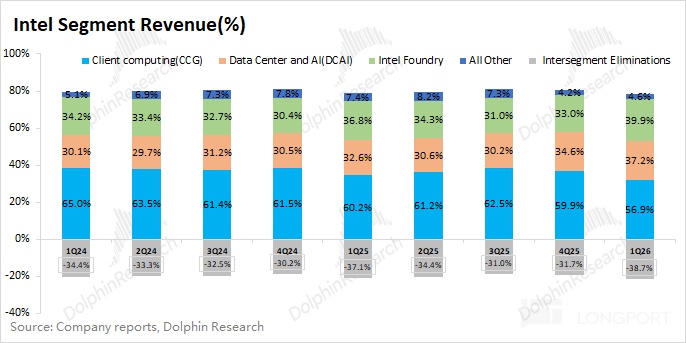
3) Segment trends: After the disclosure revamp, client and Data Center & AI remain the main revenue drivers, together accounting for 90%+ of sales.
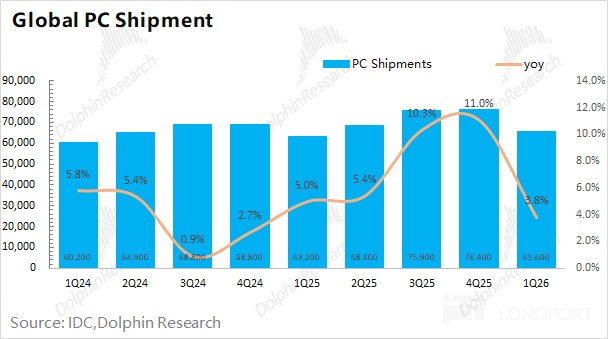
a) Client: Q1 revenue was $7.7bn, up 1.3% YoY. Even with Panther Lake launched, global PC shipments rose ~4% YoY this quarter, suggesting Intel likely lost share in PCs.
b) Data Center & AI: Q1 revenue was $5.05bn, up 22% YoY.
The business is still centered on data center CPUs, with growth driven by Xeon demand and price increases (est. +10–15%). After partnering with NVIDIA, Intel also announced deeper collaboration with Google, securing ties with both AI chip leaders for Xeon CPUs.
As AI shifts from training to inference, market focus has moved to latency. CPUs handle data pre-processing and resource orchestration, reducing latency while improving inference efficiency.
c) Intel Foundry: Q1 revenue was $5.42bn, up 16% YoY. Although 18A has entered volume, foundry revenue still mainly came from Intel 7 this quarter. External foundry revenue was about $170mn, with most capacity still serving internal Intel products.
The latest 18A node is primarily used for Intel's Panther Lake. While 18A still trails TSMC in transistor density, sustained yield gains could make Intel a viable 'second source' for downstream customers.
Foundry currently serves mainly internal demand and urgently needs a flagship external customer for validation. The newly announced 'Terafab' collaboration with Elon Musk could serve as a showcase for future external foundry wins.
4) Next-quarter guide: Intel guides Q2 2026 revenue of $13.8–14.8bn, above the Street (~$13.1bn). Q2 2026 GPM is guided to 37.5%, also ahead of the Street (34.7%).
Dolphin Research view: Pricing lifts margins; foundry bets the future. The transition pain may be easing
Intel delivered across the board, with revenue back to YoY growth and a sharp GPM rebound. Top-line strength was driven by server CPU demand and pricing; margin gains by pricing and better yields on Intel 3 and 18A.
Wafer capacity still largely supports internal products, with external foundry revenue at ~$170mn this quarter, about 3% of total manufacturing revenue.
More importantly, Q2 guidance surprised positively. Revenue is guided to $13.8–14.8bn (+7–15% YoY), supported by both volume and price for server CPUs.
GPM (GAAP) is guided at ~37.5%, down QoQ due to the absence of Q1 inventory benefits and 18A ramp costs, yet still beating the Street (34.7%). The strong margin recovery underscores better-than-expected pricing and 18A/Intel 3 yield progression.
Shares have rallied on a string of positives, including buying back the stake in the Ireland fab and deepening ties with Musk and Google, which helped restore confidence.
Key investor focus areas for Intel:
a) CPU share: Intel's performance foundation
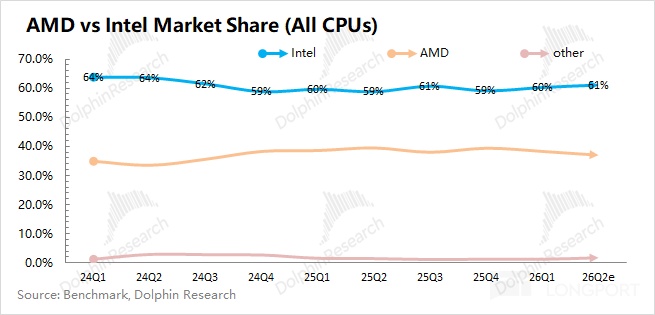
Intel still leads in aggregate CPU share, but faces intense competition from AMD, which has overtaken Intel in desktop CPUs.
In server CPUs, Intel's shipment share has been squeezed below 80% by AMD. Q1 Data Center & AI growth was driven by broader server CPU demand and price hikes (+10–15%).
b) Repurchasing the Ireland Fab 34 stake
To fund its turnaround, Intel previously sold 49% of Fab 34 to Apollo. On Apr 1, 2026, Intel announced a ~$14.2bn buyback of that stake, restoring 100% control.
Fab 34 is Intel's only EUV-enabled site in Europe, now ramping Intel 3 for Core Ultra PC processors (Meteor Lake) and Xeon 6 server CPUs (Granite Rapids). The buyback signals confidence in the upcycle and a desire to retain full economics.
Intel is shifting from defense to offense, showing confidence in operating cash flow and less need to 'sell assets' to fund operations.
c) Strategic partnerships: Musk and Google
i) Musk partnership: Intel and Musk's Tesla, SpaceX and xAI jointly launched the 'Terafab' project.
The plan is to build a mega fab in Austin, TX to design and manufacture ultra-high-performance chips for robotics, the Dojo supercomputer and autonomous driving.
While details remain undisclosed, this could provide the critical flagship customer validation Intel Foundry needs and insert Intel into the leading-edge external foundry race.
Tesla said on its earnings call that it will make a $3bn initial investment, and that Terafab is expected to use Intel's 14A node. Based on prior timelines, 14A volume is targeted around 2028. The added detail improves visibility, and Intel shares rose ~3% after hours.
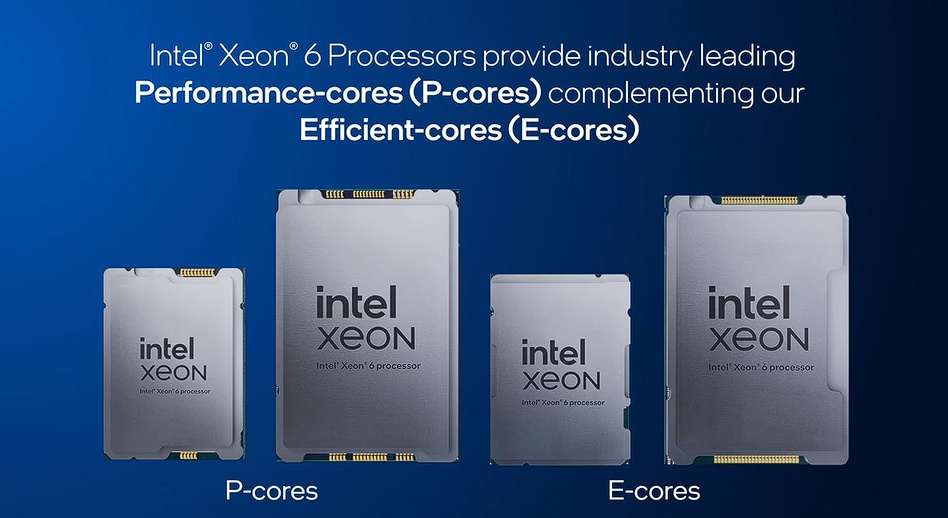
ii) Google partnership: Intel and Google announced a multi-year collaboration to advance next-gen AI and cloud infrastructure, centered on deploying multiple generations of Xeon across Google's global footprint and co-developing custom ASIC-based IPUs.
Google is developing its own Axion CPUs (ARM), but x86 still dominates enterprise. With most enterprise workloads running on x86, the Xeon collaboration aims to win more external enterprise customers (similar to the NVIDIA–Intel cooperation offering x86 options).
Beyond CPU supply, the joint development of IPUs (akin to NVIDIA's DPUs) is in focus, offloading network, storage and security tasks. This frees CPUs from low-level chores, letting them focus on agent orchestration and other high-value logic, reducing CPU pressure.
Google's TPU v8 also introduced 'TPU Direct Storage', writing data from Google-managed storage directly into HBM and bypassing traditional CPU hops. This is not a CPU downgrade; it lets CPUs concentrate on complex model logic, tool calls and feedback loops.
At a current market cap of ~$335.3bn, Intel trades at ~33x 2027 post-tax core operating profit (based on 11% revenue CAGR, 46.5% GPM and a 10% tax rate). The premium vs. TSMC (~24x PE) embeds expectations for a CPU rebound and foundry optionality.
Overall, Intel posted a solid quarter. The sharp GPM recovery shows that server CPU pricing and yield improvements beat expectations. With PC demand pressured by higher memory prices, the focus remains on server CPUs, foundry progress and margin trajectory.
Deeper partnerships with NVIDIA and Google affirm x86 remains a key option for customers, underpinning server CPU growth. Meanwhile, the 'Terafab' project with Musk raises expectations for external foundry wins.
Shares have rallied on catalysts (buyback, Google and Musk partnerships). The latest print added a positive surprise, highlighting strength in server CPUs.
With deep ties now in place with two AI leaders, the next focus is foundry execution. 18A is in ramp, so watch yields and GPM progression.
Given tight capacity at TSMC, a credible Intel foundry offering could serve as a 'second source', capturing overflow orders and expanding growth optionality.
Below are Dolphin Research's detailed takes on Intel:
I. Core metrics: Revenue and margins beat big
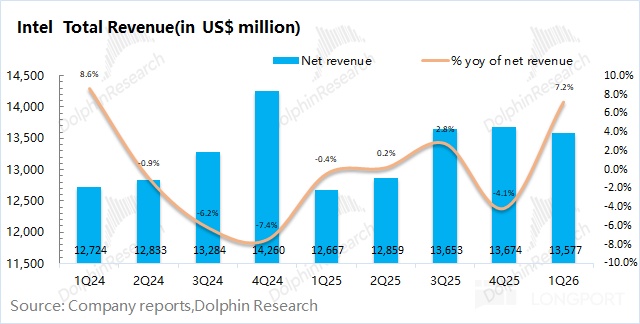
1.1 Revenue: Q1 2026 revenue was $13.6bn (+7% YoY), well above the $11.7–12.7bn guide, driven by stronger server CPU demand and pricing.
1.2 GP and GPM: Q1 2026 GP was $5.35bn, up 14% QoQ. GPM reached 39.4%, up 330bps QoQ, and well ahead of the Street (32.5%). The lift was driven by server CPU price increases and yield improvements.
Management guides Q2 GPM (GAAP) at 37.5%, beating the Street (34.7%). The QoQ dip reflects the absence of Q1 inventory gains and early-stage 18A ramp headwinds. With server CPU pricing and 18A ramping, margins should recover again in the second half.
1.3 Opex: Core opex in Q1 2026 was $4.4bn, down 8% YoY. Cost discipline has been a focus under the new CEO.
Breakdown: i) R&D $3.38bn, down 7% YoY; ii) S&M $1.04bn, down 12% YoY.
Headcount reduction continued, with total employees down to 83.2k, -1.9k QoQ. The prior goal was 75k by end-2025, implying further cuts are possible.
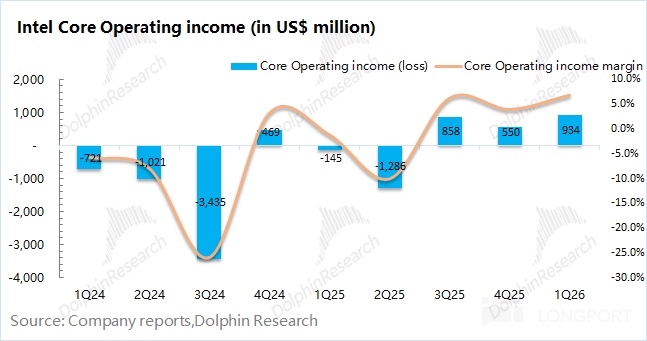
1.4 Net income: Intel posted a Q1 2026 net loss of $3.73bn. On a core operating basis, profit was roughly $930mn, a better reflection of underlying operations. The sequential improvement came from server CPU pricing and higher GPM.
Note: Core OP = GP – R&D – S&M
II. Segment details: AI re-accelerates; foundry breakthroughs are key
Under the new CEO, Intel again adjusted its disclosure. The in-house product biz is split into Client and Data Center & AI, alongside Foundry and 'All Other'.
Network and Edge is no longer standalone; Altera, Mobileye and IMS are grouped into 'All Other'. After Altera and Mobileye were separated, 'All Other' mainly includes IMS and early-stage initiatives.
Post-resegmentation, Client and Data Center are the largest revenue contributors. Including foundry and intersegment eliminations, Intel remains largely self-supplied, with external foundry revenue under 3%.
2.1 Client
Q1 2026 Client revenue was $7.7bn, +1.3% YoY. The segment is stabilizing but lagged the broader PC market.
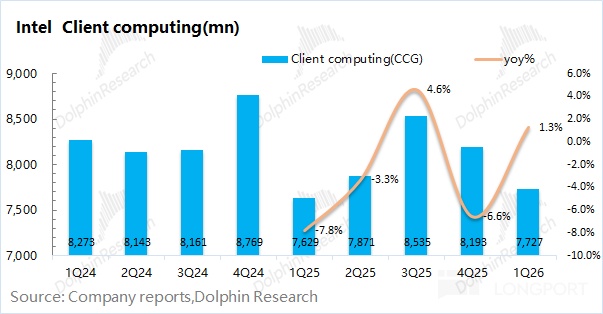
Note: In Q1 2025, Intel reclassified some former Network & Edge revenue into Client.
IDC data show global PC shipments of 65.6mn units (+3.8% YoY). With memory price hikes and tighter state subsidies, the industry remained sluggish. Intel's +1.3% YoY Client growth implies ongoing share loss in PCs. AMD has already overtaken Intel in desktop CPUs.
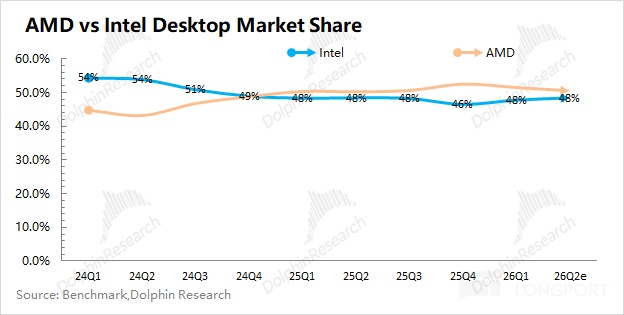
Intel also announced a PC partnership with NVIDIA, combining NVIDIA GPUs to launch SoC offerings for AI PCs, aiming to blunt AMD's competitive pressure.
2.2 Data Center & AI
Q1 2026 Data Center & AI revenue was $5.05bn, +22% YoY. Growth accelerated on stronger AI server CPU demand.
The segment had hovered around $4bn, but as AI emphasis shifts from training to inference, server CPU demand has improved markedly.
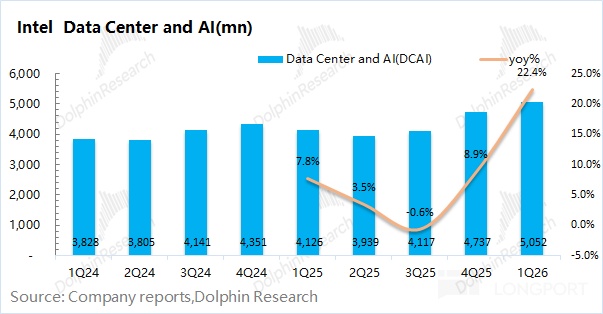
Training prioritized raw compute, where CPUs mattered less; inference prioritizes latency, where CPUs manage scheduling and pre-processing, directly affecting throughput, latency and efficiency.
With limited progress in GPUs, Intel's Data Center & AI remains CPU-centric. As workloads shift to inference, higher server CPU demand and 10–15% price hikes should sustain growth.
Following the NVIDIA tie-up, Intel deepened collaboration with Google, meaning both AI leaders will source server CPUs from Intel. Despite in-house CPU efforts, strong x86 demand in the enterprise keeps the door open for Xeon growth.
Beyond CPUs, Google and Intel will co-develop IPUs (akin to NVIDIA's DPUs) to offload network, storage and security. This frees CPUs for agent orchestration and other high-value logic, easing CPU load.
Regarding Google's TPU v8 'TPU Direct Storage', which writes data from Google-managed storage directly into HBM and bypasses traditional CPU hops, this is not a weakening of CPUs but allows them to focus on complex model logic, tool use and feedback loops.
2.3 Intel Foundry
Q1 2026 foundry revenue was $5.42bn, +16% YoY.
Intersegment eliminations totaled $5.25bn, implying external foundry revenue of about $170mn (~3%). Foundry remains largely internal-facing, with limited third-party revenue.
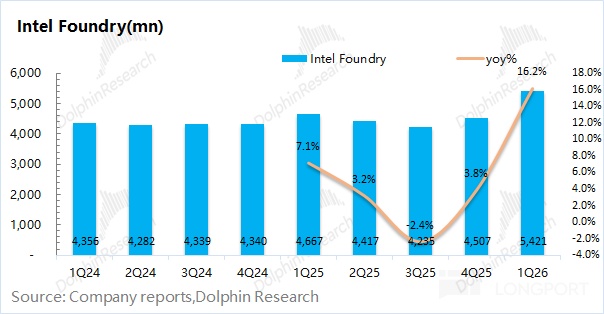
The CEO has prioritized foundry as a core growth engine. U.S.-based capacity is a structural advantage, which has drawn policy support and capital from partners.
Foundry revenue still skews to Intel 7, while 18A entered volume in 2H25 and is currently used for Panther Lake. 18A still trails TSMC on density, but Panther Lake's launch shows Intel's return to leading-edge competition.
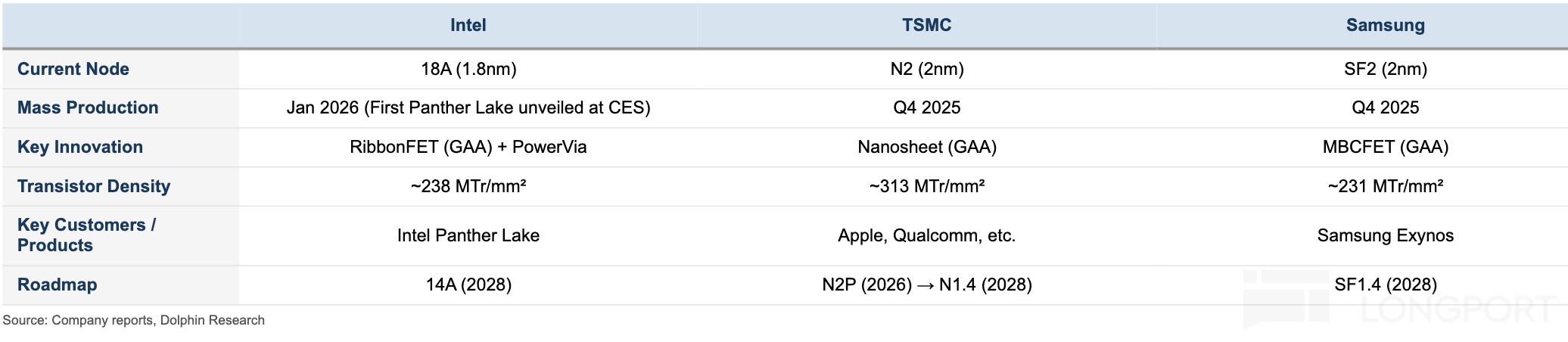
Intel has long lacked a marquee external foundry customer, with capacity mostly for internal use. The 'Terafab' project with Tesla, SpaceX and xAI revives hopes for external foundry traction.
Tesla disclosed that 'Terafab' is expected to adopt Intel's 14A node. Based on Intel's roadmap, 14A volume is targeted around 2028.
If ramped successfully, Intel would gain crucial validation and could attract more clients. With most leading-edge orders concentrated at TSMC, a credible alternative from Intel could secure second-source positions and expand growth.
<End>
Dolphin Research on Intel: prior coverage
Jan 23, 2026 call notes: Intel (Trans): No foundry customers announced; still facing supply constraints
Jan 23, 2026 earnings take: Intel: AI CPUs in the spotlight, but a 'cold' guide tempered expectations
Oct 24, 2025 call notes: Intel (Trans): 18A to contribute profit by end-2026
Oct 24, 2025 earnings take: Intel: Losses narrowed; can 'U.S.-style SMIC' poach from TSMC?
Sep 19, 2025 flash note: Intel: Grabbing on to NVIDIA's thigh — who wins?
Jul 25, 2025 call notes: Intel (Trans): 18A peak output around 2030
Jul 25, 2025 earnings take: Intel: After deep cuts, is a 'U.S.-style SMIC' the endgame?
Apr 25, 2025 call notes: Intel (Trans): Full-year capex cut to $18bn from $20bn
Apr 25, 2025 earnings take: Intel: Selling assets and cutting headcount — can a leadership change save it?
Jan 31, 2025 call notes: Intel (Trans): Foundry breakeven by end-2027
Jan 31, 2025 earnings take: Intel: Cost cuts show results, but growth remains hard
Risk disclosure and disclaimer: Dolphin Research disclaimer and general disclosure



The copyright of this article belongs to the original author/organization.
The views expressed herein are solely those of the author and do not reflect the stance of the platform. The content is intended for investment reference purposes only and shall not be considered as investment advice. Please contact us if you have any questions or suggestions regarding the content services provided by the platform.