
D
Apr 27 at 01:24 PM
ORCL: Big Bet on AI Compute — Are the Odds Good Enough?
 I'm LongbridgeAI, I can summarize articles.
Per Dolphin Research’s prior coverage on $Oracle(ORCL.US) here, our core take is that Oracle is essentially a scaled-up CoreWeave. The key bull case is an AI-driven surge in compute demand that could lift compute rental revenue by an order of magnitude or more. The key risk, however, is uncertainty in AI demand vs. committed upfront Capex and debt, which could leave the company exposed to substantial credit losses if the AI cycle falters.
Overall, this is a high-variance name with limited visibility, where risks and opportunities coexist and the stock carries sizable upside and downside optionality. The setup is more of a trading proposition than a defensive compounder.
In this valuation piece, we focus on four questions: 1) the revenue mix and outlook across legacy vs. AI-linked businesses, 2) how much AI compute revenue is embedded in guidance and how achievable it looks, 3) the impact from AI-related Capex and leverage and the ultimate earnings contribution, and 4) Oracle’s value across scenarios.
Below is the detailed analysis.
I. Forecast framework — building blocks
As discussed previously, Oracle is in a starkly bifurcated state. On one side, everything outside OCI is effectively in ‘late-cycle’ mode, with OCA SaaS growing just above 10% YoY, and Software, Hardware, and Services running low single-digit growth.
This cohort, still ~70% of total revenue in FY26, lacks catalysts but offers visibility. Revenue is fairly predictable and delivers software-typical high GPM (often 60%–70%+) and steady cash flow, serving as the baseline ‘foundation’ of Oracle’s business and valuation.
On the other side, the critical OCI segment (IaaS + PaaS) concentrates both the upside and the risk. Under Oracle’s long-term FY25–FY30 guide, total revenue grows from $57 bn to $225 bn (~4x), with ~92% of the incremental ~$155 bn from OCI, and AI could ultimately drive even more.
Flip side: AI compute demand is concentrated in a few very large customers and requires massive upfront Capex. Oracle posted two consecutive quarters of ~$10 bn net cash outflow and now carries interest-bearing debt at ~2.4x book equity, implying material balance sheet risk and the theoretical possibility of equity wipeout.
Net-net, uncertainty is very high. AI could multiply revenue several times over, but aggressive expansion and execution or judgment errors in building out compute could inflict heavy losses on the company and shareholders.
To address this polarization, our valuation framework splits in two. We first lay out the foundation value from non-OCI ‘base’ businesses, then layer in scenario-based expectations for OCI to arrive at total equity value.
1.1 Snapshot of the ‘foundation’ businesses
Step one is to anchor expectations ex-OCI. The ‘foundation’ includes: OCA SaaS under the Cloud umbrella, legacy Software (licenses + support), Hardware (servers, databases, etc.), and Consulting (training and related services).
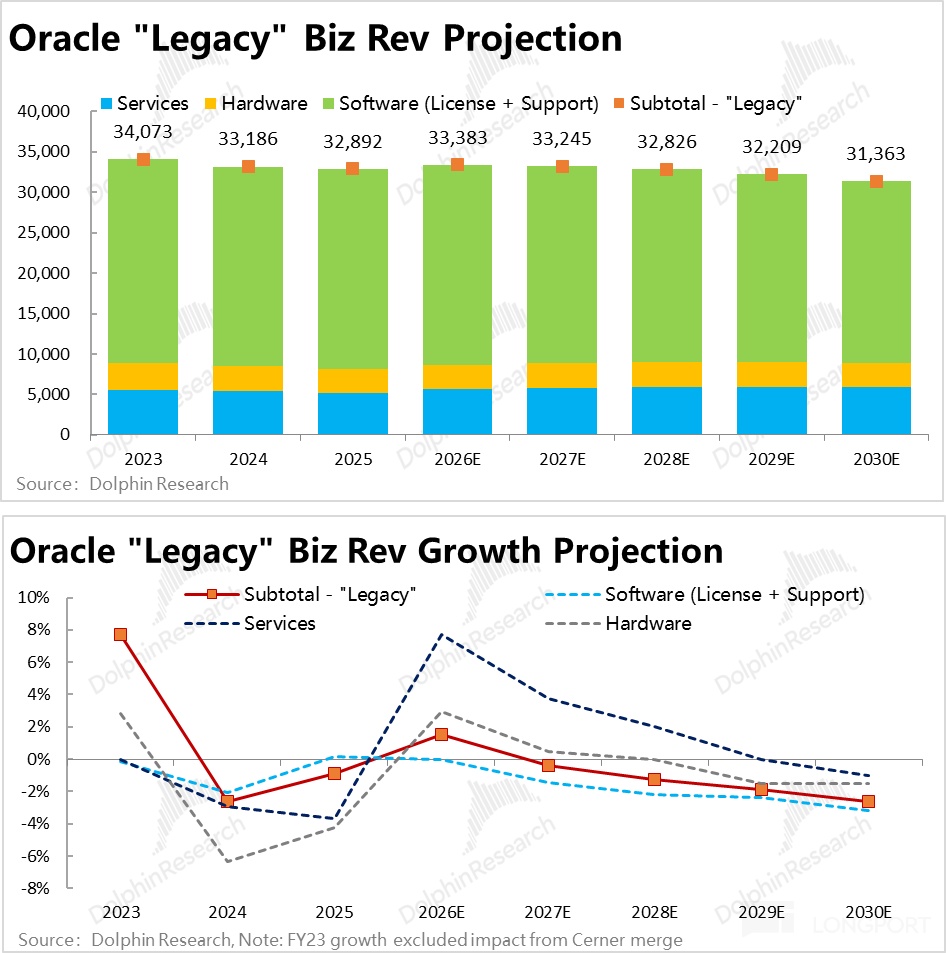
Software + Hardware + Consulting — gradual decline: Given historical trends and the secular shift to cloud and AI, our base case assumes legacy Software and Hardware continue low single-digit YoY contraction. We err on the side of simplicity and prudence.
The chart below shows our forecasts for these segments. In aggregate, we expect the three ‘foundation’ segments to post a -2% CAGR over FY26–FY30.
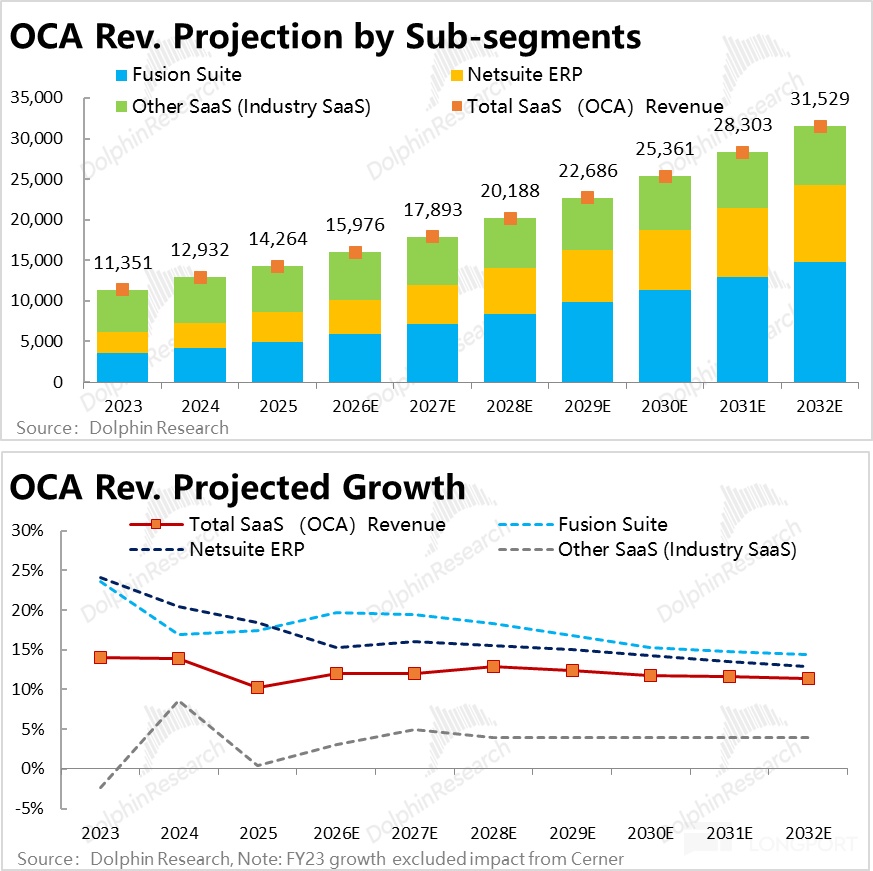
OCA steady growth: OCA SaaS (just over 20% of total revenue) splits into two lines: a) Strategic Back-Office (ERP, HCM, SCM), and b) other offerings centered on vertical SaaS, where Oracle is relatively weaker and growth has hovered around low single digits (±) in recent years.
The larger Back-Office line (60%+ of OCA) further breaks down into two suites by customer size: Fusion for larger enterprises and NetSuite for SMEs and startups. Management disclosed that Fusion ERP and NetSuite ERP each delivered roughly $1.1 bn in quarterly revenue over the last two quarters, together ~55% of OCA revenue, underscoring their importance.
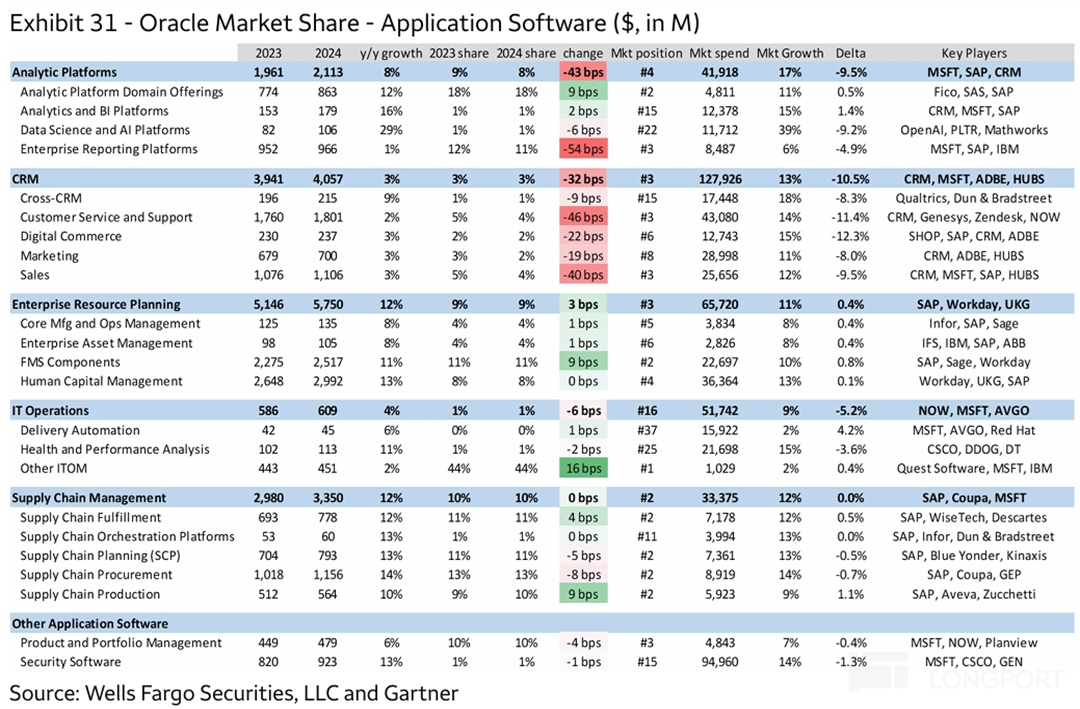
Industry checks confirm Oracle’s top-tier position in back-office applications, ranking top 3 by share. In CRM, ERP, and SCM, Oracle is typically No. 2–3 behind SAP and Salesforce, while in areas like Analytics and IT Ops its ranking slips, highlighting a clear strength-vs.-weakness split.
Given Fusion and NetSuite ERP have sustained ~15%–25% growth over the last 2–3 fiscal years and Oracle’s leading position in back office, we assume Strategic Back-Office grows ~15%–16% CAGR during FY26–FY30. This drives OCA overall to ~12% average growth in the same period.
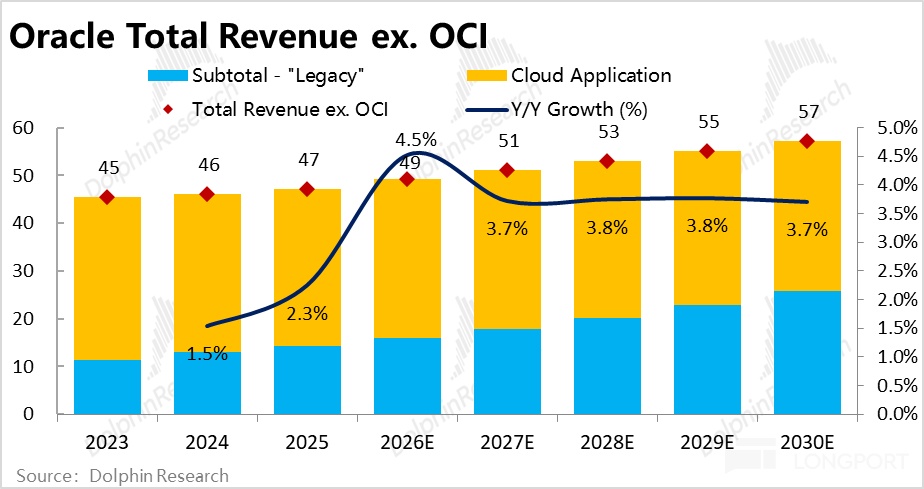
Combining legacy segments with OCA SaaS, we project Oracle’s ex-OCI revenue to rise from ~$49 bn in FY26 to ~$56.7 bn in FY30 (CAGR 3.6%), about 100 bps below management’s implicit guide.
What could drive deviations? Key swing factors: a) downside — rapid AI substitution of traditional enterprise software could cause a cliff-like decline rather than a gradual fade in legacy and even SaaS; b) upside — explosive OCI growth could attract new clients and enable cross-sell, lifting the foundation businesses as well.
We think large-scale cross-sell from AI compute is unlikely near term, given the customer mix skewed to hyperscalers and AI labs, not broad-based enterprises. It is hard to see OpenAI adopting Oracle’s SaaS or databases just because it rents compute from Oracle.
Conversely, AI displacement risk for legacy enterprise software, while not imminent, cannot be ruled out given rapid iteration. Hence, we assign higher probability to downside than upside for legacy trends and keep expectations conservative for Software and Hardware revenue.
1.2 Deep dive into OCI
We further break OCI into three buckets: legacy (Gen1 and managed hosting), Database cloud, and Core OCI (narrow IaaS — compute, storage, network), with legacy + Database grouped as Non-Core.
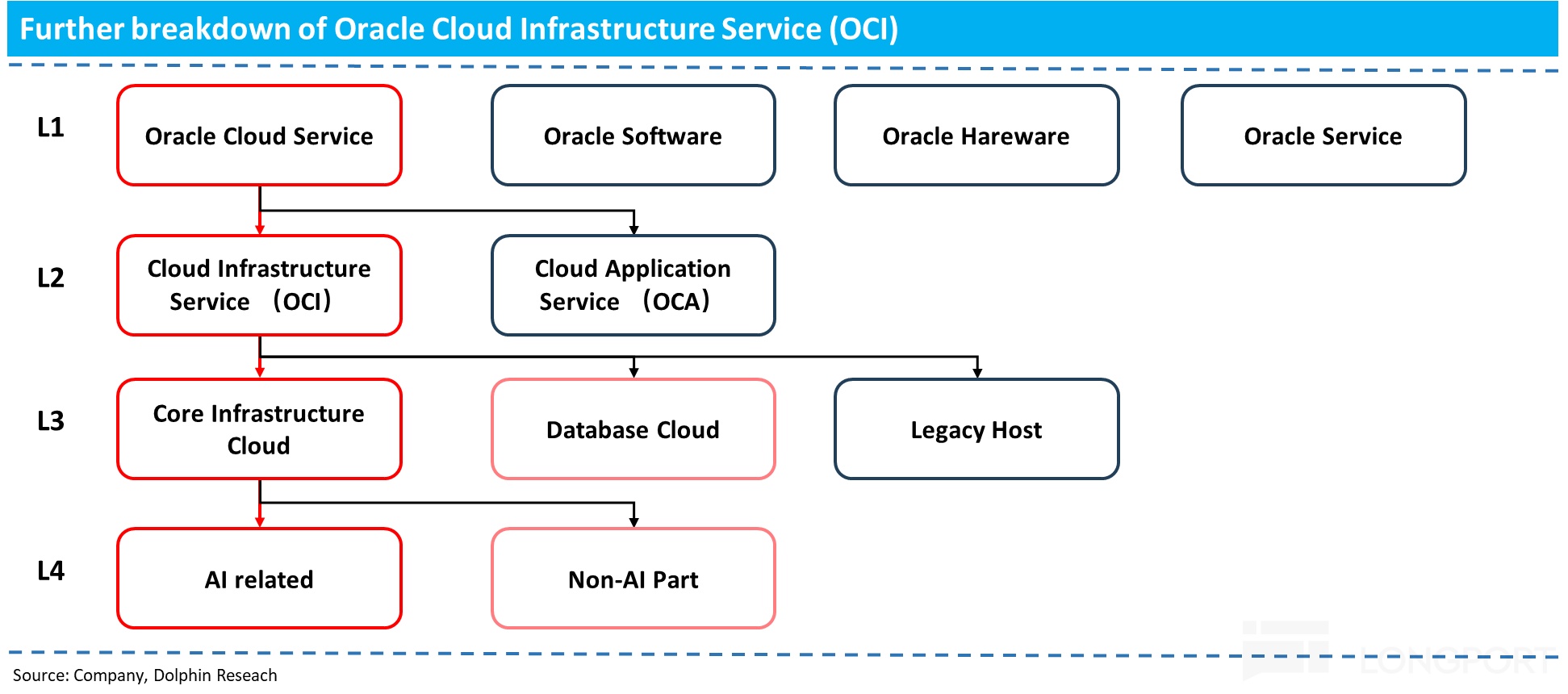
1) Legacy Hosting: residual Gen1 and managed services for on-prem or third-party cloud deployments of Oracle software/databases. This is <3% of OCI revenue and shrinking slowly, hence low strategic importance.
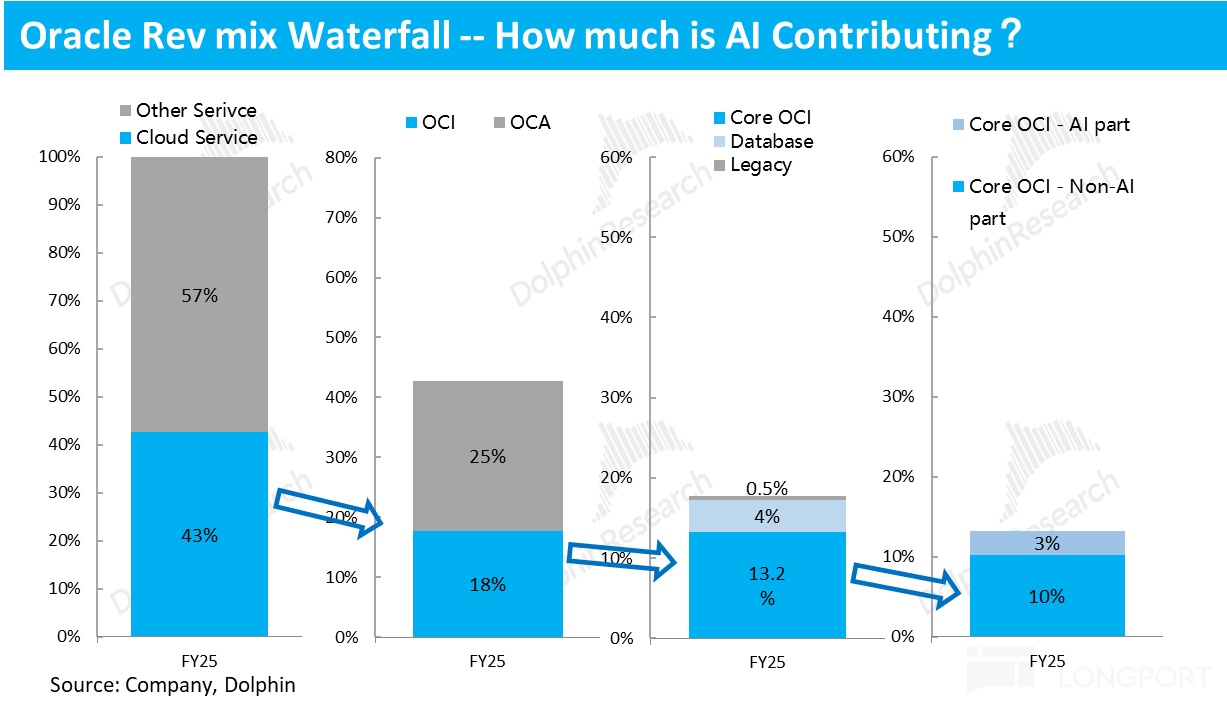
2) Database cloud: one of Oracle’s most differentiated products (e.g., Autonomous Database, Exadata Cloud Service). Street estimates put FY25 Database cloud revenue at ~$2.0–2.1 bn (~22%–23% of OCI), growing 20%–30%+ YoY in FY24–FY25, indicating healthy momentum.
3) Core OCI: the narrow IaaS offering — renting compute, storage, and network via bare metal, VMs, or large clusters. We estimate Core OCI delivered $7.5 bn+ in FY25, ~75% of OCI revenue.
We further split Core OCI into AI-related and non-AI. a) Non-AI compute: mainly CPU-based workloads for enterprise customers. For FY25, revenue was just under $6 bn, still larger than AI compute, and grew ~40%–50% YoY in FY24–FY25.
Even without AI and big OpenAI orders, Core OCI has runway with traditional workloads, as its ~5% share of global IaaS (by revenue) in FY25 leaves room for share gains. b) AI compute — the wild card: as of FY25, AI compute revenue was < $2 bn (~3% of total), but growth is blistering with 200%+ annual growth projected in FY23–FY26.
1.3 What could OCI revenue be?
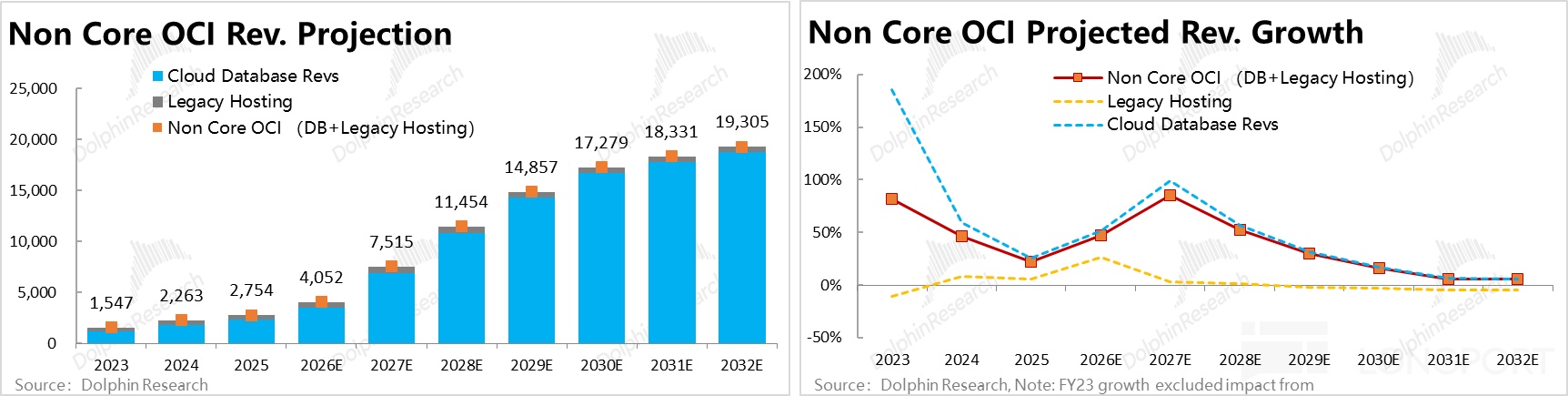
1) Non-Core OCI
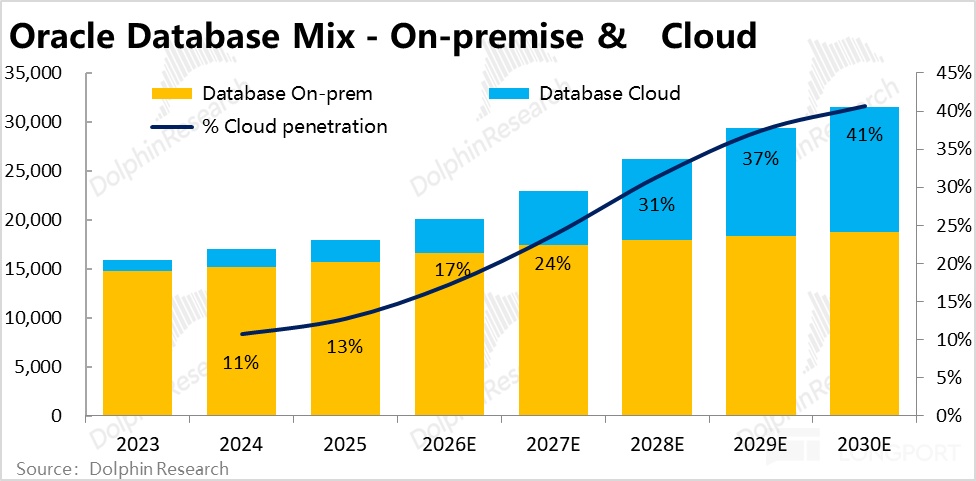
Legacy Hosting is small and likely to continue low single-digit YoY declines as cloud and AI advance. For Database cloud, we expect solid growth: a) structural strength with recent momentum, and b) by FY25, cloud Database revenue is <15% of the on-prem licenses+support database base, leaving meaningful migration upside.
2) Core OCI
Given the uncertainty in forecasting AI compute needs over five years, we anchor to company guidance as the base case and test for achievability. We then adjust based on validation.
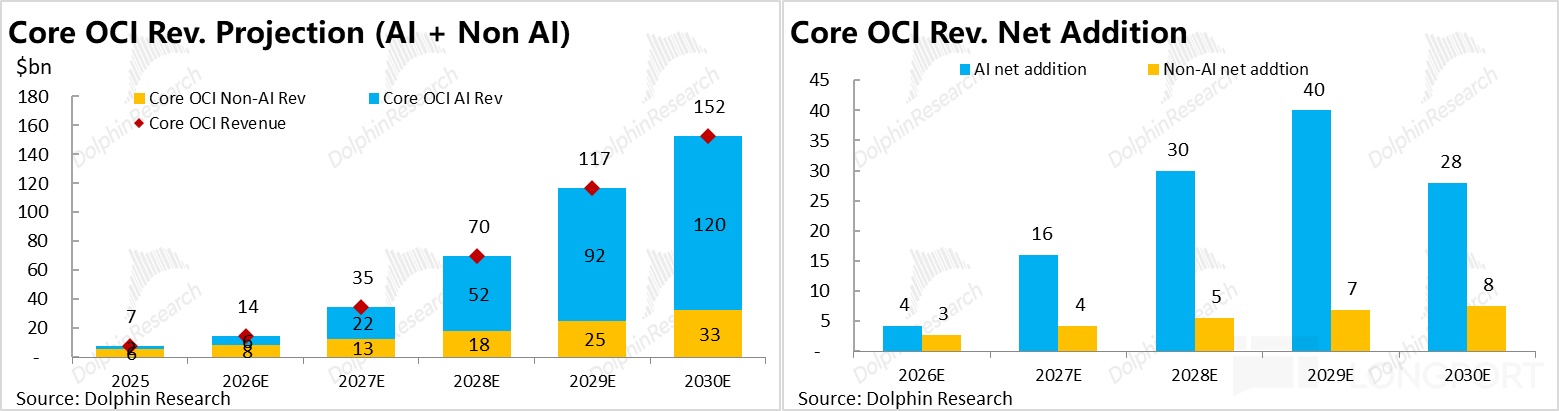
From the latest post-F3Q26 OCI guidance, backing out Non-Core implies Core OCI revenue must surge from ~$14 bn in FY26 to >$150 bn in FY30. Within that, a) AI compute grows from < $6 bn in FY26 to ~$120 bn in FY30, and b) non-AI compute rises from ~$8 bn to ~$33 bn (CAGR ~42%), with some uplift from AI halo effects.
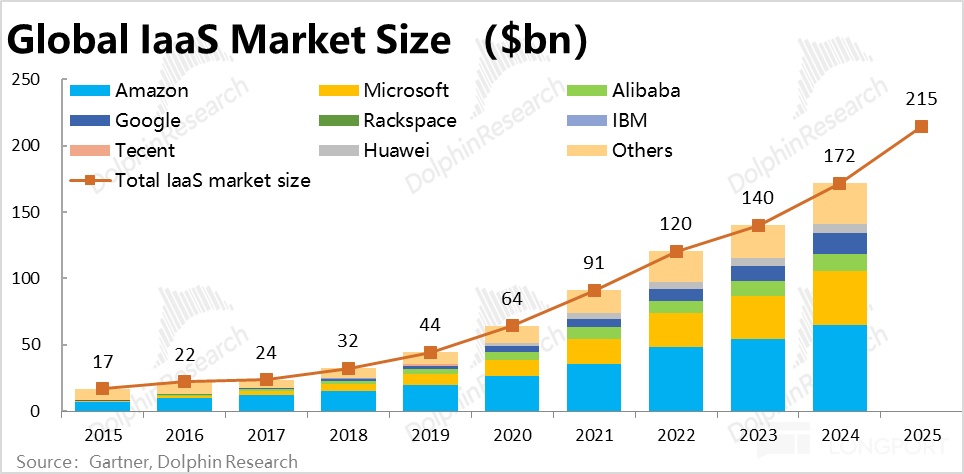
How big is $150 bn IaaS revenue? Two lenses: a) Gartner puts global IaaS revenue at ~$215 bn in CY25 (IaaS only). Oracle’s Core OCI in FY30 (~CY29) would be >60% of CY25 global IaaS.
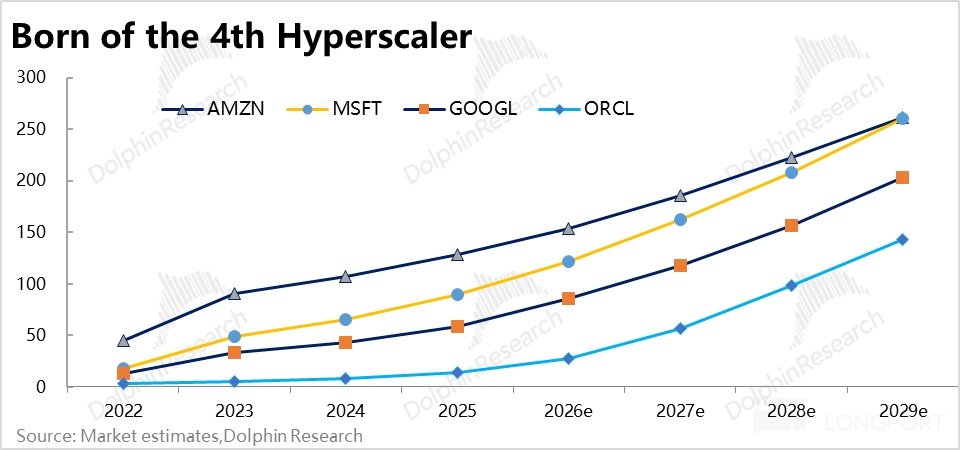
b) From a dynamic view, total OCI (IaaS + Database + Legacy) by FY30 would approach Google Cloud’s revenue and reach ~50%–55% of AWS or Azure. That would make Oracle the fourth hyperscaler.
II. Can Core OCI hit its revenue target?
2.1 Cross-check suggests ~$100 bn is more realistic near term
Oracle’s investment case hinges on how much of the Core OCI target is achievable. We triangulate with multiple approaches.
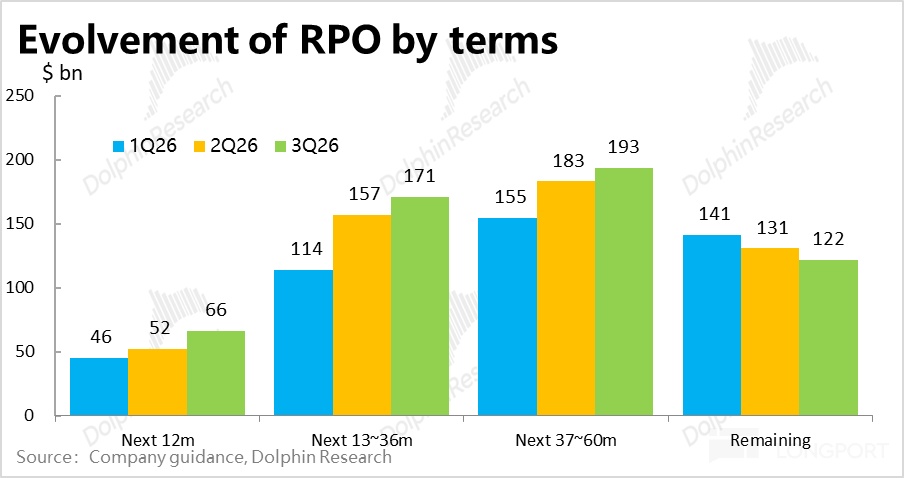
1) RPO coverage: Post-F3Q26, remaining performance obligations for the 13–36 month bucket are $17.1 bn, covering >91% of our FY28–FY29 Core OCI revenue estimates. The 37–60 month bucket is $19.3 bn, covering ~58% of FY30–FY31 Core OCI.
In simple terms, current RPO supports a Core OCI annual revenue peak of roughly ~$100 bn, leaving a sizable gap to the ~$150 bn FY30 target. Note: while Oracle does not break out RPO by segment, we follow the Street convention that 90%+ of >12-month RPO relates to OCI, increasingly skewed to Core OCI.
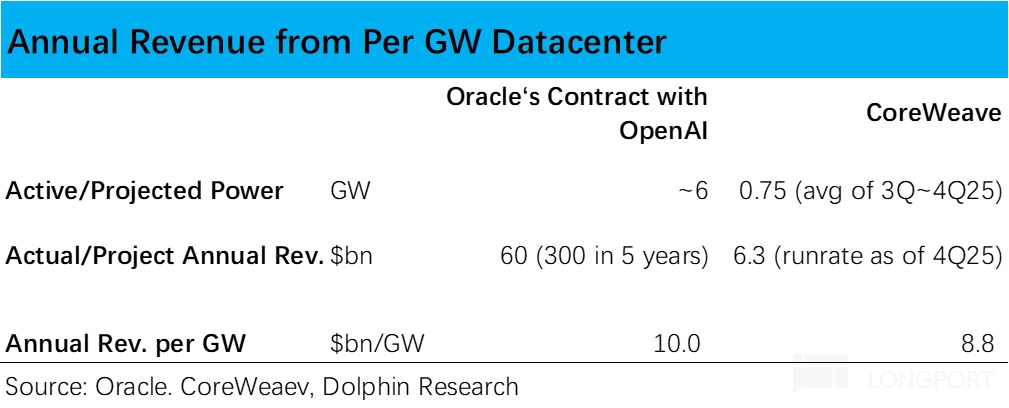
2) Supply capacity — GW check: Management indicates a 1 GW data center can generate ~$10 bn annual revenue. Two references validate this: the OpenAI-Oracle 5-yr $300 bn deal implies ~6 GW (i.e., ~$10 bn per GW per year), and CoreWeave’s FY25 4Q annualized $6.3 bn revenue vs. ~0.75 GW average online implies ~$8.8 bn per GW.
So ~$10 bn per GW is reasonable, with Oracle’s yield slightly above CoreWeave’s. Hitting $150 bn would require ~15 GW of online capacity.
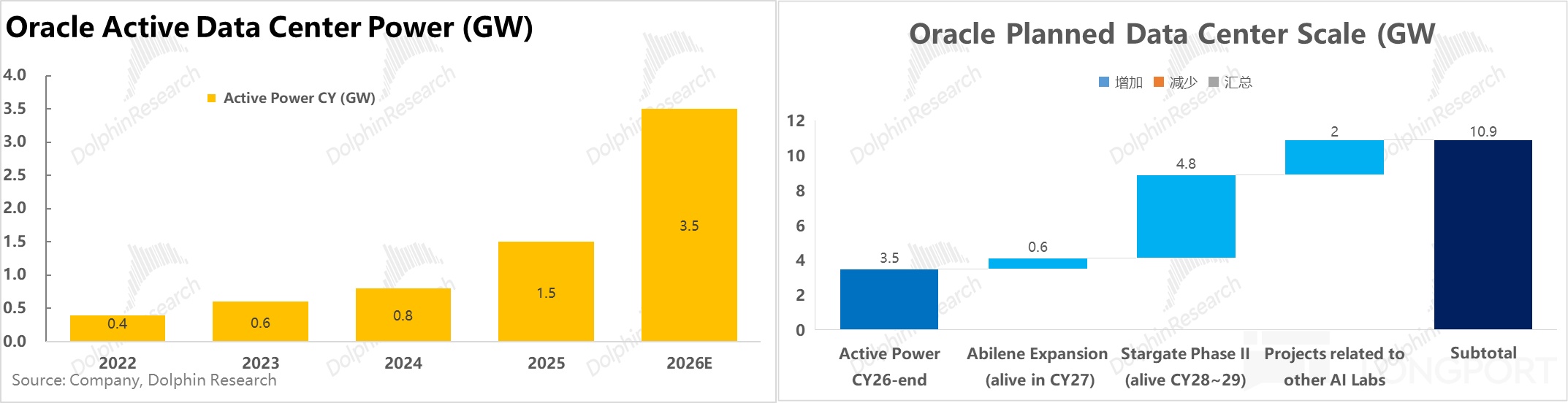
What is Oracle’s current and planned capacity? Market estimates suggest ~3.5 GW online by end-CY26, with ~7.4 GW planned thereafter: ~0.6 GW from expanding the Abilene project, ~4.8 GW from Stargate Phase II, and ~2 GW from partnerships with AI labs like xAI and Meta (the latter not publicly confirmed).
Total planned capacity sums to ~10.9 GW, supporting a Core OCI revenue peak of ~$110 bn, in line with the RPO-based peak. This still leaves a gap to the $150 bn FY30 goal. Another cross-check: as of F3Q26, Oracle disclosed $261 bn in committed data center lease obligations.
Assuming a 17-year average term and ~$2 bn/GW/year lease cost, implied signed-but-not-yet-utilized capacity is ~7.7 GW, broadly matching the planned post-CY26 ramp. This further indicates Oracle has not yet secured enough capacity for a 15 GW footprint.
Across RPO, planned capacity, and lease commitments, the implied Core OCI peak converges, showing a ~$40–50 bn annual revenue shortfall vs. target.
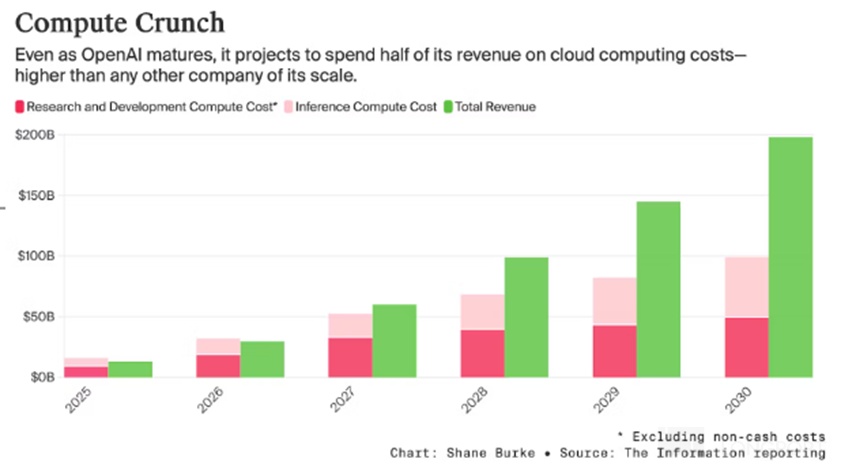
3) Demand sufficiency: How much compute will model providers need, and how much can end-users ultimately consume? The Information (late-2025) projects OpenAI at ~$200 bn revenue by 2030 and ~$100 bn total compute spend, roughly split between inference and training.
Oracle’s current contract with OpenAI (~$60 bn per year) already represents ~60% of OpenAI’s 2030 compute spend estimate. Unless OpenAI’s actual spend far exceeds that, it is unlikely Oracle can close the entire gap with additional mega-orders from OpenAI alone, as concentration risk will limit dependency on a single supplier.
Thus, Oracle likely needs additional large customers such as Anthropic to reach ~$150 bn in Core OCI revenue. This conclusion aligns with our supply-side checks.
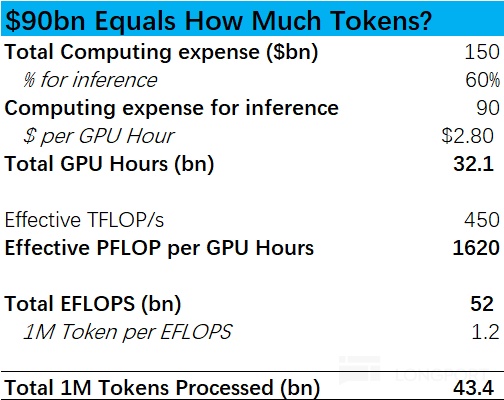
Finally, we estimate FY30 end-user demand capacity against Oracle’s $150 bn target by assuming 60% ($90 bn) for inference and 40% for training. Based on token economics assumptions, $90 bn of inference could translate into ~40–45 bn million-token outputs.
Using typical adoption heuristics, if a light user consumes 10 million-token units per year, that supports ~4 bn light users; if a heavy user (e.g., Agent users) consumes 500 units per year, it supports ~8 mn heavy users. This is for Oracle alone; the industry total would be >5x of that.
Hence, light chatbot usage alone cannot justify the global data center buildout and cloud revenue targets. Heavy-use cases must scale. That said, both the number of heavy users and tokens per heavy user could substantially exceed our base assumptions, implying total demand could indeed support Oracle’s $150 bn ambition — the open question is share capture.
In summary, as Agent-like heavy token consumers scale rapidly, industry-wide compute demand should be ample to utilize planned capacity across clouds. The constraint for Oracle is customer acquisition and data center supply to bridge the current gap to its longer-term revenue goal.
In other words, more partners and suppliers will be needed to reach the target.
III. How much profit from AI-led revenue ramp?
We next assess incremental profit from the above revenue path, focusing on the effects of AI on GPM, Capex, leverage, and interest expense. These are the key drivers of earnings translation.
3.1 How much GPM dilution?
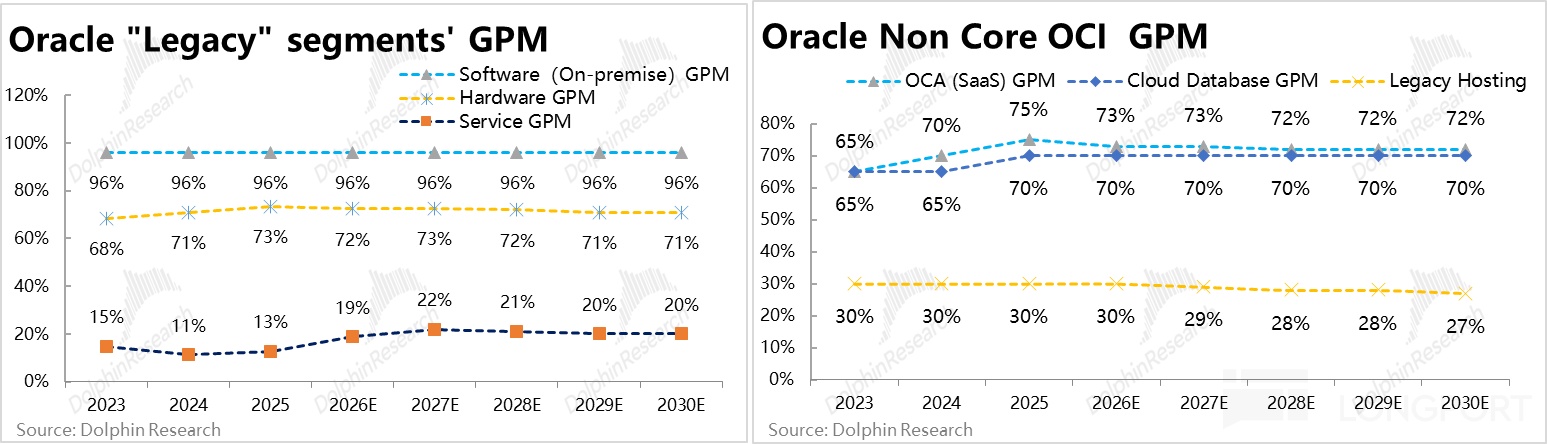
To gauge mix impact, we map GPM by product line using market research. Outside Core OCI, we group into: a) legacy Software with 90%+ GPM (near-zero marginal cost), b) OCA SaaS, Hardware, and Database cloud around ~70% GPM, and c) Legacy Hosting and Consulting at ~20%–30% GPM.
For these non-Core OCI lines, our base case assumes stable-to-slightly lower GPM, more cautious than the Street’s gradual improvement view. The main swing factor for consolidated GPM is mix shift toward lower-margin Core OCI and the steady-state GPM of AI compute.
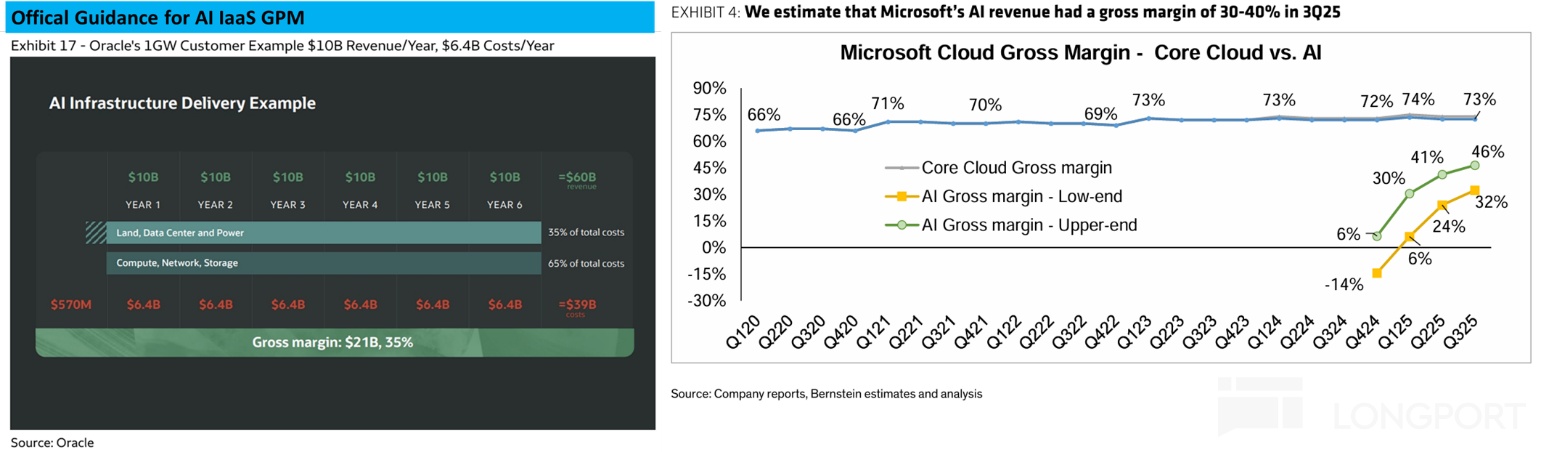
Management guides AI compute within OCI to a 30%–35% GPM. Cross-checks: a) CoreWeave’s steady-state GPM is ~25% by our prior estimates, and b) Bernstein pegs Microsoft’s AI cloud GPM at ~30%–40% in CY3Q25.
Given Oracle’s capabilities and scale sit between CoreWeave and Microsoft, its AI GPM should sit between the two, making management’s guide broadly credible. Oracle may exceed CoreWeave due to slightly higher unit pricing (GPU/hour) and scale efficiencies.
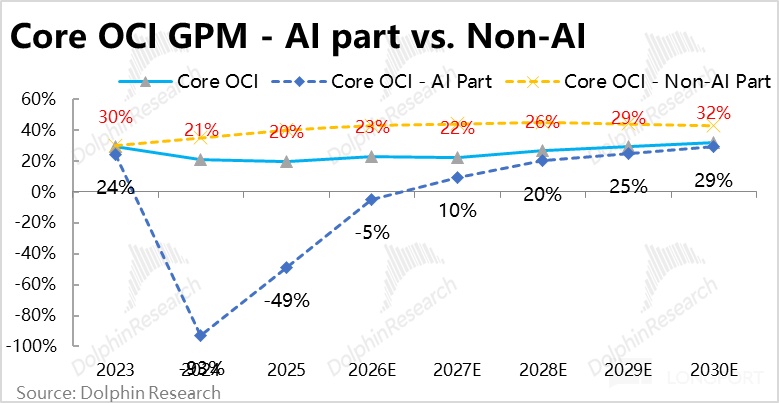
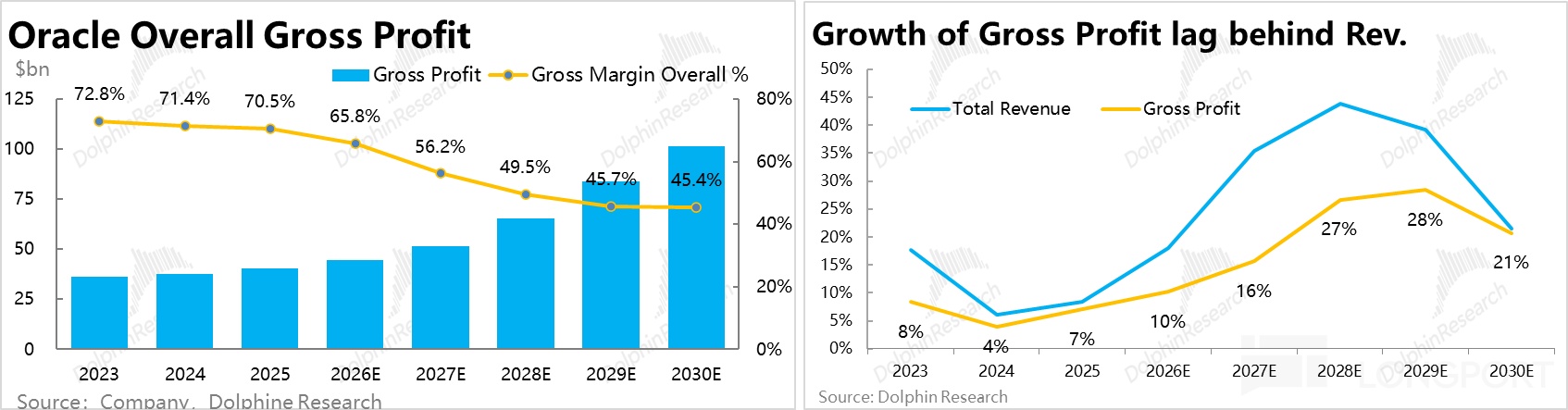
Specifically, we assume non-AI Core OCI GPM stabilizes just above 40%, while AI GPM turns positive in FY27 and approaches ~30% by FY30. On our mix model, Oracle’s consolidated GPM declines from just above 70% in FY25 to ~45% by FY30.
As a result, FY26–FY30 revenue growth will outpace GP growth, with FY30 GP at ~2.3x FY26 vs. revenue at ~3.3x. Growth will be less accretive to margins in this period.
3.2 Capex, leverage, and interest
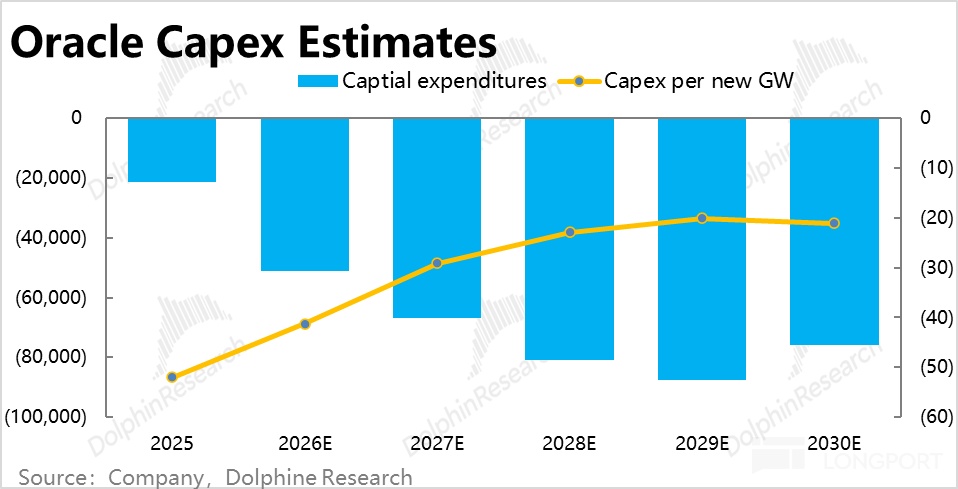
Management indicated each incremental 1 GW requires roughly $2.5 bn Capex for Oracle, below NVIDIA’s $5–6 bn per GW benchmark because Oracle leases shell data centers from third parties rather than building them. Facility, power, and cooling show up as rent in COGS/Opex, not Capex.
Oracle also noted some projects rely on customer prepayments or customer-provided GPUs, which could further reduce net Capex/GW. We assume ~$2.0 bn/GW in our model.
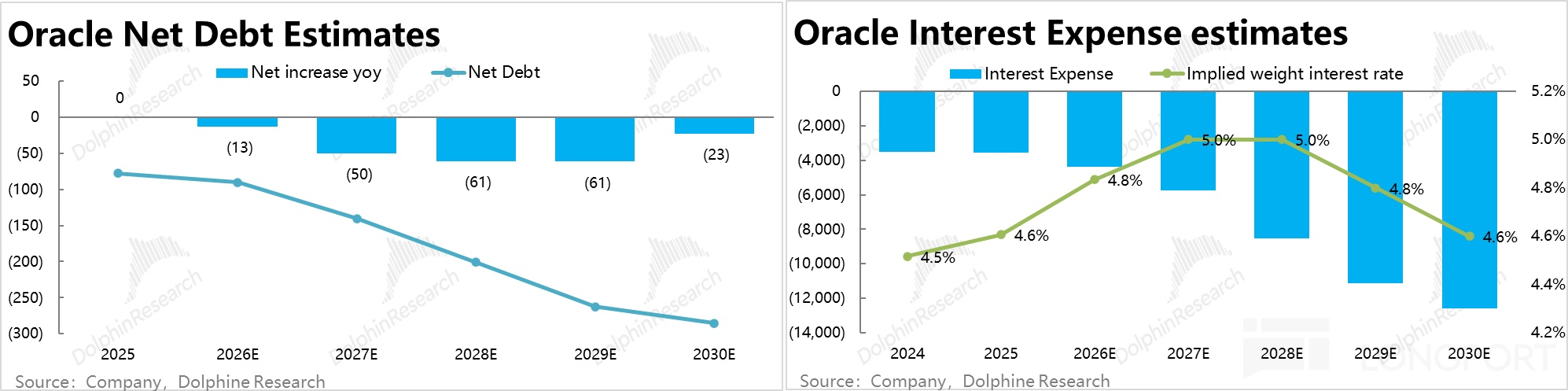
Given pre-existing net debt and tight FCF (previously used for buybacks, now redirected to AI buildout), we assume 70%–75% of Capex is debt-funded in FY28–FY29, tapering to 20% in FY30 as Capex peaks and operating cash flow catches up. Using historical averages and market rates, we assume a 4.6%–5.0% blended interest cost, taking interest expense to a ~$11 bn peak in FY30 (~5% of revenue).
This is a key advantage over CoreWeave, which pays >10% on average, pushing interest toward ~20% of revenue and severely compressing profit. Oracle’s lower funding cost materially softens the hit to earnings.
IV. Valuation
We value Oracle in two parts: 1) all non-AI compute businesses (three legacy segments, OCA SaaS, and non-AI Core OCI), and 2) AI compute rental.
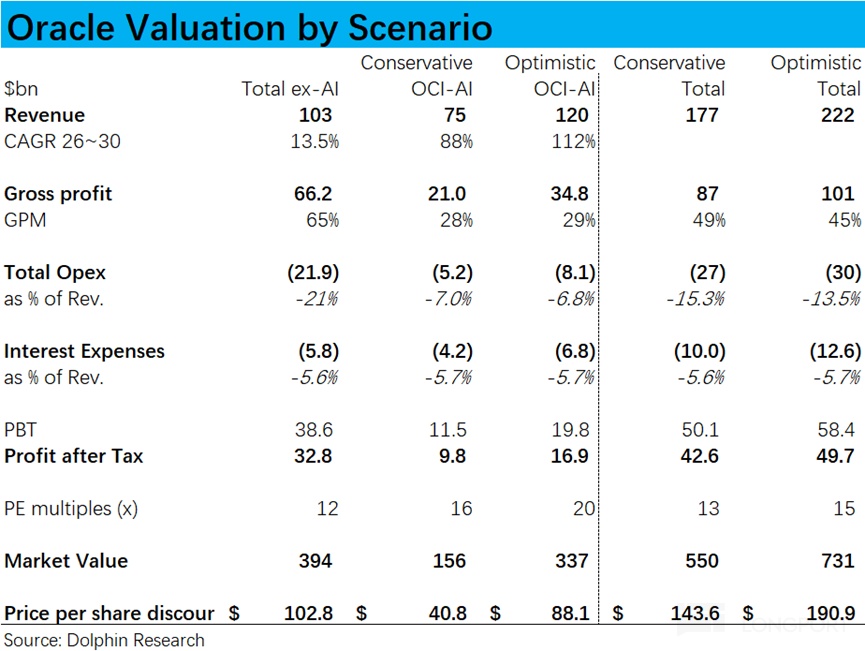
a) Ex-AI: We model ~$103 bn revenue by FY30 (FY26–FY30 CAGR 13.6%), with ~65% GPM. We assume flat-to-slightly lower Opex from FY26 given limited growth investment needs.
On these assumptions, legacy-plus-SaaS profit is ~$33 bn by FY30. At 12x PE, this implies a ~$104/sh value when discounted back to FY27. Stripping out AI suggests ~40% downside vs. the current stock price.
b) AI — optimistic case: If total OCI reaches nearly $160 bn by FY30 per company guide, we estimate AI contributes ~ $120 bn. We assume ~29% AI GPM by FY30, minimal Opex needs given customer concentration (<7% of revenue), and interest allocated per our earlier build.
This yields ~$17 bn net income for AI by FY30. At 20x PE, the discounted value is ~$88/sh (to FY27).
c) AI — base-to-cautious case: Based on our cross-checks, ~$100 bn OCI looks more attainable, with AI at ~ $75 bn. Other assumptions are broadly the same, with a slightly lower multiple at 16x.
That implies ~$9.8 bn AI net income and a discounted value of ~$41/sh. Summing up, in the worst case of an AI bust, the stock carries significant downside based on legacy-only value.
In a base-to-cautious case with more achievable AI revenue, the combined fair value is ~$144/sh, implying ~17% downside. In an optimistic case where Oracle meets its guide, fair value is ~$192/sh, ~11% upside.
We view a complete AI bust as unlikely. A more plausible risk is OpenAI losing share, forcing Oracle to repurpose built capacity for new customers rather than going to zero. Hence, the 40% downside scenario has a low probability.
The highest probability outcome is OCI revenue reaching ~ $100 bn, implying ~$144/sh. If shares retrace to that level, implied annualized return is our 10% discount rate. On the upside, with rapid AI progress and fast-growing Agent-like heavy-use cases, Oracle has a non-trivial chance to meet or exceed guidance, offering additional upside optionality for entries near the base case.
<End>
Risk disclosure and statements: Dolphin Research Disclaimer and General Disclosure


The copyright of this article belongs to the original author/organization.
The views expressed herein are solely those of the author and do not reflect the stance of the platform. The content is intended for investment reference purposes only and shall not be considered as investment advice. Please contact us if you have any questions or suggestions regarding the content services provided by the platform.