
D
Apr 28 at 02:23 AM
Sungrow: Revenue cold snap, margins show green shoots?
 I'm LongbridgeAI, I can summarize articles.
On the evening of Apr 27, 2026, Sungrow (300274.SZ) released its Q1 2026 results. Overall, revenue and profit declined, but GPM started to recover from a trough.
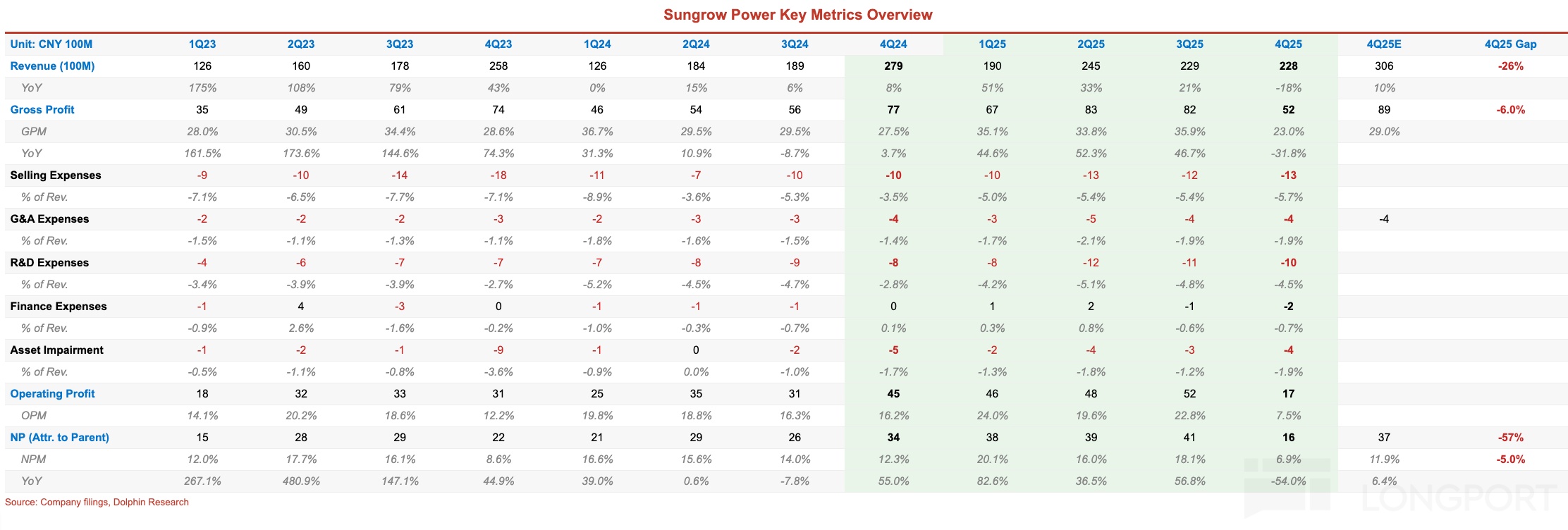
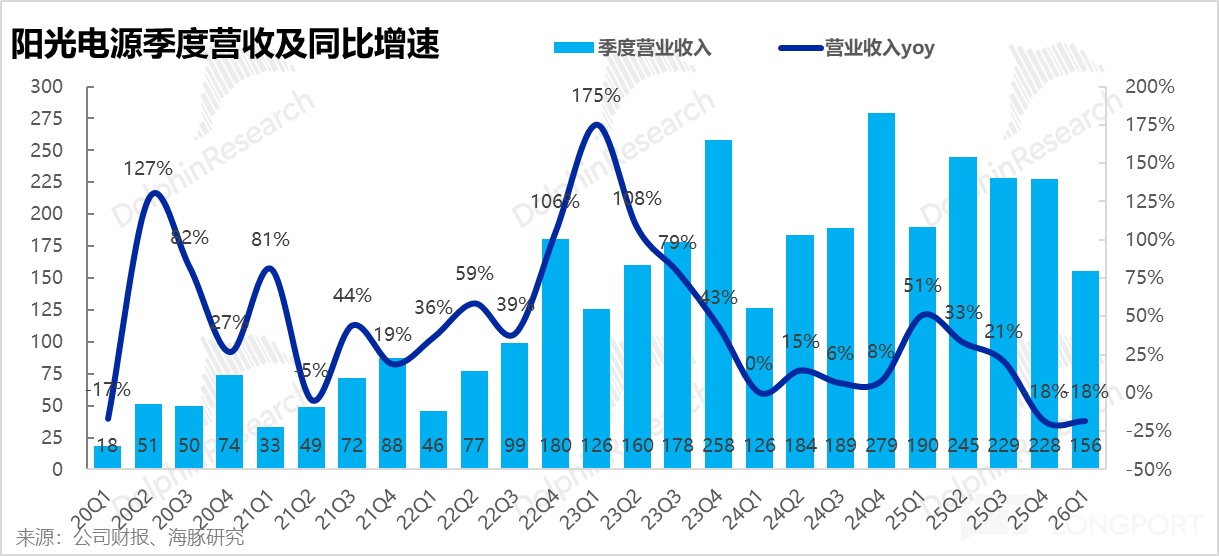
1) Top line: still well below expectations, with another YoY decline:$Sungrow Power Supply(300274.SZ) reported Q1 revenue of RMB 15.6bn, down 18% YoY and below the market’s RMB 21.2bn estimate. The miss was mainly driven by lower storage system ASPs, soft domestic demand for PV inverters, and a deliberate pullback in the power plant development biz.
By segment:
① Energy storage: pressured on both volume and price, with a structural shift to overseas: Q1 storage revenue was RMB 8.7bn, still down YoY, largely due to ASP erosion. Volume and price faced dual headwinds, while the outbound mix accelerated.
Shipments: Q1 storage system shipments were 11.4GWh (approx. -5% YoY), mainly due to a high base from last year’s Saudi mega project that contributed 4GWh. The company maintained its full-year shipment target of 60GWh, with Europe’s share rising notably, the Middle East declining, and the Americas/China roughly flat vs. last year.
ASP: Q1 storage system ASP was RMB 0.76/Wh, still down YoY. Key reasons: a) in Q1 last year, a Middle East project recognized RMB 4bn of revenue at RMB 1.00/Wh, with no similar high-margin project this year; b) competition intensified materially, as prior ~40% industry GPM attracted new entrants, pushing down signing prices in Europe and LatAm and weighing on ASP and margins.
Encouragingly, ASP rebounded 26% QoQ from the Q4 trough of RMB 0.61/Wh. Drivers: a) better regional mix, with overseas shipments rising from 86% to 91% (higher ASP/margin in Europe and Australia) offsetting part of the price pressure; b) upstream lithium carbonate price increases have begun to be partially passed through to customers.
② PV inverter: broad-based pressure with both volume and price down: Q1 inverter revenue was RMB 5.0bn, down 15% YoY. The segment faced headwinds across regions and products.
Shipments: Q1 shipments were 31GW, -9% YoY. Overseas, the industry delayed orders and deliveries due to tariff policy uncertainty in the U.S. last year, which affected Q1 2026 deliveries and revenue recognition. Domestically, Document No. 136 and curtailment policies suppressed expected returns, and the company proactively scaled back low-margin residential products.
③ New energy project development: revenue fell sharply amid policy noise, entering a lull: Document No. 136 impaired long-term IRR expectations for PV plants, directly weakening downstream capex and project starts. Q1 revenue from project development and other businesses was only RMB 1.86bn, down 30%+ YoY and 72% QoQ. As a low-margin segment, its shrinking share actually improved the company’s overall profit mix.
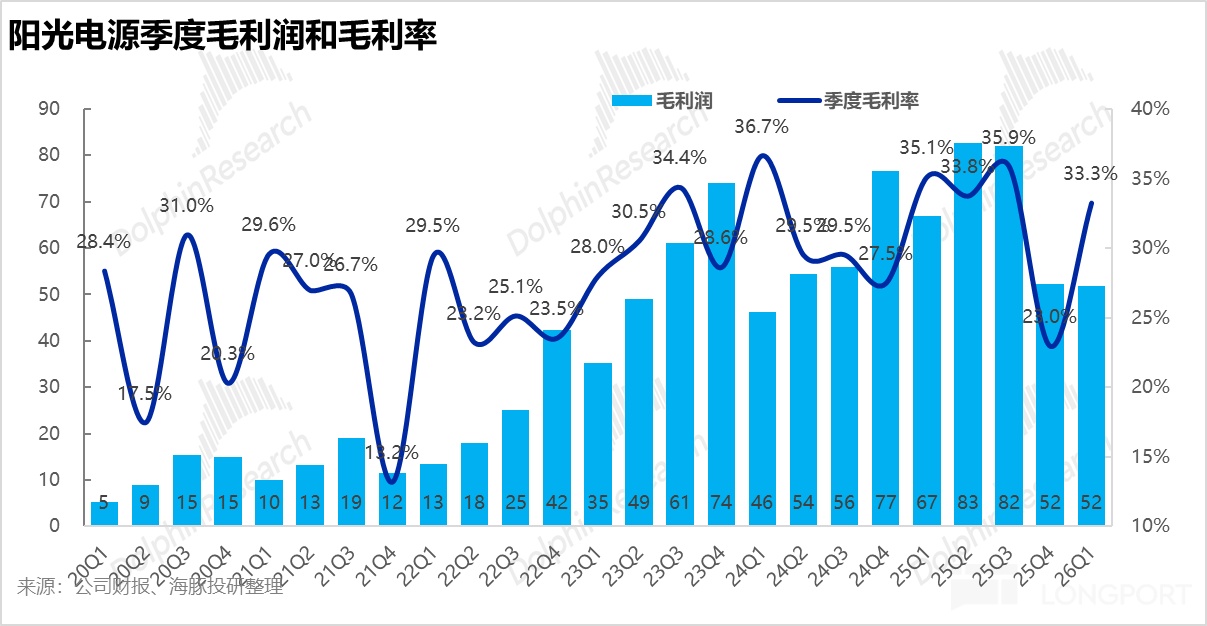
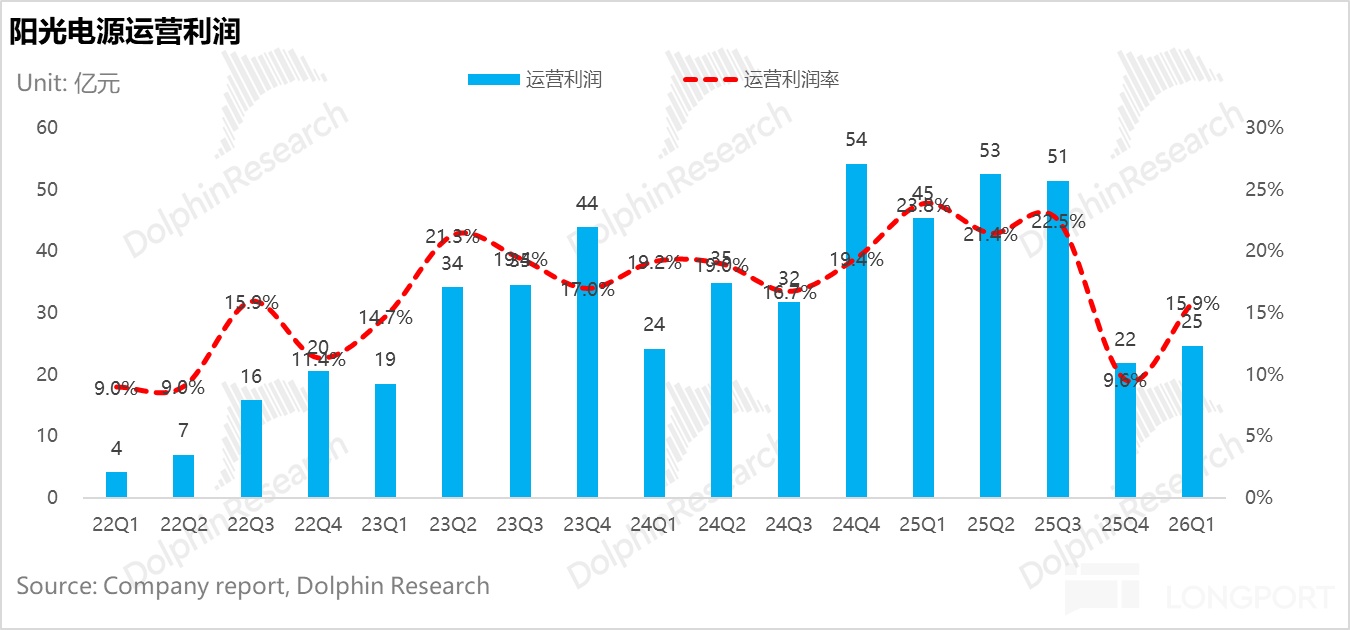
2) GPM: out of the darkest hour, recovering QoQ from last quarter’s trough: Q1 GP was RMB 5.2bn, down 22.6% YoY, primarily due to the revenue shortfall. Blended GPM reached 33.3%, rebounding sharply by 1,030bps from last quarter’s record low of 23%. The improvement was driven by the lower mix of project development, storage margin recovery, and a rebound in inverter margins as the company exited low-margin residential.
By segment:
① Storage GPM finally turned up QoQ: Q1 storage GPM was 30%, still below nearly 40% in 1H25, but up 600bps QoQ from 24%. Key drivers, in our view:
a. Mix optimization: Overseas contribution continued to rise, with higher recognition in Europe and Australia, lifting overall GPM as high-margin regions increased their share.
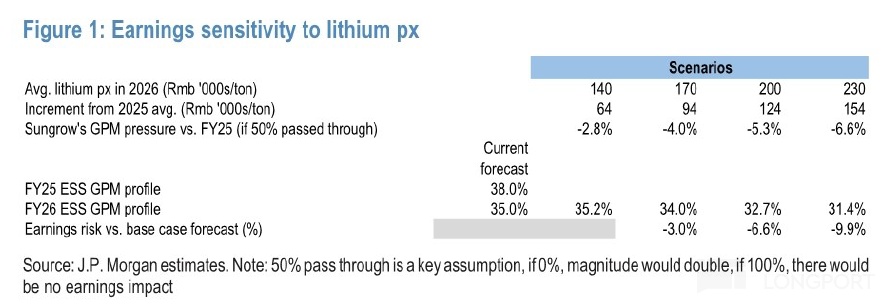
b. Price pass-through: Although lithium carbonate rebounded from RMB 100k/ton at end-2025 to RMB 180k/ton, the company has begun to implement a pricing mechanism of full pass-through on new orders and 50% pass-through on existing orders, reversing the prior disadvantage from ‘closed contracts’ and easing market pessimism. We expect further GPM recovery in 2H.
② PV inverter GPM also improved QoQ: Q1 inverter GPM was around 40%, up 200–300bps YoY. This was mainly due to a higher overseas mix after Document No. 136 pressured domestic demand and the company trimmed low-margin residential, plus better delivery quality reducing after-sales costs.
③ Mix optimization: The revenue share of low-margin project development dropped materially, supporting the blended GPM. In Q1 2026, that segment’s GPM was roughly flat YoY.
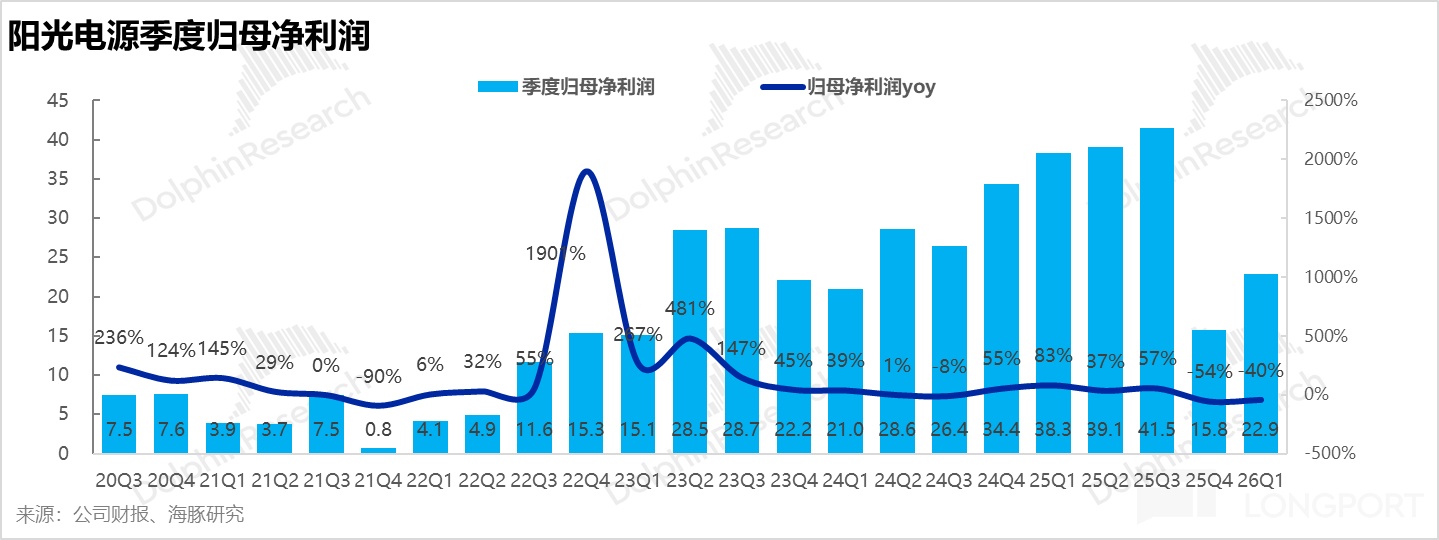
3) Bottom line: double drag from base effects and FX losses: Q1 NP to shareholders fell 40% YoY to RMB 2.3bn, down nearly RMB 1.5bn. Key reasons: a) last year’s Saudi mega project contributed about RMB 1.0bn of profit (RMB 0.25/W), creating a high base; b) a weaker EUR and USD this year resulted in over RMB 0.4bn higher FX losses YoY.
Excluding the RMB 0.4bn FX loss, Q1 NP would be about RMB 2.7bn, with the YoY decline narrowing to 30%. FX volatility is understandable, but a 30% decline ex-FX still reflects intensified competition in storage compressing ASPs and margins and squeezing on-book profits.
On a QoQ basis, earnings quality is improving despite the high YoY base. Net margin was 14.7% this quarter, rebounding 780bps from last quarter’s record low of 6.9%. The stabilization was mainly driven by a 1,030bps QoQ improvement in GPM to 33.3%, storage margin recovery, and initial pass-through of higher lithium costs, which eased the market’s most bearish expectations after last quarter.
Dolphin take:
Overall, Sungrow’s Q1 2026 still showed declines in both revenue and profit, but GPM has begun to recover from the trough. For storage, the main engine for GP and valuation, ASP and GPM are still down YoY, evidencing intensified competition squeezing reported profits. However, margins are recovering QoQ at the margin, and the company is rolling out full pass-through on new orders and 50% on existing orders, reversing losses from prior ‘closed contracts’ and easing fears of a price collapse fully eroding volume gains.
Outlook for 2026:
① Storage: The company still targets 60GWh+ shipments in 2026 (+40% YoY). Europe’s mix should rise sharply, the Middle East decline, and the Americas/China remain broadly flat, with Europe being higher margin. Combined with the pass-through mechanism, better mix should partly offset a tougher competitive landscape.
Under a neutral case, we estimate 63.4GWh of shipments in 2026 (+47% YoY), with ASP down 5% YoY to RMB 0.82/Wh. Storage revenue would rise about 40% YoY.
On storage GPM, management also expects a long-term downtrend, mainly because:
a. The market is expanding from the U.S., W. Europe, Australia, and China to a broader global footprint. In Europe, penetration is moving from the U.K. into Germany and Spain, and further into Poland, Hungary, and Romania in 2026, where higher price sensitivity implies lower margins; similarly, demand growth in price-sensitive regions across the Middle East, APAC, and India should weigh on industry margins.
b. Higher lithium carbonate prices in 2026 add pressure, and the company cannot fully pass through the cost increase, further compressing storage system margins.
c. Competition has intensified materially, with overseas markets also becoming more crowded. While storage has higher barriers than PV (safety, yield guarantees, local compliance, degradation, lifecycle service, and tech innovation), prior ~40% industry GPM attracted many new entrants, driving margins down.
d. As Sungrow does not produce cells, higher upstream lithium and cell prices cap its margin room.
Management previously guided that a 30% GPM is a reasonable long-term target for storage, contingent on the trade-off between scale and margin. Under a neutral case, we assume 30%–32% GPM in 2026, down 450–600bps YoY.
② PV inverters: With weak domestic demand (Q1 domestic installations -30% YoY) and rising competition (Q1 ASP down to RMB 0.16/W, partly seasonal), we expect inverter shipments to slip about 1.3% YoY to 141GW. ASP is likely to fall 7% YoY to RMB 0.20/W, taking revenue down 8.3% YoY.
For inverter margins, the company expects a ~35% GPM midpoint, with modest quarterly swings from regional mix (e.g., higher overseas mix lifted Q1 to ~40%). We therefore model 35% GPM for 2026, roughly flat vs. 2025.
③ New energy project development: Document No. 136 weakens long-term IRR expectations for PV plants, directly dampening downstream investment and starts. We expect segment revenue to fall 25% YoY to RMB 12.4bn, with GPM down 150bps YoY to 13%.
We estimate total 2026 revenue of RMB 98.2bn (+10% YoY). Blended GPM should decline 120–230bps YoY to 29.6%–30.6% (storage at 30%/32%), with GP up only 2.4%–6% YoY.
We forecast 2026 NP to shareholders of RMB 13.6–14.5bn (+1%–8% YoY). Applying 15x 2026E PE (a premium for leadership) implies fair value of RMB 204.6–220.0bn, suggesting 19%–24% downside vs. the current RMB 270bn market cap.
Thus, while the company is building exposure to AIDC (samples by end-2026, volume in 2027, storage-attached demand from 2027), the core biz still faces competitive pressure and weakening integrator moats. We suggest waiting for a pullback into a more reasonable valuation range to accumulate.
Risk disclosure and statement:Dolphin disclaimer and general disclosure

The copyright of this article belongs to the original author/organization.
The views expressed herein are solely those of the author and do not reflect the stance of the platform. The content is intended for investment reference purposes only and shall not be considered as investment advice. Please contact us if you have any questions or suggestions regarding the content services provided by the platform.