
D
Apr 28 at 10:05 AM
BYD: Overseas Boom Won't Plug Home-Market Hole
 I'm LongbridgeAI, I can summarize articles.
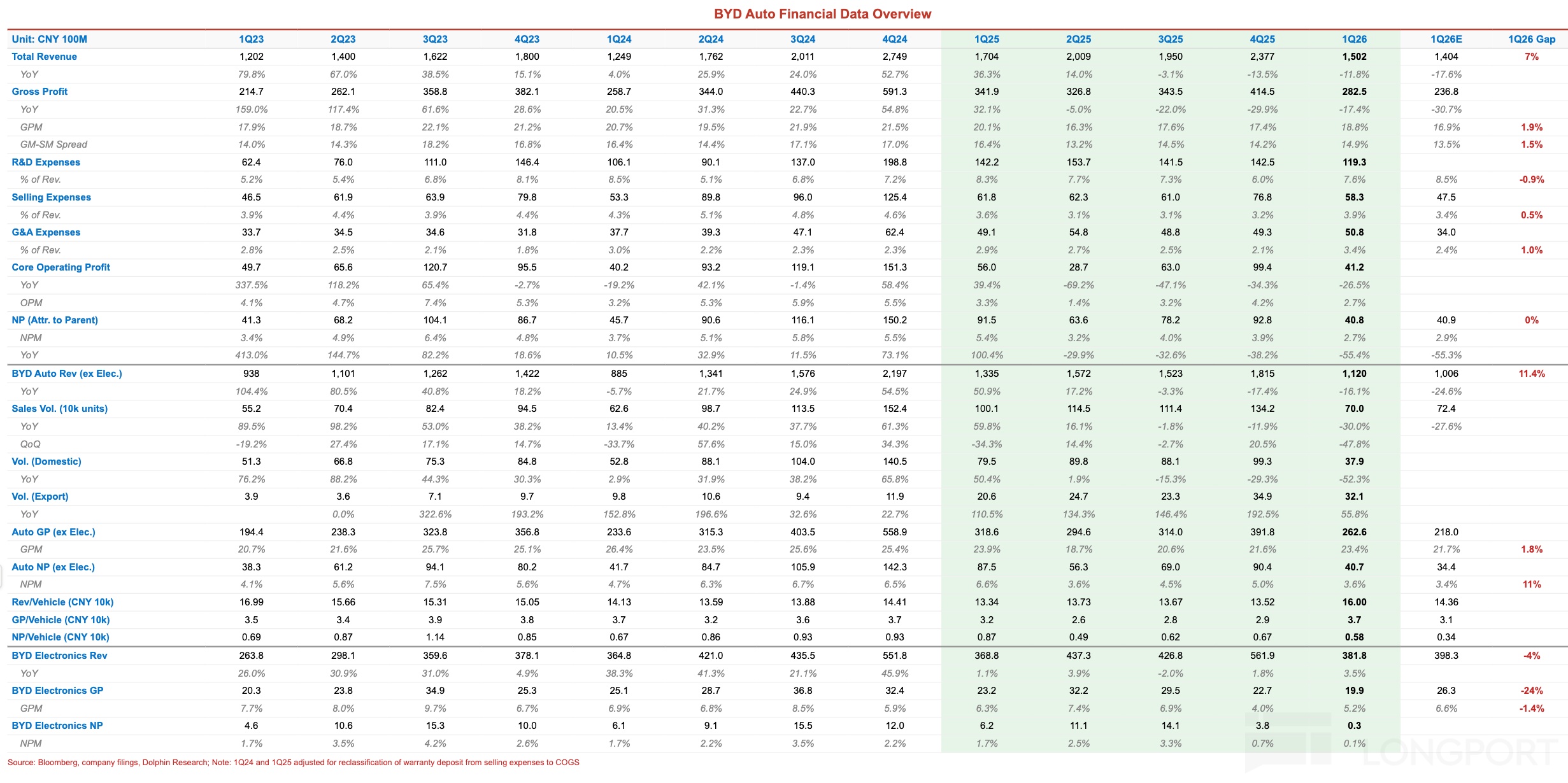
$BYD COMPANY(01211.HK) released its Q1 2026 results after the Hong Kong close on Apr 28 Beijing time. Key takeaways:
1) Solid vs. low bar on topline: Q1 revenue was RMB 150.2bn (-11.8% YoY). Auto revenue was RMB 112.0bn (-16.1% YoY), dragged by lower unit sales. However, revenue beat the Street’s ~RMB 100.6bn on stronger-than-expected ASPs.
2) ASPs rose sharply against the trend as mix tailwinds fully kicked in: Q1 auto ASP reached ~RMB 160k, up ~20% YoY and well above market expectations. The key driver was a step-up in export mix, with exports rising from 21% to 47% of volume, while overseas ASPs are ~1.5x domestic, offsetting domestic clearance and legacy model price cuts.
3) Auto GPM climbed counter-cyclically, beating by a wide margin: Despite bearish expectations on domestic volume declines and cost pressure, Q1 auto GPM was 23.4%, up 180bps QoQ and 170bps above consensus. A surge in high-margin overseas models offset the negative mix from domestic forced feature add-ons, raw material inflation, and adverse scale effects from volume declines.
4) Headline NP attributable fell sharply, but core OP held up better than feared: Q1 NP attributable was RMB 4.08bn (-55.4% YoY), mainly hit by large FX losses and other non-operating items. Per-vehicle NP was ~RMB 5.8k, down vs. Q4 2025 (~RMB 6.7k) due to domestic legacy inventory clearance discounts, higher opex ratio on a smaller revenue base, and FX losses (financial expenses deteriorated by ~RMB 4.0bn vs. Q1 2025).
Ex-FX and other noise, Q1 2026 per-vehicle core OP was ~RMB 5.9k, above ~RMB 5.6k in the prior-year quarter. BYD Co.’s core operating profit was RMB 4.12bn (-26.5% YoY), a much smaller decline than headline NP.
Dolphin Research view:
Against a backdrop of pre-reported Q1 volume of 700k units (-30% YoY) and broadly bearish expectations, BYD delivered a ‘better than low bar’ print. While revenue and profit contracted on lower units, per-vehicle price, auto GPM, and per-vehicle NP topped expectations.
The core logic is a step-change in the mix of high-profit overseas models, which offset domestic clearance, forced add-ons, and raw material inflation that dilute margins and scale. With sizable FX losses this quarter (financial expenses deteriorated ~RMB 4.0bn YoY), ex-noise per-vehicle core OP (GP - taxes - opex) was ~RMB 5.9k, above ~RMB 5.6k a year ago, a decent performance for a trough quarter.
The Q1 slump is largely in the price. The key now is the 2026 outlook.
From BYD’s 2026 strategy, its Mar chip and charging event highlighted MW fast charging and 2nd-gen Blade battery tech. The product playbook for this year is clear:
1) Reinforce BEV competitiveness with long range and ultra-fast charging
BYD targets an ICE-like refueling experience via tech iteration (10%–70% in 5 minutes at room temp, 10%–97% in 9 minutes). The 2nd-gen Blade battery raises energy density by 5%, and together with a 1,000V platform and high-efficiency motors, delivers a range step-up (e.g., Denza Z9GT BEV range >1,036km).
It pairs this with aggressive infra and marketing (20k fast-charging sites by end-2026 and 1-year free fast charge). Crucially, 6C fast charge is pushed down to RMB 150k–200k core models (e.g., Song Ultra EV, Sealion 06 EV), directly targeting Geely and XPeng in the 800V mid-tier.
For PHEVs (e.g., Song Pro DM-i), EV-only range is approaching ~200km. BYD’s 2026 lineup should see a broad-based range uplift.
2) ‘Smart driving for all’ continues to trickle down, with Q2 as the key validation window
To fix the short board, BYD has pivoted to in-house hardware and software to reduce reliance on external suppliers, securing tech control and cost advantages. Launched in Jan 2026, the DiPilot 5.0 system (end-to-end model) brought a major AEB upgrade and map-free urban NOA, but did not clearly signal a full-scale roll-down of urban NOA to RMB 100k–150k core models at the time.
Dolphin Research sees the make-or-break in H1 2026 as BYD’s in-house urban NOA algorithm, slated for mass production in H1. Success in delivering RMB 100k-class smart driving is critical to fortify its mainstream moat.
3) Build toward DM 6.0 to defend the PHEV core
Supply-chain checks suggest the DM 6.0 platform could reach >48% thermal efficiency. With variable-flux motors, full-tank/full-charge range would rise further, and fuel-only consumption could drop to ~1.8–2.79L/100km (vs. ~2.9L/100km on DM 5.0 in 2024), a material improvement. That said, with a likely H2 2026 launch, it will not immediately relieve current PHEV volume pressure.
Dolphin Research notes long build times for fast-charge networks and the purchase tax rollback, plus new subsidies skewed to ≥RMB 167k mid-to-high-end models. This is unfavorable for BYD’s RMB 100k–150k core and poses major challenges to the domestic base.
Pricing disclosed at prior events also implies a shift for sub-RMB 200k core models to ‘protect margin, stabilize base’, rather than aggressive price wars. As such, Q26 domestic volume is unlikely to rebound sharply.
Dolphin Research expects domestic sales to fall 5% YoY to 3.39mn units under a base case, with an optimistic case of +5%–10% to 3.75–3.92mn (share stabilizing). Weekly orders have slipped from ~85k at new model launch to ~50k, supporting this view.
Against this backdrop, overseas becomes the main earnings pillar and swing factor in 2026:
Overseas volume remained strong at 320k units in Q1 2026, contributing 46% of mix when domestic came under pressure. More importantly, higher ASP and GPM ex-China make overseas the true profit ballast.
If exports reach 1.5–1.6mn units in 2026, and assuming ~RMB 20k per-vehicle NP overseas, overseas would contribute RMB 30–32bn NP directly. That implies nearly two-thirds of auto profit from overseas, providing a solid margin cushion against domestic competition.
Valuation under base and optimistic scenarios for 2026:
1) Base case: Total volume 4.79mn (+4% YoY), with 3.39mn domestic and 1.60mn overseas. Auto NP estimated at RMB 42.1bn (global blended per-vehicle NP ~RMB 8.4k); at 20x P/E, auto EV ~RMB 842bn, plus BYD Elec. at ~RMB 52bn current value, total ~RMB 894bn, broadly in line with current A-share mkt cap.
2) Optimistic case: Total volume 5.35–5.52mn (+16%–20% YoY), with 3.75–3.92mn domestic and 1.60mn overseas. Company NP of RMB 47.0–47.7bn (global blended per-vehicle NP ~RMB 8.6k–8.8k, implying easing domestic competition); upside remains limited on SOTP.
Batteries/Energy storage: Assuming strong storage growth and possible spin valuation under a bullish tape, storage shipments of 75GWh in 2026 (+50% vs. 50GWh in 2025). At RMB 0.07/Wh NP (a ~40% discount to CATL), storage NP ~RMB 5.3bn; at 30x P/E, EV ~RMB 159bn.
Auto ex-battery: After stripping battery/storage profits, 2026 pure auto NP ~RMB 41.7–42.4bn. At 20x P/E, EV ~RMB 834–848bn.
BYD Elec.: Carry current value of ~RMB 52bn.
Thus, under the base case, target mkt cap is ~RMB 894bn, roughly in line with current A-shares. At an optimistic sentiment peak, total mkt cap could reach ~RMB 1.03–1.06tn, implying ~7%–15% upside vs. current A-shares, with limited elasticity. Hence, upside looks capped near term, and unlocking the ceiling still hinges on overseas localized capacity ramp and sustained export outperformance.
PS: BYD is a complex conglomerate across autos, handset components and assembly, secondary rechargeables, and PV. Dolphin Research’s deep dives in Jul 2025 — ‘https://longbridgeapp.com/news/40995588’ and ‘https://longbridgeapp.com/topics/1024280’ — argue the core driver remains autos; those seeking background should revisit.
Detailed analysis below:
I. Auto GPM rose against the tide: exports are not just a lifeline but the profit ballast
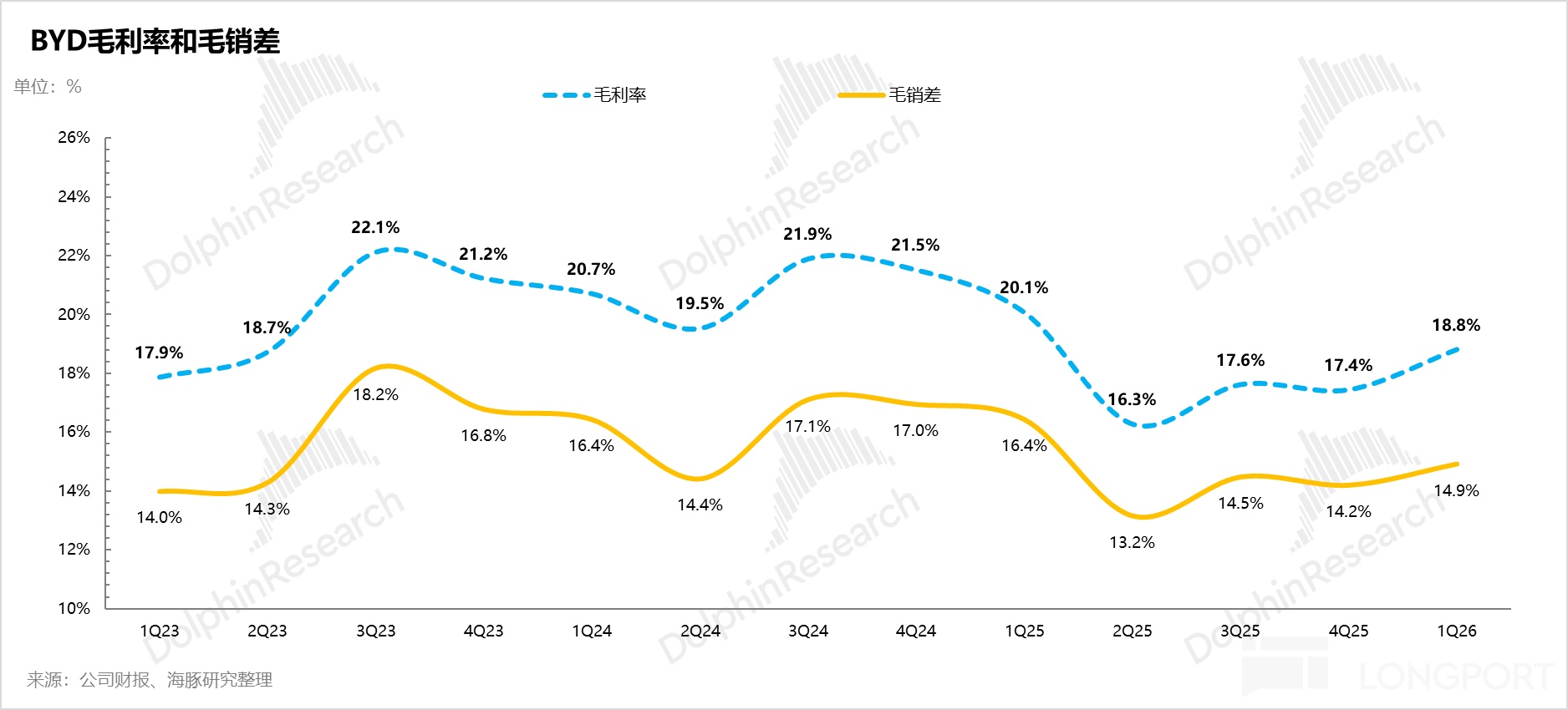
Each print, the market focuses most on auto GPM. Despite pre-reported Q1 volume of 700k (-30% YoY) and bearish sentiment, BYD delivered a ‘better than low bar’ outcome.
Q1 auto GPM was 23.4%, and rose 180bps QoQ instead of compressing on lower volume, beating consensus by 170bps. The support came from a step-change in exports: with export mix near half (47%), BYD has pivoted profit focus from domestic price wars to global profit capture.
Per-vehicle unit economics:
1) Price: Export mix doubled, driving quality ASP uplift
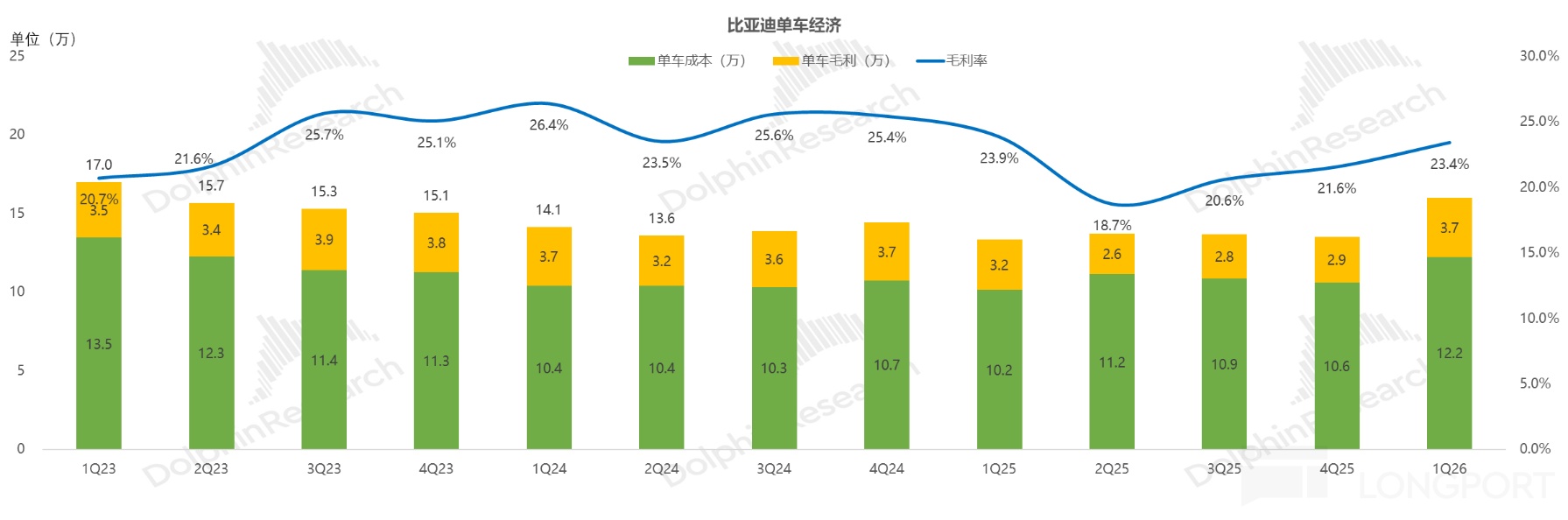
Q1 ASP was ~RMB 160k, up from ~RMB 133k a year ago (+20% YoY), beating the Street’s ~RMB 144k. Exports are not only a volume lever but a price-quality upgrade: export mix jumped from 21% to 47%, and with overseas ASP at ~1.5x domestic, this structural shift effectively offset domestic clearance and legacy price cuts.
2) Cost: dual squeeze from adverse scale and forced add-ons
Per-vehicle cost was ~RMB 122.5k, up ~RMB 16k QoQ and above market’s ~RMB 113k, mainly due to adverse scale and higher BOM from forced add-ons. a) Adverse scale: Q1 units were 700k (-30% YoY); domestic fell 52.3% YoY to 380k on tax rollback and tougher competition, partially offset by exports (+55.8% YoY to 320k), but overall volume decline lifted per-unit fixed-cost absorption.
b) Raw materials + forced add-ons: Lithium carbonate and commodities rose, pressuring costs. To meet 2026 purchase tax exemption thresholds, BYD pushed ‘spec bump at same price’ on core DM-i models (e.g., Qin, Song), lifting EV-only range to >100km, which mechanically increases battery kWh and BOM cost.
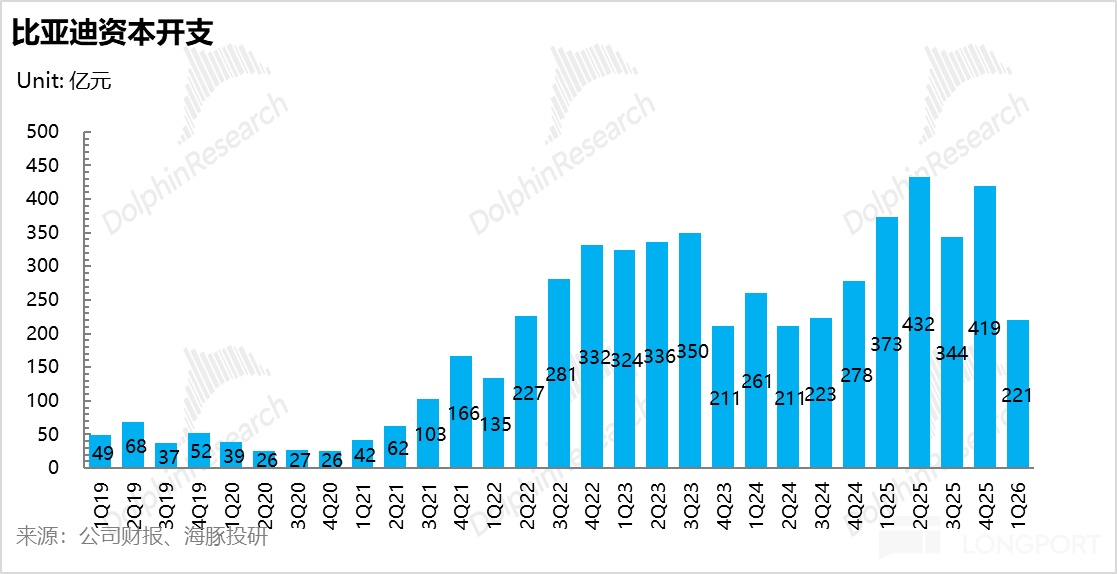
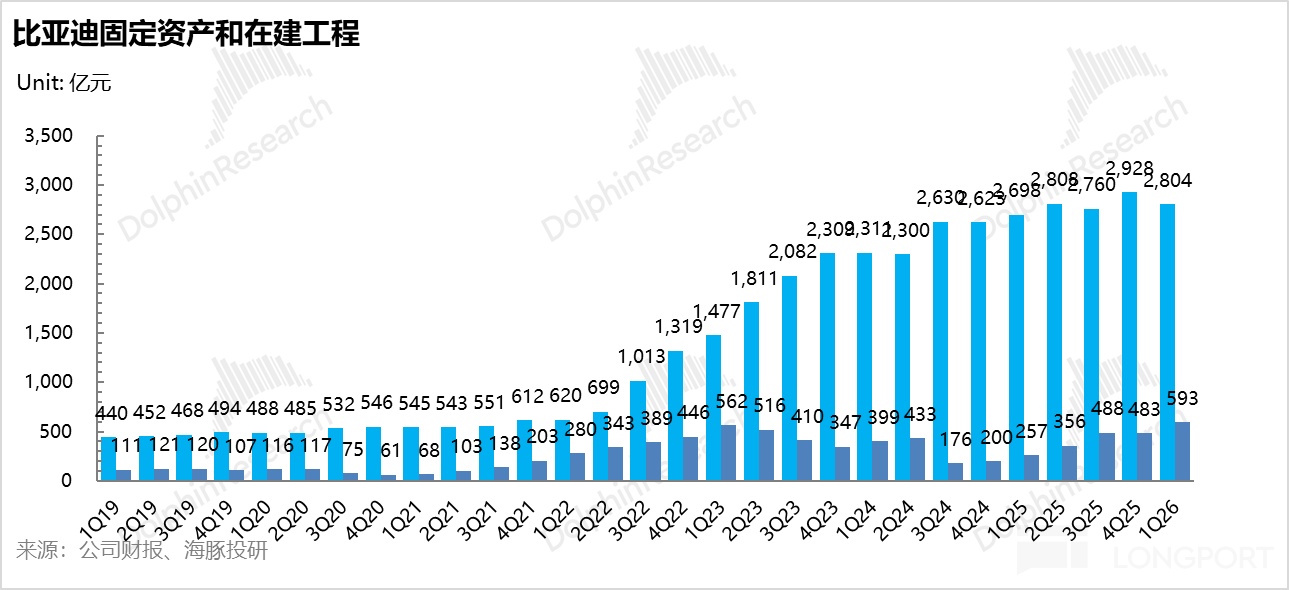
c) Capex slowed this quarter: capex fell to RMB 22.1bn (nearly halved QoQ). As overseas auto and battery plants move into ramp, if the investment peak is past, depreciation pressure should ease at the margin.
3) GP per vehicle: ~RMB 37k, above ~RMB 31k consensus
Q1 GP/vehicle reached ~RMB 37k, up ~RMB 8k QoQ, beating market’s ~RMB 31k. Auto GPM was 23.4%, up 180bps QoQ.
Explosive mix of high-margin overseas models (2H25 margin ~11ppt above domestic) played the pivotal role. This structural dividend absorbed higher BOM from forced add-ons and adverse scale from lower units.
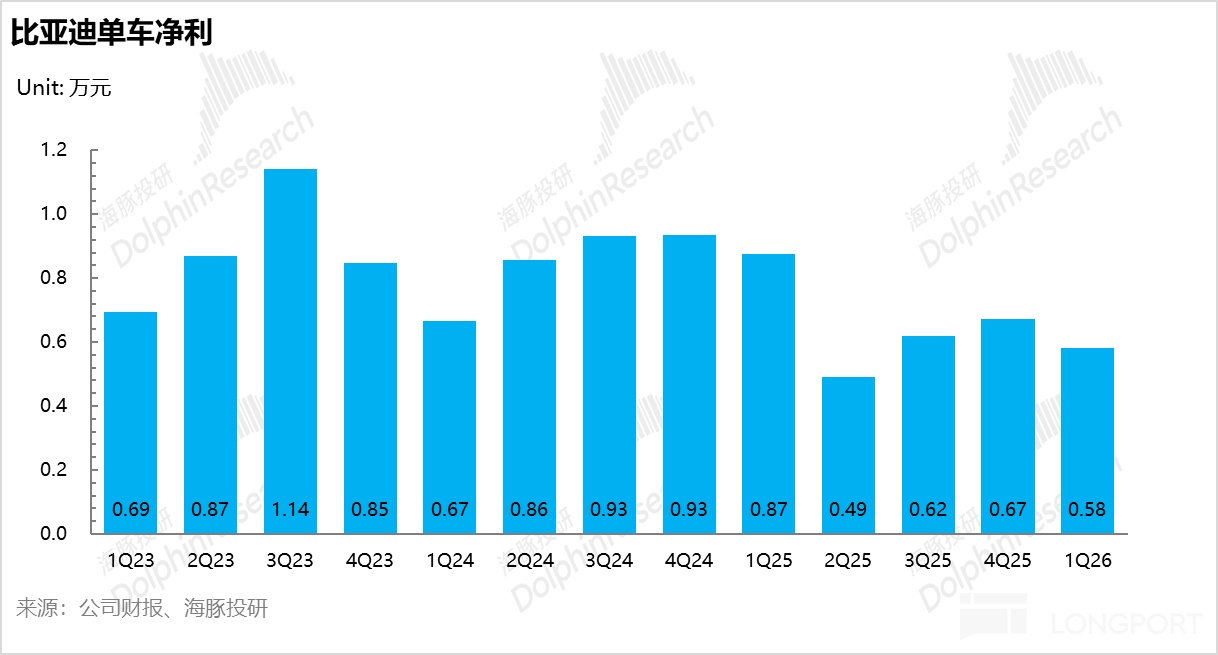
2. Per-vehicle NP: resilience masked by FX losses
Q1 NP attributable was RMB 4.1bn (-55.4% YoY), largely driven by non-operating FX swings. Per-vehicle NP was ~RMB 5.8k, down from ~RMB 6.7k in Q4 2025 but above the Street’s ~RMB 3.4k.
Drivers of QoQ NP/vehicle decline: a) Clearance discounts for legacy models in China; b) Negative operating leverage as volume fell ~30%; c) FX losses, with financial expenses deteriorating ~RMB 4.0bn YoY.
Specifically:
1) R&D: steady but disciplined to fuel smartization and new model cycles
R&D stayed robust to win the smartization endgame and support a dense 2026 launch slate, but Q1 spend was restrained, likely as key cars and batteries were finalized and due to seasonal cadence. Q1 R&D was RMB 11.3bn, down RMB 2.9bn QoQ and slightly below market’s ~RMB 11.9bn, focused on in-house ADAS/AD, next-gen e-powertrain, and new platforms.
New product cycle: ICE-like refuel speed for EVs trickling down to RMB 150k class
On Mar 5, 2026, BYD unveiled the 2nd-gen Blade battery and MW fast charge. Key upgrades:
a) Much faster charging: 10%–70% in 5 minutes, 10%–97% in 9 minutes at room temp, and ~12 minutes at -30°C, approaching ‘ICE-like’. b) Longer range: energy density +5% vs. gen-1; Denza Z9GT BEV range reached 1,036km.
c) 1,000V system upgrade: motor efficiency at highway speeds lifted from 82% to 91.5%, boosting range by 12%. d) Faster charger rollout: ‘Flash Charge China’ targets 20k sites by end-2026.
Most importantly, 6C fast charge is systemically pushed down to RMB 150k–200k core models (Song Ultra EV, Sealion 06 EV). This breaks the 2025 pattern where ultra-fast charge sat only above RMB 200k and directly counters 800V down-market plays by Geely and XPeng.
Smartization push: pivot to in-house closed loop, launching ‘smart driving for all’
BYD is reducing reliance on external suppliers by in-housing hardware and software to secure control and cost. Launched Jan 2026, the DiPilot 5.0 AD system uses an end-to-end model to enable ‘AI self-evolving driving’.
The key 2026 move is to roll urban NOA down to RMB 100k-class models for true ‘smart driving parity’. BYD plans a dedicated AD event in H1 2026, and its in-house urban NOA could enter mass production within H1, a crucial proof point.
2) Selling expense: flexed with volume, early gains from org optimization
Q4 selling expense was RMB 5.8bn, down RMB 1.85bn QoQ, likely because: a) Most low-to-mid models sell via dealers, so lower volume reduces commissions, logistics, and some marketing/after-sales; b) Headcount and pay structure adjustments from late-2025 to early-2026 helped tame personnel costs, including in sales.
3) G&A: rose RMB 150mn QoQ to RMB 5.08bn, reflecting negative leverage on lower revenue
G&A edged up as revenue shrank, showing clear negative operating leverage. This is consistent with a softer top line.
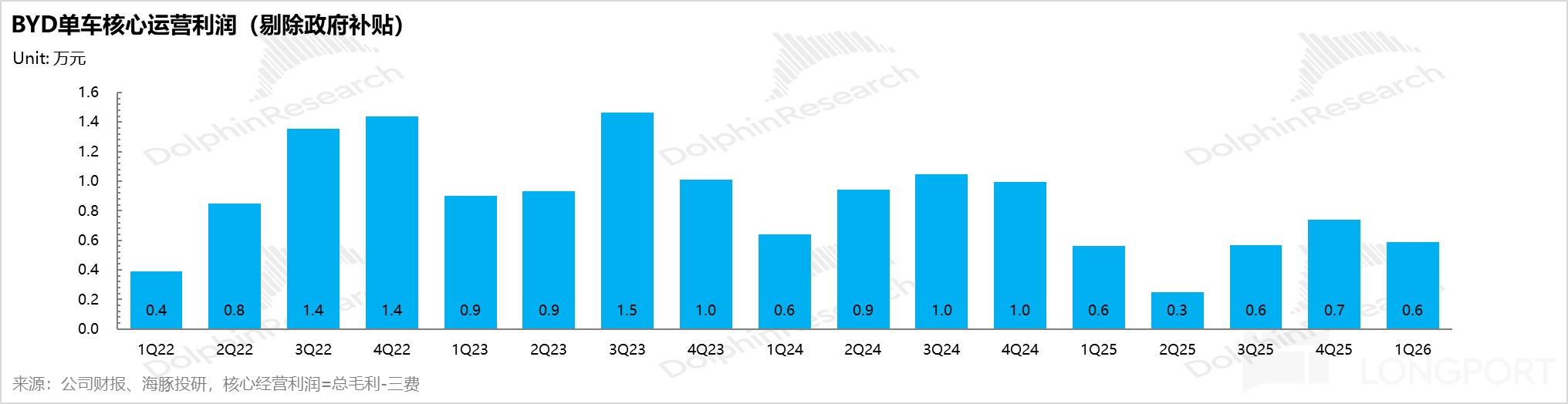
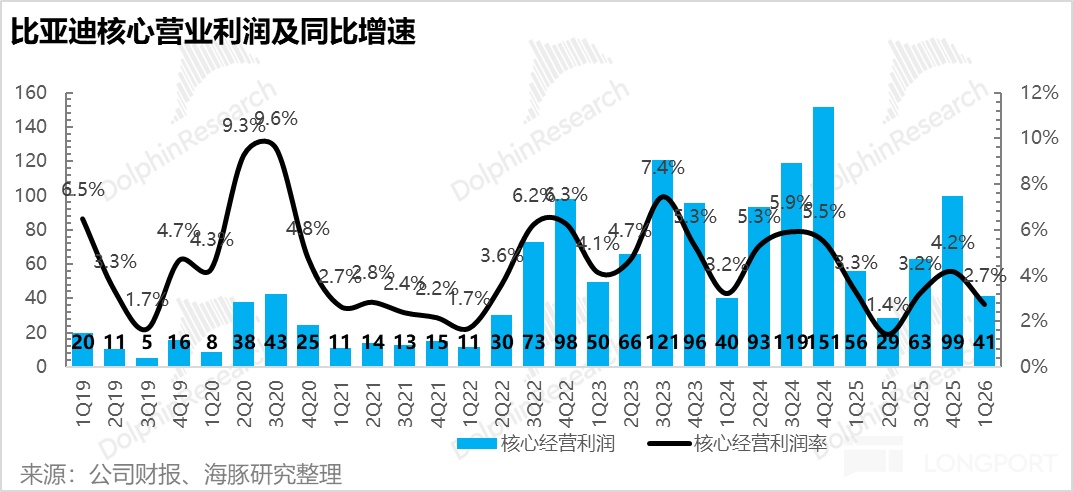
Ex-FX and other noise, the best gauge of core health — per-vehicle core OP (GP - taxes - opex):
Q1 2026 per-vehicle core OP was ~RMB 5.9k vs. ~RMB 5.6k a year ago. Core OP was RMB 4.12bn (-26.5% YoY), a far smaller drop than NP attributable.
3. Domestic share under pressure; BYD leans on ‘overseas expansion + tech upgrades’
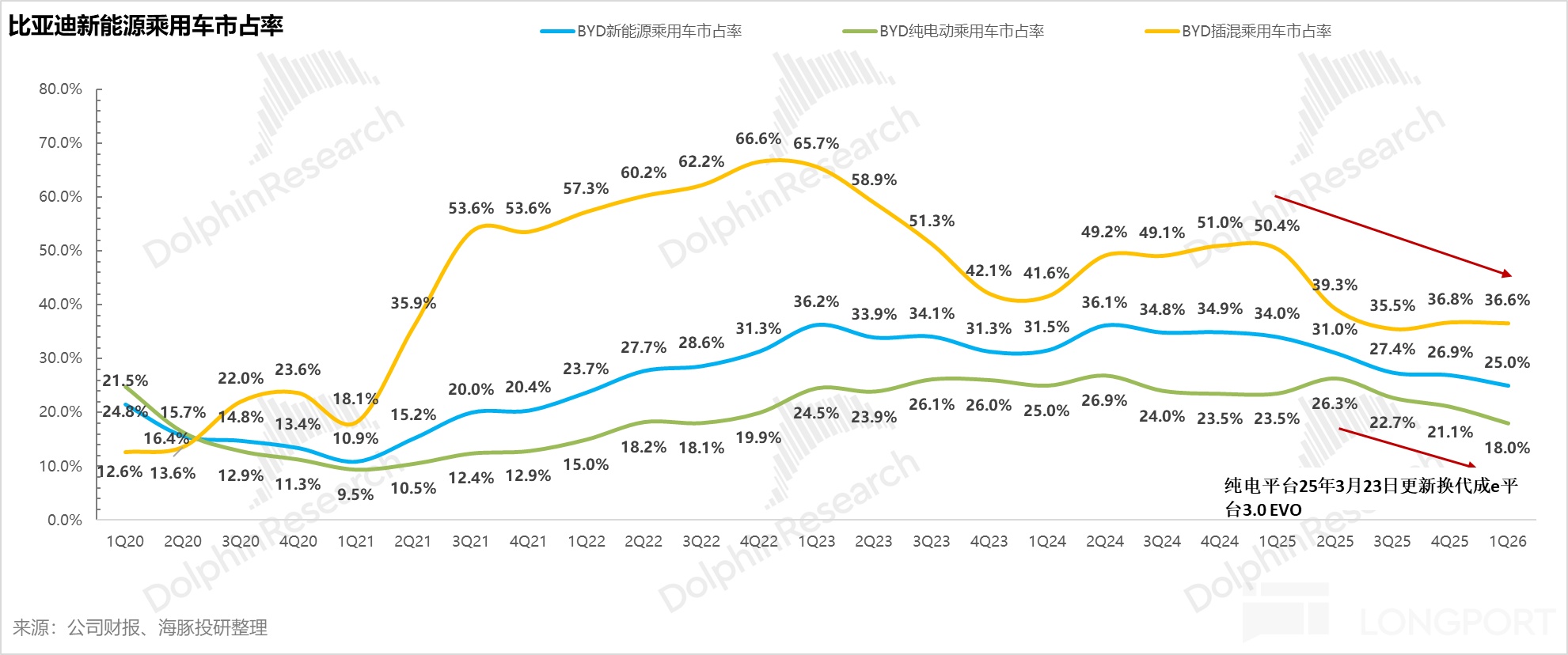
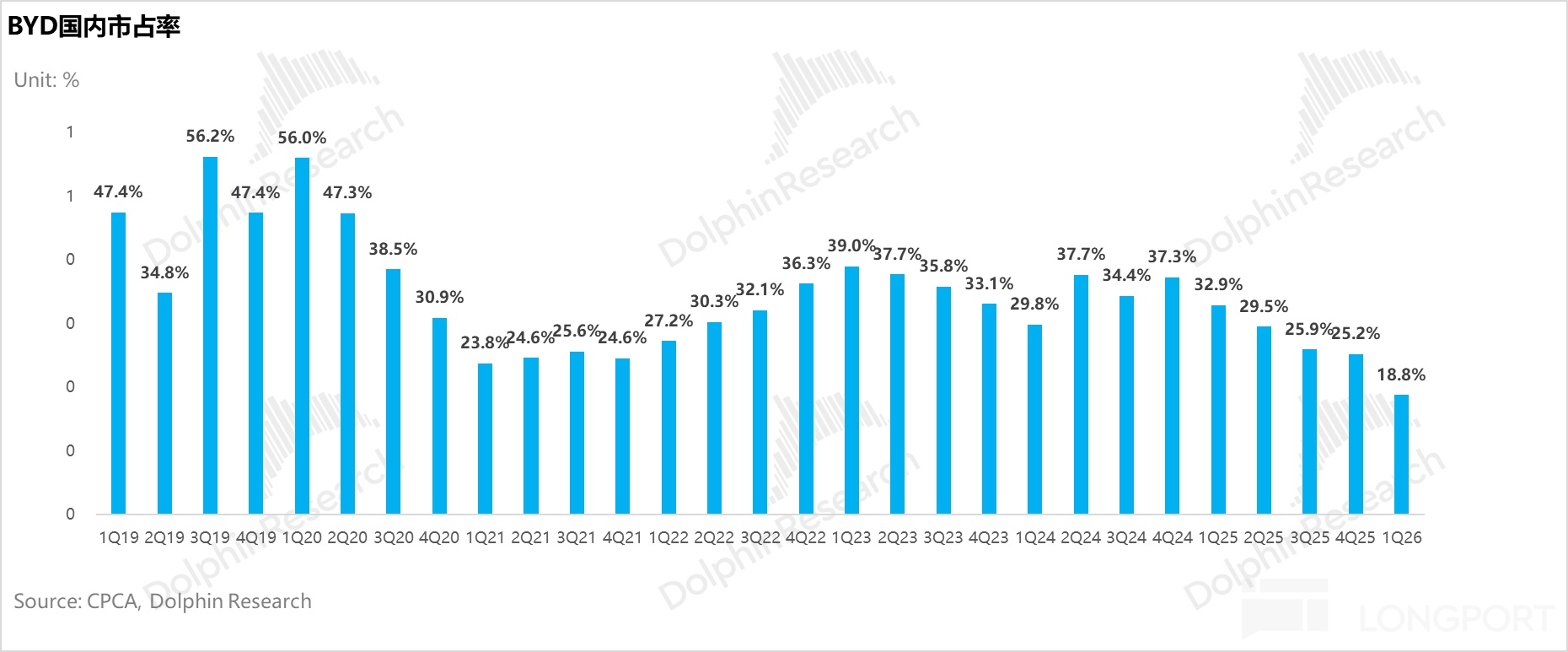
After peaking at 36% in Q2 2024, BYD’s domestic share has trended down. Despite overseas growth cushioning, its NEV share fell from a 2024 peak of 37.3% to 25% in Q1 2026 amid red-ocean rivalry and tax rollback, nearly halving.
Even with overseas offset, overall share still fell ~2ppt QoQ to ~25%. This shows the 2025 ‘smart driving for all’ cycle did not fully lift sentiment, and anti-price-war policies limited the traditional price-led share regain.
Details:
- PHEV tech gap narrowed; fierce domestic rivalry; BYD constrained by anti-price-war rules
Tech moat challenged: Despite deep DM upgrades in 2025 (fuel-only at ~2.6L/100km), rivals such as Geely (Thor) and Chery (C-DM) have rapidly iterated to parity on efficiency and performance. ‘Smart’ variants faced delayed feature rollout and higher BOM, while highway NOA is not yet a mass-market must-have, limiting conversion to sales.
Anti-price-war policy caps pricing room: Since mid-2025, regulators have curbed malicious pricing via stricter discipline. As the leader, BYD’s pricing is closely scrutinized, constraining its former scale-driven price-slash playbook.
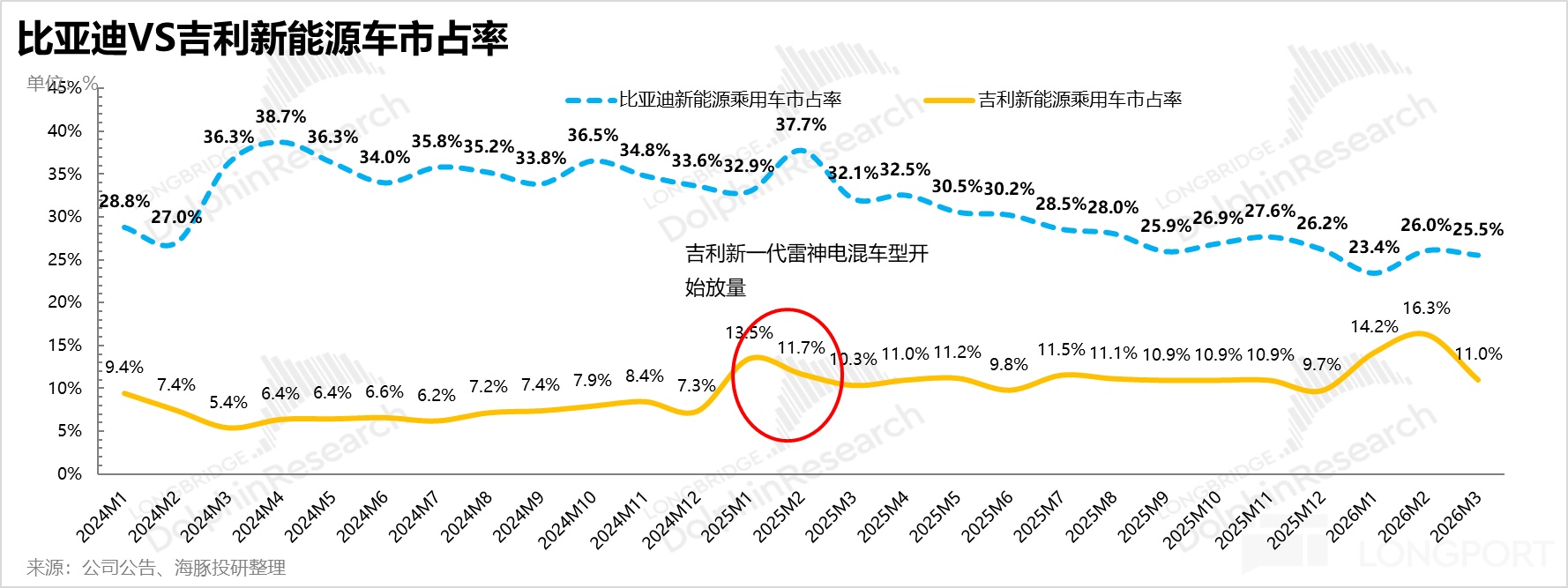
Core price bands face encroachment: In the RMB 100k–200k base, competition is intense. Geely’s Galaxy series used ‘high spec + value’ to nearly double sales, lifting Geely NEV share another ~2.8ppt QoQ to 13.4% in Q1 2026, while Leapmotor, Changan, and Great Wall pushed in their niches.
2) BEV lineup: infra constraints and slow trickle-down drove faster share loss
BEVs faced sharper contraction, with share down from 26.3% in Q1 2025 to 18% in Q1 2026. Although BYD launched the Super E platform in Mar 2025 (new ultra-fast-charge battery, high-performance motors, SiC power modules, 1,500V and 200°C operation, ‘5 minutes for 400km’), it was initially confined to >RMB 200k models like Han L and Tang L.
With core tech not yet pushed to volume models and the self-run fast-charge network still ramping, BYD could not blunt rivals in mainstream BEVs. Share loss accelerated.
2026 focus: ‘tech for all’ and ‘global localized capacity’
To stem domestic share loss, BYD set a new counteroffensive in early 2026: push ‘tech parity’ at home and accelerate model refresh. The plan is to roll 2nd-gen Blade and MW fast charging quickly from high-end down to ≥RMB 150k mainstream models, boosting competitiveness via ‘tech for all’.
In tandem, a ‘self-build + partner’ fast-charge network targets 20k sites in 2026 to solve charging pain points and repair share. This is a key execution year.
Overseas remains the top priority for 2026:
4. Overseas: from growth engine to profit pillar, monetizing higher margins faster
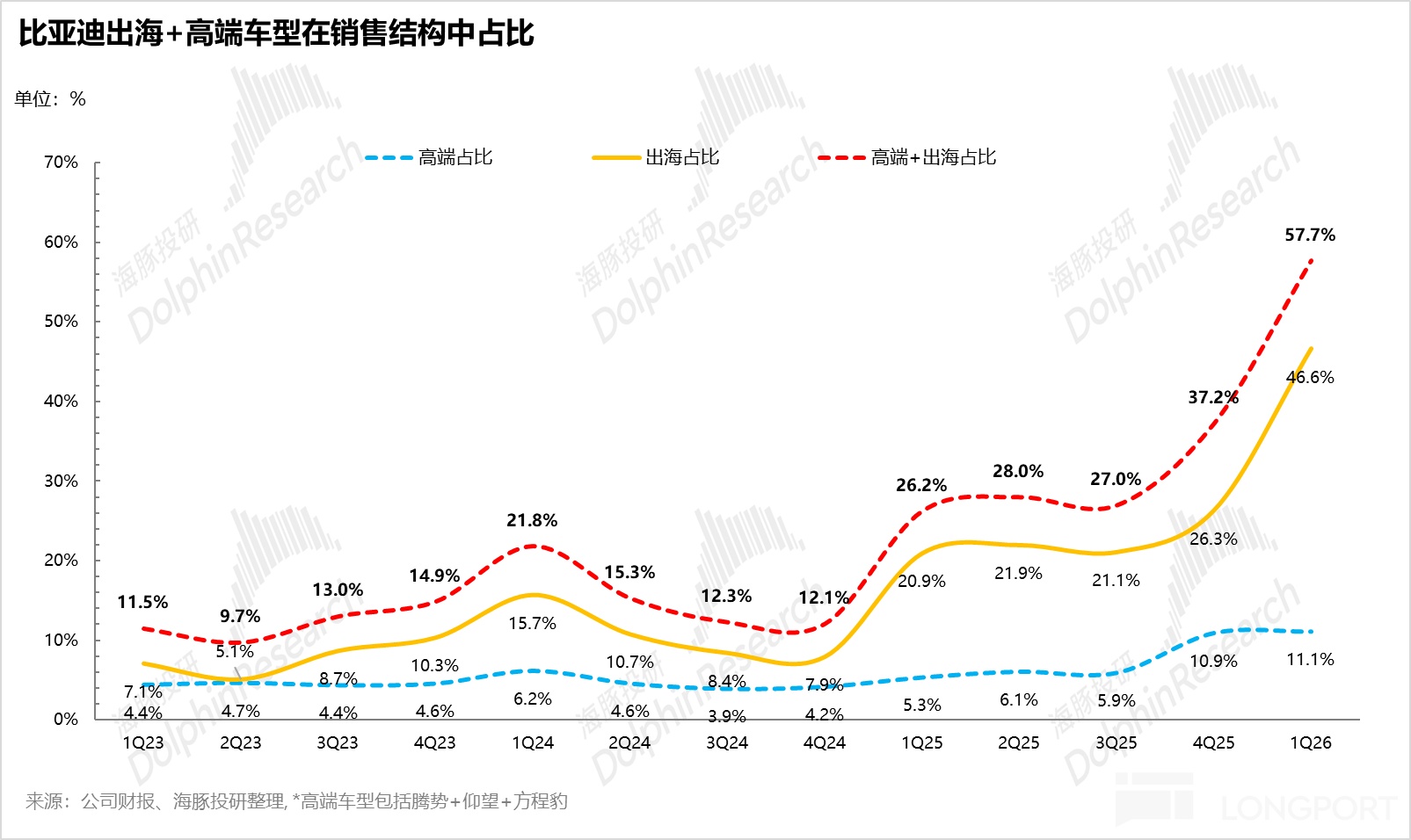
Overseas volume reached 320k in Q1 2026, while domestic fell 52.3% YoY to 380k on tax headwinds. Overseas mix rose 25.7ppt YoY to 46.6%, providing powerful structural support to ASP and GPM.
Given higher ASP and profit per unit ex-China, overseas shifted from pure scale to profit ballast. This underpins 2026 earnings resilience.
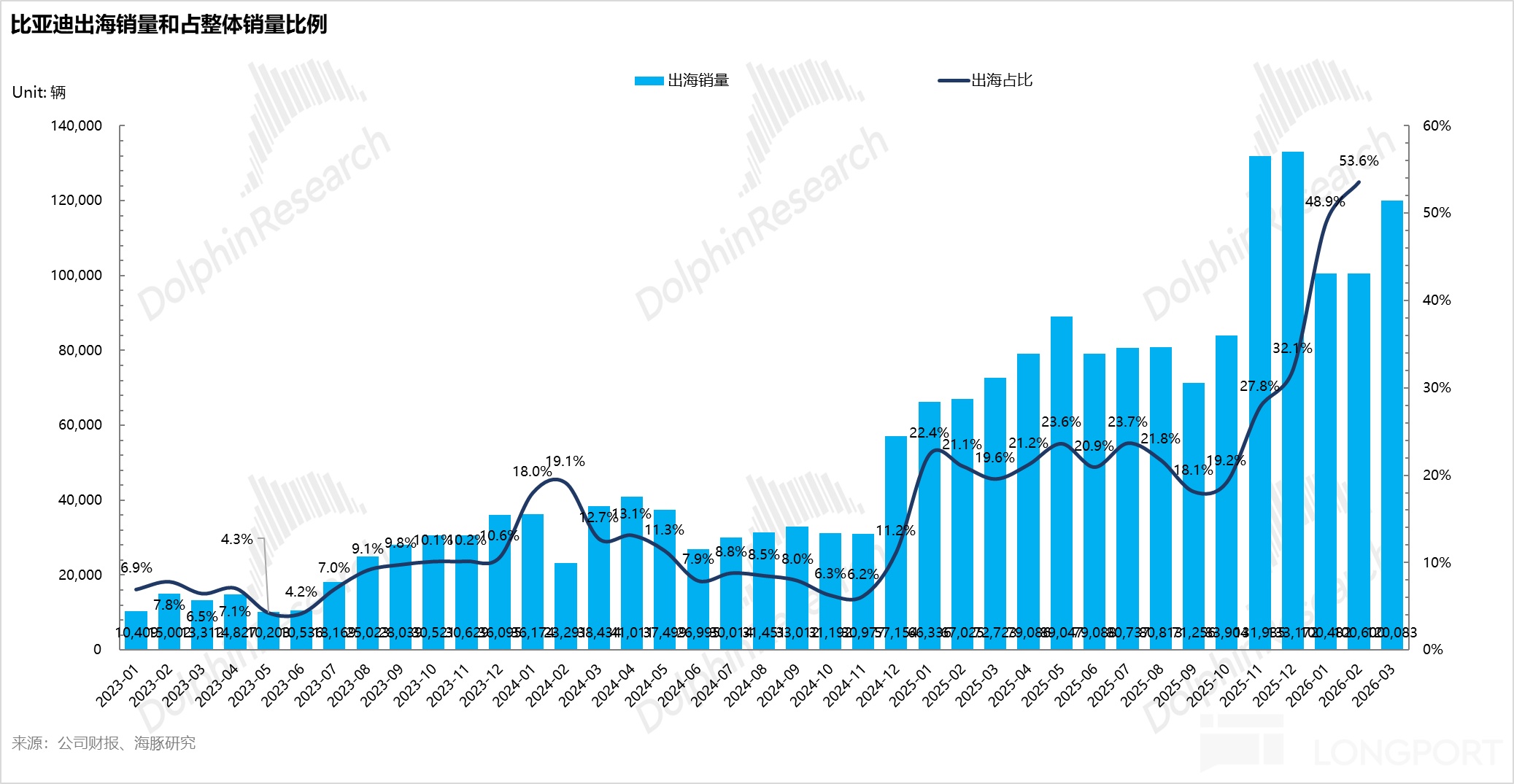
To counter domestic headwinds and tax rollback, BYD made overseas expansion a core 2026 strategy, targeting 1.5–1.6mn exports (+45%–55% YoY), driven by local capacity and denser sales networks:
a) Accelerate localized capacity to bypass tariff barriers
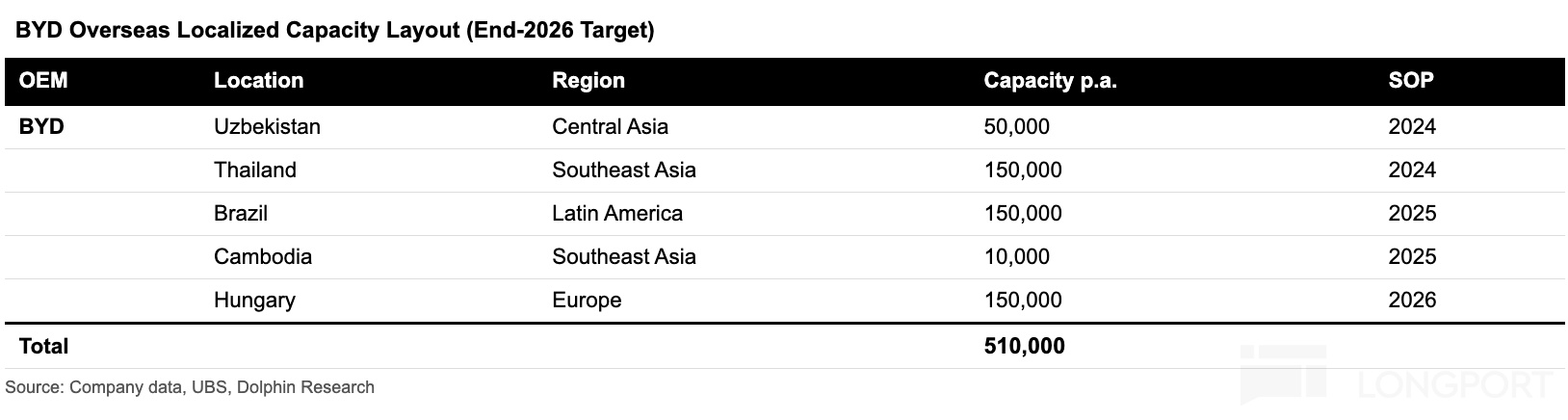
To mitigate trade frictions and improve regional delivery, BYD is building a global manufacturing footprint. Americas/Europe hubs: Brazil is online and planned to 300k/year; Hungary is expected to start in Q2 2026 with 150k/year.
Emerging markets: capacity in Indonesia and Türkiye is progressing. By end-2026, localized overseas capacity should exceed 510k/year, supplemented by widespread KD assembly to shorten supply chains and respond to local demand.
b) Rapidly expand sales networks to strengthen reach
Europe retail points will double from ~1,000 at end-2025 to ~2,000 in 2026. Partnerships with major local dealer groups will enhance brand reach and localization.
Successful overseas expansion will offset lower, less profitable domestic volumes. At ~RMB 20k NP per vehicle, 1.5–1.6mn exports imply RMB 30–32bn NP, or nearly two-thirds of 2026 auto profit from overseas, creating a robust profit cushion.
5. Premiumization: mix lift relies on ‘down-market blockbusters’; structural upshift not yet proven
The market’s two key upside pillars — overseas expansion and premiumization — are diverging: overseas is surging while premiumization remains slow. BYD still faces hurdles in smart experience, brand premium, and marketing/service.
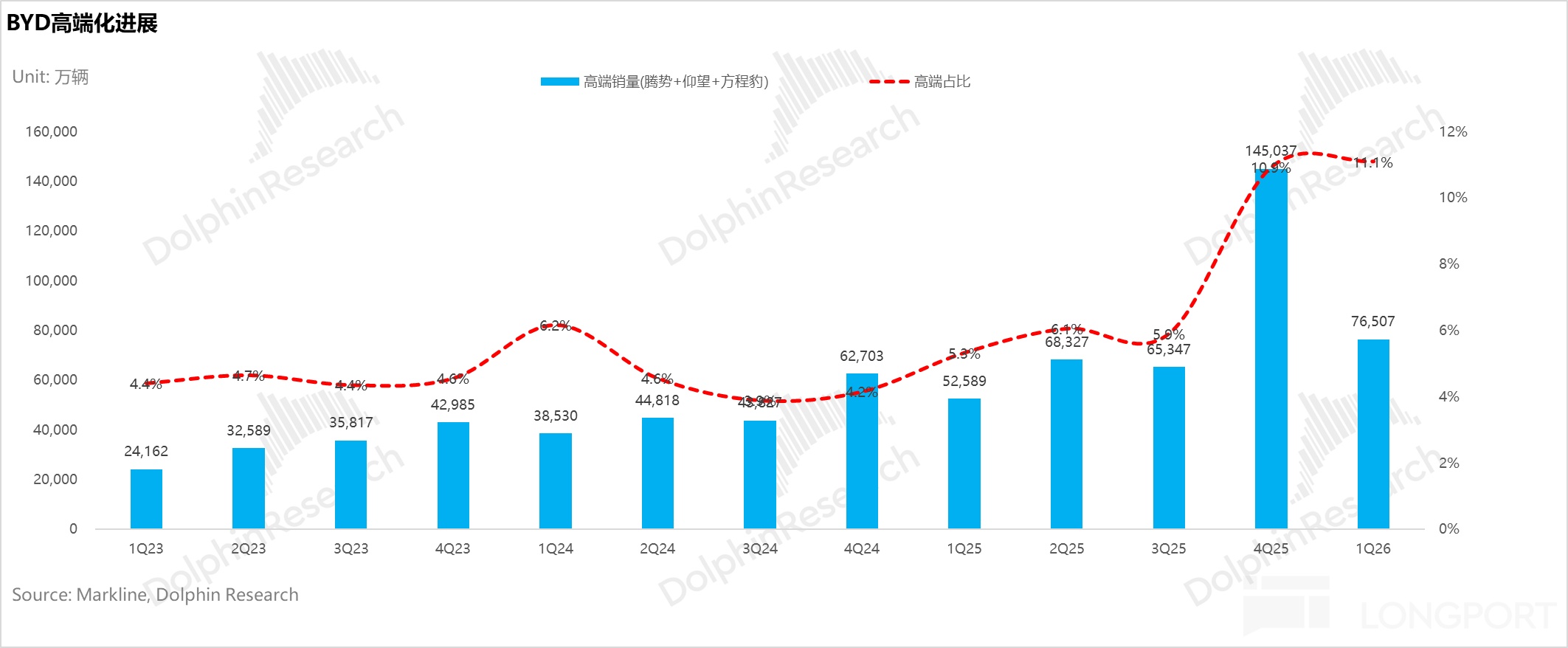
In Q1 2026, sales of premium brands (Denza, Yangwang, Fangchengbao ex-Tai 3) were 77k, -37.3% QoQ. Given the broader domestic slump, premium share was roughly stable at ~11%.
The premium push was driven largely by the blockbuster ‘Fangchengbao Tai 7’ in the RMB 179.8k–219.8k band. With ‘rugged off-road + 135km EV-only range’ value, it reached ~6% of total Q1 volume.
Excluding sub-RMB 200k Tai 7 and entry Tai 3, core premium sales were only ~32k, roughly halved QoQ, with premium share still around ~5%. This highlights structural imbalance beneath headline growth.
Growth reliance and brand tension: The breakthrough leans on ‘affordable premium’ models around RMB 200k, rather than broad strength above RMB 300k where true premium is defined. To chase volume, Fangchengbao has trended down-market with Tai 3/7, which may dilute long-term premium brand equity.
Dolphin Research believes true premiumization — sustained brand premium and stable share in RMB 300k–400k — will depend on higher-end launches such as Denza N8L/N9 and realized smart capabilities. The journey is long, with only early signs of progress.
6. Inventory rose again
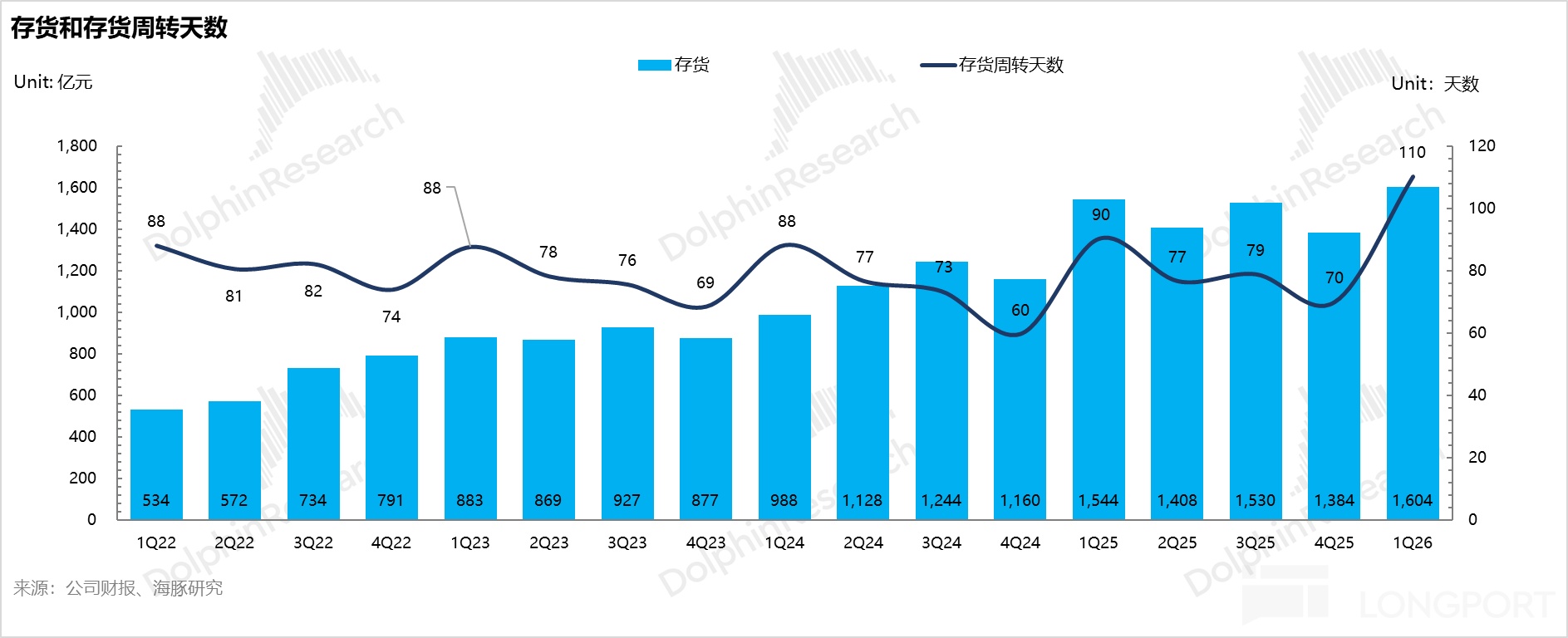
Inventory climbed in Q1, with days up to ~110. Likely reasons:
a) A cliff-like domestic volume drop (-52.3% YoY in Q1). b) Strategic stockpiling ahead of dense 2026 refreshes (e.g., 2nd-gen Blade and 6C fast-charge models) to ensure Apr–May launches can deliver immediately.
<End here>
Dolphin Research archive:
Earnings season
Aug 30, 2025 review: BYD: The cost-cutter king under siege — does the sword cut both ways?
Hot topics
Oct 14, 2025: Auto tax break reshuffled — another hit to BYD?
Jun 4, 2025: BYD: Could it become the next Evergrande?
Jun 12, 2025: BYD, Geely, Great Wall, Nio: whose 60-day payables are make-or-break?
Deep dives
Feb 26, 2025: Can ‘smart driving for all’ create another BYD?
Feb 19, 2025: Up 30%: what’s inside BYD’s ‘smart driving for all’?
Risk disclosure and disclaimer: Dolphin Research disclaimer and general disclosure


The copyright of this article belongs to the original author/organization.
The views expressed herein are solely those of the author and do not reflect the stance of the platform. The content is intended for investment reference purposes only and shall not be considered as investment advice. Please contact us if you have any questions or suggestions regarding the content services provided by the platform.