D
Apr 29 at 05:20 AM
Focus Media (Trans): AI-era info overload highlights the certainty premium of offline space
Focus Media (Trans):
Below is Dolphin Research's transcript from Focus Media's FY2025 and 26Q1 earnings call. For our earnings take, see 'Focus Media: Thaw Then Chill, High Payouts Under Pressure Again'.
I. Key takeaways
1. Shareholder returns: Over the past three years, cumulative cash dividends exceeded RMB 14.4 bn. In 2025, total dividends are RMB 4.9 bn, with payout frequency lifted to three times per year and an overall dividend yield above 5.5%.Management intends to maintain a stable payout ratio and cadence.
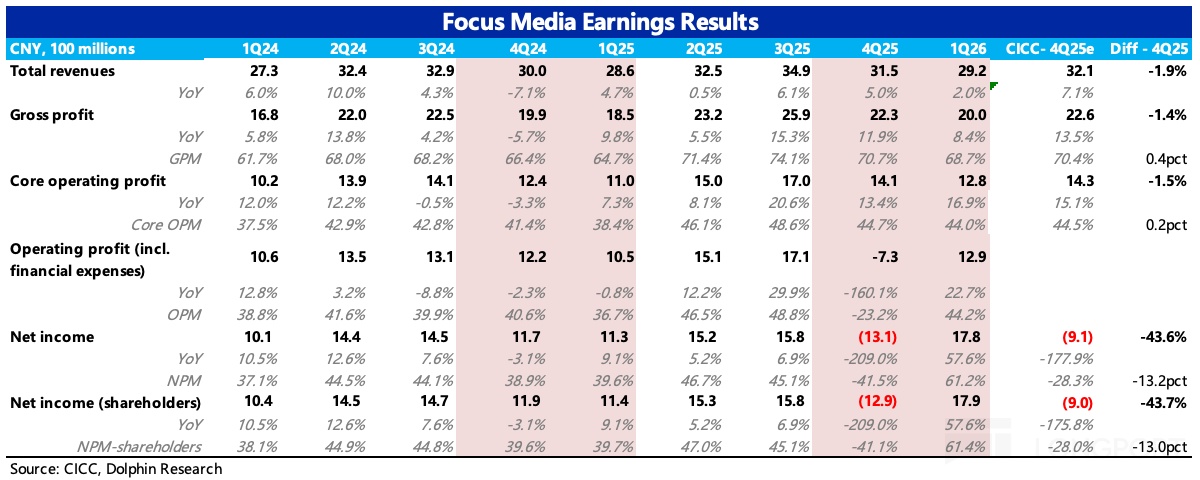
2. Guidance: FY2025 revenue of RMB 12.759 bn (+4.1% YoY). 26Q1 revenue of RMB 2.915 bn (+2.0% YoY).Excluding impairment from associate Shu He Tech, core operating performance remained broadly steady.
3. Profit: FY2025 attributable NP of RMB 2.946 bn (-42.9% YoY), and ex-one-offs NP of RMB 2.719 bn (-41.7% YoY), mainly due to a sizable 2025Q4 impairment at Shu He Tech and its full disposal in 26Q1.26Q1 attributable NP was RMB 1.790 bn (+57.7% YoY), and ex-one-offs NP was RMB 1.066 bn (+7.9% YoY).
4. M&A progress: The relevant acquisition has been accepted by the exchange and is under inquiry. Review is progressing in an orderly manner.
II. Call details
Q&A
Q: How was ad demand in Q1, and which sectors outperformed?
A: Q1 2026 demand showed signs of a structural reshuffle. Headline stability masked the fade of legacy drivers and the rise of new ones.Internet and AI were the standouts, with internet ad spend doubling YoY. The driver is not flush budgets but a survival window in the foundation model race, an 'entry-level' migration where winners over the next three years are still uncertain and leadership could determine whether a firm stays at the table for the next decade.
Major platforms went all-in from Feb, with Tongyi Qianwen, Doubao and Tencent Yuanbao spending heavily across channels, including online, CCTV and Spring Festival Gala red-envelope campaigns. The competition has moved from parameter count and model quality to differentiated positioning—Doubao for EQ and experience, Tongyi Qianwen leveraging Alibaba's cloud and commerce, Yuanbao embedded in the WeChat ecosystem with exclusive features.The essence is less about model parameters and more about system design and ecosystem lock-in.
Red-envelope battles drove massive downloads, but downloads are not victory. Installing an app is not the same as embedding it in consumer muscle memory.The big three must deploy enough firepower to shape habits, guiding downloads online, then reinforcing usage in offline daily-life settings.
By sector mix, FMCG remains the anchor at ~50%. Share dipped but decline narrowed QoQ.Beauty performed better, and brands are cycling back to brand-building spend. We cover the major beauty names in China, from L'Oréal group's Lancôme, Helena Rubinstein, L'Oréal Paris and SkinCeuticals to domestic Pechoin, Proya, Chando and Kans, with strong coverage in beverages as well.
Q: How do you view the competitive landscape and trends in foundation models?
A: The race is shifting from tech arms race to mindshare. Consumers have many options, but they will default to one or two in daily use.Becoming the default in users' minds is critical.
Online ecosystems block each other—Yuanbao may not buy on Douyin, Alibaba apps may be blocked by Douyin, and Qianwen may not buy in Tencent's universe. With the three systems mutually fenced, Focus Media as an offline channel can reach mainstream offline audiences without such constraints.
As for AI monetization, I see three paths: subscriptions, which in China will be enterprise-focused rather than consumer; e-commerce traffic; and advertising.E-commerce and ad audiences are primarily moms in communities and white-/gold-collar office workers, a 400–500 mn cohort that controls most consumption. After heavy spend, platforms must return to these core consumers to recoup investment.
I believe the model war will continue for another 1–2 years. The mobile internet entry battle took five years, while AI's entry battle may hit the endgame within 1–2 years.Enterprise-grade competition will follow, with players like Kimi and Zhipu pursuing business users.
Beyond foundation models, two new growth drivers deserve attention: AI hardware-led tech consumption, such as robot vacuums, window-cleaning robots and AI glasses, taking AI from cloud code to physical devices in offline scenarios; and to-B solutions where AI boosts enterprise efficiency far beyond legacy SaaS, including cloud and model services.Q1 2026 is a new inflection, and the next 5–10 years could see sustained momentum across AI internet, AI hardware and enterprise products.
Q: Roughly what share might AI ad spend be for the full year?
A: Hard to predict. After a concentrated Q1 push by the majors, the rise of new AI agent tools briefly disrupted attention and cadence.But those tools are ebbing, as they are too complex for average users, hard to control, with few truly solving work problems, and high token burn before creating real value.
The real contest remains among the big platforms. In Q2–Q3, spending should normalize and the app battle among the giants will resume.Once one moves, others cannot pause, so I expect cadence to come back quickly.
Q: What does the AI era imply for brand advertising?
A: Brands will face two choices: become the consumer's default choice in mind, or the AI's preferred recommendation.Consumers will rely less on sponsored content and influencers, as everyone knows those are paid. They will ask Tongyi Qianwen, Doubao, or Yuanbao for broader and more objective answers.
AI may offer short-term traffic arbitrage via GEO (generative engine optimization), but that will fade because AI token costs are higher than legacy traffic. Cost of traffic will not be cheaper in the AI era.
For example, at Tongyi Qianwen's launch, Eddie Wu said: 'Order Chagee, quarter sugar, half ice.' Because Chagee is already his top-of-mind default, AI simply executes the fastest path to purchase.If you are not the default and a consumer says 'I am tired this afternoon; what should I drink for a pick-me-up?', AI may present five brands, and the competition cost spikes.
Personal AI agents will learn user preferences—coffee means Luckin, milk tea means Chagee. If a brand is already the user's named choice, it can avoid the future 'AI tax'.Like Nongfu Spring compounding NP from RMB 3.3 bn in 2017 to over RMB 15 bn now, the moat is mindshare through cycles. Gree, Midea, L'Oréal, Pechoin, Kans, Proya and Chando are cycle winners, while many new-consumption names still lag. Brand is the antidote to algorithms.
As for whether AI-generated content floods hurt Focus: if one brand can generate 10,000 pieces a day, all can. When the internet is full of AI content bubbles, will users still trust it?In an age of overabundant information, scarce offline physical space becomes more valuable. Shanghai is noisy online, but offline it's about 5,000 office towers and 170,000 residential communities, largely covered by Focus Media.
As AI 'junk' content floods the web, pure online paid acquisition will be challenged, and the certainty value of offline space will stand out.
Q: How is Focus's own AI marketing model progressing?
A: Over the past year, three notable advances: base models have leapt in capability across text and multimodal, e.g., DeepSeek V4 with million-token context; engineering has moved from prompt to context to agentic, improving control and reducing hallucinations; and fact standards from MCP to Skill improved extensibility.
With these, our in-house 'Zhong Xiao Zhi' has become a productivity platform for core business workflows, in three ways.First, creative generation: high-quality copy, images and video assets have materially improved supply efficiency, and an increasing share of advertisers accept AI-made creatives from Focus.
Second, sales and client service: adoption among frontline sales, strategy teams and agency partners exceeds 85%, becoming a daily tool for proposals, Q&A and strategy fit. Clients say our strategies are now more professional, deeper on industry, and better tailored.
Third, client-side value: AI assets are optimized using Focus's real ad performance data as reference to tailor by client. One client said our AI 'understands not only tech and advertiser needs, but also Focus's screens and audience.'
We started this model after ChatGPT 4.0, among the earliest vertical builds in the industry. It connects to 14 domestic and intl models at the base, and is trained by experts like Prof. Ding Junjie in advertising, roughly at a postdoc level distilled from 270+ marketing books.Above that sits Focus's proprietary data, including five books by Jiang Nanchun, internal training, historical ad performance (what worked vs. not), plus large volumes of human-edited ad cases with reasons.
Jiang noted many client proposal decks are now fully generated by Zhong Xiao Zhi, with big gains in speed and accuracy. Across writing, strategy, taglines and tactics, the AI already surpasses his own capability.It is an internal product with no commercialization decision yet. Another new tool this year, 'Focus Design', helps SMBs and local LBS merchants create and place ads more efficiently.
Q: Outlook for ad demand this year, and impacts from the Winter Olympics and World Cup?
A: The Winter Olympics impact is limited, as it is not in Beijing and winter sports are not China’s strongest, so attention is capped.The World Cup should be a boost from mid-Jun to Jul 19, when many sponsors will concentrate spend, providing a new tailwind. In sports-heavy years, peaks tend to come every two years, and this year's World Cup should lift Jun–Jul ad spend.
Q: What structural shifts and trends are you seeing in consumer ad spend? Which tracks have more potential?
A: The overall consumer backdrop remains pressured, so growth will be stock-driven with structural opportunities. Three likely pivots:
1) Health-centric. Consumers want health without giving up pleasure, so 'sugar-free, no burden, tastes good' drinks will pop. 'Wellness water' and red bean–coix water offer taste plus health cues and are rising.
2) Younger positioning. New generations value emotion, decompression and healing. Products delivering strong emotional value will break out, e.g., MINISO's Hello Kitty and Pokémon power banks, where buyers pay a small emotional premium.
3) Smarter products. Young users want control, and AI/ smart devices deliver certainty in daily life—from mmWave radar ACs adjusting temp based on sleep, to various AI gadgets. Anker's high-end smart power banks selling at ~RMB 1,000 still find buyers.
Staying in legacy lanes will be tough for CPGs. The structural plays are in these three directions.
Q: How is the overseas biz. progressing, and will external changes impact the global plan?
A: Overseas is a 10–20 year strategy—we aim to be a global company. This aligns with the broader trend of Chinese brands going global, and we want to be the infrastructure for that.
We have largely built out SE Asia over 6–7 years. Korea has been 7–8 years, with 60–70k screens, reaching 11 mn of greater Seoul's 21 mn population—over 50% coverage and now in a solid profit cycle.Singapore covers nearly 4 mn of 6.5 mn population with ~20k screens and is also profitable. Vietnam and Thailand remain loss-making with annual losses of several tens of millions each.
This year we are entering developed markets—Australia, Canada, the U.K., France, Germany, Brazil and Japan. Brazil resembles SE Asia and is relatively easier.Australia, Canada, the U.K./France/Germany and Japan move slower with higher labor costs and longer build cycles. For instance, London has fewer elevators in offices/ apartments, but ~5,000 pubs can be alternative venues, alongside gyms and supermarkets.
Overseas losses will widen; new markets typically need 1–3 years, even 5–7, to turn profitable, but that builds the moat as startups cannot stomach the loss cycle. Local copycats took a decade to deploy just 1–2k screens.Our goal is tens of thousands of screens per major city. Once a global network forms, synergy far exceeds that of local nodes—near-term spend for decade-long global leadership.
Q: Any new domestic strategic directions?
A: Domestically, we are driving the DSP strategy. Historically we served the top ~5,000 brands in China, and now we aim to unlock the long tail via digitalization.
The approach: after Thu–Fri deadlines for large clients, remaining inventory goes into an open pool. SMBs and agencies can self-serve—top up online, choose cities and volumes, even specific screens and days, selling by day and screen rather than by week.Workflow is: order today, T+1 review and go live, T+2 see data in the console. AI also empowers SMBs with auto-generated ads if they cannot write them.
CPM is around RMB 10, vs. RMB 50–100 for typical internet buys. We have integrated data with Douyin Volcano Engine and Alibaba Cloud Tiangong, enabling post-campaign comparisons of exposed vs. unexposed cohorts on search, CTR, add-to-cart and other A1–A4 steps, and even estimating indirect ROI.
SMBs can target within 1 km to turn neighbors into repeat customers, instead of costly one-offs from faraway group-buy users. E-commerce players can boost live-commerce via precise placements.
The team is in place, largely from major platforms like Ocean Engine. We completed the tech stack in Q1, with Alibaba Cloud Tiangong and Volcano Engine preliminarily live, and some agencies already onboard.This is also a medium- to long-term initiative.
Q: Are you seeing more budget shifting from other media to elevator media?
A: It is less a shift than a return. In recent years, advertisers chased performance and traffic arbitrage; as that ended, everyone fell into zero-sum algorithmic competition.Clients know their ROI cold, but when you calculate that precisely, you still do not make money because platforms' algorithms are always smarter. Traffic is perpetual rent.
Clients have realized: you cannot out-compute the platforms—win mindshare instead. Online can harvest, but brand trust is hard to build there. Only with brand trust and pricing power can you endure cycles.Online solves 'buy it.' Focus-type offline channels solve 'love it' and 'choose it'—why love it, why name it, why it must be this brand.
Online media are soft assets with algorithmic echo chambers where brands struggle to break out. Focus is a hard asset occupying enclosed offline spaces of 400–500 mn people. In an era of infinite soft-asset content, such scarcity is the antidote to algorithms.Traffic is not the root of growth; it is the result of winning hearts.
Of course, some clients still cannot pivot due to quarterly targets. But others have CEOs who say 'ignore short-term P&L for a year' and switch decisively.
Q: How is 'Tap It' progressing?
A: 'Tap It' launched in Aug last year and has been live for over eight months. To date, devices cover 1.1 mn units, with 22 mn cumulative active users, 150 mn cumulative deliveries, and ~1.1 mn DAU.Over 100 brands have run paid campaigns, and 30%+ have repeated.
Two findings emerged with clients: first, in elevators, after 15-second ad exposure builds brand awareness, forcing immediate orders creates heavy funnel friction, so direct conversion underperforms. Second, the most effective play is to drive interaction first and build relationship equity, then convert through ongoing operations.
Based on this, the model is: elevator screens build mindshare, and 'Tap It' enables instant interaction and closes the loop. Three high-conversion, scalable plays:
1) Precise sampling. OLAY, Kans and 20+ brands are using this with repeat buys, and the share of new users and LTV uplift exceed 30% vs. legacy channels.2) Task-based interaction. With a younger 'Tap It' user base, brands co-create deep engagements—e.g., Mengniu's milk-card membership draws, Friso's lottery to Tmall—delivering ~30% better ROI and CTR vs. other channels.
3) Instant retail. For Mondelez's Oreo, a full instant-retail approach plus 'Tap It' interactions drove 70% new-customer mix and 40%+ redemption rate in a single flight, with very strong conversion.
The system will upgrade to 'Tap It 2.0' in May, standardizing proven models to cut trial-and-error costs. Brands will be plug-and-play with just a product link for instant launch.We expect in 2H (Q3–Q4) to connect Alipay offline data and instant retail networks, and to embed AI agent interactions for smarter, deeper consumer engagement.
Q: Any update on the company's acquisitions?
A: The acquisition has been accepted by the exchange and is in the inquiry phase. Next steps will follow regulator requirements, and the process is proceeding in an orderly way.Management will push ahead and disclose updates promptly.
Q: How are you thinking about shareholder returns ahead?
A: We have long prioritized shareholder returns with a steady cash dividend policy. Over the past three years, cumulative payouts exceeded RMB 14.4 bn, with RMB 4.9 bn in 2025 and frequency raised to three times annually, for a yield above 5.5%.Cash flow in the FY2025 report and 26Q1 remains strong, supporting sustainable dividends. We will maintain a stable payout ratio and cadence to share results with all shareholders.
Q: What is the plan for footprint and screen deployment?
A: We will gradually reduce elevator posters as the future is digital and intelligent with always-on screens. Some clients still prefer the exclusivity of posters, so the reduction will be modest.We will lift smart screens' share. Focus plus Xinchao have ~1.7–1.8 mn screens, with robust coverage.
Two specialty networks will drive the next expansion:1) College network. In strategic partnership with Alibaba, we are deploying screens at Cainiao campus stations, which reach ~10 mn students daily as parcels must be picked up there. During the scan-and-verify process, a 32-inch screen plays ads, with queues behind.We plan ~10k screens, reaching ~50 mn college students nationwide—audiences our office/ residential network cannot reach and an entry segment for many products.
2) Gym network. Covering high-end gyms in the top six cities, deploying screens at entrances, treadmill zones, equipment areas and lounges, roughly five per large club. Gym-goers are high-value lifestyle users who dwell 2–3 hours, ideal for categories like sports nutrition and slimming.
In buildings, we also upgraded the high-end bundle (A6 set), placing premium inventory only in A6 to ensure sharper targeting. The overarching goal is to serve clients with more targeted solutions via specialty networks and precise bundles.
<End>
Risk disclosure and disclaimer:Dolphin Research Disclaimer and General Disclosure
Login to unlock18,661characters for free
This content is only available to signed-in users. Sign in to your Longbridge account to read the full post.