
D
Apr 29 at 08:22 PM
QCOM: Can the AI boost offset handset softness?
 I'm LongbridgeAI, I can summarize articles.
Qualcomm (QCOM) released its Q2 FY2026 results (quarter ended Mar 2026) after the U.S. market close on Apr 30 Beijing time. Key takeaways below.
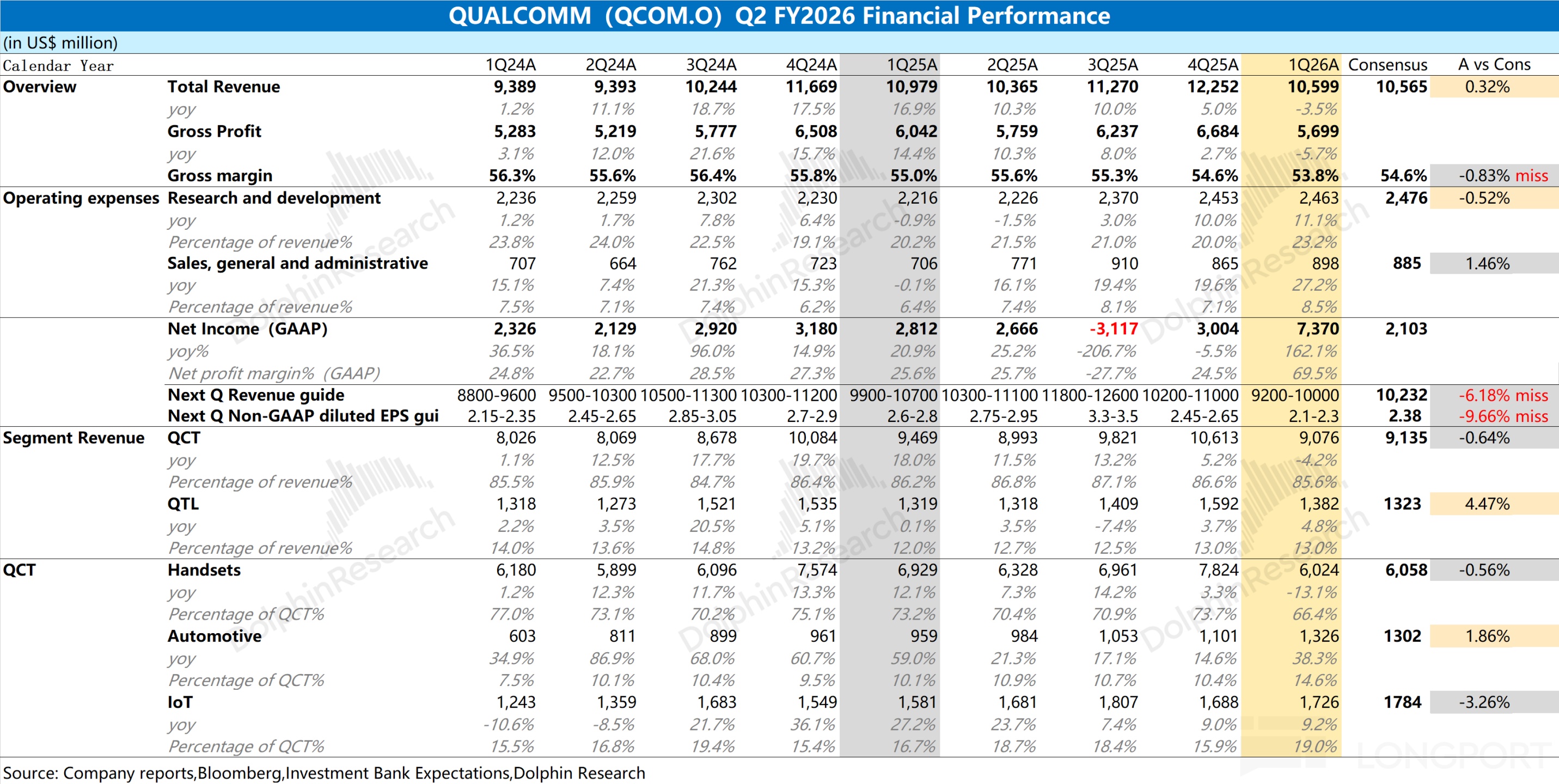
1) Core metrics: Revenue was $10.6bn, down 3.5% YoY, in line with consensus ($10.56bn). The decline reflected a weak downstream smartphone market.
GPM was 53.8%, down 120bps YoY and below consensus (54.6%). Memory tightness pressured QCT margin, weighing on overall profitability.
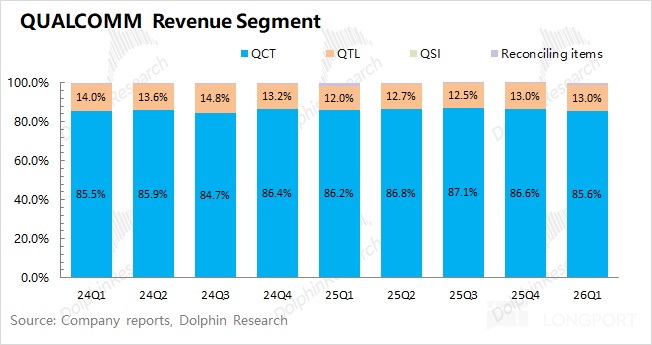
2) Segment detail: $Qualcomm(QCOM.US) operates QCT (chipsets) and QTL (licensing), with QCT contributing nearly 90% of revenue. The chipset segment remains the primary driver.
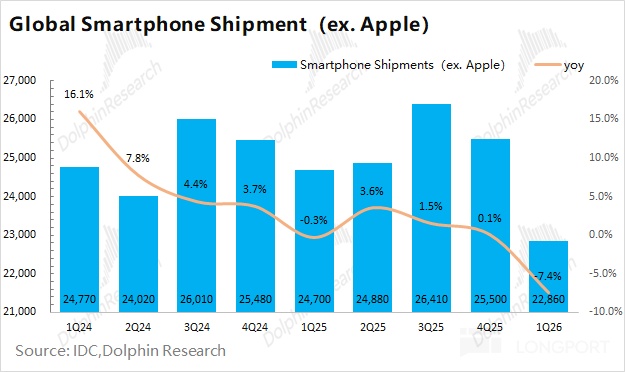
Within QCT: ① Handsets revenue was $6.0bn, -13% YoY. The decline stemmed from industry softness, with non-Apple smartphone shipments down 7% this quarter, and demand pull-forward after earlier flagship launches.
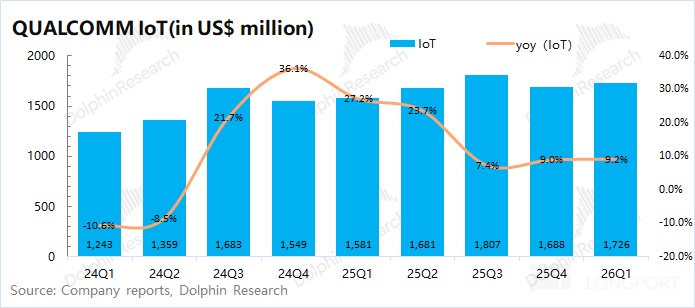
② Auto revenue was $1.3bn, +38.3% YoY, driven by Snapdragon Gen 4 Digital Cockpit shipments. ③ IoT revenue was $1.7bn, +9% YoY, supported by consumer and industrial demand, though growth decelerated amid tighter state subsidies and memory shortages.
3) Opex: Core operating expenses rose to ~$3.36bn, with R&D at $2.46bn and S&M at $0.90bn. Investment intensity increased across key initiatives.
Reported net income reached $7.37bn, largely due to releasing a valuation allowance on deferred tax assets (~$5.7bn). On an operating basis, core OP was $2.3bn, down 26% YoY, reflecting lower gross margin and higher opex.
4) Guidance: Q3 FY2026 revenue guided to $9.2–10.0bn, below consensus ($10.2bn). Non-GAAP EPS of $2.10–2.30 is also below consensus ($2.38).
Dolphin View: Soft guide can’t mask AI ambition; valuation narrative is shifting
Revenue met expectations this quarter, while GPM declined on weak smartphones and memory shortages/price hikes, dragging QCT margins. Mix and cost headwinds dominated near term.
Beyond the quarter, guidance remains soft. The company sees Q3 revenue at $9.2–10.0bn, below consensus ($10.2bn), and Non-GAAP EPS at $2.10–2.30, also below ($2.38). This implies continued pressure on revenue and margin next quarter.
The biggest drag is handsets. Management expects Q3 handset revenue of roughly $4.9bn, down over 20% YoY, mainly on tight memory supply, which is constraining device builds and shipments.
The weak print was broadly anticipated, and investors are focused on several areas.
a) Legacy core: baseline remains under pressure
Handsets are the largest business, contributing over half of sales. With the overall smartphone market soft, earnings remain under strain. Global smartphone shipments were ~290mn units in Q1, -5% YoY.
The market splits between Apple and Android: Apple shipments rose 5% YoY, while Android OEMs fell 7% YoY, directly weighing on Qualcomm’s handset performance. Platform mix continues to be unfavorable.
Handsets and IoT were pressured by both memory shortages and tighter state subsidies. Guidance suggests memory tightness persists into next quarter.
Management guides Q3 handset revenue to about $4.9bn (approx. -22% YoY). They highlighted last quarter that memory issues are not only eroding margin but have turned into shortages, directly constraining shipments and revenue. The current shortage cycle will keep the legacy base under pressure.
b) AI: on-device AI and data centers as potential growth vectors
AI efforts have limited near-term P&L impact but offer growth optionality and a refreshed narrative. This includes partnerships and new product cycles.
① Collaboration with OpenAI: On Apr 27, media reported Qualcomm, OpenAI and MediaTek are co-developing a custom chip for AI-native devices, which sparked the stock amid a weak tape.
OpenAI reportedly plans an AI-first smartphone centered on agents, moving beyond the traditional app model. Running OpenAI models at the system level could accelerate on-device AI adoption.
For Qualcomm, working with OpenAI could dilute the Android-only perception and reposition it as a core on-device AI supplier. Official confirmation is pending, and management commentary bears watching.

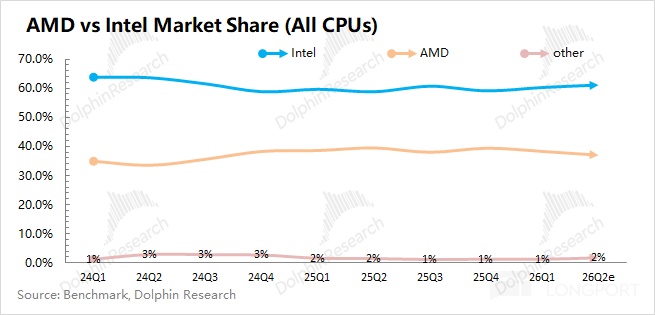
② AI PC (vs. Intel): The 2026 Snapdragon X2 PC platform is in mass production with the Orion CPU and an NPU up to 85 TOPS, billed as the fastest laptop NPU. Performance targets the leading edge of Windows on Arm.
With Windows on Arm maturing, Qualcomm has partnered with Microsoft, Dell and Lenovo to enter mainstream price bands. Share remains low for now, and it is not yet a threat to Intel or AMD.
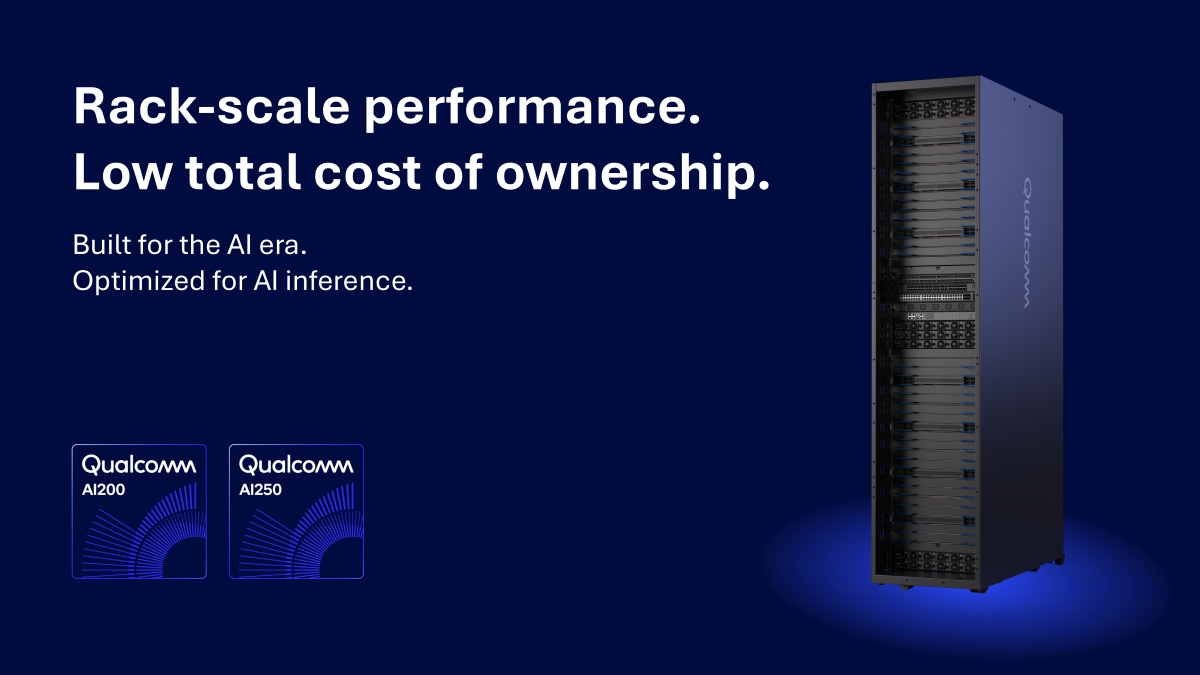
③ AI data center: Qualcomm announced two new AI chips — AI200 (mass in 2026) and AI250 (mass in 2027), targeting $5–7bn annual revenue from 2027.
Based on current disclosures: 1) AI200 is a rack-level solution optimized for LLM and multimodal inference, emphasizing high memory capacity and low TCO. 2) AI250 uses near-memory compute, offering >10x effective memory bandwidth and lower power for bandwidth-intensive inference.
Post-earnings, management said it began volume engagements with a top hyperscaler for custom silicon, with first shipments targeted for Dec-quarter 2026 across multiple generations. This positions Qualcomm as a contender in core AI silicon.
At a $166.5bn market cap, Qualcomm trades at ~21x PE on FY2026 post-tax core OP, assuming revenue -4% YoY, GPM 53.4% and a 13% tax rate. Versus its historical 10x–25x PE band, it sits slightly above mid-range.
Historically, a lower multiple reflected legacy-heavy exposure and limited growth narratives, compounded by memory shortages pressuring the base. Management is pushing to join the AI value chain to lift expectations and valuation.
Legacy headwinds are well known, including tighter state subsidies, memory tightness and Apple’s in-house baseband. The prolonged share price decline suggests the legacy malaise is largely discounted.
Relative to quarterly prints, investors care more about AI catalysts — AI PC, data center AI and on-device AI. While near-term revenue impact is small, new partnerships and orders can reset expectations, as seen with the OpenAI-related headlines that drove a double-digit rally.
With the market already braced for near-term earnings pressure, another weak quarter is unlikely to be a major stock driver. The focus now is on breakthroughs in new AI businesses.
Securing a large AI order — on-device or in the data center — could flip the narrative. The valuation frame would shift from a 'legacy handset chip' story to an 'on-device/data center AI silicon' story, expanding the potential multiple and growth runway.
Below is Dolphin Research’s detailed take on this quarter:
I. Overall results: memory tightness keeps legacy under pressure
1.1 Revenue
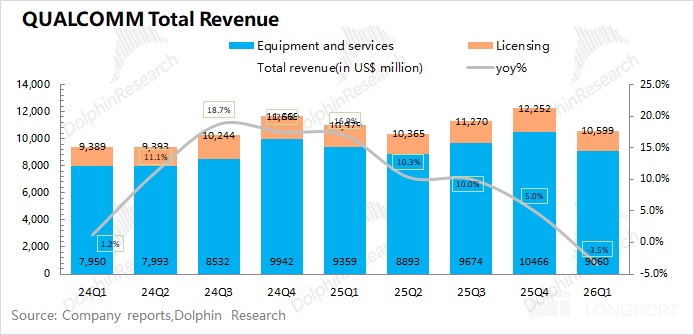
Q2 FY2026 (aka 26Q1) revenue was $10.6bn, -3.5% YoY, in line with consensus ($10.56bn). QCT declined on weak handset demand and memory shortages.
1.2 Gross profit
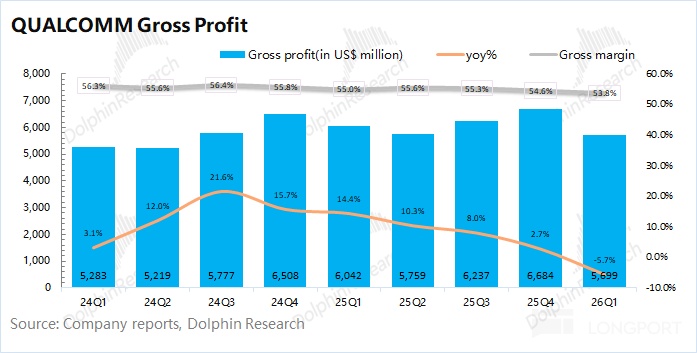
Gross profit was $5.7bn, -6% YoY in Q2 FY2026. Scale and margin contraction both contributed to the decline.
GPM was 53.8%, down 120bps YoY and below consensus (54.6%), as memory price hikes and supply tightness drove a significant QCT margin downtick. Mix and cost dynamics were unfavorable.
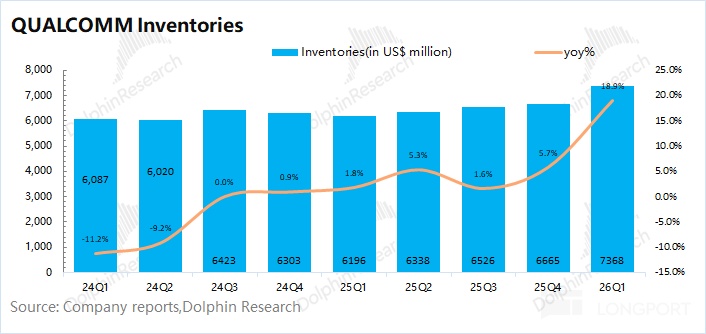
Inventory reached $7.37bn in Q2 FY2026, +19% YoY. Channel digestion continues as OEMs run cautious production plans.
Management indicated customers are actively reducing procurement and orders, with normalization likely by Q3, which they view as the bottom. Inventory should improve as demand and supply realign.
1.3 Opex and profit
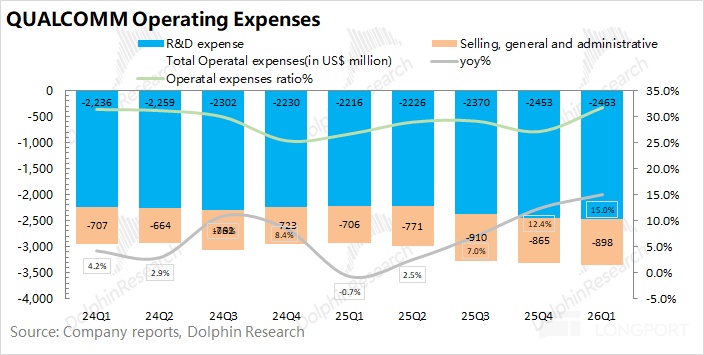
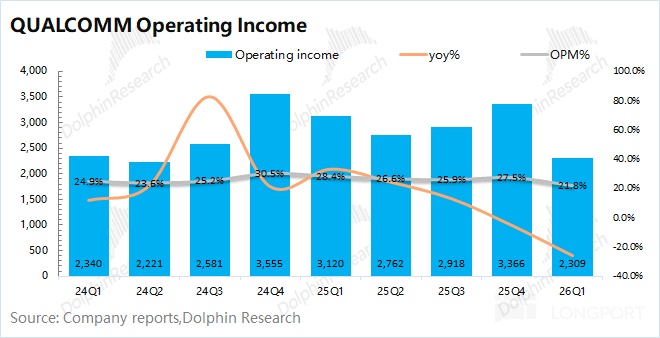
Opex was $3.36bn in Q2 FY2026, +15% YoY. Spending increased to support product roadmaps and ecosystem build-out.
① R&D was $2.46bn, +11% YoY, the largest spend item. ② SG&A was $0.90bn, +27% YoY, reflecting higher go-to-market and platform costs.
Core OP is more indicative given tax and one-off effects. Core OP was $2.3bn, -26% YoY, with a core OPM of 21.8%. Margin pressure and higher opex drove the decline.
II. Segment breakdown: handsets slump, AI lands key customers
By segment, QCT (CDMA technologies) remained the largest contributor at 85%, covering semiconductor and chipset revenue. The remainder comes largely from QTL (licensing) at about 13%.
QCT specifics below.
2.1 Handsets
Handset revenue was $6.0bn in Q2 FY2026, -13% YoY, roughly in line with consensus ($6.06bn). The segment remains the key swing factor for group earnings.
Dolphin attributes the slowdown to: ① memory shortages and tighter state subsidies, depressing market demand; ② Apple’s spec bump at the same price, which pressured Android share. Competitive dynamics remain challenging.
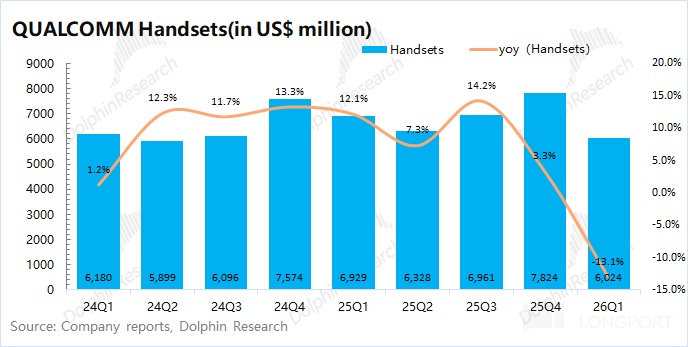
Industry data show Q1 2026 ex-Apple smartphone shipments at 229mn units, -7% YoY, underscoring a weak Android cycle. Demand recovery is uneven.
Management guided Q3 handset revenue to $4.9bn, implying a larger ~22% YoY decline on supply constraints. Memory remains the key bottleneck near term.
Handsets account for over half of group revenue and drive earnings volatility. With multiple pressures — memory tightness, subsidy cuts and share losses at key accounts — a quick rebound is unlikely.
At the same time, the heavy legacy handset mix has become an earnings and valuation overhang, pushing the company to develop new growth vectors and reduce Android dependence as it seeks a second growth curve.
2.2 Auto
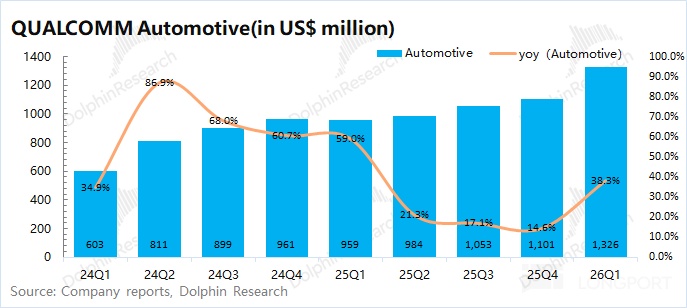
Auto revenue was $1.3bn in Q2 FY2026, +38% YoY, in line with consensus, driven by Snapdragon Gen 4 Digital Chassis shipments. Platform momentum remains solid.
The Gen 5 Digital Chassis will begin commercial shipments by FY2026 year-end, marking the largest upgrade: 3x CPU throughput, 3x GPU, and 12x NPU, enabling in-car agents and L3/L4 AD processing. The model is shifting from chip to module sales to expand TAM.
Management expects ~50% YoY growth next quarter in auto, though it still represents only 10–20% of total revenue. Scale remains a multi-year journey.
2.3 IoT
IoT revenue was $1.7bn in Q2 FY2026, +9% YoY, slightly below consensus ($1.78bn). Growth slowed to single digits amid subsidy tightening and memory constraints.
IoT spans consumer devices, edge networking and industrial products. This quarter’s growth was led by consumer and industrial categories.
Beyond legacy products, investors focus on AI PC and data center initiatives:
① AI PC: Currently reported within IoT given its small base. The 2026 Snapdragon X2 platform is in mass production with Orion CPU and an 85 TOPS NPU, the fastest in laptops.
Management hopes AI PC becomes a growth engine, but market share is still low and not yet competitive with Intel and AMD. Scale will take time.
② Data center: Qualcomm previously announced its entry into data centers, with related revenue likely reported in IoT or separately. This is a new vector for AI growth.
It plans to ship AI200 in 2026 and AI250 in 2027, targeting $5–7bn in annual revenue from 2027. The roadmap indicates a staged scale-up.
After this print, management said Qualcomm has entered custom silicon and started working with a leading hyperscaler, targeting first shipments in Q4 2026. This underscores its entry as a data center AI player, with more details at the Jun 24 Investor Day.
<End>
Dolphin Research on Qualcomm
Feb 5, 2026 call notes: 高通(纪要):内存短缺,手机厂商都在缩减生产计划
Feb 5, 2026 earnings take: 高通:“存储荒” 加码,手机股 “在劫难逃”?
Nov 6, 2025 call notes: 高通(纪要):明年初将公布 AI 芯片细节和性能指标
Nov 6, 2025 earnings take: 高通:撕下 “手机股” 标签,AI 算力才是 “新希望”?
Jul 31, 2025 call notes: 高通(纪要):汽车、物联网的增长机会远超来自苹果的收入
Jul 31, 2025 earnings take: 高通:手机风险暗涌,AI 画饼何时能 “充饥”?
May 1, 2025 call notes: 高通(纪要):今年 iPhone 新机中的份额将降至七成
May 1, 2025 earnings take: 高通:三星 “补血” 难续力,苹果 “拆台” 藏暗雷
Feb 6, 2025 call notes: 高通:2029 年实现非手机业务收入达到 220 亿美元(1QFY25 电话会)
Feb 6, 2025 earnings take: “热” 起来的高通,苹果基带要 “搅局”?
Risk disclosure and statement: Dolphin Research disclaimer and general disclosure





The copyright of this article belongs to the original author/organization.
The views expressed herein are solely those of the author and do not reflect the stance of the platform. The content is intended for investment reference purposes only and shall not be considered as investment advice. Please contact us if you have any questions or suggestions regarding the content services provided by the platform.