
D
May 5 at 12:15 PM
SHOP: As AI e-comm agents ebb, is the payments leader swimming naked?
 I'm LongbridgeAI, I can summarize articles.
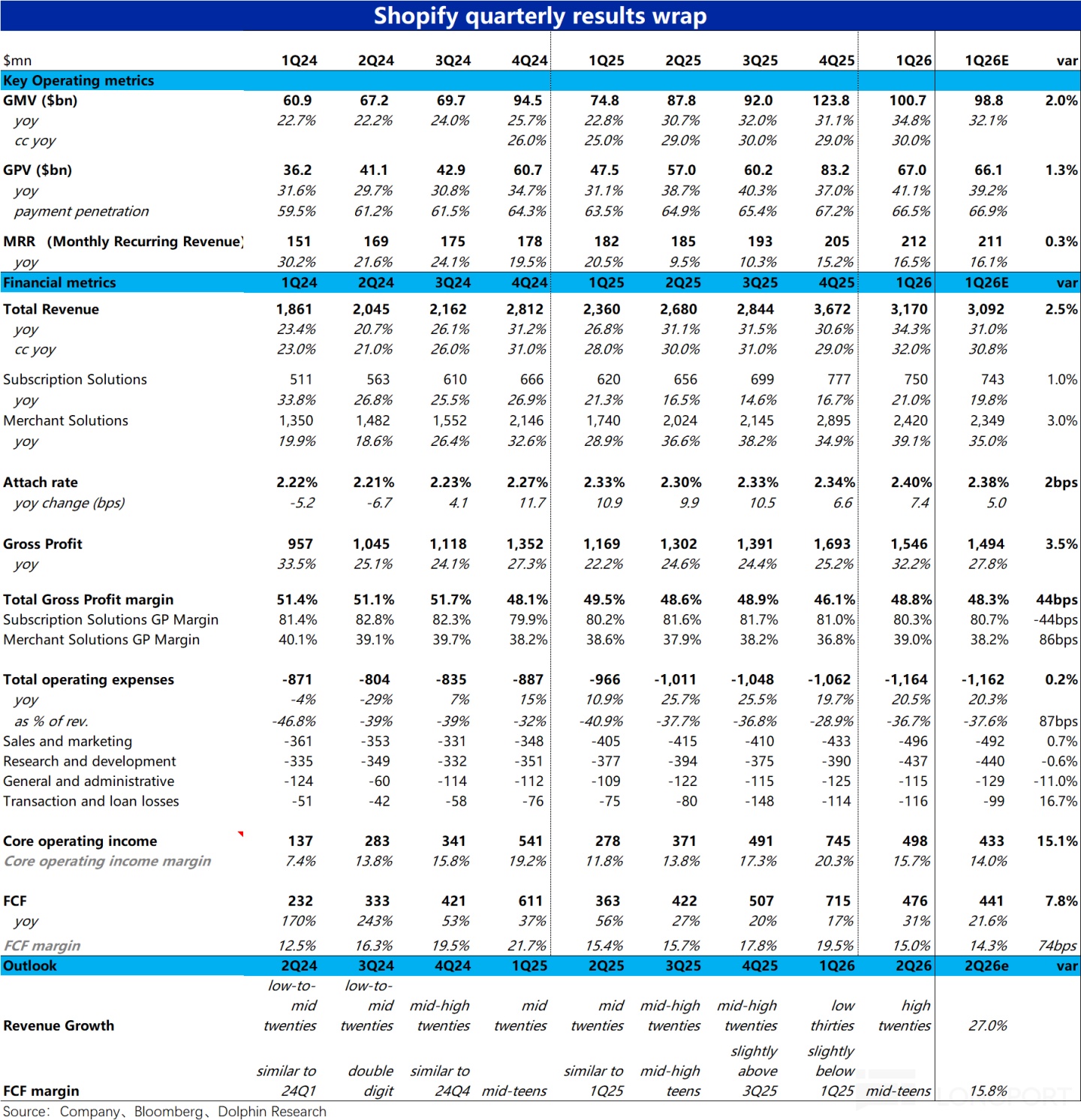
E-com tools plus payments vertical leader — $Shopify (SHOP.US) posted Q1 2026 results pre-mkt on May 5. Growth and profit both beat Bloomberg consensus. Ex-FX tailwinds, the print offered little surprise vs. buy-side hopes.
Guidance for next quarter came with blemishes. While broadly in line with Bloomberg consensus, the trend points to an 'inevitable' slowdown in GMV-driven revenue and profit growth. That is a negative for a high-growth, high-multiple name.
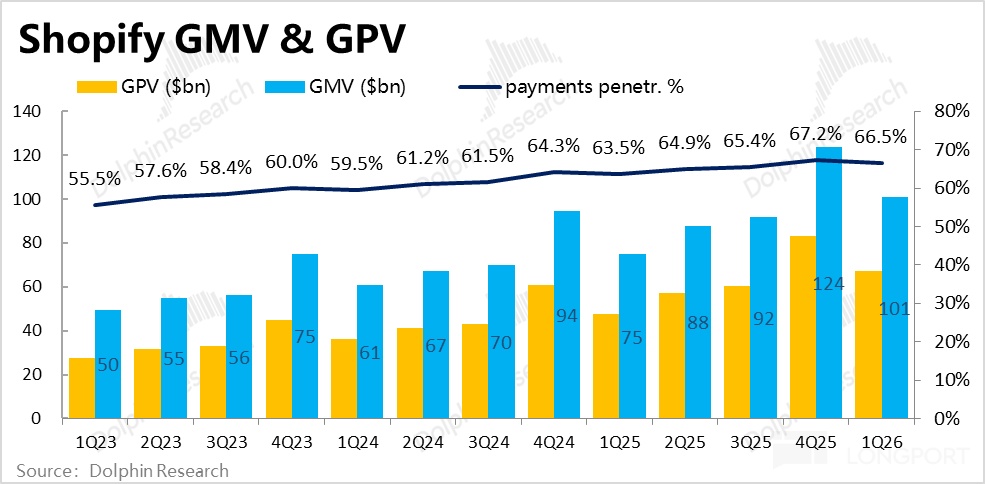
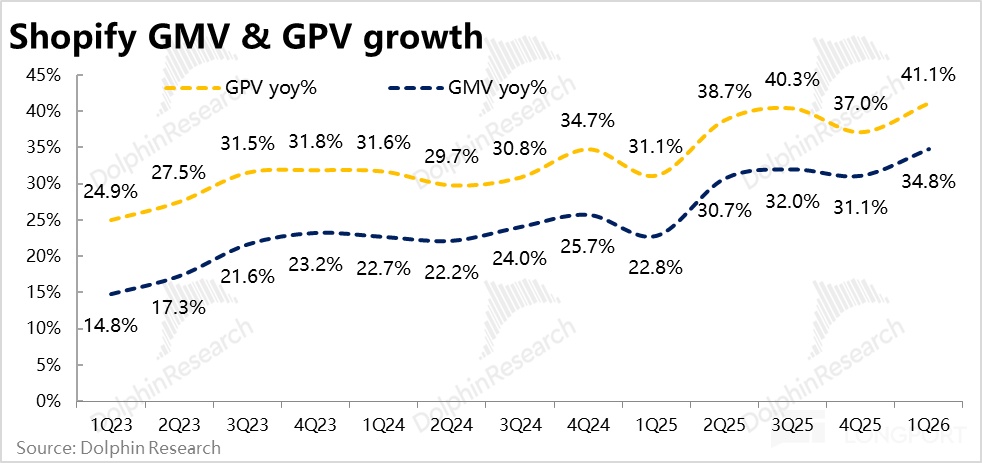
1) GMV no real surprise; payments penetration up: GMV rose nearly 35% YoY this quarter. It looks faster than last quarter, but ex-FX, growth was 30% and roughly flat vs. recent quarters. No clear acceleration.
Management cited strong Intl growth as the main driver, with Intl GMV up 45% YoY (FX a big factor). Offline GMV also did well, up 33%.
Payments penetration in GMV reached 66.5%, up 200bps YoY, lifting GPV ~41% YoY, again outpacing GMV. Shop Pay now accounts for over 52% of GPV and grew 57%, mainly supported by strength outside the U.S.
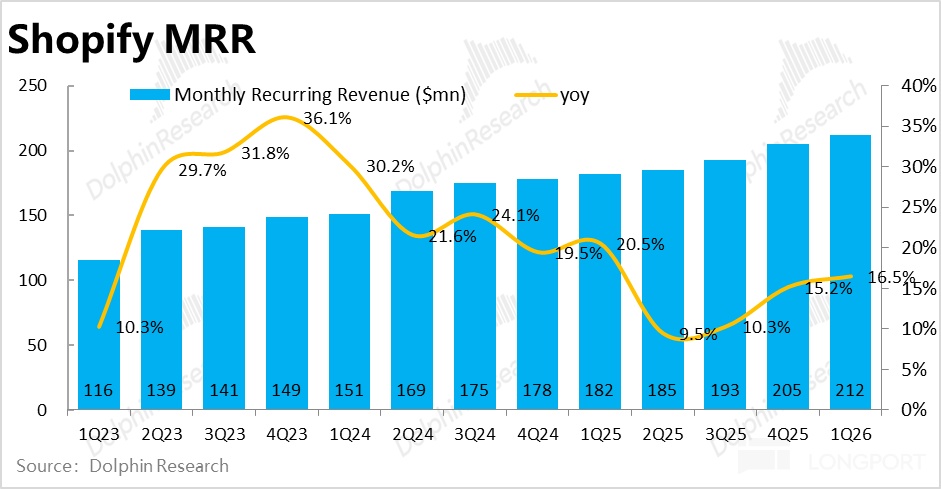
2) MRR looks repaired, but likely below true expectations? Subscription MRR was $212 mn, +16.5% YoY. Despite a QoQ acceleration, the clear FX tailwind suggests actual growth likely fell short of the market’s real expectation (e.g., DB at 18%).
Plus MRR grew ~20% YoY, with QoQ growth slowing, while non-Plus MRR rose nearly 15% YoY, showing some repair. This quarter is the last affected by the 3-month trial, and MRR growth should recover thereafter.
3) Revenue: payments strong, subscriptions softer Overall revenue rose 34% YoY, above ~31% last quarter. FX benefit was ~200bps. Ex-FX, underlying growth still improved ~100bps.
Merchant Solutions (payments-led) revenue grew +39% YoY, well above Subscriptions at +21% YoY. This aligns with rising payments penetration and MRR constrained by free trials, with actual growth likely below expectations.
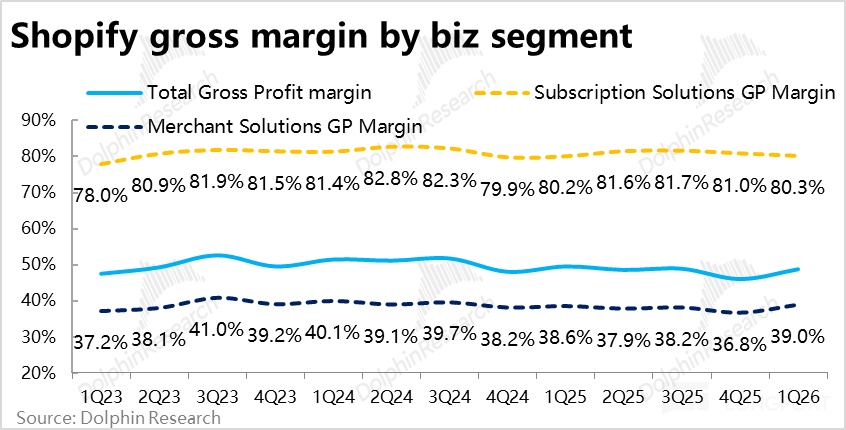
4) GPM remains structurally pressured With low-margin Merchant Solutions mix rising, overall GPM continued to trend down. It came in at 48.8%, -70bps YoY, but the decline was smaller than Bloomberg expected.
Both Subscriptions and Merchant Solutions GPM rose YoY. The overall GPM decline is entirely mix-driven and not a fundamental issue.
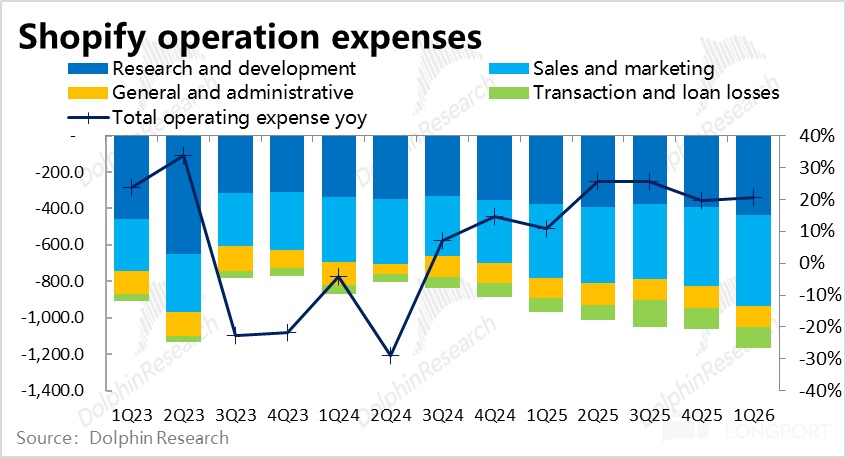
5) Marketing and credit losses rose Total opex was ~$1.16 bn, +20.5% YoY, in line with the street. Opex was ~37% of revenue, near the low end of prior guide. No real surprises.
Key drivers remained marketing and transaction losses. Marketing spend grew 22.5%, while transaction losses were nearly $120 mn, up ~55% YoY. Per management, roughly three-quarters of incremental credit losses were lending-related, and one-quarter came from higher payment volume.
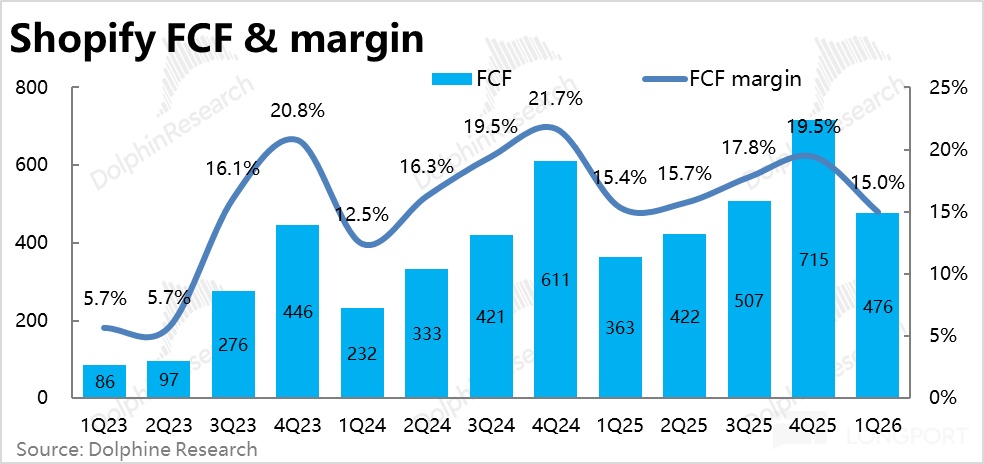
6) Margins swimming upstream As opex growth remained well below GP growth, opex ratio narrowed by over 400bps YoY, with SBC down contributing ~80bps, partly offsetting GPM pressure. Key profit metric — FCF margin — was ~15%, modestly down from 15.4% YoY, in line with guidance.
While the decline was small, FCF margin has now fallen for three consecutive quarters.
Dolphin Research view:
1) In-quarter fine; next-quarter guide flawed On balance, Shopify’s quarter was solid. Even ex-FX, GMV stayed high, payments penetration kept rising, and revenue growth ticked up. GPM and FCF margin dipped on mix, but the declines were expected.
With valuation still sky-high and SaaS broadly under scrutiny, a lack of clear catalysts can trigger outflows.
By contrast, Q2 guidance looks more problematic. Q2 revenue growth guided to high-20s% (with ~50bps FX tailwind), gross profit growth to mid-20s%, and FCF margin around ~15%.
All three are broadly in line with Bloomberg consensus. But the trend signals growth will slow after nearly a year of upside surprises. For a high-growth & high-multiple stock, that usually implies derating.
Guiding FCF margin to mid-teens also implies margins will not yet re-enter an upcycle next quarter.
2) AI industry logic has shifted The market’s stance on Agentic Commerce inside e-com has moved from near-uniform optimism to mixed, even cautious. Recent AI developments have reinforced those concerns.
a) OpenAI 'paused' native agent shopping: As The Information reported in late Mar, OpenAI shelved plans to complete end-to-end e-com (including payments) within ChatGPT, opting instead to rely on embedded third-party apps for the final transaction.
b) AI focus is shifting from 2C to 2B: With Claude Code and Openclaw surging in popularity, the industry and capital focus is moving from consumer-facing search/chat/agent-led shopping/food orders/travel bookings to coding and office automation use cases.
Dolphin believes the core changes and root causes behind these moves are:
a) For ChatGPT, Gemini and other general AIs, the idea of an 'everything gateway' that fully replaces or integrates apps looks unlikely in the near-to-mid term. Ecosystem collaboration (e.g., Tencent AI with Meituan) or in-ecosystem assistants (e.g., Amazon, Alibaba) are more plausible near-term approaches. The root cause: vast private business data and real-world fulfillment/operations barriers cannot be easily bypassed by an AI entry point. ChatGPT’s role in e-com has 'reverted' to recommending and explaining products, with third parties still executing checkout, rather than an agent completing the entire flow.
b) Monetizing C users is harder than B users Dolphin believes OpenAI’s reduced emphasis on agent commerce and other C-side monetization stems in part from lower willingness and ability of consumers to pay vs. enterprises. Shifting to B monetization, like Anthropic, is an easier path.
That said, today’s challenges do not mean C-side agent monetization will never work. Long term, AI agents can still become a major channel in those 2C industries and reshape the landscape.
3) AI: tailwind or headwind for Shopify? What does the AI narrative shift mean for Shopify’s core investment logic?
a) For e-com tools, it is a clear headwind: The pivot toward work automation is a negative for Subscriptions, which contribute roughly one-third of GP (the software tools that help merchants build and run online shops). Investors do worry about AI substituting commercial software. As AI agents improve in assisting SMEs/individuals to automate workflows, expectations will weigh on Subscriptions.
b) Weaker agent-commerce narrative: good for incumbents, bad for incremental players In simple terms, the weaker agent-commerce narrative benefits existing e-com platforms and hurts those counting on agents to add incremental GMV. For Shopify, both effects apply. On one hand, Shopify has been among the most aggressive in agent commerce (partnering with OpenAI, Google, Microsoft on agent commerce R&D and go-to-market). As the rollout lags, the bull case of GMV acceleration from agent commerce is harder to argue.
On the other hand, OpenAI and Google are both partners and potential competitors. They aim to control the agent-commerce payment entry point, implying Shopify’s payment share and take rate could be lower in an agent era.
4) After a sharp drawdown, is valuation cheap? Fundamentally, the business remains intact. The main issue is Shopify’s positioning shifting from AI beneficiary toward potential victim. Despite decent results, the stock has fallen nearly 40% from the peak.
The drawdown has squeezed out much of the prior optimism — that agent commerce would lift share and enable higher-margin commission monetization vs. the current payments-heavy model. But by Dolphin’s math, current mkt cap implies 2027 P/EBIT ~50x and P/FCF ~40x. Even on 2028, those are still ~39x and ~28x. This is not cheap.
Outside of the 2022 selloff, Shopify has rarely been truly cheap. Opportunities likely come from narrative-driven multiple swings. For safety-first investors, we would prioritize margin improvement and wait for the rich valuation to be digested.
Detailed notes below
I. GMV surprise fades; payments penetration keeps rising Core growth metric — Shopify ecosystem GMV was $100.7 bn, +35% YoY, matching buy-side expectations of ~34–35%. Growth remains strong. However, a meaningful portion reflects FX tailwinds; ex-FX, growth was 30%, up ~100bps QoQ and broadly similar to the 29–30% ex-FX pace over the prior three quarters.
At first glance, GMV looks markedly faster QoQ and clearly above Bloomberg expectations. In reality, it broadly met expectations. Versus a string of recent upside surprises, this quarter was more muted.
From the call, Intl GMV was the main driver (+45% YoY vs. 31% last quarter). Offline GMV also rose 33%.
Disclosures show Shopify payments penetration reached 66.5%, up 200bps YoY but down QoQ on seasonality. GPV grew ~41% YoY, outpacing GMV.
II. MRR growth likely below true expectations Subscription MRR was $212 mn, +16.5% YoY. While faster QoQ and slightly above Bloomberg consensus, FX tailwinds were notable. Dolphin believes the market’s true expectation was likely 100–200bps higher.
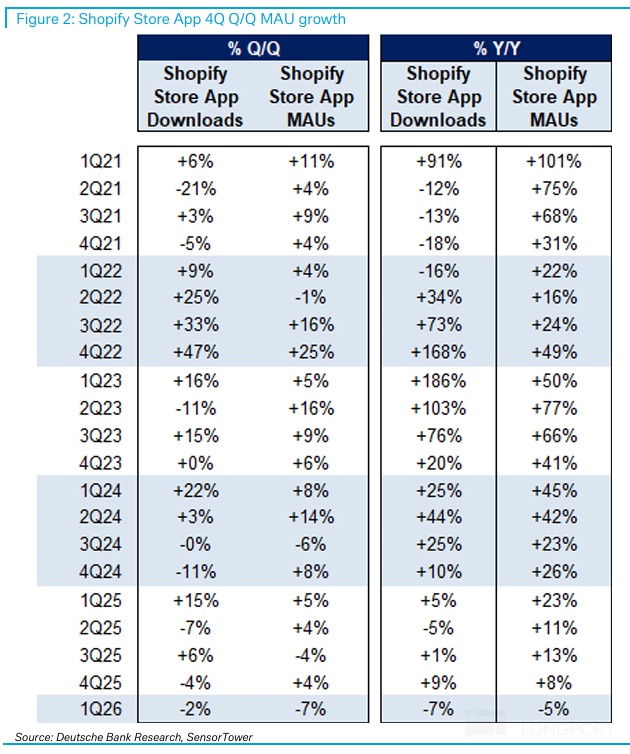
In other words, MRR probably missed the market’s real bar (e.g., DB at 18%). Sensor Tower data show Shopify Store App downloads and MAU both fell YoY (first time since 2021), hinting that subscription merchant growth was weak this quarter. That likely weighed on MRR.
From the call, Plus MRR grew ~20% YoY with QoQ growth slowing. Non-Plus MRR rose nearly 15% YoY, showing some repair.
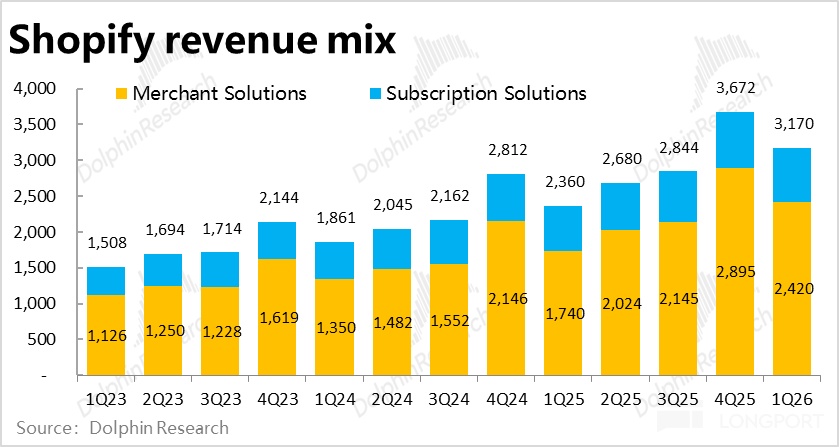
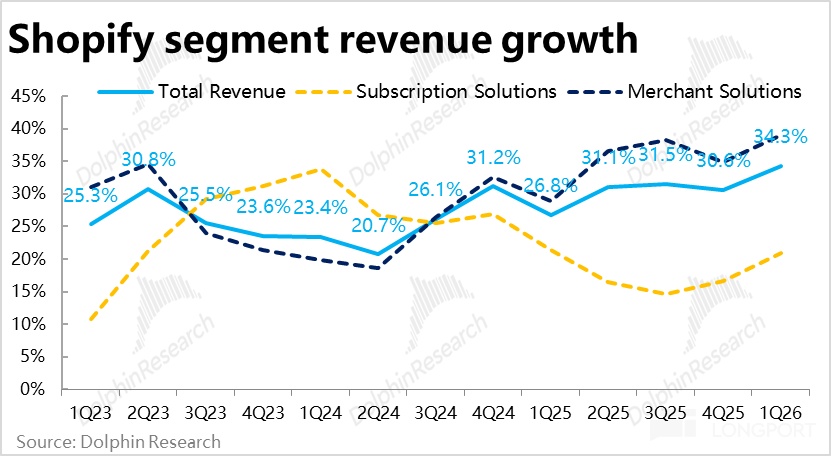
III. Revenue growth: payments strong, subscriptions weak Ex-FX, GMV and GPV growth were not truly above expectations, but headline growth was higher. Revenue rose 34% YoY vs. ~31% last quarter. FX tailwind was ~200bps.
Merchant Solutions revenue growth remained well above Subscriptions. Specifically, Subscriptions +21% YoY, slightly above Bloomberg consensus. Merchant Solutions +39% YoY, beating consensus by ~400bps.
Implied monetization for Merchant Solutions revenue/GMV was ~2.4%, up ~7bps YoY. The lift was similar to last quarter, but below 1Q25–3Q25. The higher monetization reflects rising payments penetration.
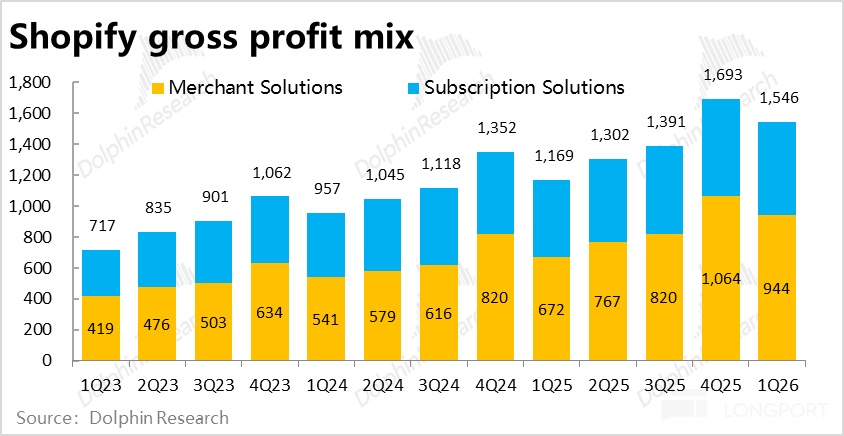
IV. Rising payments mix drives lower GPM With low-margin Merchant Solutions mix rising, Shopify’s overall GPM continued to fall. This quarter was 48.8%, -70bps YoY, with the decline smaller than Bloomberg consensus.
By line, both Subscriptions and Merchant Solutions GPM were up YoY. The overall GPM decline is purely mix-driven. From a surprise lens, Subscriptions were soft (GPM below expectations) while Merchant Solutions were strong (above expectations).
V. Margins: swimming upstream On opex, total spend was ~$1.16 bn, +20.5% YoY, broadly matching market expectations. Opex was ~37% of revenue, near the low end of the 37–38% guide. Execution was as planned.
Marketing and transaction losses remained the main drivers. Marketing rose 22.5%, while transaction losses were nearly $120 mn. This is similar to the prior two quarters, but up ~55% YoY from $75 mn.
Per management, ~3/4 of incremental credit losses came from lending, and ~1/4 from higher payment volumes. G&A and R&D growth were restrained at ~5.5% and ~16%.
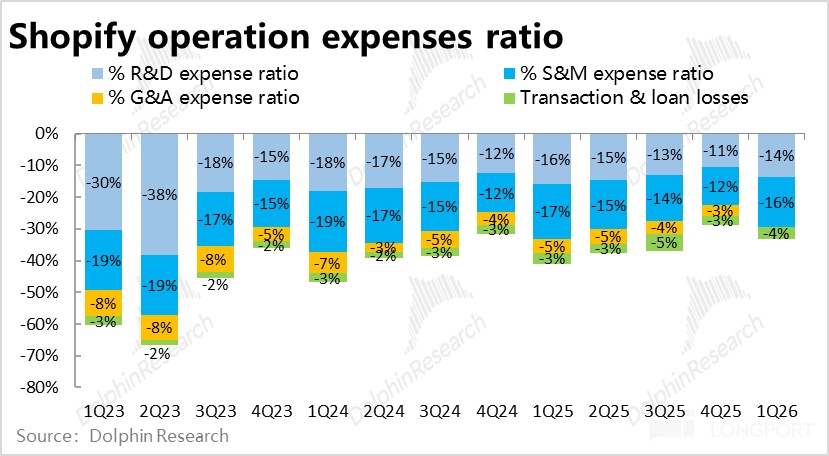
Overall, opex growth remained well below revenue and GP growth, so opex ratio narrowed by over 400bps YoY. SBC reduction contributed ~80bps.
FCF margin was ~15%, slightly below 15.4% last year, in line with guidance. Profit delivery was steady, but FCF margin has fallen for three straight quarters.
Even small margin declines matter when the multiple is very rich. Without margin expansion, it is 'swimming upstream'.
<End of text>
Past Dolphin Research on [Shopify]:
Earnings notes:
Feb 12, 2026 call notes: Shopify (Trans): In agent commerce, monetization still leans on payments
Feb 12, 2026 review: Shopify: Solid print yet stock plunges — are agent-led e-com cures or poison?
Nov 5, 2025 call notes: Shopify (Trans): Bullish on enterprise and AI inside e-com
Nov 5, 2025 review: Shopify: Imperfection is failure — original sin of a high multiple?
Aug 7, 2025 review: Shopify: When growth explodes, other problems fade
Aug 7, 2025 call notes: Shopify (Trans): Strong EU and N. America drove GMV beat
May 9, 2025 review: Shopify: Tariff sword still hanging — small merchants most exposed?
May 9, 2025 call notes: Shopify (Trans): No tariff impact seen yet in May
Feb 12, 2025 review: Shopify: Original sin of a high multiple — not great is not good enough
Feb 12, 2025 call notes: Shopify (Trans): Many growth avenues; current margin already satisfactory
Risk disclosure & statements: Dolphin Research disclaimer and general disclosures


The copyright of this article belongs to the original author/organization.
The views expressed herein are solely those of the author and do not reflect the stance of the platform. The content is intended for investment reference purposes only and shall not be considered as investment advice. Please contact us if you have any questions or suggestions regarding the content services provided by the platform.