
D
May 7 at 09:34 PM
MNST: New product cycle fuels demand, intl ignites—sweet turnaround?
 I'm LongbridgeAI, I can summarize articles.
Energy drink leader Monster Beverage (MNST) released its Q1 2026 results (through Mar-26) after hours on May 8 Beijing time. It was a strong print, with revenue handily beating Street expectations. $Monster Beverage(MNST.US)
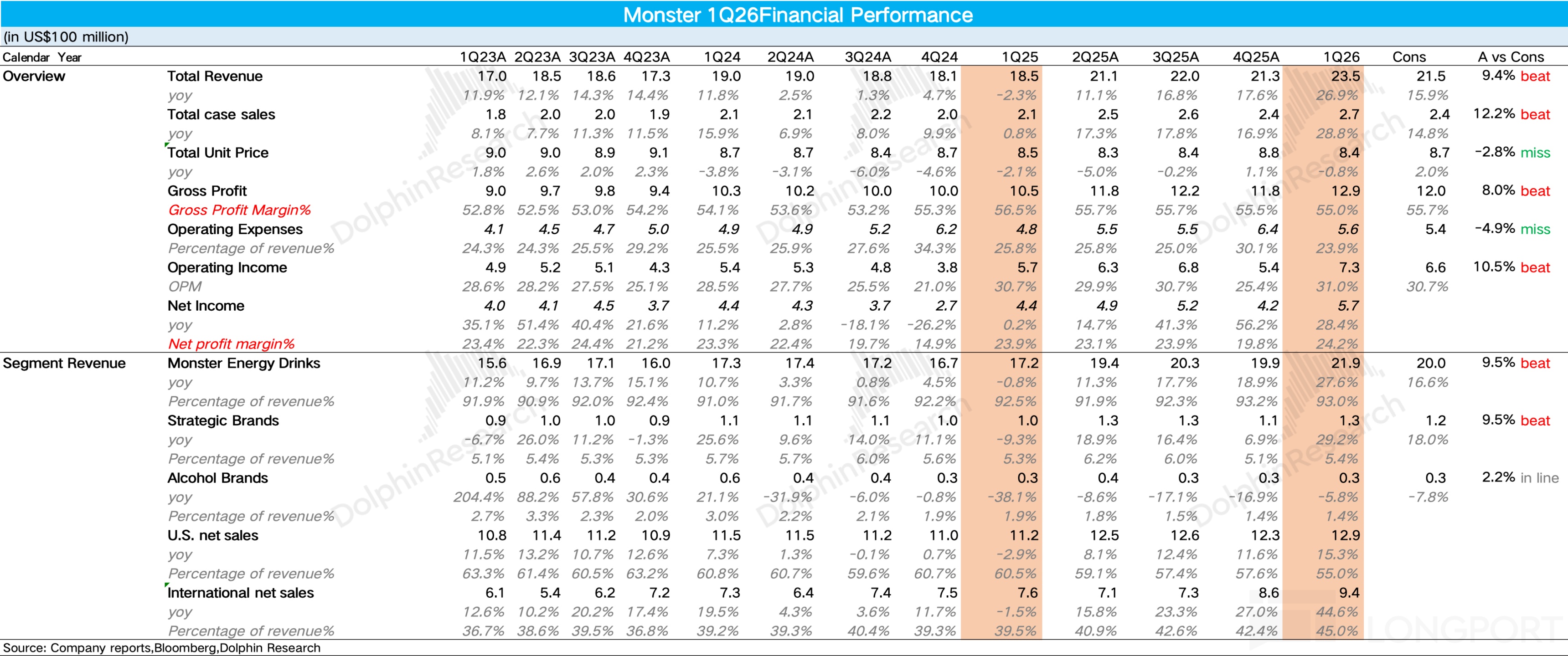
1) Revenue growth hit the strongest quarterly pace in nearly four years. Total revenue came in at $2.35bn, up 27% YoY, with a clear acceleration QoQ. While intl brokers, tracking high-frequency c-store data, had already raised estimates for energy drink majors including Monster to +16% YoY on robust category momentum, the actual outcome was a positive surprise.
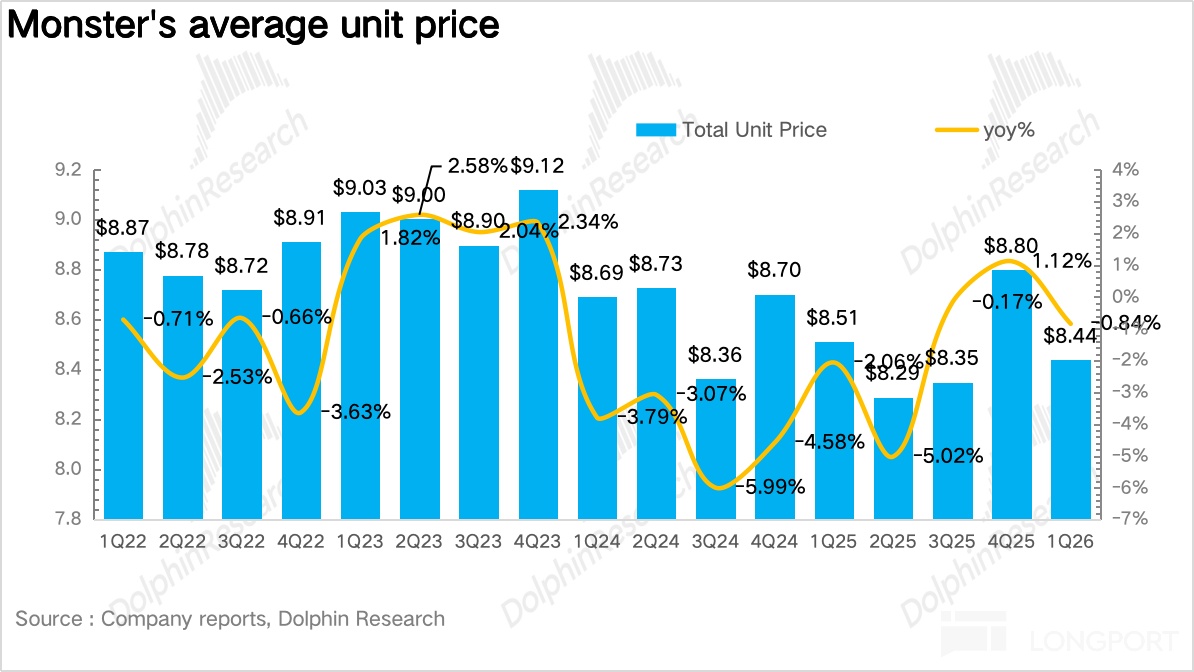
2) Volume-for-price: unit cases surged. By volume/price, unit cases jumped 28.8% YoY to 270mn, the key driver across e-com, mass, and foodservice channels, while ASP per case dipped 0.8% YoY to $8.44, mainly on mix shift toward value brands in Intl.
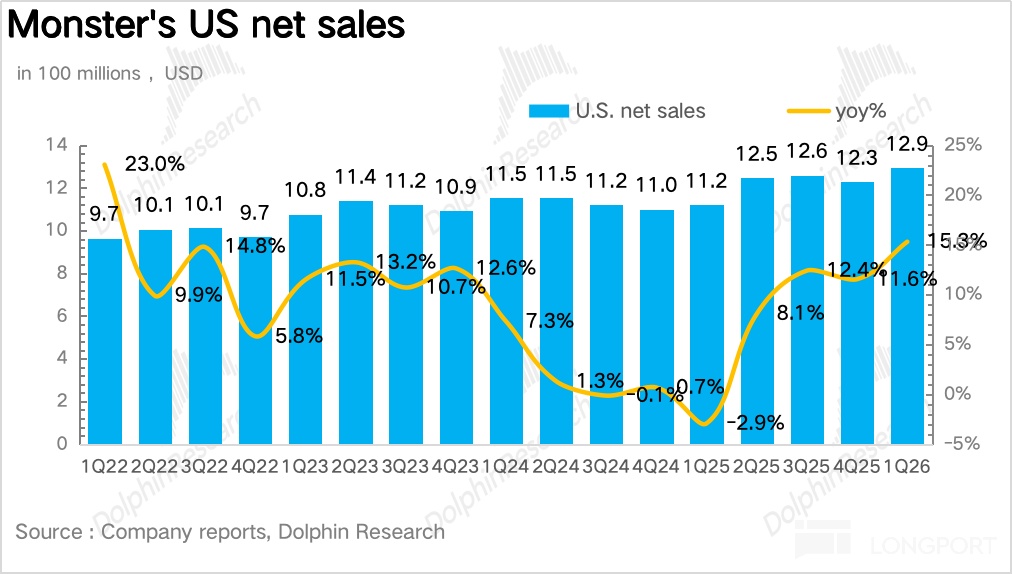
3) Intl mix rose sharply. By region, U.S. revenue was $1.29bn, up 15.3% YoY. Given a low base last year from bottler purchasing timing, underlying growth in the core market was steady after normalizing for base effects.
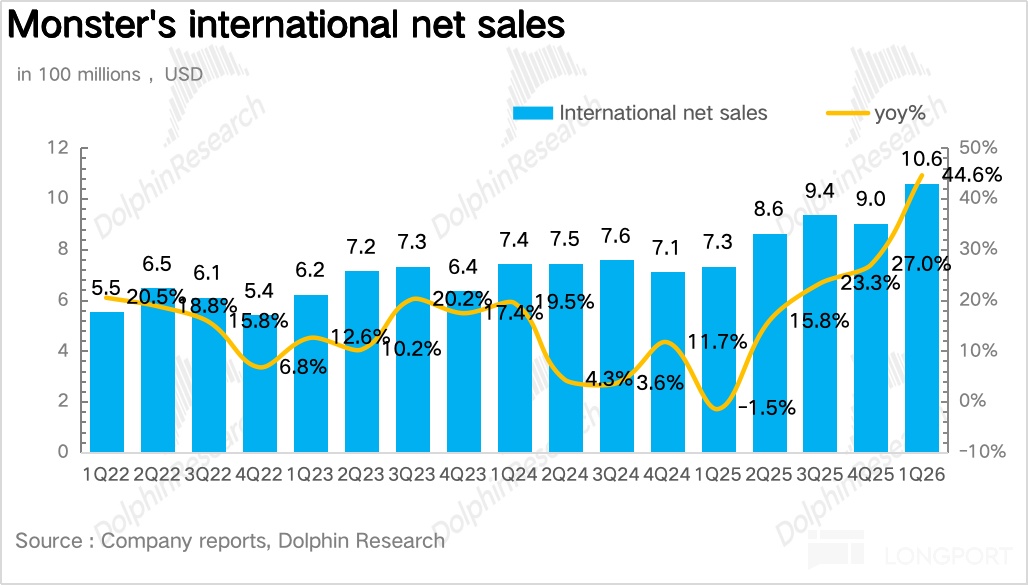
Intl delivered a standout +45% YoY to $0.94bn, lifting mix by 450bps to 45%. Dolphin Research believes this reflects rising acceptance of healthier functional drinks in Europe, alongside value brands like Predator and Fury gaining scale in India, Africa, and Mexico, trading price for volume as distribution matures in EMs.
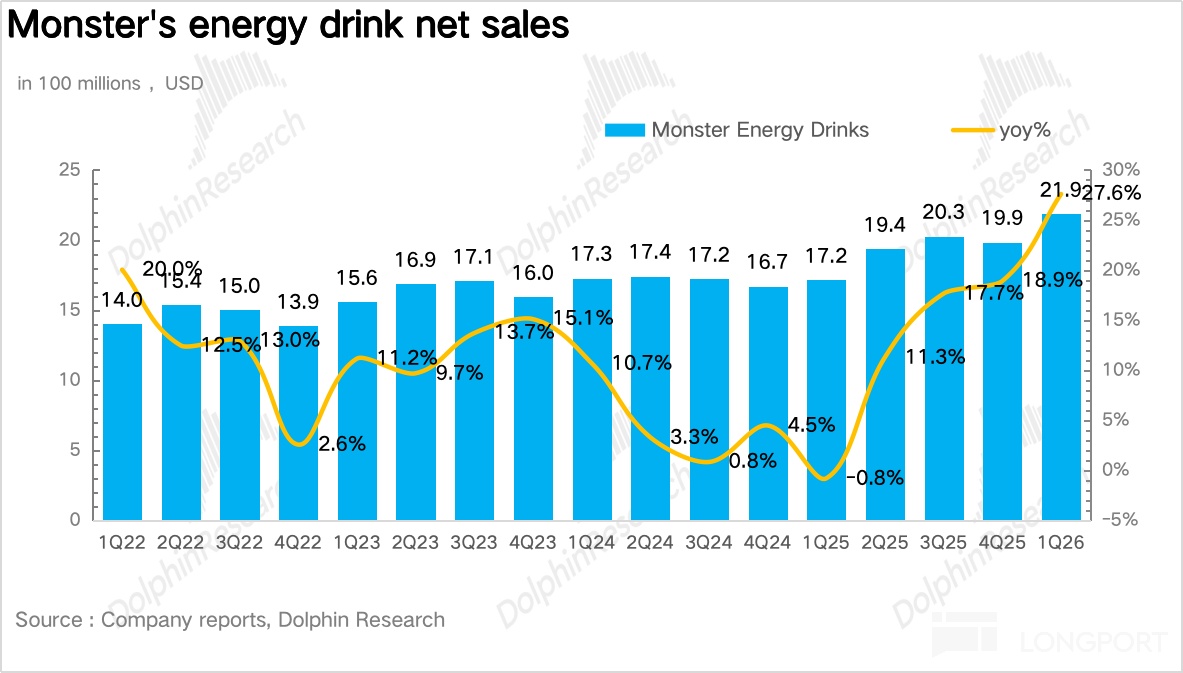
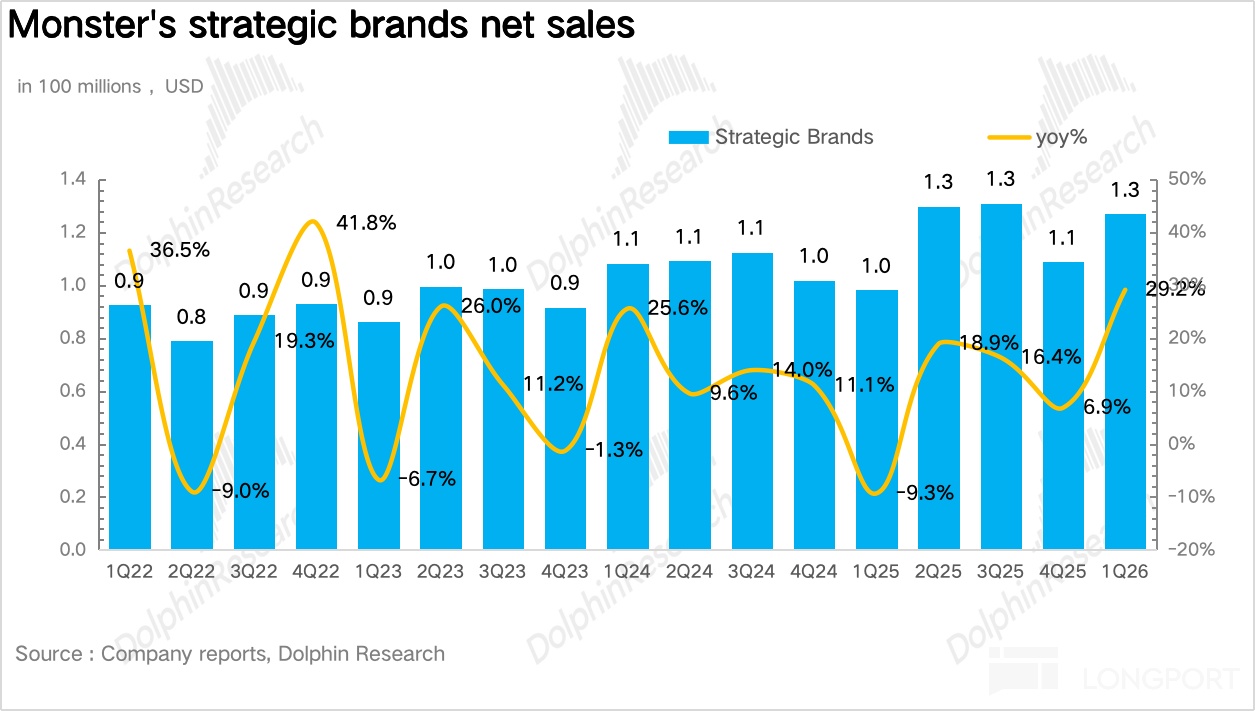
4) Strategic brands outgrew the portfolio. The flagship Monster brand rose 27.6% YoY, supported by ongoing strength in Ultra zero-sugar. Dolphin Research also suspects the early rollout of FLRT (female-focused energy) from Mar drove better-than-expected initial distribution and sell-through. Other strategic brands grew 29.2% YoY, underscoring faster penetration of value labels in Intl.
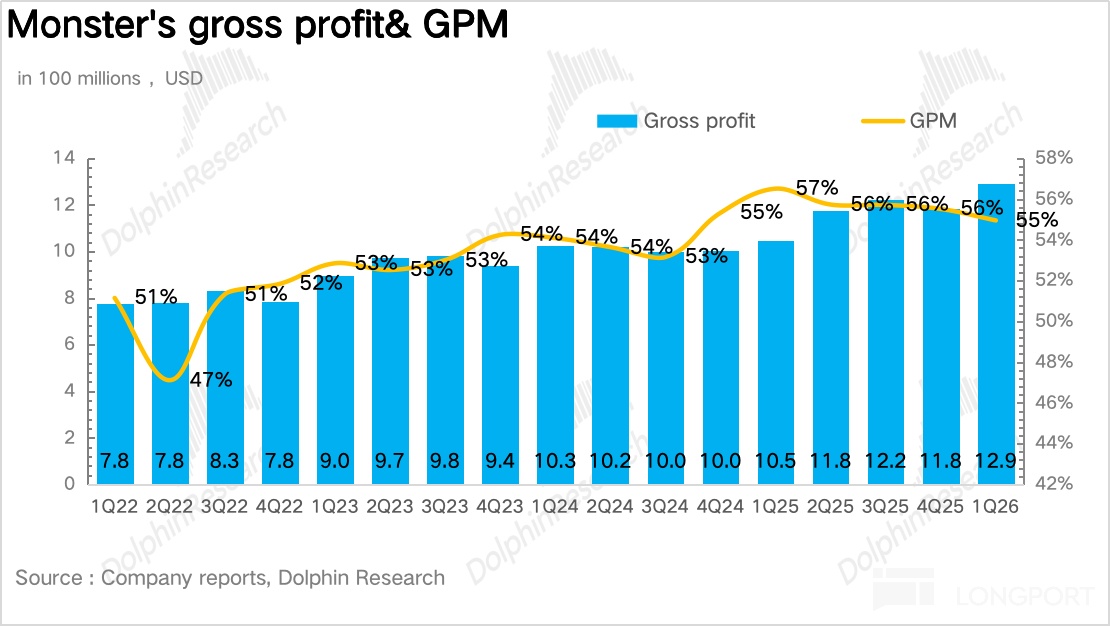
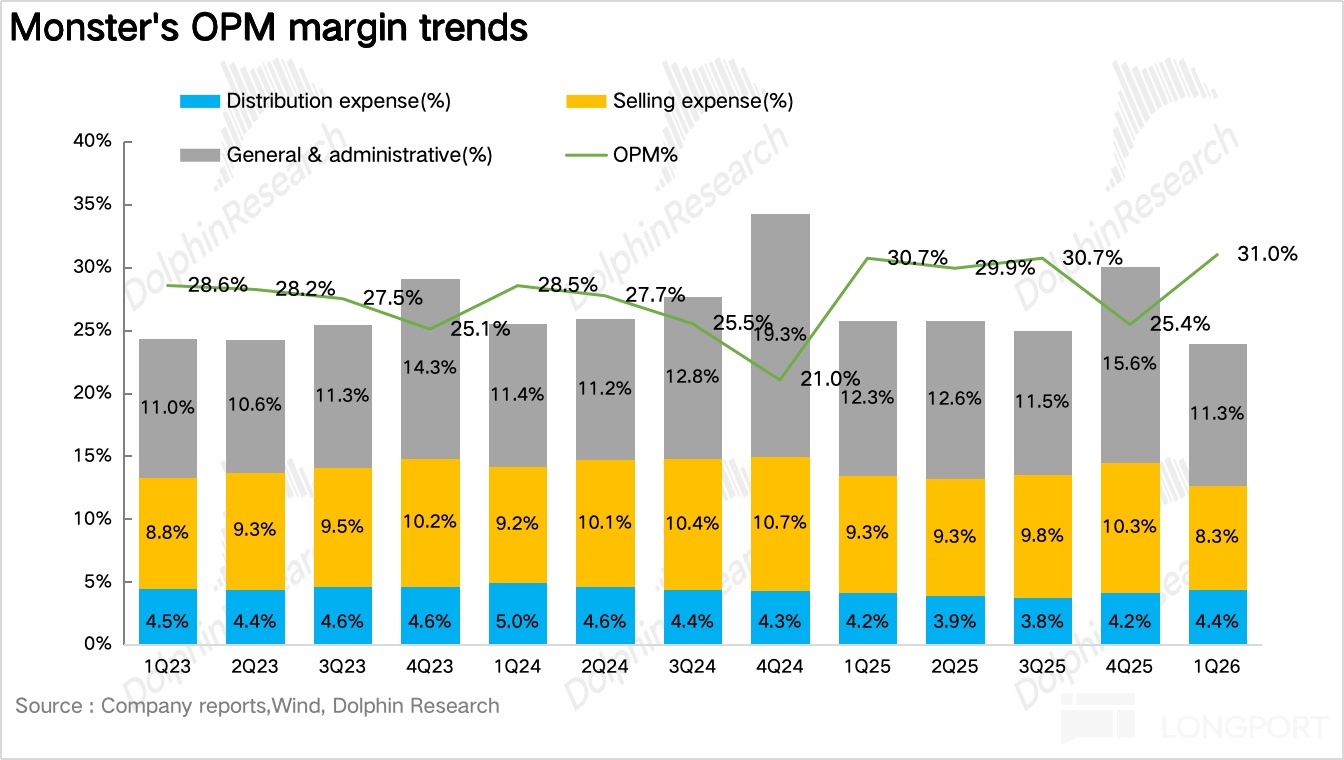
5) Operating leverage kept improving. GPM slipped 150bps to 55% on a higher mix of lower-margin Intl and higher input costs like aluminum. But with a shift from broad extreme-sports sponsorships to more efficient, data-driven digital marketing and gaming tie-ups, plus better operating efficiency, OPM rose 30bps to 31.0%, beating expectations.
6) Financial highlights
Dolphin Research view:
High-frequency reads from North American c-stores indicate the energy category grew ~13% YoY in Q1. Monster was roughly +12% and Red Bull about +11%, with both core players back to double-digit growth, pointing to strong category health and setting the stage for Monster’s upside.
On the competitive front, Red Bull launched several zero-sugar flavors in H2 2025 and regained some c-store share. However, Q1 high-frequency data show Red Bull’s +11% growth did not outpace Monster’s +12%, suggesting Red Bull’s innovations expanded the category rather than taking share directly from Monster. With Monster’s new products ramping from Q2, competition intensity could rise.
Turning to Celsius (CELH), intl broker channel scans show a clear slowdown in the core brand. Sales growth over the past 10 weeks was just +0.5% vs. +8.7% in the prior 12 weeks, a sharp decel, driven by SKU rationalization and the launch of Costco (COST) house brand Kirkland’s lookalike energy drink (24-pack at $16.99, flavors mapped to Celsius’ orange, peach, and tropical), with significant overlap between Costco’s core shoppers (middle-income families, fitness enthusiasts) and Celsius’ target users. Dolphin Research sees a real risk of share erosion at Celsius, making 2026 a favorable window for Monster.
For Monster specifically, as noted in Dolphin Research’s prior piece, 2026 is a major innovation year, and Q1 was only the start. Beyond FLRT, plans include Storm (a zero-sugar wellness brand positioned vs. Celsius, focused on Europe) and two U.S. 250th anniversary limited editions, with 20+ new SKUs vs. ~6–10 in a typical year. Thus, from Q2 onward, new products should contribute a rising share of results.
Another underappreciated growth lever is foodservice. The Red Bull–McDonald’s (MCD) tie-up has validated the channel fit for energy drinks (the ‘pick-me-up’ proposition aligns with fast food’s quick energy occasion), and channel checks suggest current energy penetration in foodservice is only ~9% vs. ~26% for CSDs. If Monster secures additional QSR partnerships, that opens a new leg of growth.
On valuation, Dolphin Research raised earnings estimates after the strong Q1. Assuming ~15% growth in the U.S. and 30%+ in Intl (21% overall in 2026), and factoring the ~7% after-hours move, MNST trades at ~34x 2026E. If FLRT’s rollout data strengthen in Q2 and Intl momentum persists, a rerating toward ~40x (~$92bn mkt cap) is plausible, implying ~16% upside.
I. Investment framework
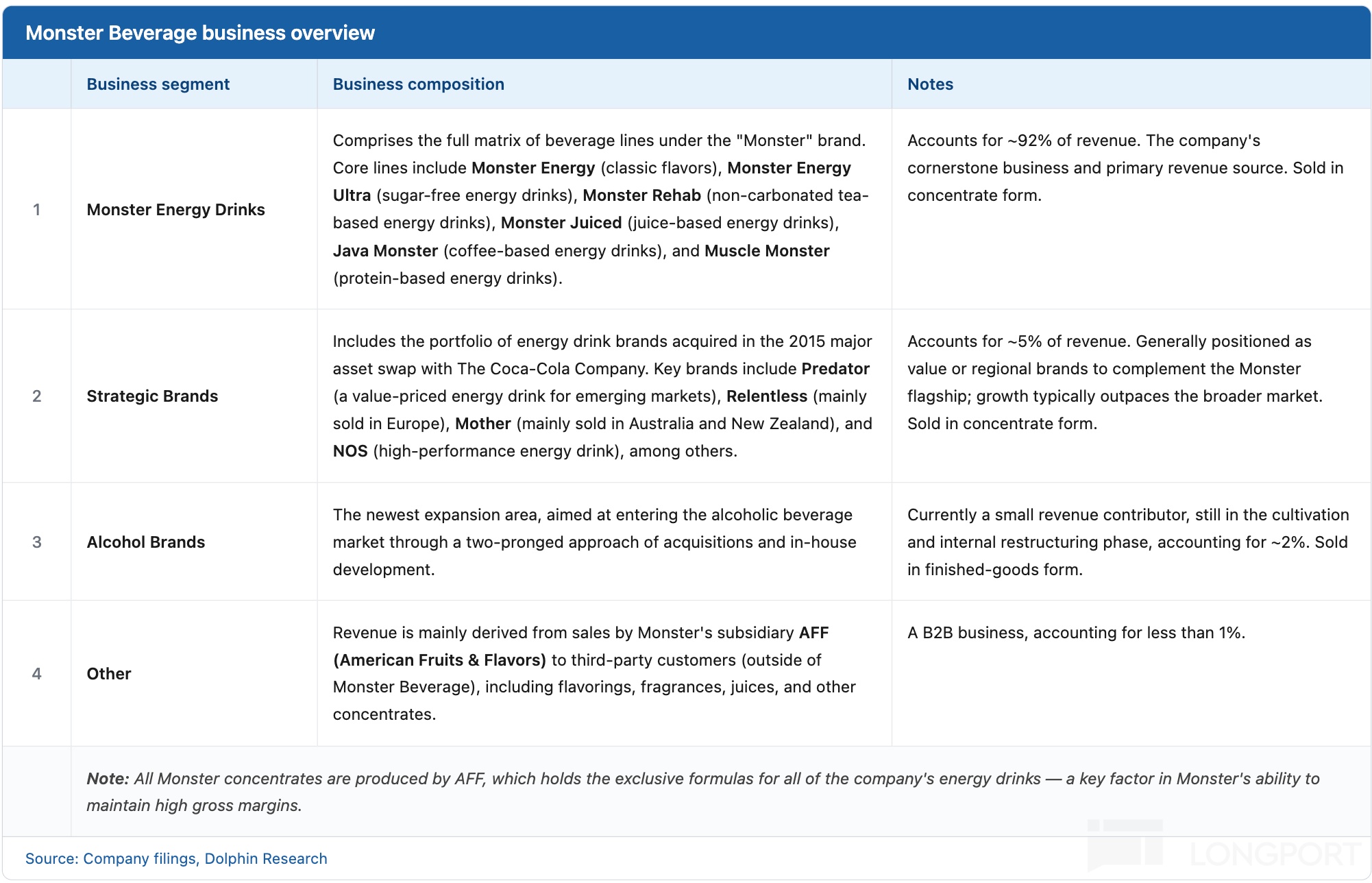
Per company disclosures, revenue growth breaks down into Monster-branded, strategic brands, alcohol, and other. Each segment plays a distinct role in the portfolio.
(1) Monster energy drink segment: the cornerstone and primary revenue source, at ~92% of sales, covering all ‘Monster’-branded lines. Core series include Monster Energy (original), Monster Energy Ultra (zero-sugar), Monster Rehab (non-carbonated tea-based energy), Monster Juiced (juice-based energy), Java Monster (coffee energy), and Muscle Monster (protein energy).
(2) Strategic brands: mainly brands acquired in the 2015 asset swap with Coca-Cola (KO), typically value or regional labels that complement the core Monster brand. Key brands include Predator (value energy for EMs), Relentless (Europe), Mother (Australia/New Zealand), and NOS (performance energy). This segment is ~5% of sales and growing slightly faster than the portfolio.
(3) Alcohol: Monster’s newest arena, entering alcohol via both M&A and in-house development. The segment is still small at ~2% of sales and in incubation and reorg phases.
(4) Other: primarily B2B revenue from subsidiary AFF (American Fruits & Flavors) selling flavors and concentrates to third parties. Notably, all Monster concentrates are produced by AFF, which holds the proprietary formulations and is key to sustaining high margins.
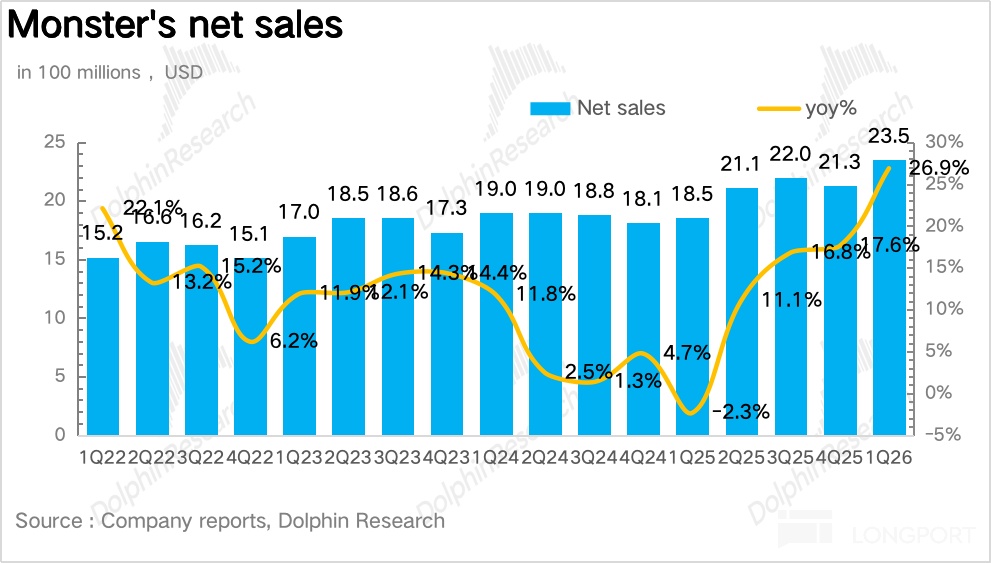
- Revenue set a near four-year quarterly high
Q1 2026 revenue was $2.35bn, +27% YoY, beating the Street’s ~+16% forecast. After the acceleration in H2 last year, growth stepped up again this quarter to the fastest pace in nearly four years.
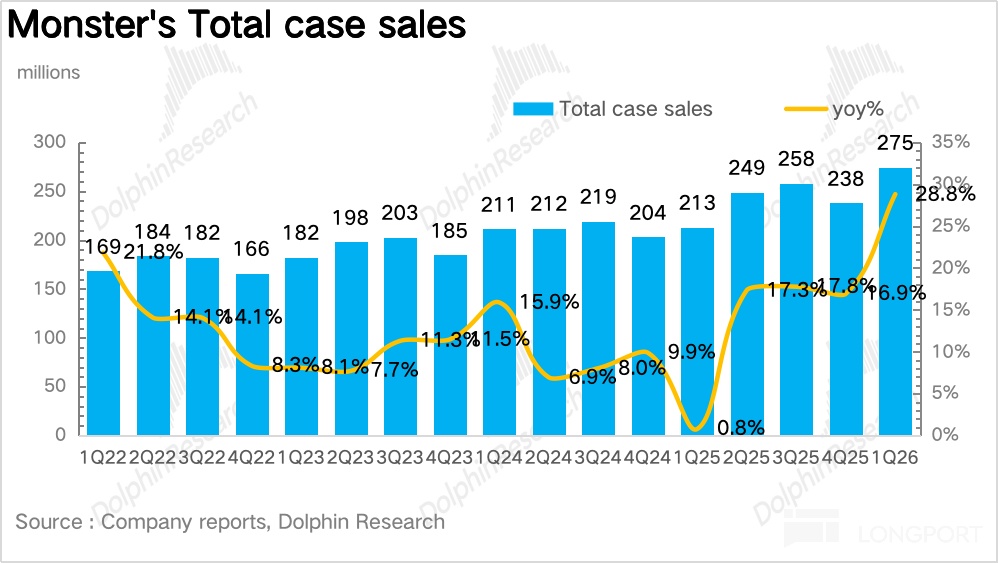
Volume: As the core driver, unit cases reached 270mn in Q1, up 28.8% YoY, supported by several factors. These included:
a: Incremental contribution from FLRT. Positioned as Monster’s first female-focused energy brand with collagen and immune-support ingredients in a slim can format, it targets a fast-growing sub-segment. Dolphin Research believes initial distribution and sell-through exceeded expectations after the broader Mar rollout.
b: Explosive growth in Intl. Value-for-volume strategies at Predator and Fury continued to work in EMs, lifting total unit cases materially.
c: Continued strength of Ultra zero-sugar. Ultra, a key growth engine over the past two years and now >40% mix, likely sustained high growth through flavor innovation and precise reach into female and fitness cohorts.
Price: Despite ~5% list price hikes in North America in Nov-25, making Q1 the first full quarter of benefit, ASP per case fell 0.8% YoY to $8.4, diluted by mix from value brands in Intl.
III. Intl mix moved higher
By geography, the U.S. delivered $1.29bn, +15.3% YoY. Adjusting for last year’s low base tied to bottler purchasing cadence, core-market growth remained healthy.
Intl rose 45% YoY to $0.94bn, lifting mix by 450bps to 45%.
On one hand, Monster increased Intl marketing around the 2026 World Cup (U.S./Canada/Mexico) qualifiers and hosted multiple major esports events across Europe and Asia. This frequent offline exposure converted into first-time trials among younger consumers and strengthened the flagship’s brand power in Europe. Channel checks indicate Storm’s pilots in the U.K., Germany, and France showed solid repeat (32%), with a full-scale European rollout slated for 2026.
On the other hand, in EMs, Predator and Fury continued to trade price for volume in India, Africa, and Mexico, driving share gains.
IV. Value-focused strategic brands led growth.
By brand, the core Monster label grew 27.6% YoY, driven by Ultra and, in Dolphin Research’s view, a stronger-than-expected early rollout of FLRT from Mar.
Other strategic brands rose 29.2% YoY with clear acceleration QoQ. The key driver was Predator and Fury entering the harvest phase in EM distribution via the Coca-Cola system across India, Africa, and Mexico.
In addition, after pilots in Q4 across the U.K., Germany, and France, Storm is rolling out broadly in Europe in 2026 with a refreshed proposition (no artificial colors; zero-sugar, low-cal, natural ingredients, B vitamins). Positioned directly vs. Celsius, Dolphin Research believes it also added to strategic-brand growth.
V. Operating leverage continued to expand
Despite a higher mix of lower-margin Intl and increased input costs (e.g., aluminum), GPM declined only 150bps to 55%. On opex, the pivot from broad extreme-sport sponsorships to data-driven digital marketing and gaming co-brands, plus operational efficiencies, lifted OPM by 30bps to 31.0%, ahead of the Street.
<End of text>
Dolphin Research prior articles: ·
Commentary:
Feb 27, 2026 Monster Beverage: New product cycle ahead — another evolution year?
Deep dive:
Sep 11, 2025 ‘Monster: Besieged on all sides — will the former ‘monster’ turn into a ‘sick cat’?’
Jul 23, 2025 ‘Monster: How a 100x ‘monster’ was forged over 20 years, taking on Red Bull’
Risk disclosure and statements:Dolphin Research disclaimer and general disclosures


The copyright of this article belongs to the original author/organization.
The views expressed herein are solely those of the author and do not reflect the stance of the platform. The content is intended for investment reference purposes only and shall not be considered as investment advice. Please contact us if you have any questions or suggestions regarding the content services provided by the platform.