
D
May 12 at 07:53 AM
TME + Ximalaya: Can It Win the Defensive Battle?
 I'm LongbridgeAI, I can summarize articles.
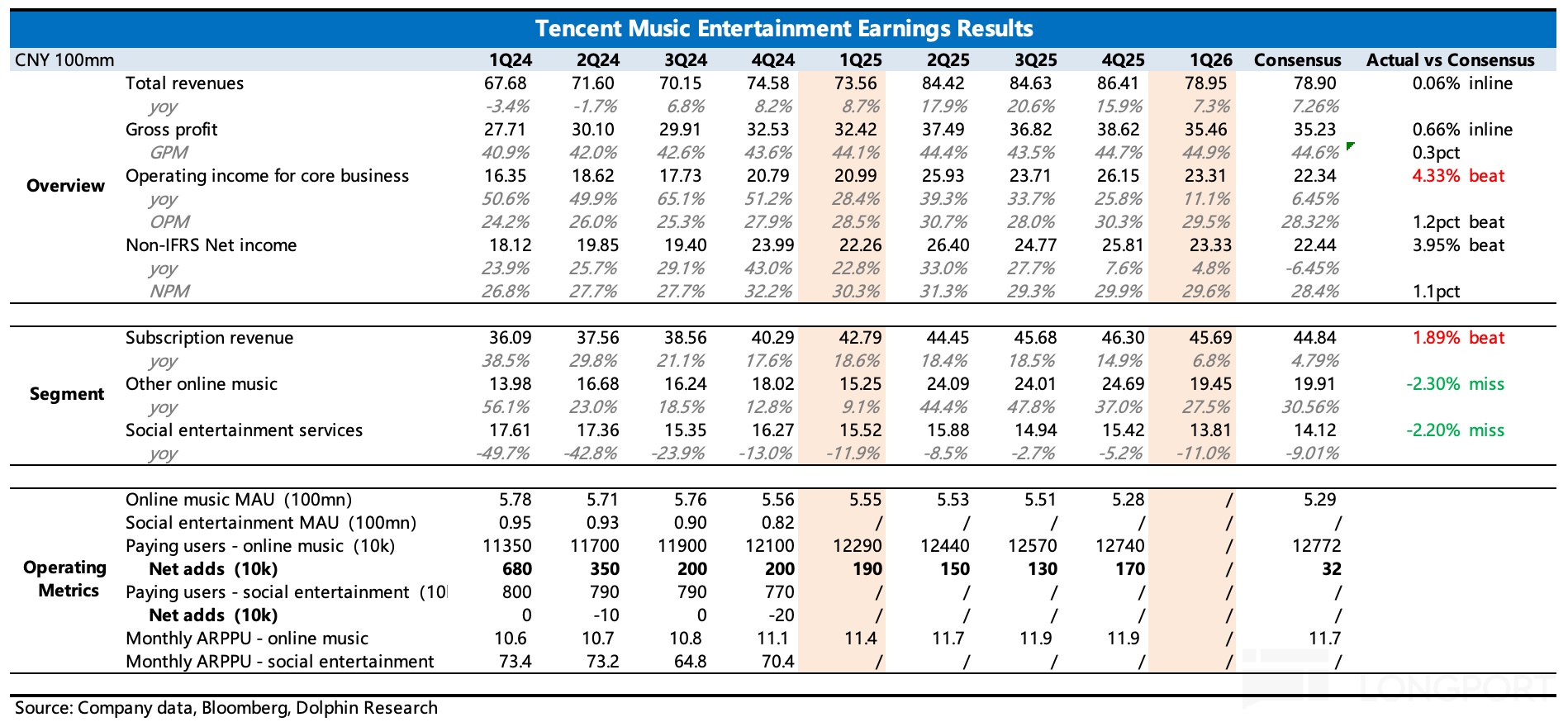
$Tencent Music(TME.US) Q1 results were broadly in line, essentially matching last quarter’s guidance, with opex slightly below the Street. Overall, under heightened competition, core subs growth is losing steam, pushing TME to lean more on non-sub music monetization.
More noteworthy than the print, pre-mkt news that the Ximalaya acquisition has been approved deserves attention. This not only enables faster integration beyond audiobooks, but also clears the way to restart buybacks.
Specifically. Details follow.
1. Ecosystem still in defense mode: The company stopped disclosing user metrics this year. Using QuestMobile trends and a reverse read from subs revenue, Dolphin Research estimates Q1 dynamics purely for reference.
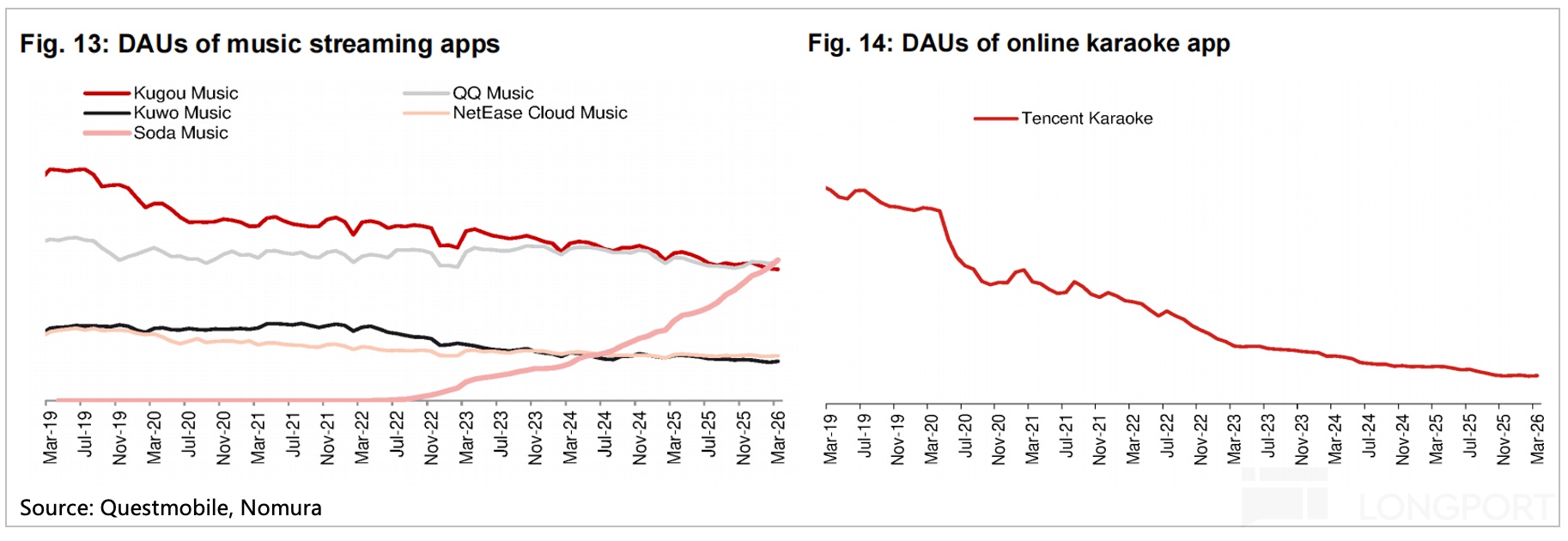
MAU kept declining QoQ in Q1, with the pace steady, and keeping the 500mn-user ecosystem will still take effort. The Ximalaya consolidation could help, as historical data suggest limited overlap between Ximalaya’s core users and TME’s base.
AI and free-music platforms continue to dilute the appeal of licensed catalogs, but the essence remains platform-on-platform competition. Even if internal cannibalization accelerates via self-disruption, TME needs to embrace AI to slow churn.
2. Sub growth remains soft: Revenue rose 6.6%, a touch ahead of expectations but still subdued. Based on management’s strategy to lower paywalls and boost stickiness, Dolphin Research estimates net adds of ~1mn subs in Q1, with ARPPU down QoQ to RMB 11.7 (ref. only).
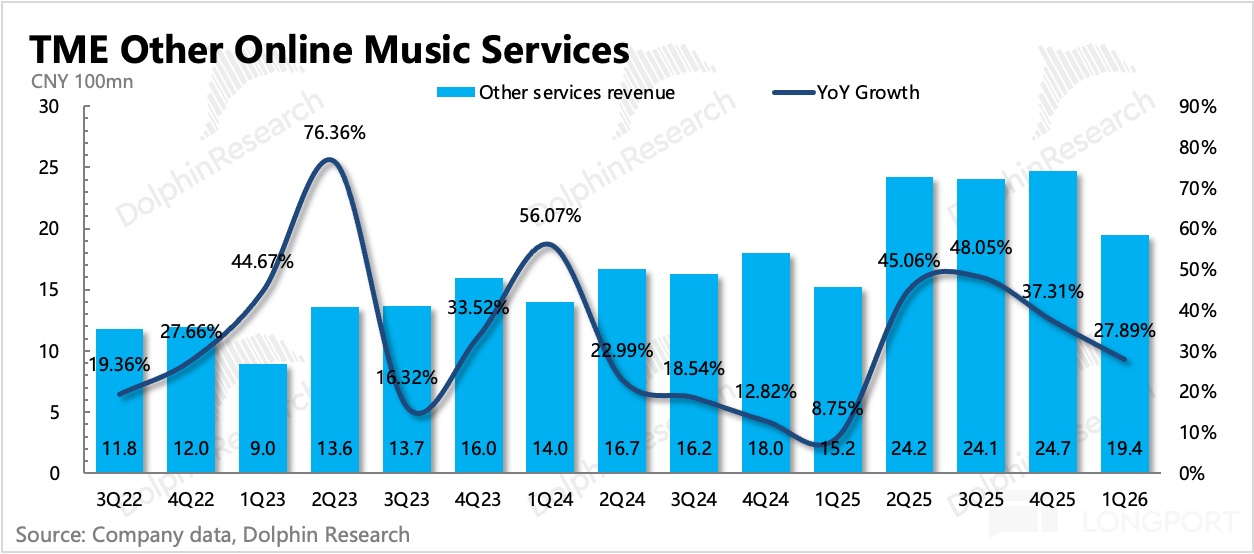
3. Music derivatives still solid: Other music revenue (ads, offline concerts, digital albums, etc.) grew 28% YoY, though momentum slowed QoQ, likely as a late Chinese New Year amplified the concerts off-season. Growth was below expectations but still solid; Jay Chou’s end-Mar album saw weaker user response vs. his last release four years ago, and some revenue should be recognized next quarter.
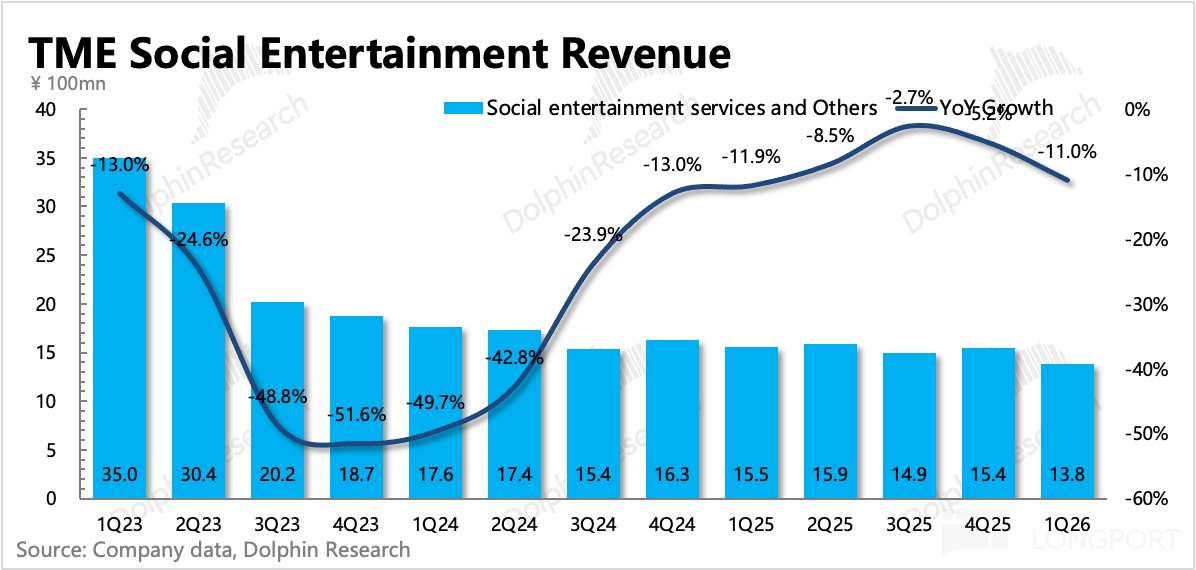
4. Social entertainment worsened again: What looked like a bottom proved unstable, with Q1 revenue down 11% and deteriorating QoQ. Beyond ongoing pressure on live streaming, QM data suggest K-Song faced heavier competition from traditional peers and AI; covers remain a primary consumer AI use case, overlapping with karaoke scenarios, and WeSing MAU keeps sliding.
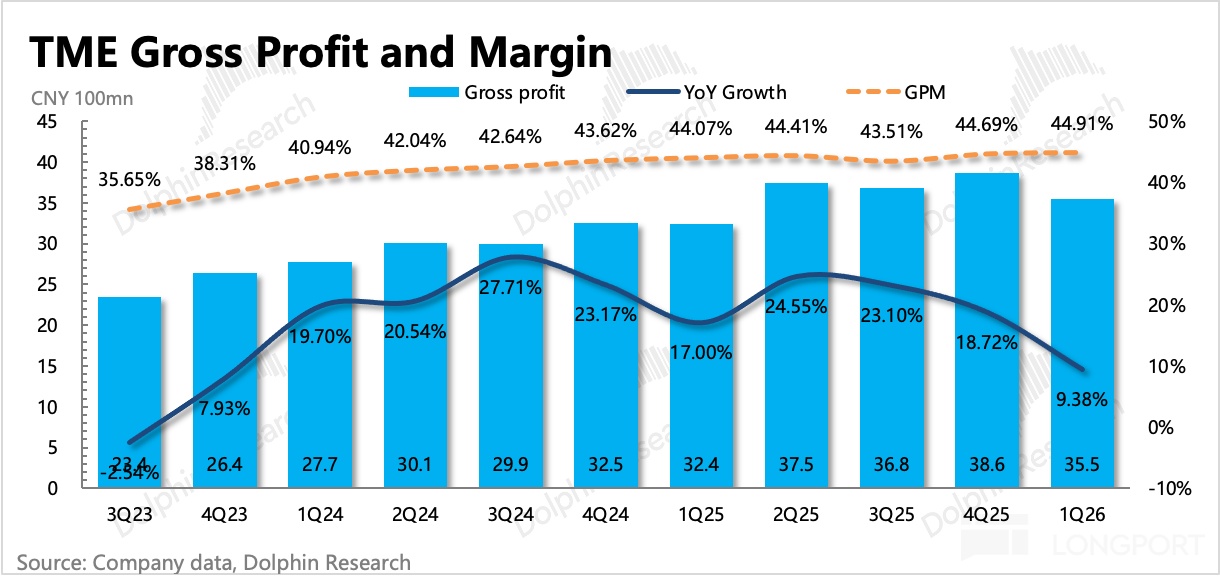
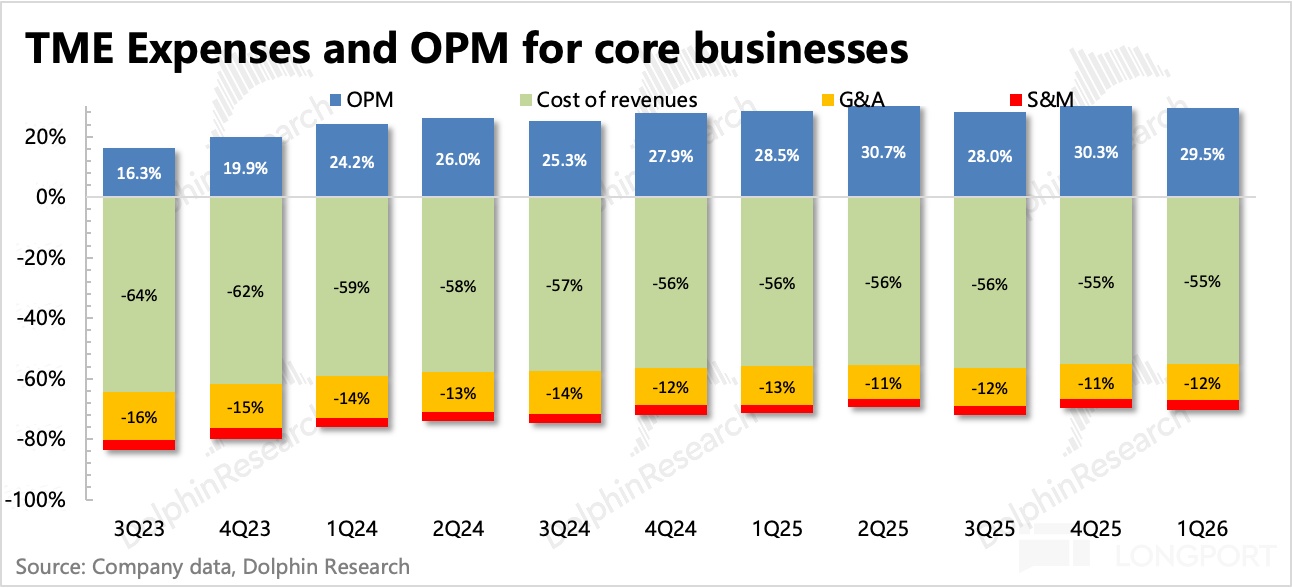
5. Spending up, internal efficiency improving: GPM was 44.9%, up 30bps QoQ, helped by a higher mix of non-sub revenue (e.g., ads) and scale optimizations in content costs. On opex, S&M continued to grow rapidly, reflecting sustained user acquisition and promotion, while G&A was flat YoY and down QoQ, likely on headcount optimization.
6. Shareholder returns to watch: As of Q1-end, TME had short-term net cash of RMB 25bn (cash + short-term investments minus short-term interest-bearing debt), or ~$3.6bn. With a cash-rich model and minimal use of the $1bn two-year buyback unveiled in Mar last year, firepower remains ample.
If the buyback is executed as planned before it expires in Mar-27 and combined with $370mn in dividends, the current ~14bn market cap implies a near-10% total shareholder return. That would be a decent signal of intent.
7. Full financials
Dolphin Research View
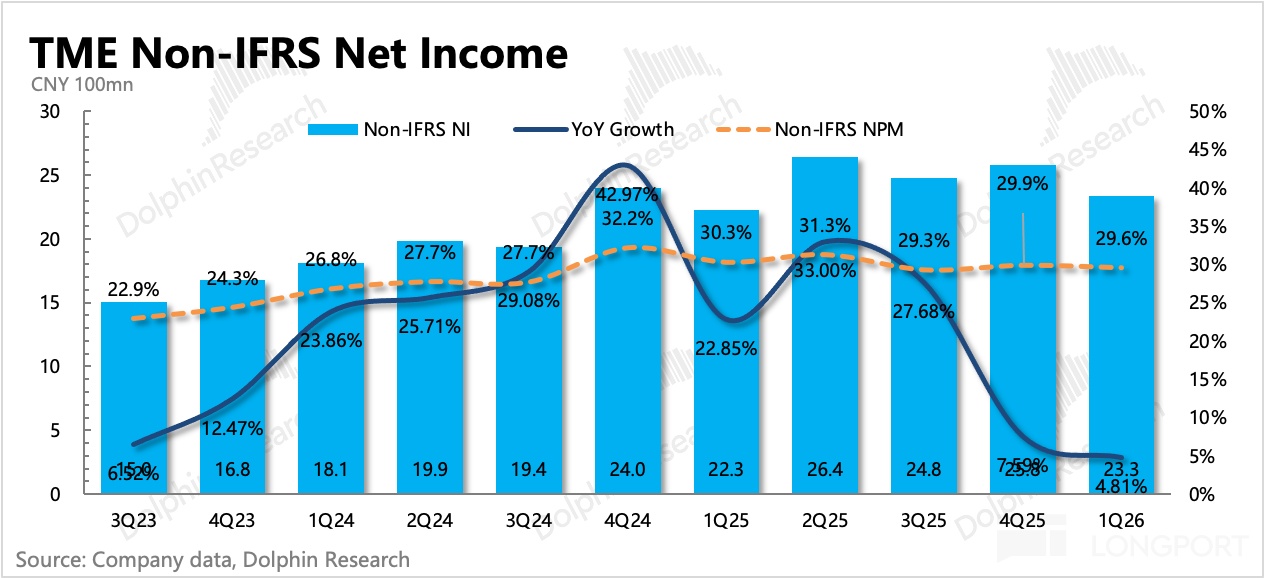
Q4 results and guidance shattered the prior investment case for TME: from a ‘streaming price-up’ narrative to ‘lower pricing to drive users,’ reflecting weaker moats. With uncertain timing on acquisition approval dampening buyback support, the multiple de-rated from ~20x P/E to ~10x P/E — based on management’s guide of RMB 36bn revenue and RMB 10.4bn adj. profit (+8% YoY), a ~14.4bn market cap implies ~9.6x.
While the multiple is below its historical and peer averages, without a clear competitive inflection, confidence in future growth is limited. This ultimately determines whether TME can sustain >10% CAGR and re-rate from ~10x back toward 15x P/E or higher.
Current user data suggest the inflection is not here yet. Soda Music DAU kept growing past 50mn in Q1, surpassing Kugou and QQ Music, with little sign of a slowdown. Meanwhile, Kugou is still losing users, WeSing remains weak, and QQ Music is only marginally stable.
On the print alone, a constructive near-term market reaction is unlikely. But the pre-mkt approval of the Ximalaya deal is the real ‘confidence’ catalyst.
It can lift expectations for user ecosystem stability and competitive repair, even if modestly, and more importantly addresses buybacks. TME is not short of cash, nor cash flow; previously, share-swap considerations tied to the acquisition limited buyback support under share-price pressure. With approval in hand, the two-year $1bn buyback initiated last year can resume.
In an optimistic case, TME completes the $1bn buyback by Mar-27 as initially planned (less than $100mn used so far). Given the drawdown, management may stick to or exceed the original pace to bolster confidence; that would equate to a near-10% shareholder yield (buyback + dividends), which is attractive for some investors. As sentiment normalizes, the multiple could recover, but near ~15x P/E (i.e., >~20bn market cap), caution is warranted: shareholder yield would fall toward ~6%, value appeal fades, and investors will demand clearer competitive inflection and delivery.
Detailed analysis below
I. Subscriptions: growth as expected but sluggish
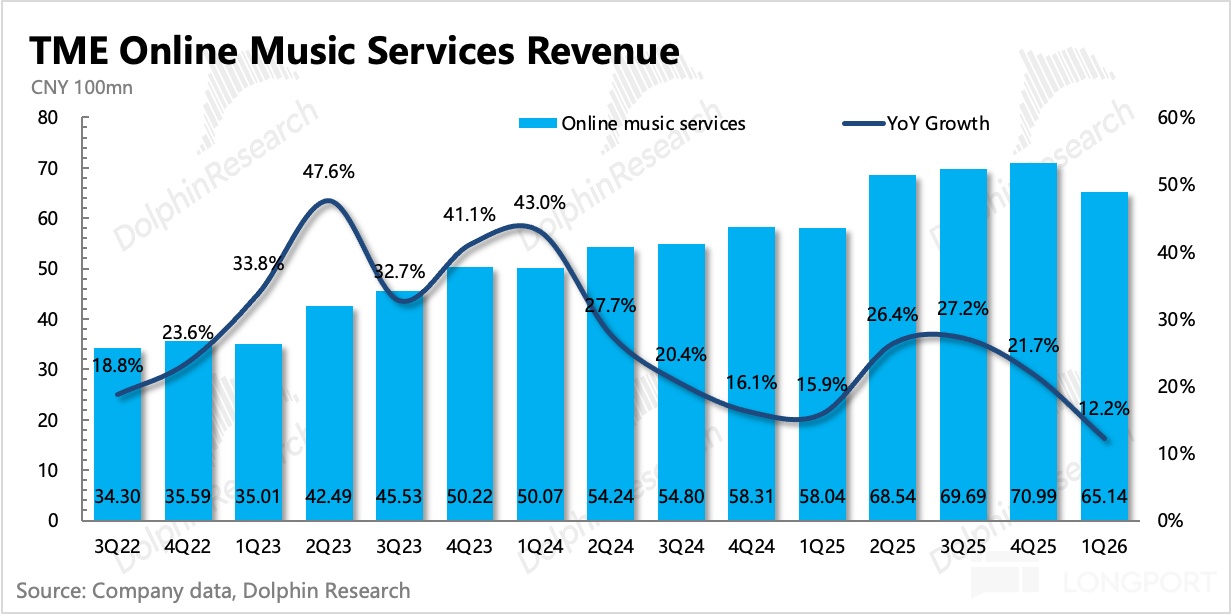
Music subs revenue grew <7% in Q1. With no ‘volume/price’ disclosure, Dolphin Research estimates net subs adds of ~1mn and ARPPU of RMB 11.7/month, reflecting early-year promos and a strategy shift to lower membership thresholds and scale users.
Post-Ximalaya consolidation could offer a short-term window; QuestMobile shows only ~15% overlap between the two platforms’ core users. Given music’s universality, bundling (e.g., adding RMB 1–2 to existing memberships) should not be hard to convert.
Trying to charge a higher premium on ‘category leadership’ is off the table: beyond a weak consumption backdrop, regulators explicitly prohibit price hikes with lowered services, mandate minimum free content proportions, ban exclusive licensing with rights holders, and disallow tying music services to automakers.
While the deal’s monetization upside is capped, having it is better than not for TME at this juncture. Beyond integrating long-audio users, organic growth may lean on deeper SVIP penetration by adding more fan privileges.
II. Other music services: growth still solid
Other music services rose 28% YoY in Q1, slightly below expectations with a QoQ slowdown, likely due to the concerts off-season. Even so, the quarter still saw multiple large-scale K-Pop shows and NCT-WISH’s Hong Kong concert.
This line includes ads, digital album sales, sub-licensing, and VAS — IP-driven monetization around fan value. While the audience is smaller than mass-market music, per-user spend is high, and China’s core fans are no less willing to pay than those in the US/EU.
III. Social entertainment: the bottom didn’t hold
Q1 social-entertainment revenue fell 11% YoY and deteriorated further. Beyond live-streaming pressure, QM data point to heavier competition hitting K-Song from both incumbents and AI.
IV. Profit: investing externally, introspection internally
GPM reached 44.9%, +30bps QoQ on higher mix of non-sub revenue (e.g., ads) and scaled content costs. Sales & marketing rose 36% despite a small base, showing continued push in acquisition and promotion, while G&A was flat YoY and down QoQ, likely on staff optimization.
Core operating profit was RMB 2.3bn, up 11% YoY, outpacing 7% top-line growth, with OPM up 100bps YoY to 29.5%.
<End here>
Dolphin Research on 'Tencent Music' — recent coverage:
Earnings season
Mar 27, 2026 call Trans: TME (Trans): nimble response to competition, prioritizing shareholder returns
Mar 27, 2026 instant take: Tencent Music: Soda’s aggressive push, are the good days gone?
Nov 12, 2025 instant take: ByteDance ramps up — can TME stay ‘small yet beautiful’?
Nov 12, 2025 call Trans: TME (Trans): subs growth softens marginally; near-term investment weighs on margin
Risk disclosure: Dolphin Research disclaimer and general disclosures


The copyright of this article belongs to the original author/organization.
The views expressed herein are solely those of the author and do not reflect the stance of the platform. The content is intended for investment reference purposes only and shall not be considered as investment advice. Please contact us if you have any questions or suggestions regarding the content services provided by the platform.