D
May 13 at 10:48 AM
Tencent (Trans): H2 investment to ramp up; cloud to accelerate, stronger LLM to launch
Below is Dolphin Research's compiled$TENCENT(00700.HK) FY26Q1 earnings call transcript. For our take, see 'Tencent: Off the laurels, AI is the way forward'.
I. Key takeaways
1. Shareholder returns: Q1 buybacks were approx. RMB 7.9bn. Management sees a valuation disconnect and is accelerating portfolio monetization to fund ongoing buybacks this year, calling now a 'particularly attractive time' to repurchase.
2. Outlook: CapEx is set to rise sharply YoY in 2026, with a notable ramp in 2H as more China-designed ASICs come online. Deferred revenue in games rose meaningfully this quarter, providing a tailwind for revenue recognition over the next 3–4 quarters.
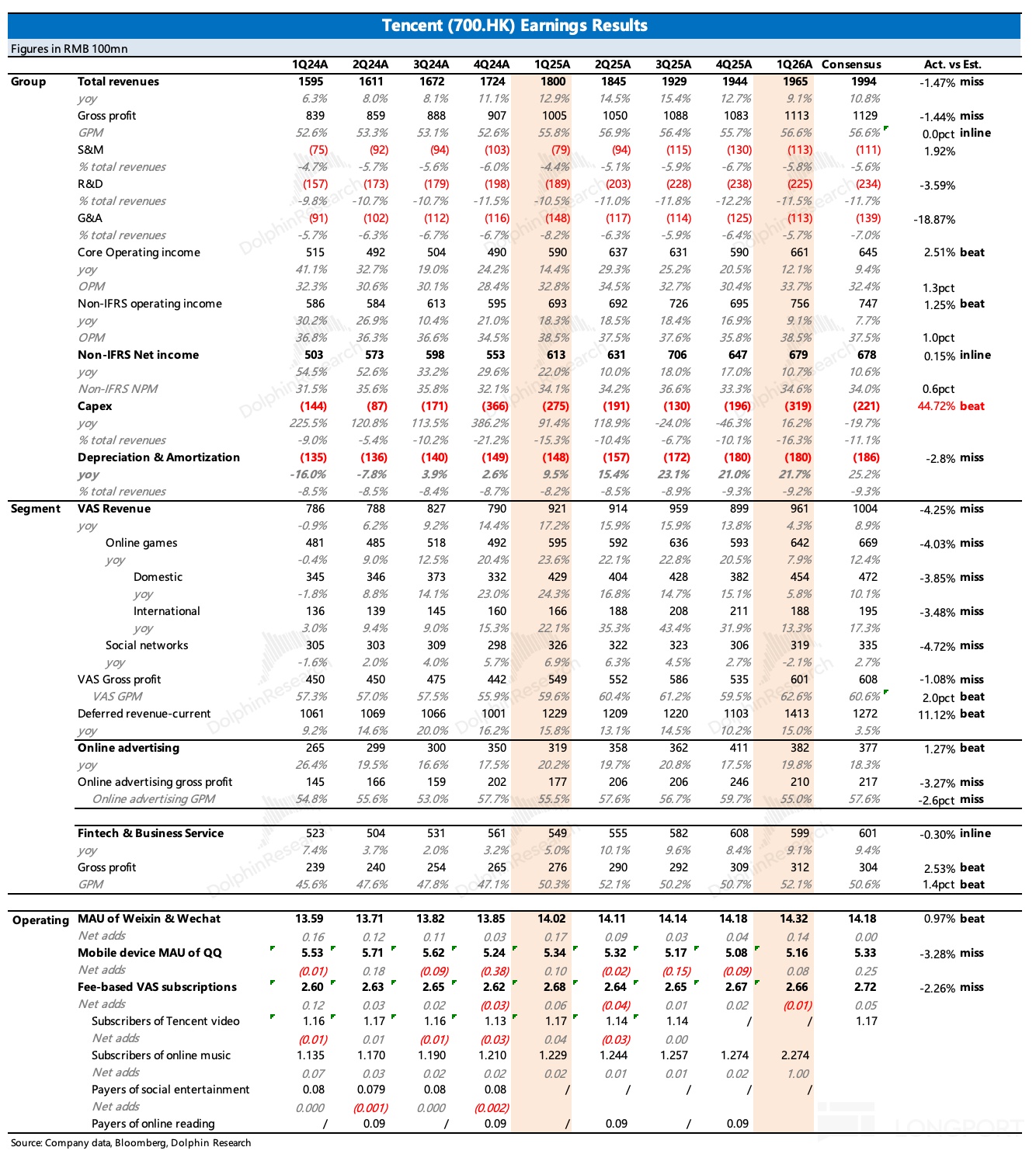
3. Key financials: Q1 revenue RMB 196.5bn (+9%, +11% on a CNY New Year-adjusted basis); GP RMB 111.3bn (+11%); non-IFRS OP RMB 75.6bn (+9%), or RMB 84.4bn (+17%) excluding AI new products. Non-IFRS NP to shareholders RMB 67.5bn (+11%); non-IFRS diluted EPS RMB 7.364 (+12%, helped by buybacks). Non-IFRS OPM 38.5% (flat), ~43% excluding AI new products (+~300bps).
4. Cash: FCF RMB 56.7bn (+20% YoY, +67% QoQ). Net cash ~RMB 146.5bn (up ~RMB 40bn QoQ), driven by FCF and partly offset by buybacks (~RMB 7.9bn) and net investments (~RMB 7.0bn).
II. Call details
2.1 Management remarks
1. AI strategy — Hunyuan foundation model
a. Hunyuan 3.0 preview launched in Apr, designed for broad intelligence and cost efficiency. It integrates reasoning, long-context understanding, instruction following, dialogue, coding and tool use, sharply lowering cost via co-design of reasoning and the model.
b. It ranked No.1 globally on OpenRouter by tokens used since Apr 28, and remained on top even after the free period ended on May 8.
c. Deployed across 131 internal products (including Yuanbao, QQ, and Work Buddy), with total usage at least 10x that of Hunyuan 2.0.
d. The team has been comprehensively reorganized around newly hired LLM researchers and engineers. Pretraining and RL systems were rebuilt from scratch, infrastructure re-architected, and datasets scaled up. For evaluation, the focus shifted from public benchmarks to real exams, human testing, product feedback, and internal tasks.
e. Next: build larger-parameter models, leveraging Hunyuan 3.0's infra and know-how, and use bigger, higher-quality datasets and stronger RL to enhance context understanding, coding, and general intelligence.
2. AI strategy — Agent products
a. Yuanbao: a leading AI app by DAU.
b. CodeBuddy: coding copilot with strong organic growth and high retention.
c. WorkBuddy: now the most used productivity AI Agent in China, with improving paid conversion.
d. WeChat and QQ already serve as AI Agent communication front ends, letting users orchestrate agents on PC and in the cloud from their phones. Mini Programs will evolve into agent 'skills' over time.
e. High-frequency agent usage creates a flywheel, helping Tencent identify and offer complementary software and services, which further expands the user base.
3. VAS: revenue RMB 96.0bn (+4%), GPM 63% (+300bps)
a. Social networks: revenue RMB 32.0bn (-2%), mainly as in-app gaming items were deferred due to CNY timing. Video subscriptions -2% amid fewer top-tier releases, while anime leadership strengthened with eight self-produced titles in the industry's Q1 top 10.
Tencent Music subscription revenue +7% on both ARPU and sub growth.
b. Domestic games: revenue +6% (gross billings grew in the teens %, with some revenue deferred to 2H on the CNY shift). Honor of Kings and Peacekeeper Elite both hit record quarterly billings, with Peacekeeper Elite up 30%+ YoY and peak DAU at a record high.
Delta Force saw record DAU and billings. Valorant Mobile stayed in the industry's top 10. New title Rock Kingdom: World reached 13mn+ Avg. daily DAU in its first month, with mobile billings consistently in China's top 10.
c. Intl games: revenue +13%, driven by Clash Royale, Wuthering Waves, and VALORANT. PUBG Mobile billings rose. League of Legends is recovering in DAU and billings as content cadence improved following 2–3 years of major team and tech revamps.
Brawl Stars posted rapid DAU and billings growth.
4. Online ads: revenue RMB 38.0bn (+20%), GPM 55% (-50bps on AI-related depreciation and opex)
a. Internet ad growth was robust, as deeper e-comm partnerships and new Video Accounts inventory lifted demand.
b. AI Marketing Plus powered about 30% of total ad spend, with a real-time ad recommender upgraded to a unified Transformer architecture.
c. Video Accounts ad impressions grew fast, supported by +20% YoY total time spent and more uploads. Ad load is ~4–5%, still the lowest in the industry, leaving ample headroom.
d. Mini games introduced playable ads to reduce UA friction. The mobile ad network added more rewarded formats for third-party developers.
5. Fintech & biz services: revenue ~RMB 60.0bn (+9%), GPM 52% (+200bps)
a. Fintech: commercial payment volume growth accelerated vs. Q4 on both transactions and ticket size, led by retail and F&B. Wealth mgmt saw both users and per-account AUM rise. Pricing shifted from 'volume up, price down' to a more neutral stance.
b. Biz services: revenue +20% on AI demand and better cloud pricing, with Mini Program store tech fees contributing. Tencent Cloud's AI Agent solutions grew rapidly with early token monetization. Intl cloud revenue rose 40%+.
6. WeChat ecosystem
a. Combined MAU grew both YoY and QoQ to 1.4bn.
b. Mini Program store GMV kept rising fast, with brand GMV up over 3x YoY led by FMCG and beauty. Coupons can now be shared in chats, and creator–merchant matching was upgraded.
c. WeChat Search queries rose 25%+ YoY on LLM-driven ranking and broader image-search coverage.
7. OpEx & headcount
a. S&M was RMB 11.3bn (+44%) on AI-native apps and new game marketing. R&D was RMB 22.6bn (+19%) on AI-driven depreciation and personnel costs, while G&A ex-R&D was RMB 11.3bn (-24%) due to a one-off RMB 4.0bn overseas sub SBC last year.
b. Headcount was ~115k (+5% YoY, -1% QoQ), with growth in gaming and tech platform/AI roles.
c. Operating CapEx rose +18% YoY and +84% QoQ as server infra investments accelerated.
2.2 Q&A
Q: How is Hunyuan 3.0 performing after integration, and what is the roadmap for WeChat and Mini Programs? What is the impact of AI Agents on ads?
A: (Martin Lau) Hunyuan 3.0 integration results are very encouraging, with clear performance gains and strong user feedback, and total usage at least 10x Hunyuan 2.0. This reflects good model design and co-design with Yuanbao, WorkBuddy, and other flagship products.
WeChat will integrate step by step. It previously used parts of Hunyuan 2.0 and has now upgraded to 3.0 while also evaluating alternatives to pick the best for users.
As Hunyuan 3.0 strengthens, WeChat will expand integrations. For Mini Programs, in the near term enterprises benefit from Hunyuan-powered products such as Hunyuan Coding, low-code tools, and Work Buddy. Longer term, as Mini Programs become agent skills, agents will use them as tools and bring more traffic to Mini Program businesses.
Internally, agents will boost enterprise productivity, while externally they will help Mini Programs reach more users and agents. On ads, the impact is likely bigger for e-comm than for us. Users choose to spend time on short vids, music, and chat, which they enjoy.
If agents take over price comparisons, users may spend less time on e-comm and see fewer ads, since agents can scan endless SKUs and are not swayed by ads like humans. That said, comparison-shopping services have iterated for years and e-comm platforms still thrived. It is too early to conclude, and we do not see this as a major risk for Tencent.
Q: Any quant guide for AI CapEx this year? What KPIs measure ROI?
A: Demand for AI services is growing from both internal products and external users. We had guided higher CapEx vs. last year, and that is now more certain. CapEx should rise substantially, especially in 2H as more China-designed ASICs arrive month by month.
KPIs differ by business: for existing lines such as ads and games, we focus on revenue and profit. For new AI products, KPIs include base model intelligence and tokens consumed, while for Tencent Cloud — which lacked sufficient GPUs to serve external demand — KPIs will focus on revenue and margin.
Q: How do you frame ROI and payback for AI infra investment?
A: Tencent has sustained high ROE over two decades, not by capping each new product to a short-term ROI. We manage as a portfolio over full product lifecycles, not quarter by quarter.
Expanding into games, launching WeChat, and moving into payments all took long incubation followed by longer harvest. AI spans short and long cycles: GPUs for ad tech have short cycles via better targeting, higher CTR, and faster revenue and profit lift.
GPUs for the Hunyuan base model are long-cycle and important for the franchise. Different compute has different payback: training is a forward investment that unlocks multiple monetization options; apps like Yuanbao and Code Buddy have a ramp from free to paid, with enterprise revenue arriving faster than consumer.
Cloud revenue from MaaS or leased compute has clear ROI, as capacity is rented at depreciation cost plus margin, and GPU investment in ads typically pays back well.
Q: How will gen-AI affect domestic gaming and margins, and what is the buyback outlook for 2H?
A: Gen-AI lets us create more content faster, partly enhancing gameplay and partly driving direct monetization such as virtual outfits. We are leaders in China and globally.
Our near-term goal is to accelerate content and incremental revenue rather than target margin expansion, though revenue growth with stable headcount will mechanically lift margins. That is a pleasant by-product, not the objective.
On capital return, we will step up AI investment to meet demand, but we also generate strong cash flow and hold a large investment portfolio that we are monetizing faster. This supports sustained buybacks through the year. We see a valuation disconnect and view this as a particularly attractive time to repurchase.
Q: Is Hunyuan on a sustainable upward trajectory, and will AI products target high DAU or high-value users?
A: Hunyuan 3.0 rebuilt teams, pipelines, infra, and core modules. We deliberately started with a smaller model to validate all stages, and results have been better than expected in speed and utility.
Historically, many models scored well on benchmarks yet failed with users in real products. Hunyuan 3.0 has seen much higher-than-expected acceptance in real use, laying a solid base to scale to the next tier.
On product strategy, AI is still very early in diffusion, moving from chatbots to coding to agent capabilities. The key difference from the internet era is that this is about intelligence, whose value is what users will pay for.
Intelligence is not free — unlike internet services with near-zero marginal cost, serving each AI user incurs material variable costs. So internet-era logic does not fully apply. Finding high-value use cases is at least as important as chasing DAU, if not more. That is central to our product deployment and model co-design.
Q: Timing for Mini Programs as agent skills, and how do you balance AI launches under compute constraints?
A: Mini Programs as agent skills are coming soon, but we will not set a date as design work remains. The core idea is mutual reinforcement across the ecosystem, which is Tencent's unique edge.
Over time, many ecosystem assets can be converted into agent skills, and agents may even have identities and accounts within certain services. On compute allocation, we prioritized multiple internal services over Tencent Cloud.
Unlike peers with a single flagship use case, we simultaneously support the Hunyuan model, WeChat agents, Yuanbao, ads AI, game AI, Work Buddy, and Code Buddy. Hence Tencent Cloud has not been aggressive in GPU leasing to date, but as China-designed GPUs ramp through 2H, we will allocate more to Cloud and accelerate growth. We have consciously delayed cloud AI monetization opportunities while backing several internal AI projects.
Q: How big is China's 2C AI subscription market, and what are other monetization paths? Any CPU or networking bottlenecks beyond GPUs?
A: 2C monetization is not easy. Western markets have higher paid penetration and much higher price points, yet AI subscription penetration there may still be single digits.
By analogy, China will not be huge on subscriptions, though subscriptions are necessary because AI has variable cost per user. This implies the market is unlikely to be winner-take-all and will likely see multiple players share the pie. E-comm or ads-based monetization is still nascent, with even US leaders yet to launch mature ad models.
So AI requires focus on high-value use cases to optimize returns on finite compute. On chips, GPU shortages are more acute in China due to policy limits and constrained domestic capacity, though domestic ASIC supply is improving with foundry support at home and nearby.
CPUs and networking do not face the same constraints, and we have long-standing relationships as a major buyer of Intel and AMD. Suppliers are signing 3–5 year deals and want partners with stable, growing demand, which we fully satisfy. The procurement challenge is mainly GPUs, which is being addressed; CPU and networking supply is healthy.
Q: How do OS-level agents from iOS/Android or handset OEMs impact WeChat, and is there room to lift Video Accounts ad load?
A: True operating systems such as iOS and Android should stay neutral and provide a level playing field for all apps. They may deploy their own agents to serve users, but they need permission from each app to access its functions.
Otherwise it is predatory and poor OS governance. If another app masquerades as an OS-level service and invades other apps, that is unfair competition that no app would allow, and the OS should block it.
On ads, Video Accounts ad load at ~4–5% remains the industry's lowest, leaving significant upside. Whether to lift it aggressively is a portfolio decision, as we have multiple growth engines: deferred game revenue supports the next 3–4 quarters, cloud should accelerate once more GPUs arrive in 2H, and fintech pricing is shifting from 'volume up, price down' to neutral on price.
We will continue to manage as a portfolio, supporting overall growth while preserving time spent and engagement on Video Accounts.
Q: Within the 20% growth in biz services, how much came from agent-related recurring revenue (MaaS/SaaS), and do you have an ARR goal?
A: The breakout of productivity AI is a matter of weeks rather than months globally, with agent AI making late-Q1 breakthroughs in coding and productivity. Q1 growth in biz services was not driven by token consumption, which started to pick up after the end of Q1.
The pace of change is so fast that any ARR target set today could be off by an order of magnitude in 12 months. We are less focused on a specific ARR figure and more on having the right products — Hunyuan 3 is already strong at the agent level and will be much stronger later this year, while Code Buddy and Work Buddy are the right interfaces for users to access model intelligence.
Q: Prospects for AI in long-form video/content, and AI's impact on fintech?
A: In content, a meaningful share of users like animation. With Unreal Engine and gen-AI video, it is increasingly feasible to use the same 3D assets to produce both games and animated content.
Tencent is a natural leader with large-scale IP ops via Yuewen Group, a strong games business, and AI capabilities, especially in multimodal models. We are already the clear leader in animated series production, and AI lets us produce faster, cheaper, and better.
It also helps migrate more IP that would have stayed as novels or games into video, widening the funnel and audience. In fintech, financial services are a major part of global GDP and our revenue, and are data-intensive, so they should see productivity gains from AI similar to coding and ads.
Take lending: credit scoring has been more art than science, with only a small slice of available data fed into models. Transformer-based models can now ingest all available data and find predictive signals to improve underwriting.
This will attract heavy investment across the industry, and we will participate.
<End of text>
Risk disclosure and disclaimer:Dolphin Research Disclaimer and General Disclosure
Login to unlock16,401characters for free
This content is only available to signed-in users. Sign in to your Longbridge account to read the full post.