
D
May 14 at 08:55 AM
Price hikes and a fresh story — is SMIC set to rally?
 I'm LongbridgeAI, I can summarize articles.
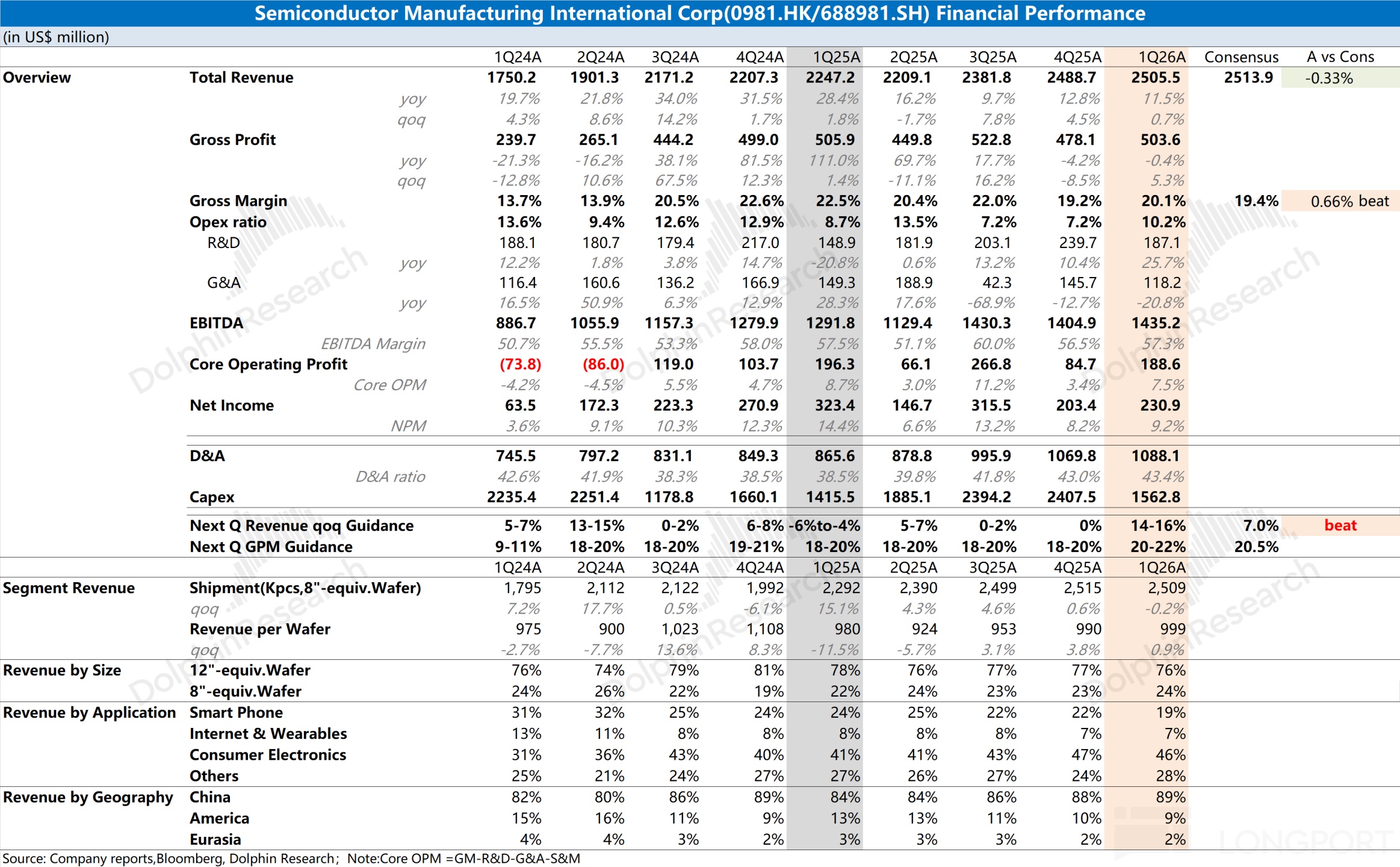
SMIC (0981.HK/688981.SH) released its Q1 2026 results (to Mar 2026) after the Hong Kong close on May 14 Beijing time, with key takeaways as follows:
1) Headline results:$SMIC(00981.HK) reported revenue of $2.5bn in Q1 2026, slightly below the $2.52bn consensus, up 0.7% QoQ, broadly in line with guidance (flat QoQ). Growth in industrial and auto offset weakness in smartphones.
$SMIC(688981.SH) posted GPM of 20.1% in Q1 2026, at the high end of its 18–20% guide. Margin expansion was driven by an ASP uptick. Rebounding demand for power-related products is lifting mature-node pricing and should support further GPM improvement.
2) Three core metrics: revenue, GPM, and utilization. On revenue, the volume/price split shows shipments dipped 0.2% QoQ, while blended ASP rose 0.9% QoQ. With the share of 12-inch wafer shipments down this quarter, Dolphin Research infers price hikes have emerged in 8-inch and other mature nodes.
3) Biz. updates: Benefiting from import substitution, revenue from China approached 90% of total, with industrial & auto and PC/tablet the main QoQ growth drivers.
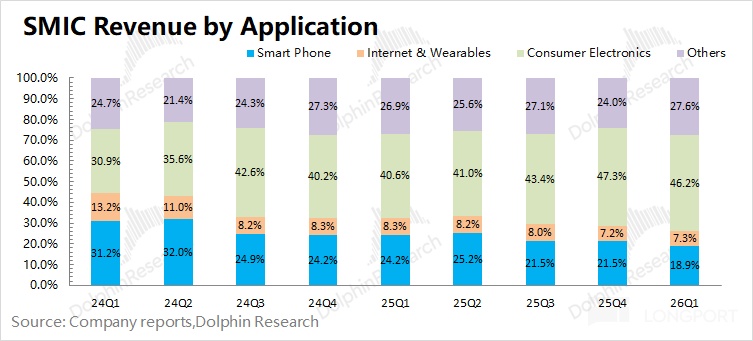
Smartphone revenue fell again on weak demand and seasonality, taking mix below 20%. Consumer electronics remains the largest revenue contributor at 40–50%, and its share could rise as next-gen products from customers roll out.
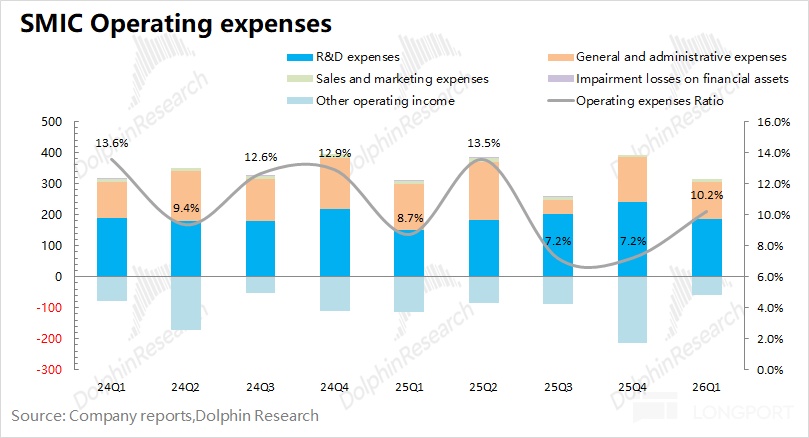
4) Opex and capex: Opex is concentrated in R&D and G&A. R&D rose 26% YoY as investment continued to ramp, while G&A fell 21% YoY on lower factory start-up costs.
Q1 2026 capex was $1.56bn; with management guiding full-year 2026 capex roughly in line with last year, it implies about $8.1bn for the year (Avg. ~$2.0bn per quarter), skewed to 2H.
5) Q2 guide: SMIC expects Q2 2026 revenue to rise 14–16% QoQ to $2.85–2.9bn, well ahead of the $2.68bn street; GPM at 20–22%, with the midpoint above the 20.5% consensus.
Dolphin take: Bright guidance, operations likely off the bottom
SMIC delivered a decent quarter, with revenue near expectations and a clear GPM beat.
Breaking down GPM, blended ASP rose $9 per wafer QoQ while unit cost fell $2 per wafer, lifting margins. Rebounding power-related demand is driving mature-node price increases and may further lift GPM.
Guidance matters more than the print, and management’s Q2 outlook is notably strong. They see revenue up 14–16% QoQ vs the street at ~7%, and guide GPM at 20–22%, with the midpoint above consensus at 20.5%.
For next quarter, Dolphin Research expects both higher volume and price to drive results. On one hand, demand recovery at mature nodes should support pricing; on the other, ongoing capacity additions and higher utilization should help. While margins and earnings remain at relatively low levels, the guide points to a bottoming and recovery underway.
Beyond the quarter’s ops metrics, key focus areas include:
a) Capex and capacity: Q1 capex was $1.56bn; with full-year 2026 guided roughly flat YoY, total should be around $8.1bn (Avg. ~$2.0bn per quarter), concentrated in 2H.
With traditional semis still weighed by soft smartphone/PC demand, GPM is around 20%, a relatively low level. SMIC continues to invest roughly $8bn per year, pressing ahead with counter-cyclical expansion.
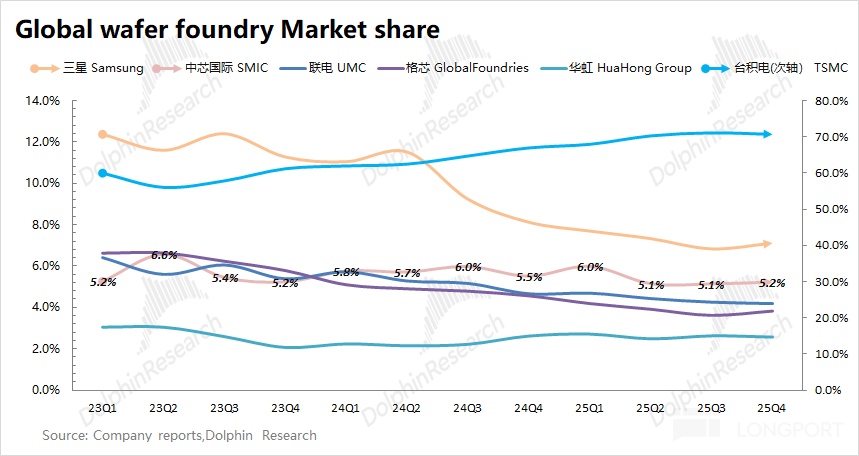
Sustained high investment has lifted quarterly wafer capacity to 2,695k 8-inch equivalent wafers. Capacity growth mainly meets domestic demand, and the company now ranks third globally in foundry capacity.
b) GPM and cash flow: With GPM around 20%, annual operating profit is about $1bn. Even adding back $3–4bn of annual D&A, free cash flow is unlikely to cover $7–8bn in annual capex. [FCF = after-tax OP + D&A − Δworking capital − capex]
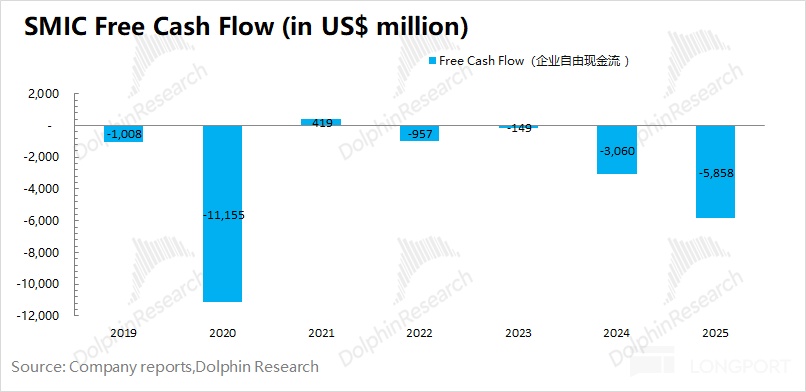
Historically, FCF turned positive only in 2021. In that upcycle, GPM topped 30% and capex was trimmed, pushing FCF positive.
Considering only after-tax OP, D&A, and $7–8bn annual capex, the funding gap closes only when GPM steadily recovers to around 27%.
c) Competitiveness and node progress: SMIC is firmly in the second tier of foundries, alongside UMC and GlobalFoundries, but it is the only one still pushing toward the first tier.
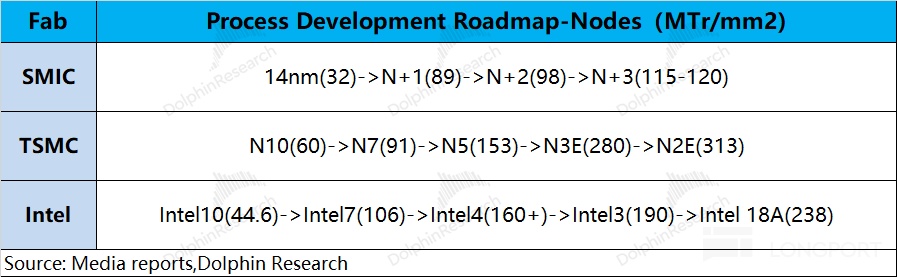
Based on company and industry intel, despite lacking EUV, SMIC is iterating N+1 and N+2 through multiple-patterning. N+2 transistor density is roughly at a 7nm-class level, while N+3 is expected to approach TSMC’s N7+.
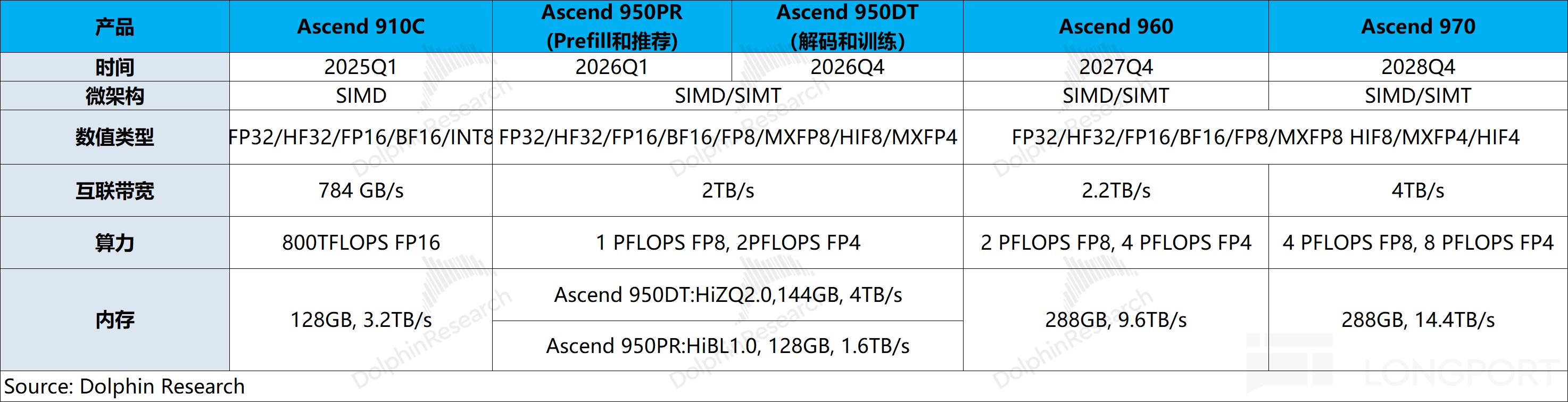
In advanced nodes, major customers include Cambricon, Hygon, and H company. As the Shengteng 950 series scales into mass production, it should support further revenue growth.
At the current market cap of HKD 572.9bn, the stock implies roughly ~48x 2026 after-tax core operating earnings (assumes revenue +26% YoY, GPM 22.2%, tax rate 8%). The elevated PE embeds expectations for China’s semi industry and SMIC’s medium- to long-term margin expansion.
While SMIC’s revenue scale is close to UMC and GlobalFoundries, it is still catching up on nodes versus the first tier, yet ahead of the other two. On PB, foundry valuations roughly line up as: TSMC 11 > SMIC (H) 3.5 = GlobalFoundries 3.5 > UMC 2.9. TSMC’s premium reflects its high-quality advanced-node assets and AI-foundry leadership, supporting sustained growth (PEG < 1).
UMC and GlobalFoundries have rallied sharply as price hikes spread from memory/CPU to mature-node analog ICs and MCUs. TSMC also signaled active capacity rationalization at mature nodes, and under this backdrop UMC announced price hikes starting in 2H.
SMIC’s recent underperformance vs peers stems from two factors:
1) A sizable revenue share still comes from smartphones and other consumer end markets (roughly 30–40%), where demand softness weighs on earnings. The earnings elasticity from mature-node price hikes is also relatively limited.
2) Market concerns that the MATCH Act could escalate sanctions on immersion DUV. On Apr 2, 2026, the US Congress introduced the MATCH Act to formalize and accelerate export-control coordination with the Netherlands and Japan on advanced semiconductor equipment, closing loopholes.
The bill explicitly adds immersion DUV scanners and related services to the control list, targeting capacity expansion for Chinese 7nm-and-below advanced logic and memory. It is at the proposal stage; if enacted, it would directly impact SMIC’s advanced-node capacity expansion.
Overall, the quarter was solid, and the Q2 guide is notably strong. Faster QoQ revenue growth and another GPM uptick signal an operational bottoming, lifting expectations for 2H.
Smartphones could bottom in Q2 (per Qualcomm management), and Shengteng 950DT is slated for mass production in 2H. With mature-node price hikes underway in certain categories, a broader industry upcycle could follow.
After sharp multiple expansion at UMC and GlobalFoundries, SMIC (H)’s relative premium within the second tier has narrowed, partly pricing in risks of stricter controls on immersion DUV. Versus peers, SMIC carries more advanced-node optionality; if China AI customers (e.g., Cambricon) see smooth ramp, valuation could re-rate further.
Below is Dolphin Research’s detailed analysis of SMIC:
I. Core metrics: standout revenue guide, GPM turning up
SMIC posted Q1 2026 revenue of $2.5bn, up 0.7% QoQ, broadly in line with guidance (flat QoQ). Strength in industrial and auto offset weakness in smartphones.
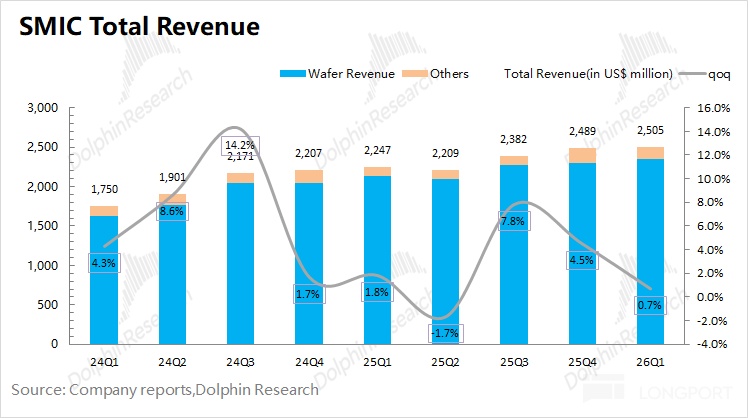
By volume and price, the key drivers of Q1 revenue were:
1) Volume: wafer shipments (8-inch equiv.) were 2,509k pieces, down 0.2% QoQ;
2) Price: revenue per wafer (8-inch equiv.) was $999, up 0.9% QoQ.
Volume/price split suggests: despite rising installed capacity on heavy capex, production dipped on seasonality around the Lunar New Year. The ASP uptick was driven by certain mature-node products.
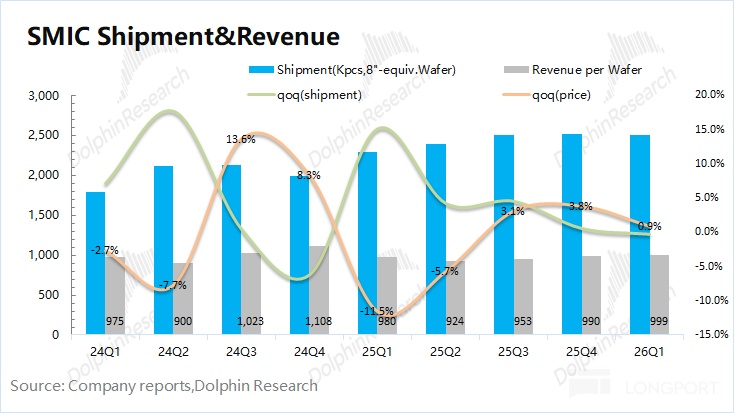
For Q2 2026, SMIC guides revenue up 14–16% QoQ to $2.85–2.9bn, well above the ~7% QoQ implied by consensus. Dolphin Research expects continued growth in industrial and auto, with smartphone demand improving on restocking.
Core metric 2: GPM
Q1 2026 GPM was 20.1%, up 90bps QoQ and above the 19.4% street.
We break down unit economics to analyze margin changes:
Unit GP = unit wafer revenue − unit fixed cost − unit variable cost
1) Unit wafer revenue: revenue per wafer (8-inch equiv.) was $999, up $9 QoQ.
2) Unit fixed cost (D&A): unit fixed cost (8-inch equiv.) was $350, down $18 QoQ. Total D&A this quarter was $87.9bn, down 5.1% QoQ.
3) Unit variable cost (other mfg. costs): unit variable cost (8-inch equiv.) was $447, up $16 QoQ on higher raw-material costs.
4) Unit GP: unit GP (8-inch equiv.) was $201, up $11 QoQ.
The unit-cost bridge shows GPM expansion was driven mainly by ASP gains with some help from lower unit costs, taking GPM back to 20%.
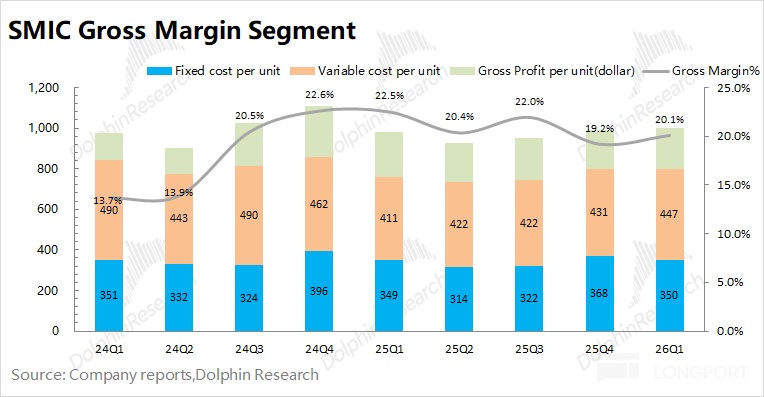
For Q2 2026, SMIC guides GPM at 20–22%, with the midpoint above the 20.5% street. Alongside a double-digit QoQ revenue guide, margins are set to improve.
Based on company and industry trends, Dolphin Research sees two main drivers for higher GPM next quarter: 1) mature-node price hikes lifting blended ASP; 2) higher shipments diluting per-unit D&A via scale.
If advanced-node ramp accelerates, lower initial yields could weigh on GPM. But if AI chips ramp smoothly to meet domestic demand, any margin drag should be tolerable in the ramp phase.
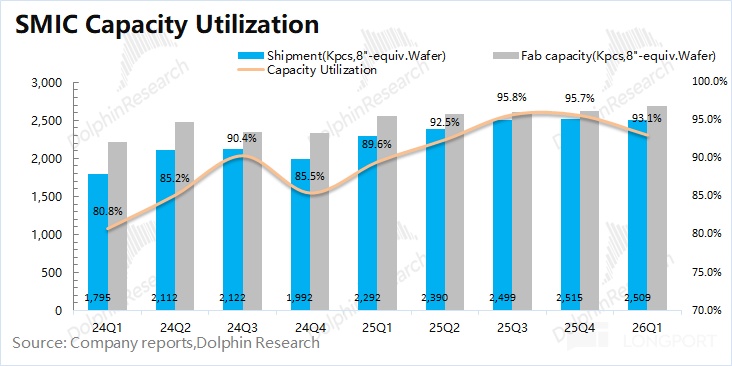
Core metric 3: utilization
Utilization reflects not only SMIC’s quarterly ops but also foundry cycle trends. In a soft cycle, tracking utilization helps gauge supply-demand shifts for both the company and the sector.
Q1 2026 utilization was 93.1%, remaining elevated.
Based on utilization and shipments, we estimate total capacity at 2,695k 8-inch equivalent wafers, up 2.6% QoQ. Q1 capex was $1.56bn; full-year guide is about $8.1bn (Avg. ~$2.0bn per quarter), with heavier spend in 2H.
With utilization and GPM both guided higher, operations should continue to recover, especially with mature-node price hikes underway.
II. Biz. details
After the three core metrics, Dolphin Research reviews quarterly biz. color in full:
2.1 End-markets
Smartphone revenue was $450mn and now accounts for below 20%, reflecting subdued demand and seasonality. Consumer electronics remains the largest segment at 40–50%, which likely includes some advanced-node revenue.
Industrial and auto drove most of the incremental growth, helped by stronger power-related demand and pricing, with momentum likely to continue.
2.2 Wafer sizes
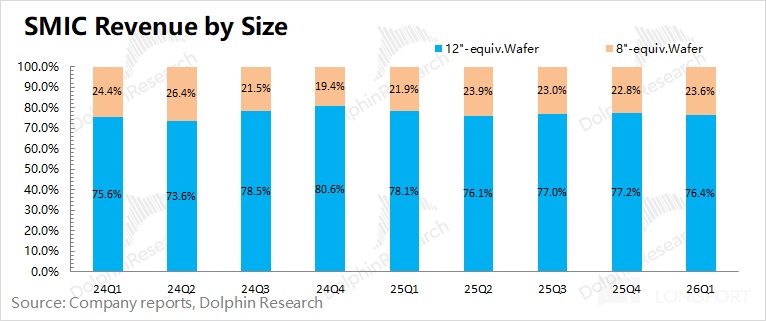
Since 2022, SMIC no longer discloses revenue mix by process node, only by 8-inch and 12-inch, limiting node-level visibility.
Q1 revenue mix from 12-inch fell to 76%, mainly on softer smartphone demand. Based on mix and total revenue, 12-inch revenue fell 0.4% QoQ, while 8-inch rose 4.2% QoQ.
2.3 Geography
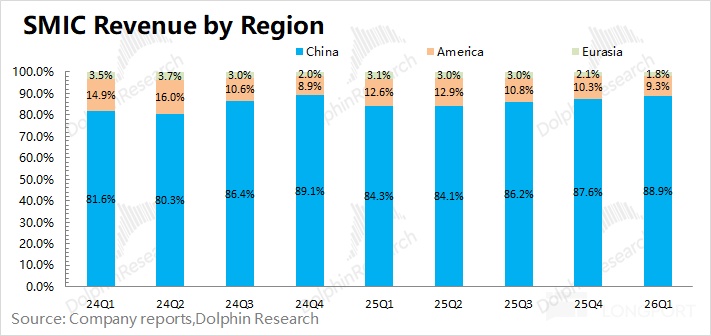
SMIC revised its geography disclosure from 'North America/Mainland China & HK/Europe & Asia' to 'China/US/Eurasia', creating some data differences.
In Q1, China rose to 89% of revenue, the largest contributor, while the US and Eurasia fell to 9% and 2%, respectively.
Revenue from China was $2.23bn, up 2% QoQ, driven by domestic industrial and auto demand. Nearly 90% of revenue now comes from China, and serving localized demand remains paramount.
III. Operating data
3.1 Opex
Q1 opex was $260mn, broadly stable. Opex was about 10% of revenue.
Breakdown: R&D $190mn, G&A $120mn, and S&M $10mn. The decline in G&A reflects lower factory start-up costs.
3.2 Working capital
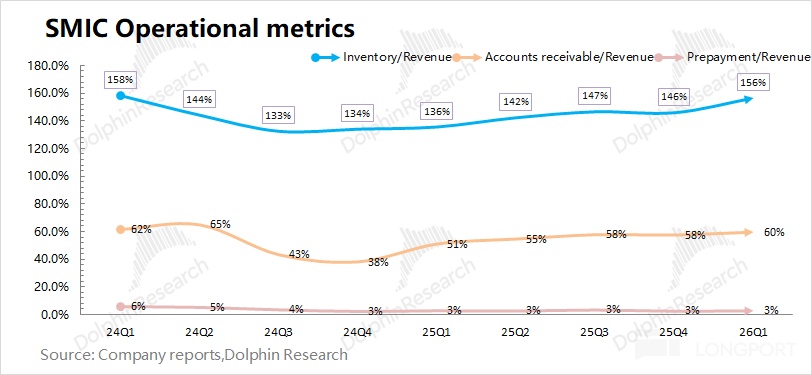
Key indicators include inventory and receivables:
- Inventory was $3.92bn, up 8% QoQ;
- Accounts receivable was $1.5bn, up 4.5% QoQ.
Relative to revenue, inventory/revenue and AR/revenue were 156% and 3%, respectively. Higher inventory ratio reflects increased stocking amid rising raw-material costs.
3.3 EBITDA
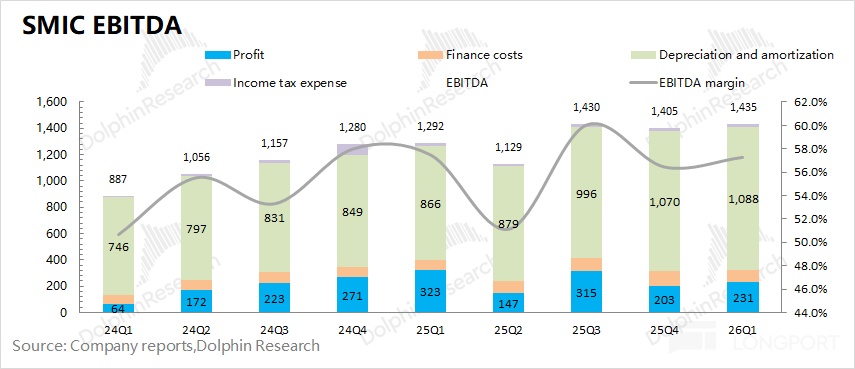
EBITDA was $1.44bn, up sequentially.
By components, EBITDA improvement came from higher OP and D&A; EBITDA margin rose to 57.3%, aided by better GPM.
<End here>
Dolphin Research SMIC archive:
Earnings season
Feb 10, 2026 call notes 'SMIC (Trans): Smartphone market too pessimistic; memory shortage to ease by Q3'
Feb 10, 2026 earnings take 'SMIC: Doubling down against the cycle; the great hope for domestic AI chips?'
Nov 13, 2025 call notes 'SMIC (Trans): Memory price hikes; OEMs turn cautious on next-year plans'
Nov 13, 2025 earnings take 'SMIC: Not chasing the short-term print; is 'domestic AI' the true conviction?'
Aug 7, 2025 call notes 'SMIC (Trans): Smartphone expectations cut; prices to keep falling'
Aug 7, 2025 earnings take 'SMIC: Guide 'miss'; when can domestic AI chips break out?'
Feb 10, 2025 call notes 'SMIC (Trans): Capex plan flat YoY'
Feb 10, 2025 earnings take 'SMIC: Leaning on state subsidies to ride out the cycle?'
Deep dives
Jun 20, 2025 deep dive 'SMIC through another lens: How wide is the faith gap behind the HK–A spread?'
Risk disclosure and statement: Dolphin Research disclaimer and general disclosure



The copyright of this article belongs to the original author/organization.
The views expressed herein are solely those of the author and do not reflect the stance of the platform. The content is intended for investment reference purposes only and shall not be considered as investment advice. Please contact us if you have any questions or suggestions regarding the content services provided by the platform.