D
May 14 at 10:33 PM
SMIC (Trans): Foundry prices edging higher; pricing tailwind to persist
Below is Dolphin Research's Trans of SMIC FY26 Q1 earnings call. For our take on the print, see 'Price Hikes In One Hand, New Narrative In The Other: Is SMIC About To Surge?'.
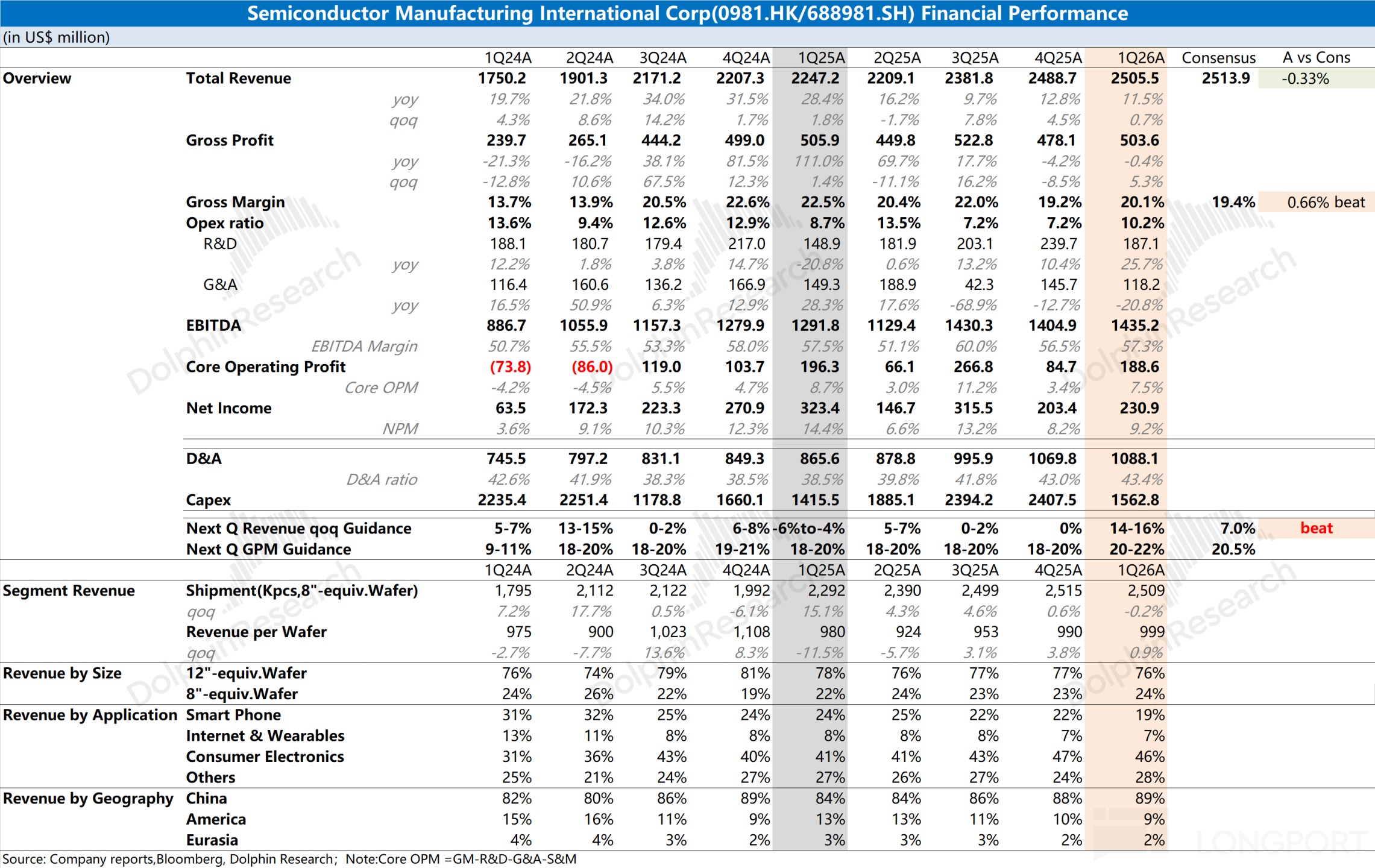
I. $SMIC(00981.HK) Key takeaways from the results
1. Shareholder returns: No profit distribution for 2025, as FCF remains negative with the company in a critical expansion phase. Priority is being given to capacity build-out and R&D.
2. Q2 guidance: Revenue to grow 14%-16% QoQ, with both shipments and ASP up meaningfully. GPM at 20%-22%, up 200bps vs. last quarter's guide, mainly driven by higher ASP.
3. Q1 key financials: Revenue of $2.505bn (+0.7% QoQ), GPM 20.1% (+0.9ppt QoQ), NP attributable $197mn. EBITDA $1.435bn (margin 57.3%).
4. Depreciation pressure: Depreciation per revenue dollar rose to 44% from 37%-38% in Q1 last year. Full-year depreciation expected to increase Approx. 30% YoY.
5. Balance sheet and cash flow: Total assets $55.0bn; cash and equivalents $13.9bn. Interest-bearing debt-to-equity 40.5%, net debt-to-equity 1.8%; Q1 OCF $685mn, investing cash outflow $1.697bn.
II. $SMIC(688981.SH) Detail from the earnings call
2.1 Management highlights
1. Revenue and fab operations
a. Wafers contributed 93.9% of revenue, up 2.3% QoQ; shipments fell 0.2% QoQ while wafer ASP rose 2.5% QoQ. This was mainly due to steady price increases in advantaged niche products.
b. Q1 added nearly 9,000 12-inch equivalent wafers of capacity. Utilization declined 2.6ppts QoQ to ~93.1%.
c. Drivers of lower utilization: AI's crowding-out effect led handset makers to cut orders in Q4 last year, with spillover into Q1; new fabs are in ramp, adding to the denominator for utilization.
2. Revenue mix
a. By region: China 89%, U.S. 9%, EMEA/Asia 2%. China was up 2% QoQ, continuing to reflect supply chain reconfiguration.
b. By size: 12-inch 76%, 8-inch 24%. 8-inch revenue rose 6% QoQ as AI-driven demand for supporting chips stayed strong with tight capacity, driving QoQ growth in BCD, logic, and embedded memory.
c. By application: smartphone 19%, PC & tablet 14%, consumer electronics 46%, connectivity & wearables 7%, industrial & auto 14%.
d. The company is allocating more capacity to BCD and memory platforms where demand is stronger. PC & tablet and industrial & auto revenue each rose 18% QoQ, while smartphone revenue fell 10% QoQ.
3. Product platform
a. The AI cycle is directly boosting demand for power management and data transfer chips, while squeezing supply chains for NOR Flash and SLC NAND. Discrete memory and analog platforms are in high demand.
b. Auto-grade processes now span logic, analog, BCD, embedded memory, discrete flash, DDIs, image sensors, and power devices. Auto-grade analog/BCD orders are full.
c. ToF products serve automotive LiDAR and handheld imaging; the Micro OLED platform targets smart headsets and AI glasses.
d. The ultra-low-power logic platform supports wired/wireless connectivity for cloud AI and edge AI applications.
4. Five reasons for a more upbeat full-year outlook
a. Strong AI-driven demand for supporting chips is tightening power management capacity.
b. AI-led overseas crowding-out is pushing consumer and IoT customers to source in mainland China, bringing orders back.
c. AI is catalyzing new applications such as AIPC, EVs, and robotics, with local firms actively expanding.
d. Localization is lifting the share of domestic logic and networking chips.
e. Customers are pre-buying on supply concerns.
f. With comprehensive tech reserves, diversified platforms, and flexible capacity conversion, the company is reallocating to logic, specialty memory, power management, AFE analog, high-precision ADC, and Micro OLED. It is also securing LTAs with customers to lock in demand.
2.2 Q&A
Q: Which products are in AI supporting chips? What advantages allow SMIC to capture this wave and outperform peers, and how will GPM trend?
A: SMIC does not make AI host processors, but serves many customers in power management, power supply, data transmission, and data drive, holding large shares in mainstream markets. As demand increases, these products are effectively supply-constrained, and we are reallocating capacity to support them given our own capacity limits.
The second area is edge AI, including ToF, robotics, and appliances. This is unleashing substantial logic demand and drawing many customers to invest, similar to how small firms flocked to BCD power management a few years ago; now logic players are doing the same in these fields.
On margin, we are strengthening on two fronts. In select niches where we are the leader, our technology breadth, early customer engagement, and platform quality/performance exceed peers; we are steering more orders to higher-priced products while negotiating sequential price increases as demand improves. Unlike others, our pricing is not a one-off hike but progresses through LTAs, so the impact is gradual, has been rising in recent months, and will be more visible in Q2. This effect should extend into Q3 and Q4. That said, we flagged at the start of the year that depreciation will rise Approx. 30% YoY, so pricing, higher shipments, richer mix, and higher depreciation will net out, and we aim for a steadily improving GPM.
Q: When will the supply-demand imbalance in the memory upcycle ease? What is SMIC's plan for specialty memory?
A: Based on equipment procurement and delivery cadence, standardized memory capacity typically shows up in consumer products about nine months after line-out, which should already be visible on lines. Yet we have not seen the market loosening, and it is not Q3 yet.
Two reasons stand out: AI industry growth has exceeded Q4 last year's expectations, where existing capacity was thought sufficient for a while, but plans have since expanded beyond forecasts; distributors have not released inventory and may be building further.
For specialty memory, as capacity for general-purpose memory gets crowded out, many former IDMs have stopped producing specialty SLC NAND and NOR, tightening supply. We have a unique advantage in building such capacity because ~90% of tools and processes are compatible with established logic lines, and only ~10% specialty tools are needed to switch. The issue is current logic, MCU, CMOS and other lines are also full, so we cannot switch entirely and can only shift part after expanding total output. Specialty memory's share is rising each quarter, but it remains supply-constrained and cannot meet all customer needs at once.
Q: What are the plans for advanced packaging, 3D integration and 2.5D integration?
A: We did not just start packaging or advanced packaging today. As early as 2015, we invested heavily in JCET to become a major shareholder and have collaborated extensively, and later set up JVs outside the company for 12-inch bumping and 2.5D packaging, though we subsequently focused on packaging required inside front-end fabs for internal customers as growth accelerated.
We have worked on 3D CIS advanced packaging for a decade and are among the few globally integrating CMOS sensors with ISPs via back-end processes, evolving from large-dimension TSV to ever-smaller geometries. We also supply interposers to external advanced packaging houses, a practice with 10+ years of history.
With new customer needs, we have set an overall roadmap and recently launched two initiatives: an Advanced Packaging Institute to deepen research on frontier trends, and Shanghai Xinsanwei Semiconductor to build supporting capacity to meet demand. We will track emerging opportunities closely, stay aligned with customer needs, and advance flexibly.
Q: How do you rank platform demand across processes today, and which can be converted across? When did you start the ToF platform and what are the applications?
A: Like peers, new fabs initially serve standard logic demand, but those orders and pricing are not enough to support a whole new fab, so we must quickly expand derivatives and embedded products. Typically the first wave is standard logic for speed, the second is ultra-low-power, then 5%-10% analog for RF/netcom, followed by embedded memory, high-voltage drivers, BCD power, and optoelectronic sensing.
ToF essentially adds optical detectors and high-performance amplification. EVs and robots require ToF in their vision systems, with use cases including phone sensing, automotive ranging, and robotic vision; we are seeing shipments ramp from an early stage. We have spent considerable time co-developing and tuning devices with customers in this area.
Q: How will the global capacity crowding evolve and for how long, and what share of orders is reshoring from overseas?
A: Global crowding stems from AI consuming substantial, higher-margin capacity, prompting foundries and IDMs to switch to AI- or HBM-related output, reducing capacity for standard products. Many overseas customers are shifting orders to China, and as the largest domestic foundry, we see the most reshoring and are engaging across the board.
Recent media reports show the world's largest product companies are seeking new foundry partners, often reflecting reduced allocation guarantees at mainstream fabs with cuts to prior volumes. Memory makers are also exiting NOR or EOL'ing products, pushing users of small-lot, diverse specialty NOR and NAND into panic.
Data center capex could be ~$600bn this year and $1tn+ next year. Conventional capacity is not increasing as fast, and as AI host and edge demand rises, non-AI capacity may be further squeezed. We see this as a long-term trend, with some reports suggesting it lasts to 2030. Through this year and next, we expect broad reshoring in logic, handset, IoT, and netcom, as these were cut in the AI era while China is building capacity faster and can absorb orders.
Q: What is the progress on acquiring minority stakes in SMIC South and SMIC North? Was Q1 profit consolidated at 100% or 51%, and when will it complete?
A: The SMIC North acquisition was approved by the SSE M&A Committee on May 11 and has been filed with the CSRC for registration, with timing uncertain. Q1 SMIC North profit was still consolidated at 51% to attributable NP; once registration clears and the deal closes, SMIC North profit will be consolidated 100% to attributable NP.
The transaction will be accretive to attributable NP, EPS, and ROE, improving these metrics.
Q: 8-inch revenue grew 6% QoQ in Q1. Was it price or volume, and how do you see demand and pricing ahead?
A: Our 8-inch lines have been fully loaded since around Q2 last year and we have not expanded 8-inch capacity. We did two things: optimize the product mix by asking customers to either pay more or take fewer units for analog with very few mask layers but heavy bottleneck tool usage; and raise prices with customers based on market conditions. The 6% growth was mainly price-driven.
On sustainability, global 8-inch utilization is not high overall, but our 8-inch has two advantages: newer, more competitive tools as a later build, and capacity customized for clients in technology-driven domains with the highest quality and performance requirements. These are mostly direct AI build-out demand, not indirect crowd-out, and are increasing sequentially. If AI capex runs through 2030 as projected, demand should keep rising for years, and we are confident in order durability.
Q: Q1 total depreciation rose QoQ, but depreciation within COGS, R&D, and G&A declined QoQ. How to reconcile, and any update to full-year depreciation?
A: Depreciation per revenue dollar is rising, from ~37%-38% in Q1 last year to 44% this year, which pressured GPM vs. Q1 last year. We held or even improved GPM through mix upgrades, doing less low-priced and more higher-priced output to lift ASP, and by lifting utilization by 3.5ppts YoY, which broadly offset the impact of higher depreciation. Sometimes the incremental revenue from pricing exceeds the incremental depreciation, driving a lower depreciation share per revenue dollar.
As for higher total depreciation but lower expense line items, Q1 shipments fell QoQ and inventory (WIP and finished goods) increased, so part of depreciation was capitalized into inventory rather than flowing through COGS. R&D fluctuates by quarter due to settlement timing, with heavier settlements at Q4 year-end and lighter in Q1. G&A declined as new fabs exited the start-up phase, reducing start-up costs, alongside delayed fit-out projects and cost savings.
Full-year depreciation guidance is unchanged at Approx. +30% YoY. It was up 26% in Q1, and will continue to rise in the coming quarters.
<End of text>
Risk disclosure and statement:Dolphin Research Disclaimer and General Disclosure
Login to unlock12,659characters for free
This content is only available to signed-in users. Sign in to your Longbridge account to read the full post.