

LRCU is up 14%, how long can I hold it?

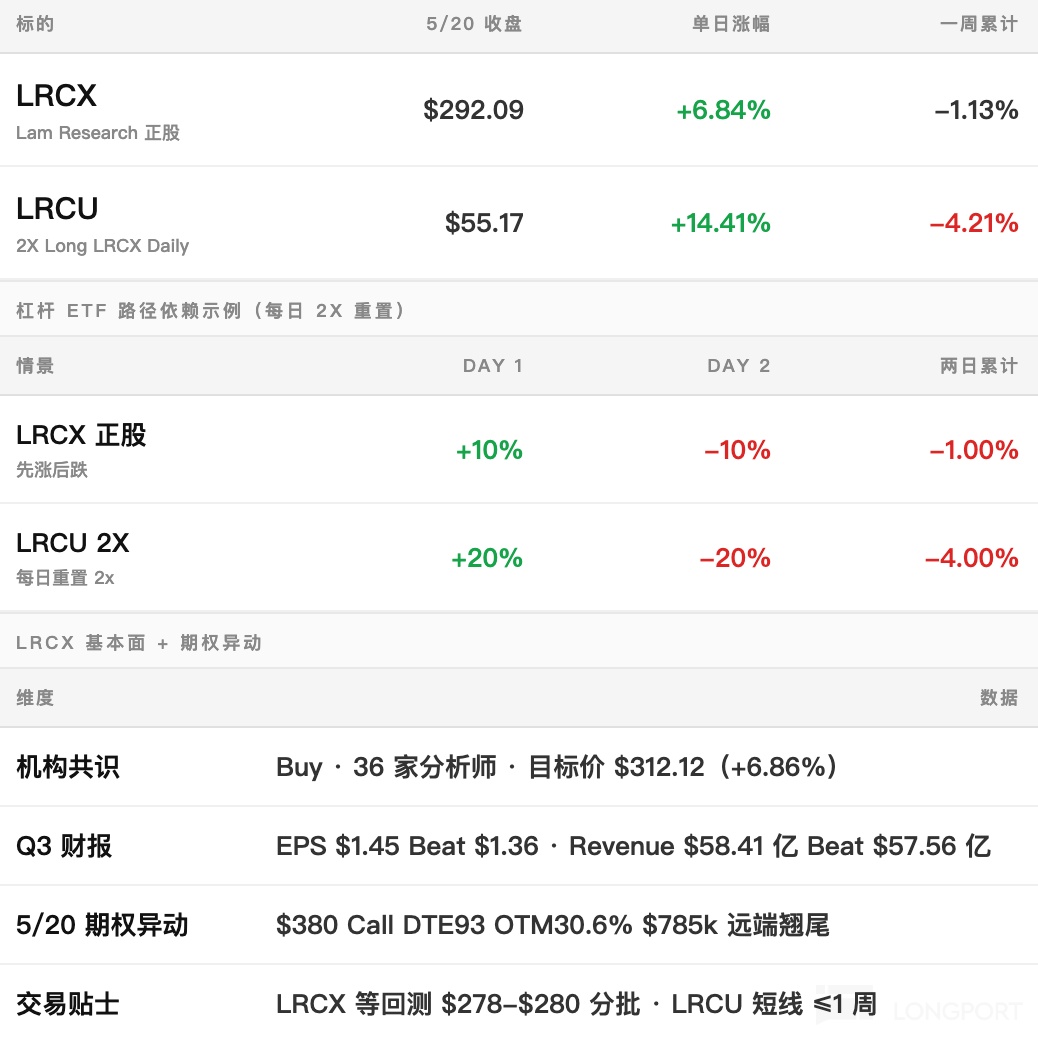
First, let me ask everyone a question — on 5/20, LRCX rose 6.84%, and LRCU rose 14.41%, almost exactly double. If you happened to buy LRCU yesterday, you'd be grinning from ear to ear today. But the question arises: how long can you hold onto a stock that "doubles in a day"?
Let me first explain the background clearly before giving my judgment.
$Lam Research(LRCX.US) is the full name Lam Research. What does it do? To put it simply, it's the "excavator of the semiconductor world" — no matter what chips a wafer fab makes, they have to order a batch of LRCX equipment before building the factory. Specifically, they do three things: etching (carving patterns on wafers), deposition (coating wafers), and cleaning (removing impurities). These three processes are the most expensive and critical steps in chip manufacturing, and only five companies in the world can do them: LRCX, AMAT (Applied Materials), KLAC (KLA), ASML (lithography machines), and TEL (Tokyo Electron).
What does LRCX benefit most from among these five companies?
Two things: HBM (High Bandwidth Memory) for AI + high-aspect-ratio etching for advanced processes. HBM is a concept that Jensen Huang mentions at every launch event. Simply put, it's the memory around the GPU; it needs to be stacked higher and higher to store AI models. High-aspect-ratio etching is a key process for making chips increasingly finer; 2nm/3nm chips can't be made without it. So LRCX is the true "behind-the-scenes miner of the AI computing chain" — NVDA makes money selling chips, while LRCX sells the pickaxes to those who make the chips.
$Tradr 2X Long LRCX Daily ETF(LRCU.US) is what? Its full name is Tradr 2X Long LRCX Daily ETF, a leveraged ETF that goes 2x long on LRCX daily. The word "daily" is key here — it rebalances its holdings after each market close to reset the leverage to 2x. This means it's designed for "today's gain × 2," not "cumulative long-term gain × 2."
Here's an example to make it clear: Suppose LRCX rises 10% on day one and falls 10% on day two, for a cumulative two-day loss of 1% (1.1×0.9=0.99). Because LRCU resets to 2x daily, it rises 20% on day one and falls 20% on day two, for a cumulative two-day loss of 4% (1.2×0.8=0.96). LRCX falls 1%, LRCU falls 4%. The longer the period, the greater the gap. This is the so-called "path dependency loss," also known as "volatility drag." This is why the first page of every leveraged ETF's prospectus states "suitable only for short-term trading."
Back to my judgment on LRCX.
The 6.84% rise on 5/20 wasn't out of thin air. First, the company announced that day the opening of a new lab in Salzburg, Austria, dedicated to "panel-level packaging" — a key node in next-generation chip packaging technology. Second, analysts released an LRCX Overweight report that day, positioning it as the biggest beneficiary in the $149 billion WFE equipment market. Third, the entire semiconductor sector was collectively strong (AMD investing $10B in Taiwan, Citigroup seeing CPU market expansion resonance).
But the trajectory of LRCX falling from $295 to $273 and back to $292 in a week tells me market sentiment is volatile. The median target price from sell-side institutions is $312, only +6.86% above the current price of $292, meaning the risk-reward ratio is no longer attractive. On the options side, I saw a $380 Call DTE93 OTM30.6% $785k long-dated bet that day, but the strike price of $380 is still 30% above the current price — this is a tail-end bet, with institutions using a small amount of money to gamble on a big rebound, not a conviction-heavy bet.
Three trading tips for LRCU:
First, LRCU is a sprint tool, not a marathon tool. Don't hold it for more than a week — beyond that, path dependency loss starts eating into profits. If you're bullish on LRCX for more than a month, buy the stock directly or LRCX Call options; don't use LRCU.
Second, LRCU is suitable for event-driven plays. For example, upcoming earnings reports from AMAT and KLAC next week are event-type catalysts. Buy 2-3 days in advance and close the position immediately after the event — this is the most suitable way to play LRCU.
Third, LRCU has an extremely small float (total shares 600k), with poor liquidity and wide bid-ask spreads. It's recommended not to trade more than 5,000 shares at a time, otherwise you might easily move the price.
I think the bulk of LRCX's +6.84% move has already played out. Chasing it now isn't worthwhile. I suggest waiting for a pullback to the $278-$280 range to buy in batches; as long as it doesn't break below $270, it should be stable. If you want leverage, LRCU is fine for the short term but don't hold it over the weekend. If you plan to hold for more than three months, it's better to buy LRCX stock + some OTM Call options instead of using LRCU.
My judgment is: Bullish on LRCX long-term (the behind-the-scenes king of the AI computing chain), but LRCU is a short-term tool — don't get attached.
The copyright of this article belongs to the original author/organization.
The views expressed herein are solely those of the author and do not reflect the stance of the platform. The content is intended for investment reference purposes only and shall not be considered as investment advice. Please contact us if you have any questions or suggestions regarding the content services provided by the platform.
