

White Dove Online is number one in third-party scenario insurance. Can it compete?

Hello, I'm Lu Xian. I research the investment field and share overseas information.
The previous post shared about [HK Stock IPO] Sinye Microelectronics, the world's number one in PCB lithography equipment, is it worth subscribing to? Today, let's look at a new insurance tech stock - White Dove Online. The company is not an insurance company, but embeds insurance into life scenarios such as travel, logistics, education, and healthcare, earning commissions and service fees from it. Let's break it down simply.
1. IPO Overview
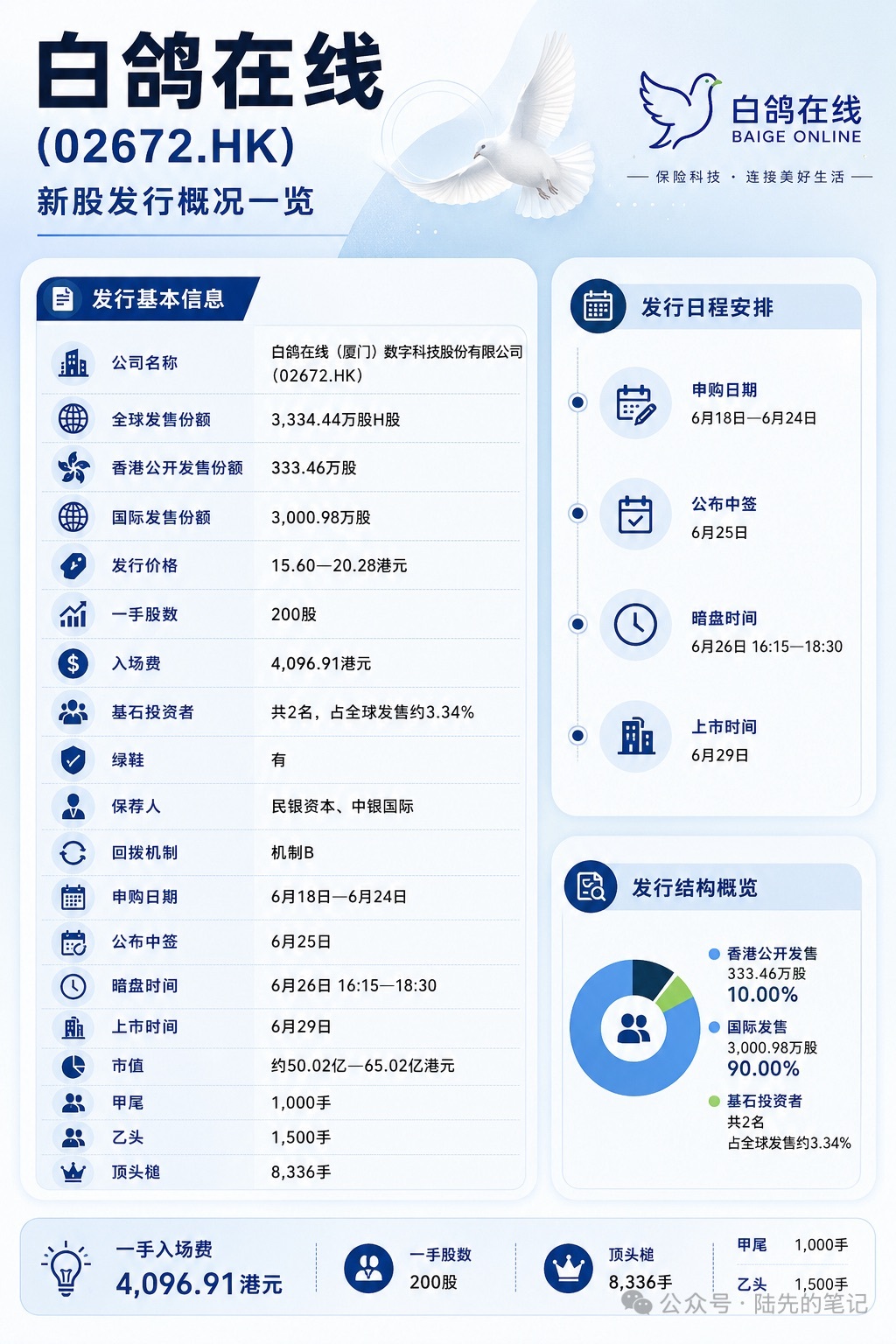
Company Name: White Dove Online (Xiamen) Digital Technology Co., Ltd. (02672.HK)
Global Offering Shares: 33,344,400 H Shares
Hong Kong Public Offering Shares: 3,334,600 shares
International Offering Shares: 30,009,800 shares
Issue Price: HK$15.60—HK$20.28
Board Lot: 200 shares
Minimum Subscription Fee: HK$4,096.91
Cornerstone Investors: 2 in total, accounting for approximately 3.34% of the global offering
Greenshoe: Yes
Sponsors: CMBC Capital, BOCI
Reallocation Mechanism: Mechanism B
Subscription Period: June 18—June 24
Allotment Results Announcement: June 25
Grey Market Trading Time: June 26, 16:15—18:30
Listing Date: June 29
Market Cap: Approximately HK$5.002 billion—HK$6.502 billion
Group A Tail: 1,000 lots
Group B Head: 1,500 lots
Top Hammer: 8,336 lots
2. Company Fundamental Analysis
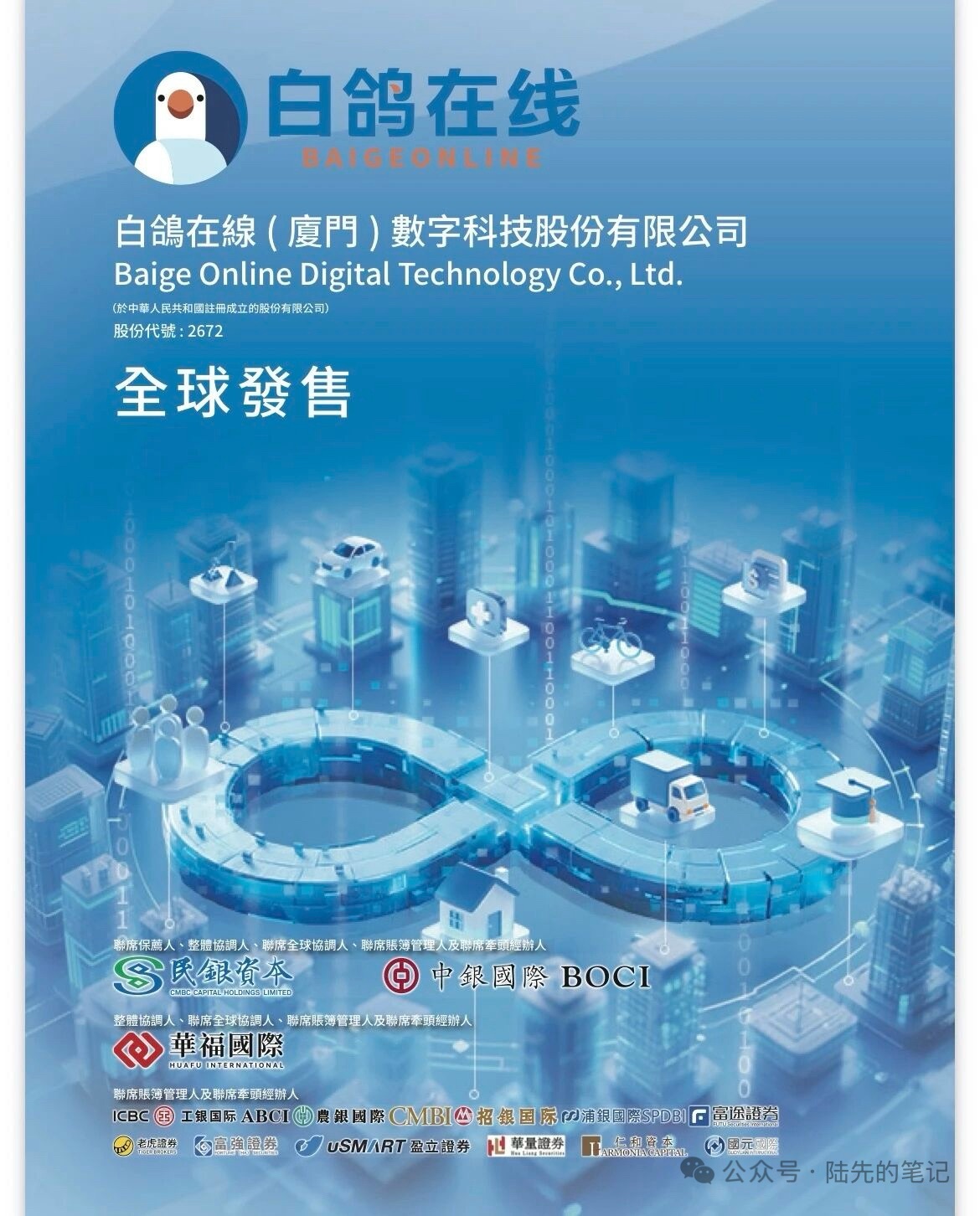
White Dove Online is an insurance technology company that primarily connects insurance companies with various scenario partners. For example, ride-hailing platforms configure accident insurance for passengers, logistics companies purchase cargo insurance, and schools purchase campus activity insurance. The company is responsible for product design, system integration, sales, and claims services, then collects commissions from insurance companies.
The company itself does not underwrite risks; its essence is still an insurance intermediary, just with added digital systems and data analysis capabilities.
The company's business covers nine ecosystems: travel, pan-human resources, inclusive finance, vehicle services, public services, major health and elderly care, education, engineering, and logistics. In 2025, it cooperated with 79 insurance companies and 260 channel partners, cumulatively developing 78 scenarios.
Based on total premiums in 2025, the company ranked twelfth among China's internet insurance intermediaries, fifth among scenario-based internet insurance intermediaries, and first among third-party scenario-based internet insurance intermediaries, with a market share of 3.1%. This "first place" is relatively narrow in scope, and the industry has over 100 participants.
Financially, revenue from 2023 to 2025 was RMB 660 million, RMB 914 million, and RMB 1.227 billion respectively, with a two-year compound growth rate of about 36%.
However, gross margins were only 7.9%, 9.1%, and 8.4%. The company needs to pay a large portion of commissions to channel partners. While the revenue scale appears substantial, the actual retained profit is not high.
Net losses for the three years were RMB 17.18 million, RMB 27.71 million, and RMB 46.67 million respectively; adjusted losses were RMB 13.46 million, RMB 7 million, and RMB 9.32 million respectively. Operating cash flow turned positive to RMB 20.14 million in 2025, but profitability remains unproven.
Another risk is the decline in business data. The number of final insured individuals dropped from 158 million in 2023 to 101 million in 2025, and the number of policies sold dropped from 1.968 billion to 494 million, mainly affected by adjustments in the travel scenario cooperation model.
In terms of valuation, the issue market cap is approximately HK$5 billion to HK$6.5 billion. The company is still losing money. Based on 2025 revenue, the P/S ratio is about 4 to 5 times. For an insurance intermediary with a gross margin of less than 10%, this is not cheap.
Of the funds raised, 44.4% will be used for MaaS model, data, and technology R&D, 20% for acquisitions and investments, 15.6% for sales network expansion, 10% for building an R&D center, and the remaining 10% for working capital.
3. IPO Subscription Analysis and My Action
White Dove Online's highlight is its relatively fast revenue growth and its number one ranking among third-party scenario-based internet insurance intermediaries. In the future, if the MaaS model can truly charge insurance companies, the profit structure may improve.
But its biggest flaw is the low gross margin. Revenue growth hasn't brought profitability; instead, net losses have continued to expand. The significant decline in the number of final insured individuals and policies sold indicates that some traditional traffic scenarios are not stable.
The offering structure is also relatively average. There are only two cornerstone investors, accounting for only about 3.34% of the global offering, which basically doesn't help lock up shares. Although there is a greenshoe, the price stabilization configuration cannot be considered strong.
White Dove Online's main business is internet insurance intermediation. This track already has several similar companies in the Hong Kong stock market, but overall performance has not been ideal, so capital market enthusiasm for this industry is limited.
Furthermore, the company still has a certain gap from the Stock Connect threshold, and there is significant uncertainty about whether it can enter Stock Connect in the future.
My action: I'll pass.
$BAIGE DIGITAL(02672.HK)
The copyright of this article belongs to the original author/organization.
The views expressed herein are solely those of the author and do not reflect the stance of the platform. The content is intended for investment reference purposes only and shall not be considered as investment advice. Please contact us if you have any questions or suggestions regarding the content services provided by the platform.
