

MiniMax management quietly priced their own stock

Recently, the market has been focused on the stock price movement of MiniMax. Many friends have linked the recent trend to the "lock-up expiration period." From a liquidity perspective, this makes sense, as the company unlocked 146 million shares on July 9th, accounting for 46.44% of the total share capital, which has had a noticeable short-term impact on the secondary market.
However, if we look from the perspective of management and the board's mindset, they don't seem too confident about the company's stock price performance within a year.
On July 10th, MiniMax announced a new financing plan, raising a total of HKD 16 billion, including:
1) 35.6 million new Class A shares at a placement price of HKD 268 per share;
2) HKD 6.5 billion in zero-coupon convertible bonds.
Among the above financing methods, raising capital through new share issuance is relatively common. Its advantage is the ability to quickly raise needed funds from the market, with the natural cost being the dilution of EPS and existing shareholders' returns.
Some friends might think that if the company's fundamental business operations improve rapidly due to this capital injection, the potential gain for EPS could outweigh the dilution. Recently, many MiniMax fans have used this reason to be bullish on the company.
At this point, management's conviction is crucial. Let's focus on the convertible bonds.
As bonds combining the three major characteristics of debt, equity, and options, convertible bonds have been favored by domestic and international, especially high-growth companies, for their low cost in recent years.
For investors, the main profit methods for convertible bonds are:
1. Market value premium before and after bond conversion;
2. Hedge funds combining bullish and bearish stock positions to hedge overall investment risk.
In summary, under the consensus that "convertible bonds are call options on the future," a company's early-stage market value management holds significant reference value for investors.
Based on the above information, let's look at the details of this MiniMax convertible bond:
The preliminary conversion price is HKD 335, representing a premium of 12.64% over the closing price on the trading day before the announcement and a premium of 0.58% over the average market price of the five consecutive trading days before the announcement.
Generally, in convertible bond issuances, if a company is in a strong position, it will try to maximize the conversion premium (lowest cost of conversion). Conversely, if it's in a relatively weak position, it will lower the conversion premium. Looking at MiniMax's convertible bond, the conversion price is almost at the average price of the five trading days before issuance, indicating relatively weak pricing power.
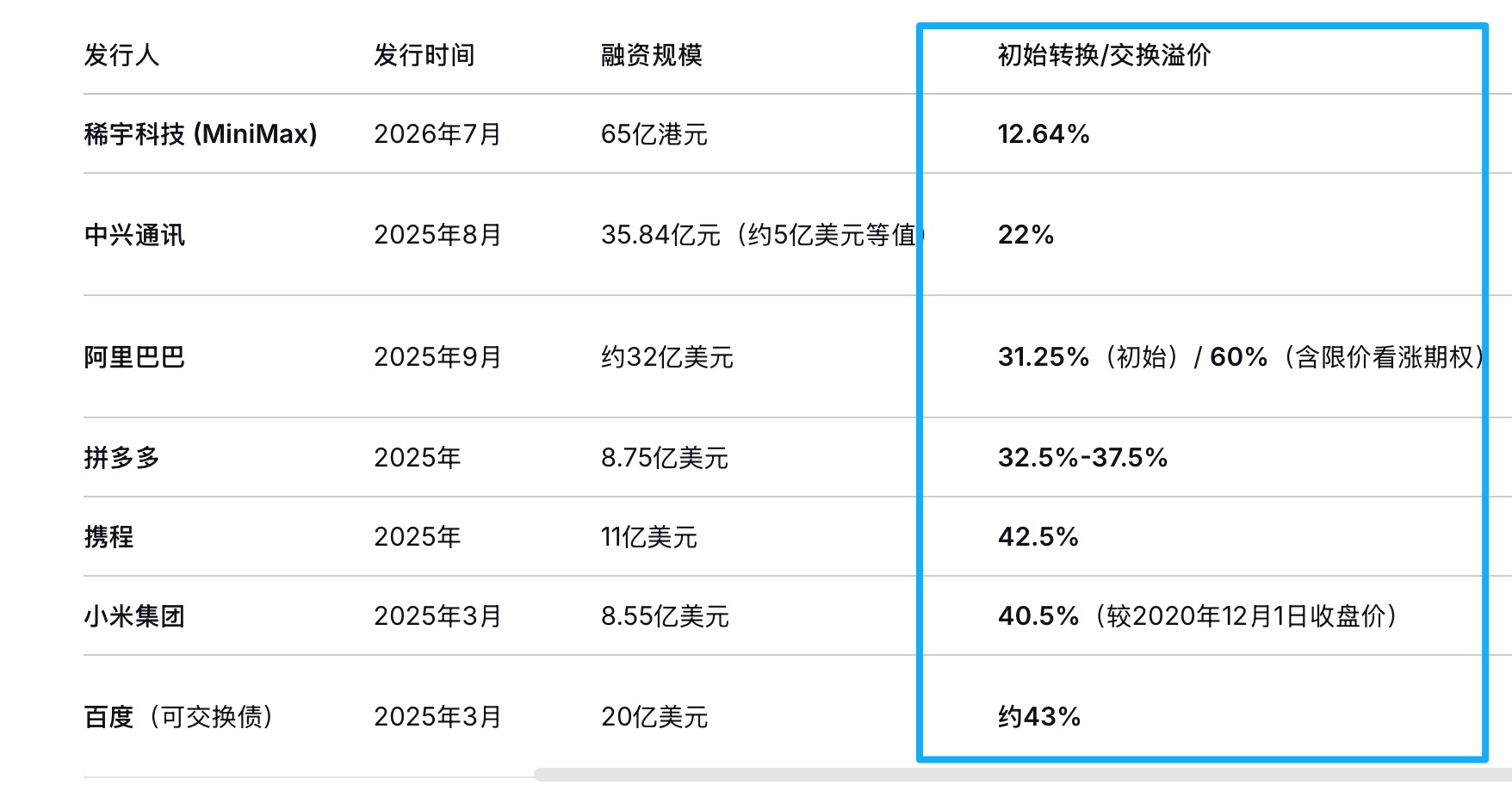
The chart above shows the premium situation of convertible bonds issued by some tech companies recently. Compared to its peers, MiniMax
is clearly at a low level.
Seeing this, many friends might be confused: why do those "old-timer" companies have such high conversion premiums, while MiniMax, a star company in the large model field, seems so ordinary? The main reasons are:
First, although companies like Alibaba and Baidu look old, their core businesses are still generating profits and cash, which is crucial for bond ratings. The bonds are relatively safer, allowing for lower financing costs.
Second, the large model industry has developed to this point. While the sector remains vibrant, it is also in a period of rapid change. For example, the once-dominant OpenAI has been replaced by Anthropic. At this stage, companies are competing not just on technology itself, but also on profitability, cash flow, and capital reserves. MiniMax's urgent fundraising at this time is likely due to these factors, forcing it to raise capital at a high cost. Notably, the placement price of HKD 268 is significantly lower than the conversion price of HKD 335, indicating management's greater eagerness for financing in the short term.
MiniMax's HKD 16 billion financing this time is, in essence, a dual compromise of "selling shares at a discount + issuing bonds at market price." It exposes management's defensive posture under cash flow pressure. The 12% premium given by the market is not a reward for the future, but a pricing of current risks.
$MINIMAX-W(00100.HK)
The copyright of this article belongs to the original author/organization.
The views expressed herein are solely those of the author and do not reflect the stance of the platform. The content is intended for investment reference purposes only and shall not be considered as investment advice. Please contact us if you have any questions or suggestions regarding the content services provided by the platform.
