

 Likes Received
 Posts
PostsLarge buy orders are bottom-fishing SK Hynix, while Puts are targeting Corning.

The South Korean Financial Services Commission's new leverage regulations caused the global storage chain to suffer a single-day sector decline of 7%. On 7/16, there were 177 unusual trades across the board, with a long-to-short ratio of 3.6:1, and longs burned $155.63M—the order book on this crash day not only didn't turn bearish, but instead saw two massive late-session super long positions. My overall judgment: This round is a leveraged position clearance, not a fundamental disproof, but those catching falling knives have chosen extremely aggressive exercise prices, leaving less room for copy-trading than it appears.
━━━━━━
$SK Hynix(SKHY.US)
Direction: Bullish 🟢
Expiration: 2026-09-18 (Call main leg)
Strike Price: $200
Notional Size: Approx. $56.7 million (plus approx. $1.22 million collected from selling $80 Put in the early session)
Volume: 35,000 contracts (Call leg) + 12,876 contracts (Sell Put leg)
Structure Type: Risk Reversal (Two legs executed at different times: Selling deep out-of-the-money Put in the early session + Buying massive volume of Call in the late session)
Data Highlights: A stampede day where the underlying stock closed down -13.7% at $152.31. At 15:16 in the late session, a single $56.7M purchase of September $200 Calls set the record for the largest trade of the day. The strike price is 28.5% higher than the current price. Coupled with the sale of 12,876 $80 Puts in the early session, the combined bias of both legs leans bullish by nearly $58M.
Bullish Viewpoint Comparison: Barclays initiated coverage on 7/14 with an Overweight rating and a $330 target, predicting a doubling in one year; Meritz stated "now is not the time to sell," and SK Group Chairman Choi Tae-won personally stepped in to support the market. The bearish side relies on JPM's hard data—the AUM of storage leveraged ETFs has shrunk by 34% since its peak in June, and since these products' scale is roughly three times that of the underlying stock's market cap, the negative feedback loop of deleveraging is not yet complete.
My Viewpoint: In just its 5th day of listing, the stock went through a rollercoaster from +27% to -14%. This Call bet is on "after the leveraged positions are cleared, HBM4 fundamentals will retake pricing power." I accept the logic, but not the entry point. By pre-market on 7/17, it had already broken below the $150 issue price, and the premium convergence in Korea hasn't finished either. I am not following the $200 strike price; if I truly wanted to express a bullish view, I would rather mimic its early session leg—selling Puts at a level like $80 where a drop is unlikely to collect rent, treating the stampede as a source of income.

━━━━━━
$Corning(GLW.US)
Direction: Bearish 🔴
Expiration: 2026-07-24 / 2026-09-18 / 2026-11-20 (Three tiers)
Strike Prices: $143 / $130 / $110
Notional Size: Total approx. $6.01 million (largest short position of the day)
Volume: 1,998 / 2,556 / 2,531 contracts
Structure Type: Stepped Put Build-up [Three Legs] (Complete strategy by the same institution within approx. one hour)
Data Highlights: Within one hour from 12:56 to 14:04, purchases were made progressively across three strike prices paired with three expiration dates. The timing coincided exactly with the window when the JPM report leaked. The underlying stock fell -9.2% on the day to close at $158.39, having already retraced 38% from its historical high of $255.69 on 6/29.
Bullish Viewpoint Comparison: JPM added Corning to its "Negative Catalyst Watch" list before earnings—not due to performance, but because the expected PE for 2028 exceeds 30x, and the optical communication business implies approx. 40x, allowing "almost zero margin for error." The rating remains Neutral with a $200 target; Passage Research directly downgraded from Buy to Sell this month. Q2 earnings will be released pre-market on 7/28, with consensus EPS at $0.75 and revenue at $4.63 billion.
My Viewpoint: Note that the first leg expires on 7/24, right before earnings. This structure isn't betting on an earnings bomb, but rather that valuations will continue to be crushed before earnings, with the latter two legs covering the earnings report and the weakening TV panel market in the second half of the year. Stocks that have doubled this year are considered too expensive even by JPM, which gives them a neutral rating. I won't catch falling knives at this level; these three legs represent a systematic short position, not an insurance policy. I treat this as a wind vane for the entire optical module chain and will step aside for the short term.

━━━━━━
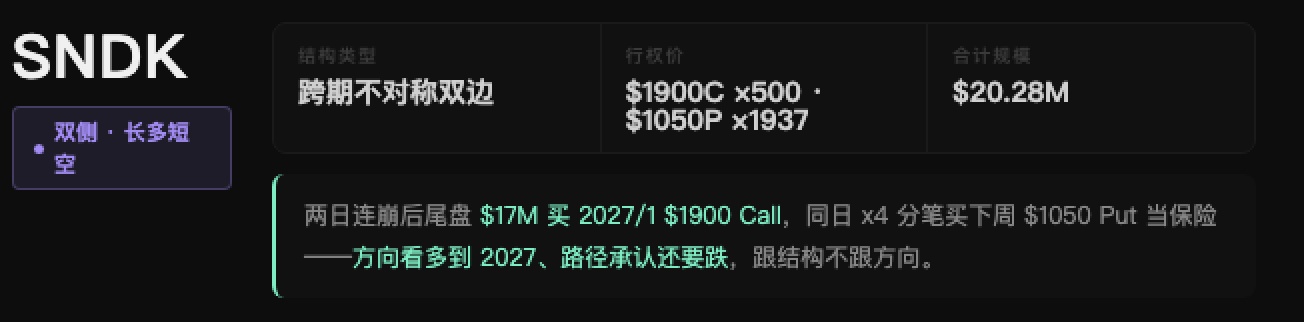
$Sandisk(SNDK.US)
Direction: Two-sided (Long-term Long, Short-term Short) 🔵
Expiration: 2027-01-15 (Call) / 2026-07-24 (Put)
Strike Prices: $1,900 / $1,050
Notional Size: Call approx. $17 million + Put approx. $3.28 million
Volume: 500 contracts / 1,937 contracts (split into 4 orders)
Structure Type: Asymmetric Calendar Spread (Heavy position in far-month deep out-of-the-money Call + Short-term deep out-of-the-money Put as insurance)
Data Highlights: After two consecutive days of crashes (-8.1%, -12.6%) closing at $1411, a single $17M buy order entered 2027 January $1900 Calls at 15:40 in the late session. On the same day, someone bought next week's $1050 Puts in four separate orders—that strike price is 25% lower than the current price.
Bullish Viewpoint Comparison: Wall Street consensus remains Strong Buy for SanDisk, but TipRanks investor Gary Alexander downgraded it to Sell on 7/16, citing higher exposure to slowing demand from hyperscale cloud vendors and overextended valuation. At the sector level, the ITC 337 investigation, South Korean interest rate hikes, and prosecutorial raids investigating price manipulation are releasing headwinds simultaneously.
My Viewpoint: Directionally bullish until 2027, but acknowledging the path still involves further declines. The massive Put positions on 6/24 were blown up by an earnings-driven surge; this time, institutions have learned their lesson, changing the short leg into insurance for their own long positions. I follow their structure, not their direction: Those holding physical storage should mimic them by adding a layer of short-term Puts; those with empty positions shouldn't rush to bottom-fish. The buyers themselves are using $1050 Puts to tell you they don't believe the decline is over.
━━━━━━
The copyright of this article belongs to the original author/organization.
The views expressed herein are solely those of the author and do not reflect the stance of the platform. The content is intended for investment reference purposes only and shall not be considered as investment advice. Please contact us if you have any questions or suggestions regarding the content services provided by the platform.
