

Agents are exploding in popularity, but the "main event" for AI hasn't even started yet.

The hottest WAIC of July has concluded, leaving behind a sense of regret for the "kings not meeting kings" scenario.
ByteDance and Doubao, as well as DeepSeek, still did not exhibit. Zhipu, being in a quiet period before its IPO, also proactively reduced its voice.
Meanwhile, the standout performers on stage danced with vigor: instead of discussing large model parameters, they focused on outputting Agent implementation capabilities.
Baidu, Tencent, and Alibaba faced each other head-on, engaging in the ecosystem strategies that big tech firms excel at; yet the "Five Little Dragons" of large models deliberately avoided direct confrontation, each setting up their own stage to perform their own plays.
Especially Moonshot AI (Yue Zhi An Mian). Their booth only had a screen looping model demonstration videos, with the main content of the booth being Xiaohongshu check-in lucky draws. One of the prizes was Tokens, valid until the end of July.
It is reasonable to suspect that Moonshot AI simply wanted to boost its presence and, taking advantage of the expo's heat, pull in new users for Kimi. After all, their model confidence is very strong.
The concurrently released Kimi K3 had already ignited the AI circle, prompting even Musk to praise it and inadvertently delivering a blow to Zhipu's stock price.
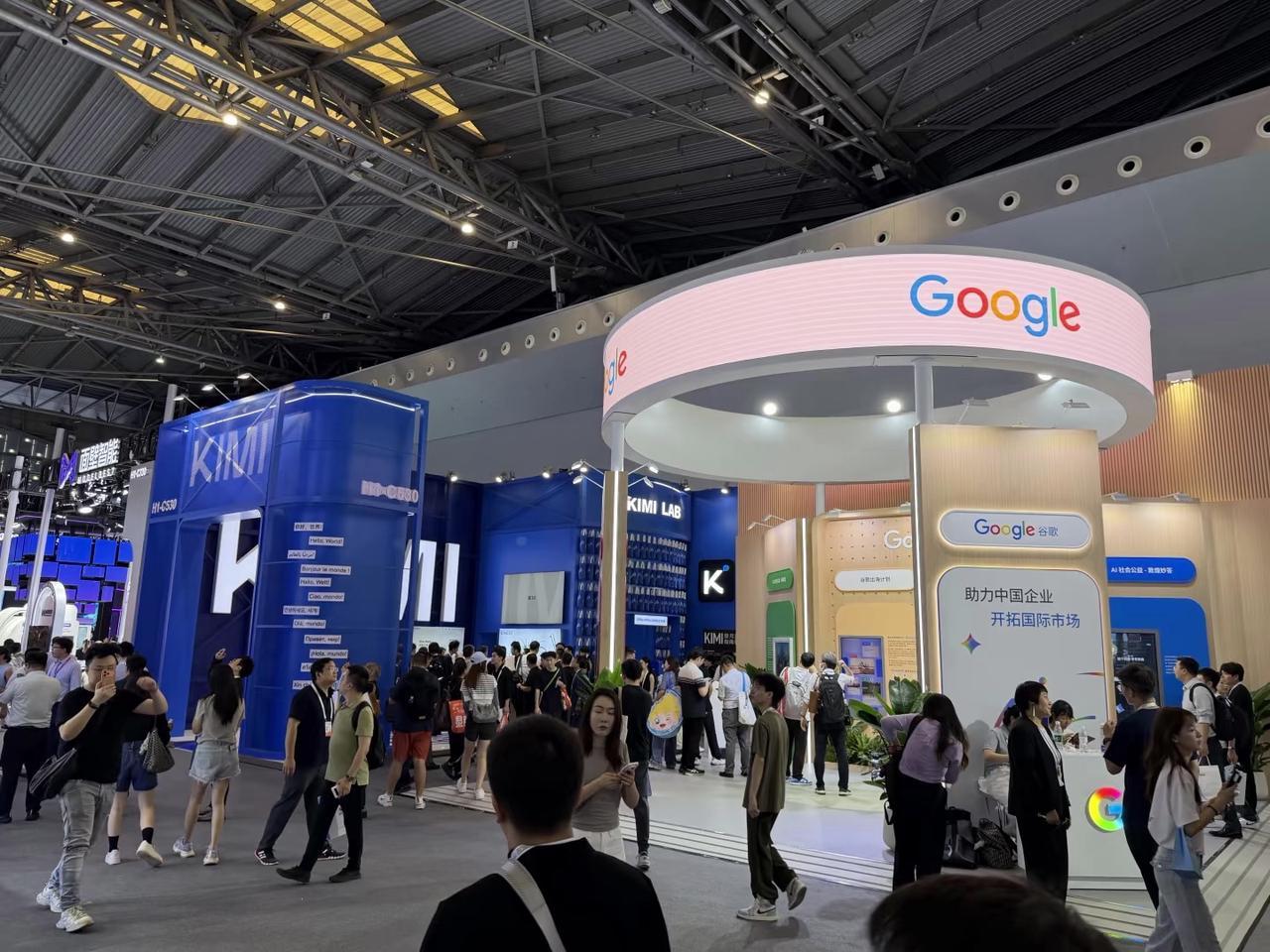
Opposite Moonshot AI, a rare international exhibitor—Google's booth—also lacked any sign of Gemini. The theme focused on AI social welfare, overseas expansion plans, and emotional clouds, acting like a breath of fresh air in the hall.
How to describe it? It feels somewhat like the consistent relaxation of a master. After all, the expo is merely a display window; if product performance and technical standards are in place, the market will naturally vindicate them.
Just like DeepSeek, which traditionally "does not participate or exhibit," its name has long been embedded into dozens of third-party booths, omnipresent.
At the 2026 WAIC, FOMO emotions still permeated, and debates over consensus and divergence remained noisy, but the players seemed less confused. Each company had its own scale in mind, roughly knowing where the direction lay and how to proceed.
1. Office Agents: The "Super Entry Point" Contested by Big Tech
The consensus formed at last year's WAIC was still "everything can be an Agent." This year, there are clear goals regarding where and how Agents should operate.
Enterprise office Agents have become the super entry point targeted by big tech firms.
After model capabilities converge, whoever becomes the "first stop" after users open their computers first will master the new traffic distribution rights and ecological dominance in the AI era.
But it must be mentioned that big tech companies' product thinking is indeed delicate.
Although the previous "raising lobsters" craze went viral, it mainly affected programmers, with thresholds for installation and uninstallation. Now, big tech firms have aggregated and packaged complex Claw product lines, translating programming language into consumer-facing terminology, creating apps usable by ordinary users with zero threshold.
Tencent's booth promoted "WorkBuddy" to everyone, allowing one-click download and one-click installation.
As of July 2026, its monthly active users exceeded 20 million, and daily active users exceeded 13 million, making it the office efficiency agent with the highest DAU in China.
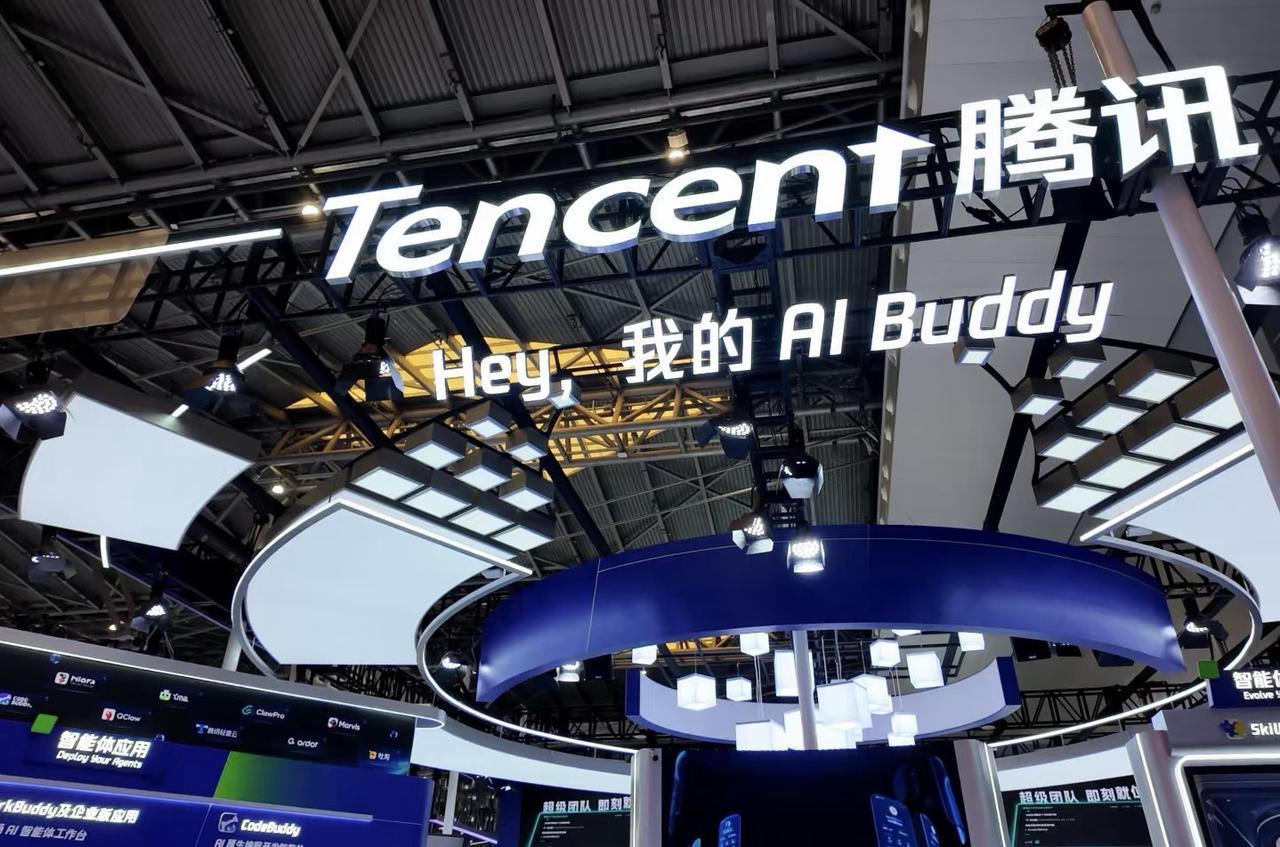
WorkBuddy focuses on open compatibility, built-in over 20 official skill packs, and supports free switching among five major mainstream models such as Hunyuan, DeepSeek, GLM, Kimi, and MiniMax. It can seamlessly integrate with office platforms like WeChat Work, Feishu, and DingTalk. Functions include automatic email replies, data analysis, meeting minutes, report organization, PPT generation, and other common office needs, covering thousands of industries.
A practical highlight is direct WeChat connection. Users can scan a code to remotely control the PC version of WorkBuddy to execute tasks,打通 ing this ecosystem entry point. WorkBuddy is almost indistinguishable from a "digital workhorse" available on call.
Previously, in a conversation between Timothy Tong and Yao Shunyu, when faced with the question "Is Tencent AI slow?", their viewpoint was: models will iterate, demands are changing, and new product forms will continuously emerge. WorkBuddy seizing the Agent wave perfectly serves as a footnote to this judgment.
Baidu's "partner" launched slightly later but moved extremely fast. At this WAIC, it also secured a "treasure of the pavilion" status.
The highlights lie in visualization and high efficiency. It can operate a computer like a human, allowing users to visually see the entire process of opening web pages, clicking, scrolling, and organizing information. Its self-developed "Intelligent Routing" technology automatically selects the optimal execution path (local or cloud), reducing average task time by 20% and improving Token utilization by 25%.
The partner is fully integrated with Baidu's internal ecosystem, including search, encyclopedia, library, maps, and other proprietary products. It also launched the industry's first fully automated Skill launch process, such as a college application assistant Skill and a professional suite for self-media, covering the full chain of topic selection, creation, and review, and integrating exclusive capabilities like Baidu's One-Lens Digital Human broadcasting.
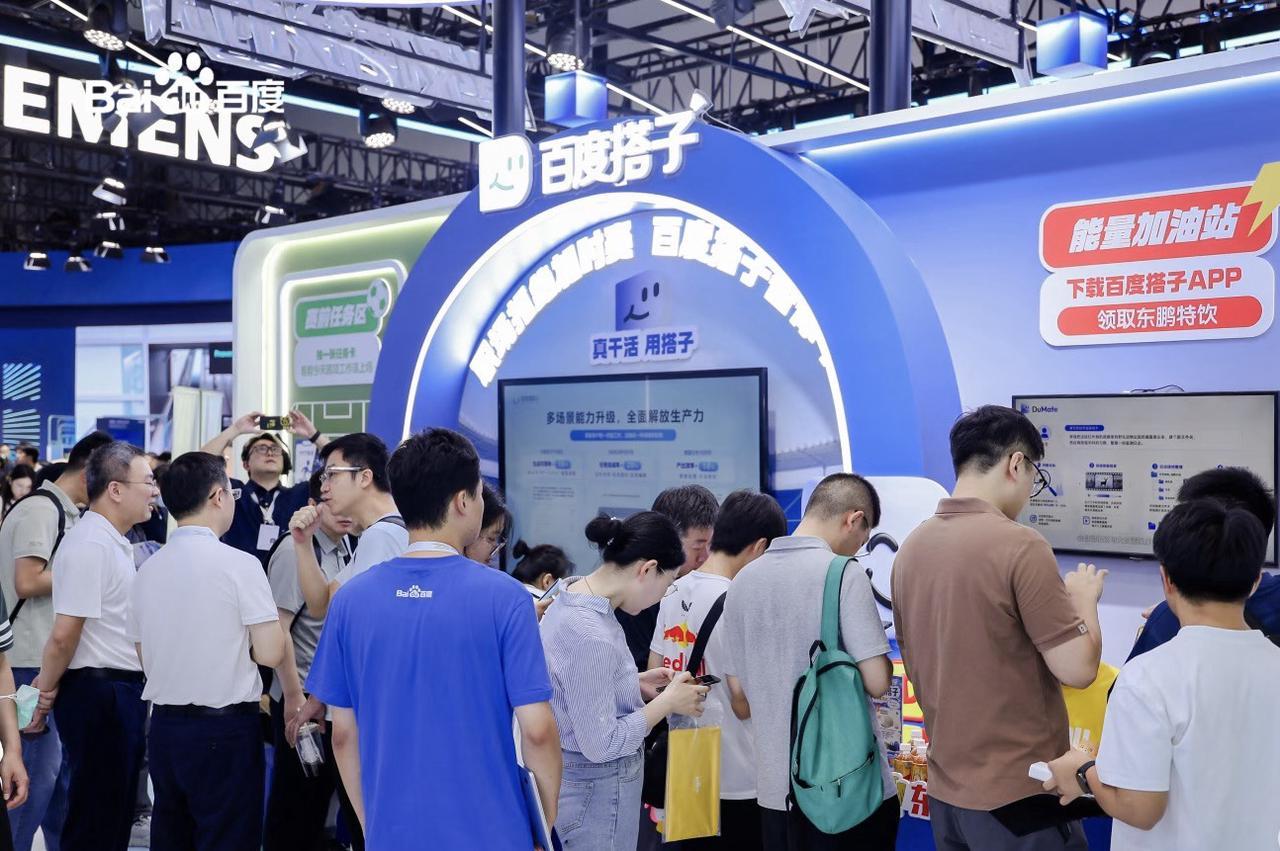
Baidu's strongest presence in the AI industry this year comes from Robin Li's proposed DAA (Daily Active Agents) metric, which measures how many agents truly work for humans and deliver results every day. Shifting from a cost perspective to an output perspective, Baidu's partner is undoubtedly the core executor of this tactical path.
Notably, Baidu also revealed its "family assets": Tianchi 2.0 Super Nodes. Through Kunlun Chips and Tianchi Super Nodes, it builds full-stack self-research capabilities from chips to systems.
Another player showcasing computing power "muscles" is Alibaba, bringing the Zhenwu M890 x Panjiu AL128 Super Node to the site and winning the conference's "Treasure of the Pavilion."
Relying on the super node, Alibaba also completed a full-stack Agent upgrade of "Chip-Cloud-Model-Inference" and, based on this, launched "Qwen Office", integrating three mature products: QoderWork (coding capability), Wukong (DingTalk scenarios), and MuleRun (execution capability), deeply binding DingTalk's enterprise relationship chains, organizational structures, and approval flows.
Currently still in gray-scale testing, it is a latecomer in the market.
Notably, unlike Tencent's WorkBuddy and Baidu's partner 抢占 ing the desktop from software entry points, Qwen Office goes further, extending the capability entry point to "Wuying" Cloud PCs, Qwen AI glasses/headsets, and other hardware terminals.
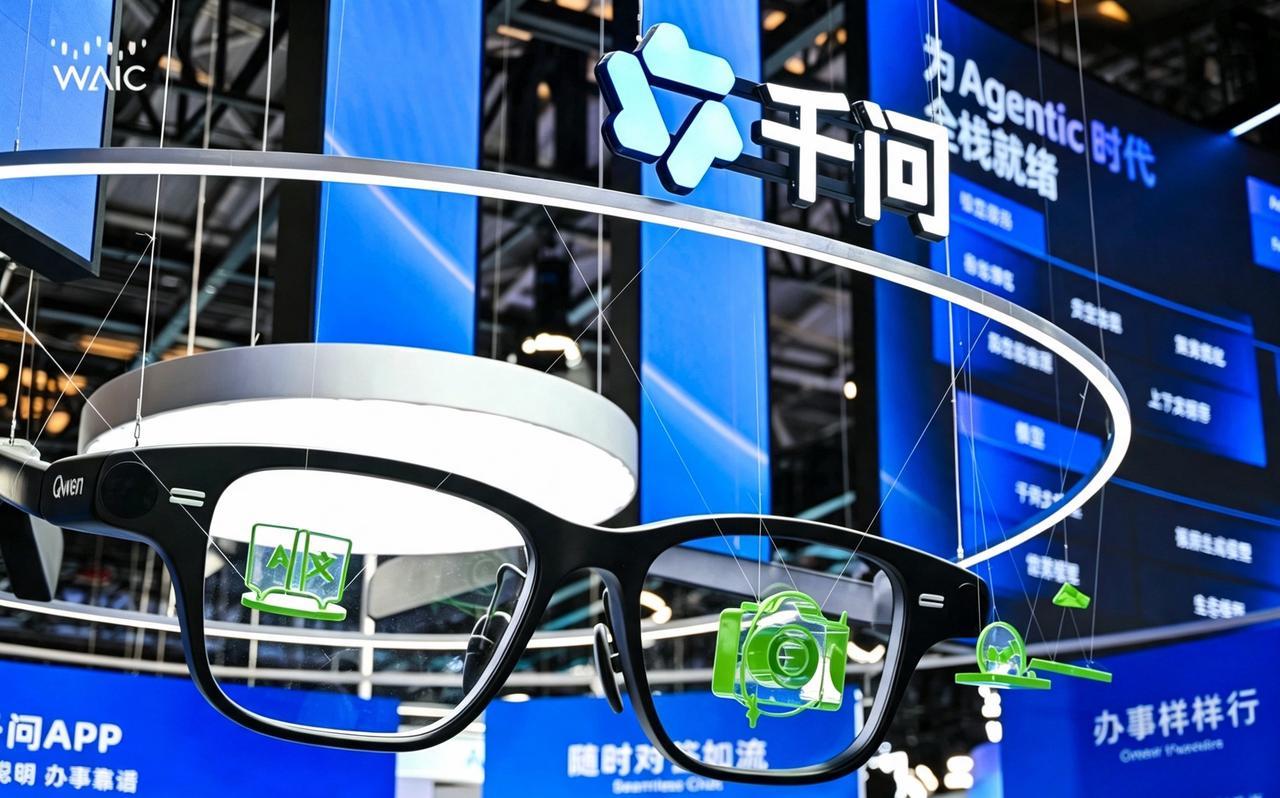
The differences among the three products essentially reflect the extension of the strategic paths of the three giants:
- Alibaba Qwen Office: Plays the role of an "integrator," connecting DingTalk's internal scenarios with external hardware entry points to create a super office platform.
- Baidu Partner: Plays the role of a "doer," efficiently converting search intent into task outcomes, serving as the most execution-savvy productivity tool.
- Tencent WorkBuddy: Plays the role of a "collaborator," transforming WeChat's collaboration advantages into AI execution power, integrating into workflows.
Each company relies on past ecological layouts, having their own foundations and cards. The entrance positioning battle for enterprise Agents has just entered the stage of masters sparring.
2. Large Model Players Show "Tacit Understanding" in Path Differentiation
If last year's large model players were still hesitating at the same starting line, wondering whether to wade into the muddy waters of the "Hundred Models War."
This year, each decided to walk their own path.
StepFun is the traffic center of this WAIC. It rarely gathered three terminals—mobile phones, cars, and embodied intelligence—at the same booth, attempting to break away from the single role of "model provider" and deeply transform into an AI hardware-software integrated solution provider.
The C-position of the booth is the world's first large model native intelligent phone, STEPX Neo. Although the real machine only appeared in the form of an operation demo, its design logic has been completely reconstructed: the main interface is the dialogue window of the personal agent Amoo, rather than the traditional multi-APP grid layout.
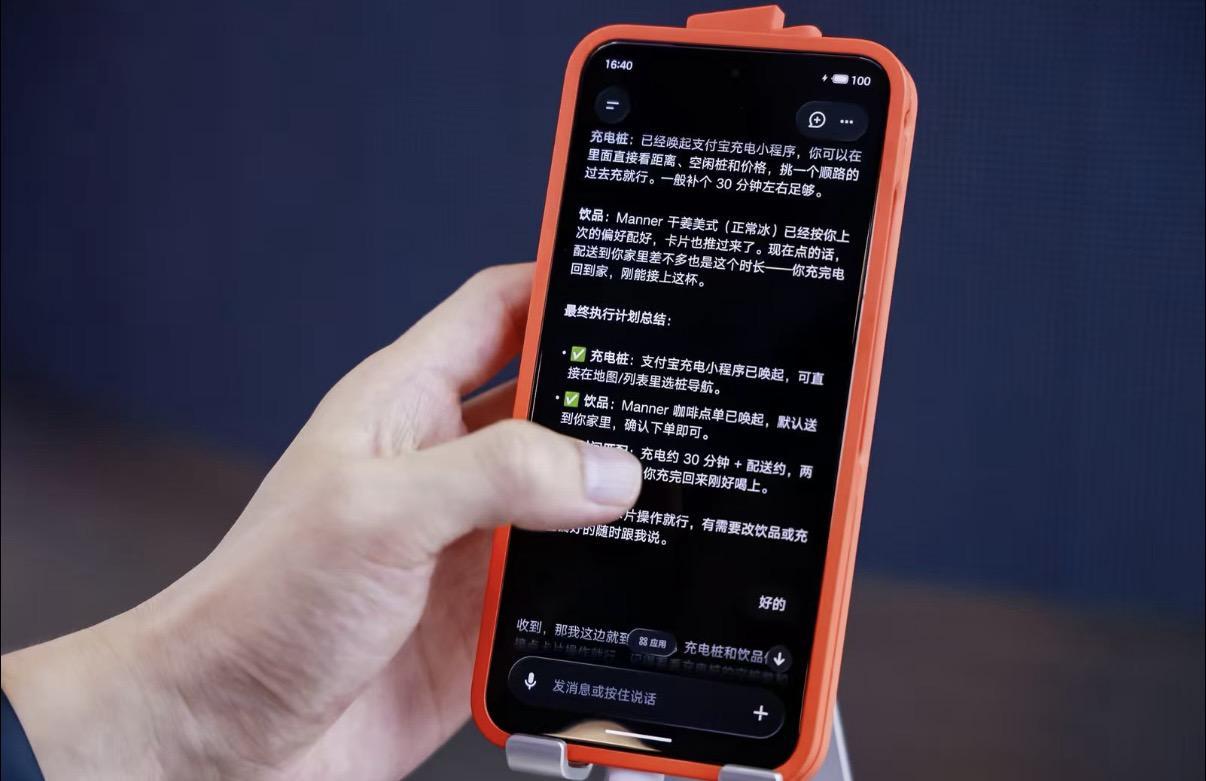
It can understand natural language commands, automatically completing complex cross-APP and cross-terminal tasks such as flight and hotel bookings, payments, photo album organization, video generation, and desktop document classification. It is the most complete demonstration sample of edge-side agent implementation.
If StepFun focuses on terminals, MiniMax advocates building a full ecosystem. It centrally displayed its flagship model MiniMax M3 and preheated the next-generation multimodal generative model H3. Through cases with robot dogs, AI glasses, smart headphones, financial services, and other extensive ecosystem partners, it demonstrated the implementation practices of its AI from underlying models to specific applications.
Wallbox Intelligence is a firm practitioner of the edge-side AI route. Its strategy is to provide the "brain" for others, rather than making the "body" itself. Its proposed "Density Law" states that model intelligence density doubles approximately every 3.5 months, emphasizing achieving equivalent intelligence with smaller parameters to solve the power consumption and performance bottlenecks of edge devices.
Currently, Wallbox has formed three core scenarios: consumer electronics, automobiles, and industry, with multi-point scaled implementation. Its edge-side model has officially entered Samsung's flagship mobile phone supply chain. In the automotive field, it is equipped in multiple mass-produced models such as Changan Mazda EZ-60, Geely Galaxy M9, and SAIC Volkswagen ID.ERA 9X. During the exhibition, Wallbox jointly released the Embodied Intelligence Framework RoboHarness with Geely's Artificial Intelligence Center, marking that the cooperation between the two parties has extended from smart cockpits to factory production and warehousing scenarios.
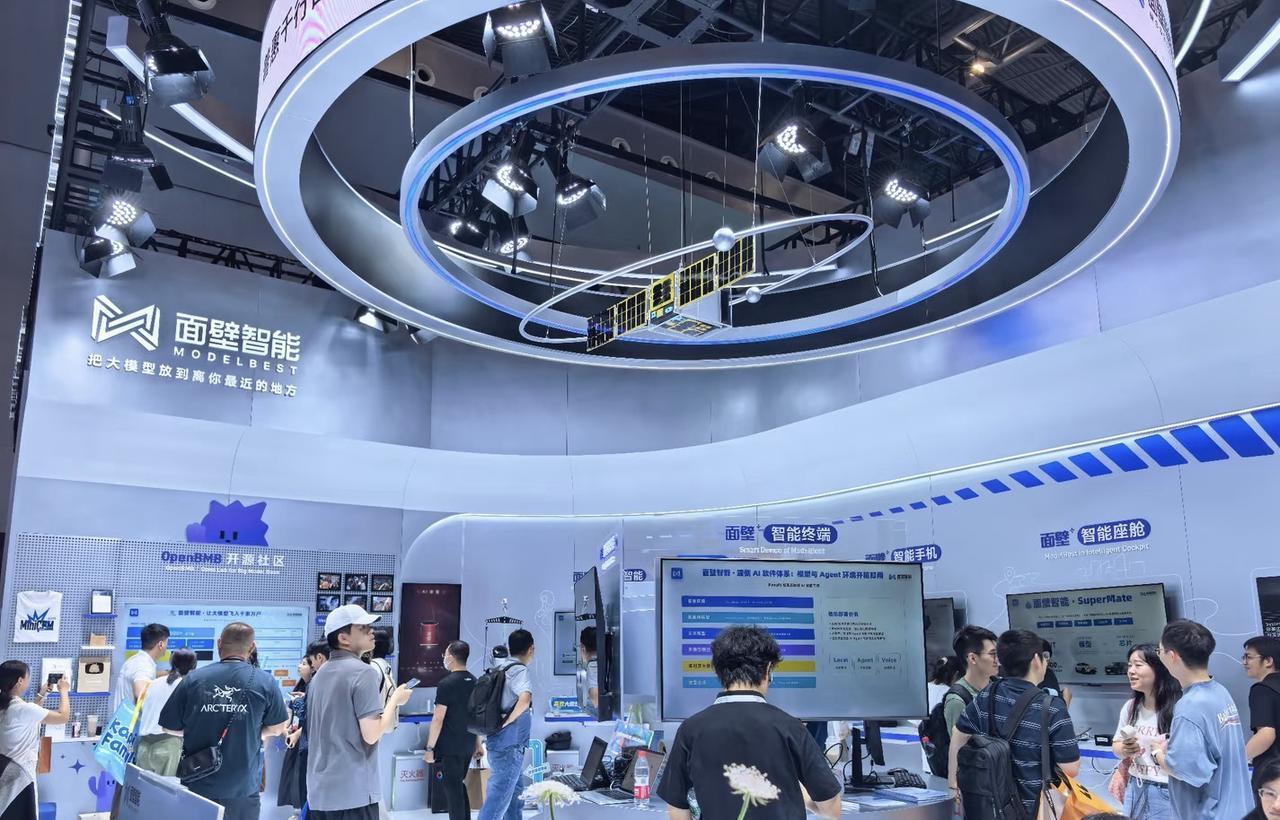
Lingyi Wanwu and Baichuan Intelligence exhibited for the first time, both abandoning the arms race of general models and turning All in vertical tracks.
The former was endorsed by founder Kai-Fu Lee, focusing mainly on To-B enterprise-level AI services, positioned as building a "Chinese Palantir". The exhibition launched the "Number One Position Decision AI" series. Unlike other Agents emphasizing office scenarios, Kai-Fu Lee believes enterprises should use Agents to assist in the key decision-making stages of top management, and held a press conference for his new book "AI Future Is Here" during the exhibition.
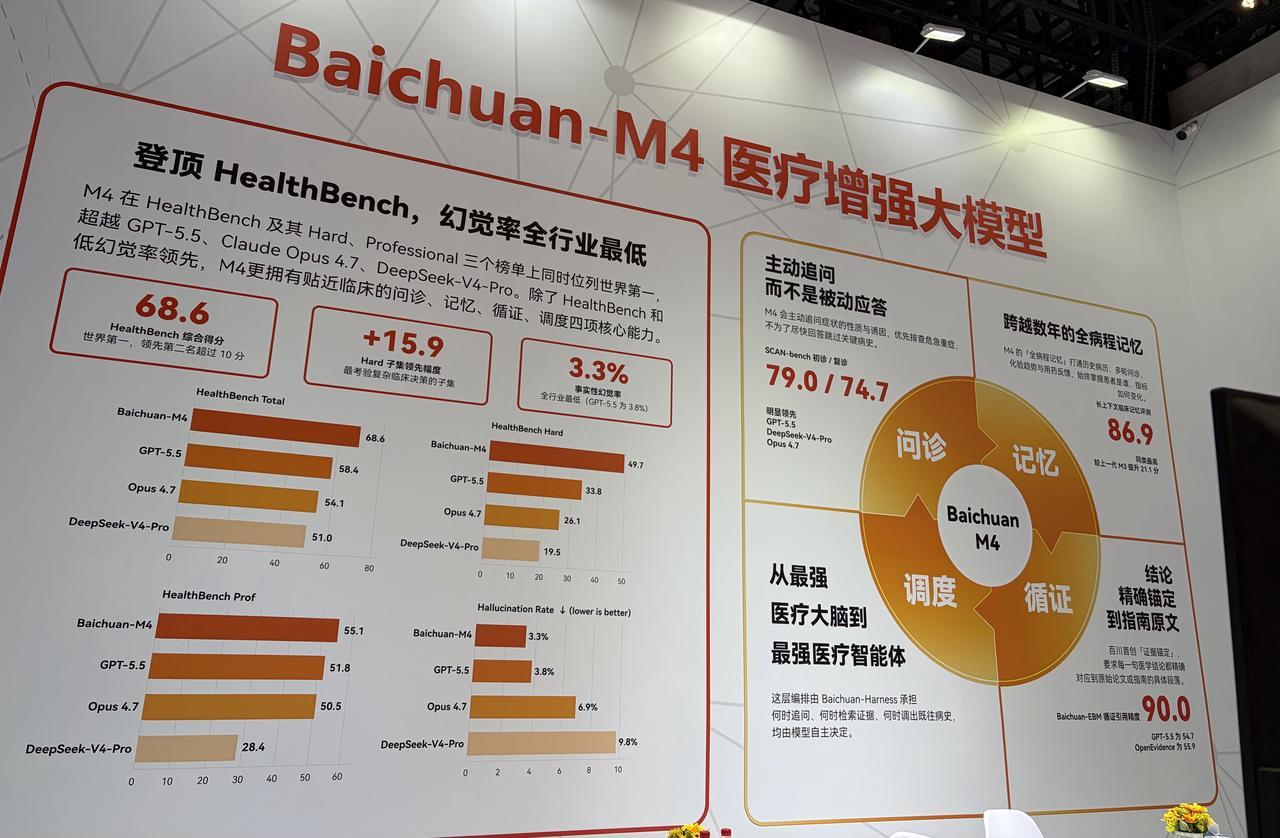
The latter has deepened its cultivation in the medical field. Baichuan this time heavily showcased the medical large model Baichuan-M4. The model scored first in the world on the authoritative medical evaluation HealthBench, and its factual hallucination rate was only 3.3%, the lowest in the industry.
Notably, Baichuan recently launched the APP "Bai Xiao Yi." It collided with Ant Group's A Fu Lai, which also focuses on the AI medical track and has rapid dissemination. However, Ant A Fu Lai's positioning is more like an "AI health friend," while "Bai Xiao Yi" is more like an "AI family doctor."
It is reported that Baichuan has been focusing on self-developed medical vertical large models and has cooperated with top institutions such as the National Cancer Center and Beijing Children's Hospital, conducting validation in real clinical scenarios such as oncology and pediatrics.
Although the routes differ, the large model players are highly consistent in three underlying logics:
First, parameter involution has completely ended.
No company uses "hundreds of billions/trillions of parameters" as the core selling point of their booth anymore. Everyone tacitly recognizes that models that purely stack parameters without application scenarios are meaningless. Even Moonshot AI, which released the 2.8 trillion parameter K3, focused its external promotion on "top coding ability" and "open source ecosystem".
Second, "All in Applications" has become the core way out.
All companies have reached a consensus that large models must "move from virtual to reality." Whether doing hardware (StepFun), edge-side (Wallbox), medical (Baichuan), or enterprise services (Lingyi), models that cannot find paying scenarios are liabilities. This consensus is extremely unified.
Third, abandoning the illusion of a "Grand Unified" model.
Few people try to solve all problems with one model anymore. Everyone admits that the future world is a world of "model matrices" or "models + external tools." Base models, vertical models, and edge-side models will coexist for a long time.
The intersection of individual differences and collective consensus precisely proves that China's AI large model industry is undergoing a great divergence in adolescence.
Irrespective of right or wrong, essentially everyone is "crossing the river by feeling the stones," with no standard answer.
3. From Usable to Excellent: There is Still a Long Way to Go for Agents
Having gone through nine editions, WAIC's evolution is exactly a microcosm of the AI industry moving from technology to commerce.
In the first stage, the AI industry was still focusing on breakthroughs in single-point technologies such as computer vision and speech recognition;
the second stage entered the "Hundred Models War," where parameter scale and ranking became the yardsticks for measuring AI.
Now, in the current third stage, the trend has completely changed.
The industry no longer discusses models in isolation but asks how they link with the physical world and generate value.
From the close combat of big tech to the diverging paths of large model players, the business of AI seems large enough for everyone to find a sufficiently self-consistent strategic route.
Just like on this consensus route of Agents, some take the "large and comprehensive" open ecosystem route, attempting to connect everything to define new entry points; while others do "small and refined" dedicated deployments to solve specific enterprise pain points.
However, whether this business can be successfully built remains to be seen.
Cold water still needs to be poured.
As Turing Award winner Richard Sutton said in his speech at WAIC, the essence of AI is still weak and unreliable. The industry generally confuses intelligence with computation. The breakthroughs achieved so far are more a reflection of computational power than a true leap in intelligence.
Aligning this with the viewpoints from Liang Wenfeng's recent investor meeting, there is a hint of similarity.
Liang Wenfeng compares the path to realizing AGI to climbing stairs, with a clear roadmap:
- Chain of Thought. Last year's breakthrough taught models how to "think" and reason more deeply;
- Agents. This year's focus gives models the "hands and feet" ability to execute complex tasks and call tools;
- Continuous Learning. This is the next problem that must be conquered.
Sutton believes AI must move from the "Human Data Era" to the "Experience Era," acquiring first-person experience through continuous interaction with the real world.
Liang Wenfeng's talk of "continuous learning" is precisely the key springboard to achieve this leap, making models no longer just repeaters of static knowledge, but agents that can constantly trial-and-error, accumulate, and evolve in dynamic environments.
That is to say, although the current pursuit of agents has found clear commercial value in scenarios, there is still a long distance from usable to excellent.
Today's Agents can help you book flights and write code, but can they summarize experiences on their own tomorrow? Can they evolve through repeated interactions with users? These remain questions.
Moreover, homogenized Agent capabilities are everywhere at this exhibition. The public watches every Demo demonstration with high expectations, hearing speakers explain "what it can do" extensively, but few can clearly explain the underlying technical paths, and no one answers, why the market should pay for this in the long run and on what basis.
It can only be said that most players at WAIC are still in the "showing off muscles" stage, treating visions on PPTs as delivered results and treating the smoothness of Demos as commercial maturity.
At this node, Li Wenfeng and DeepSeek's restraint is indeed rare and precious.
DeepSeek knows clearly how this road should be walked. It voluntarily gives up substantial profits, abandons popular tracks like 3D generation and video generation, and bets all resources on the technical main line of AGI.
The more one sees direction amidst the noise, the more one needs to hold boundaries in front of temptations.
For other players, the aspect worth learning from is not "whether to follow the same path as DeepSeek," but two points:
First, identifying where your "main line" is. In this long-distance race of AI, what is your core track, and what are the distractions that seem lively but are irrelevant to the endgame. Thinking clearly about "what not to do" is more important than rushing to decide "what to do."
Second, maintaining patience for the technological endgame. AI is far from mature. At this stage, using the anxiety of short-term commercial returns to overdraw long-term technological accumulation may be the most expensive shortsightedness.
Just like the popularity of this WAIC, although visitor numbers in the exhibition halls hit historical peaks, technology displays, business cooperation, and capital matchmaking occur in every corner. Entrepreneurs look for new scenarios for technology implementation, practitioners seek the next wind vane, and investors fear missing the next new target.
However, how much is market heat boosted by investment sentiment, how much is a technical concept hyped externally, and how much is a commercial route that can truly be persisted in the long term?
It seems that the AI industry has entered an economic upcycle, but it still has a considerable distance to go towards true maturity and inclusiveness.
After the concepts are heated up, perhaps everyone can be more pragmatic to go further.
The copyright of this article belongs to the original author/organization.
The views expressed herein are solely those of the author and do not reflect the stance of the platform. The content is intended for investment reference purposes only and shall not be considered as investment advice. Please contact us if you have any questions or suggestions regarding the content services provided by the platform.
