

Tianyuan Heavy Industries' BSE IPO hearing: The substance of "counter-cyclical growth" remains to be verified

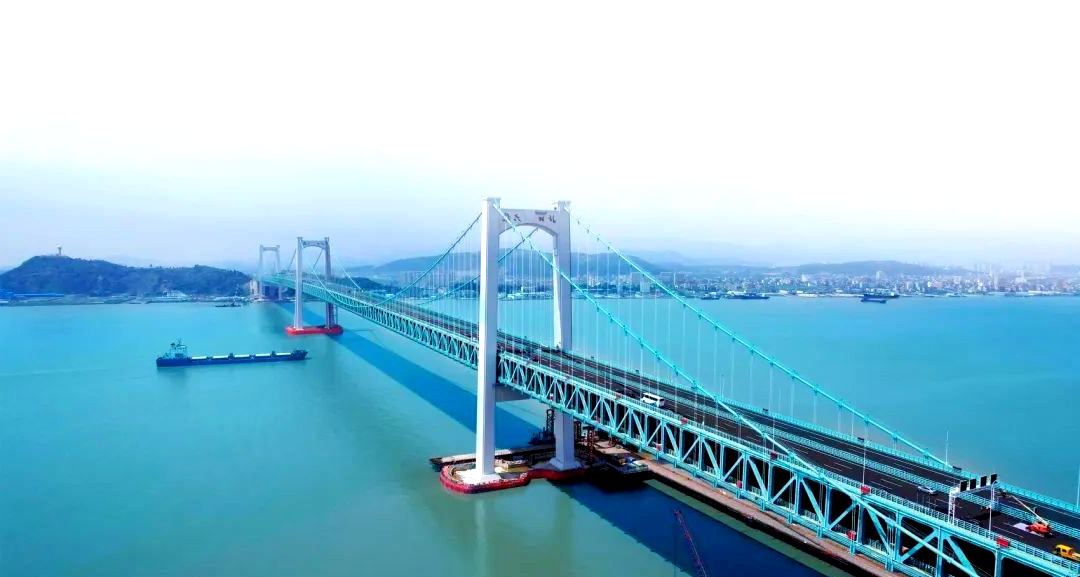
Currently, the incremental growth of domestic transportation infrastructure is slowing down, with a focus on upgrading existing assets. The bridge industry's prosperity is weakening, and the sustainability of related enterprises' performance has become a focal point.
Deyang Tianyuan Heavy Industry Co., Ltd. (hereinafter referred to as "Tianyuan Heavy Industry"), a 细分 leader in the core components field of bridge engineering equipment, will face review by the Beijing Stock Exchange Listing Committee on July 31.
As a leading enterprise in the field of core force-bearing components for ultra-large-span suspension bridges in China, the company achieved 逆势 growth in orders and performance in 2026 despite the downward trend in industry investment, demonstrating robustness.
However, multiple issues exposed in the second round of inquiries, such as performance volatility, accounts receivable collection, and the rationality of fundraising, mean that its attempt to pass the listing review still faces tests.
Leader in Core Components of Suspension Bridges, Performance Stabilizes Amid Industry Bottlenecks
Tianyuan Heavy Industry is one of the few domestic enterprises capable of researching and manufacturing a full series of core force-bearing components for ultra-large-span suspension bridges. Its main business includes bridge force-bearing products (such as saddle and clamp, which are core force-bearing components) and bridge steel structures.
From an industry perspective, the company belongs to the bridge engineering equipment sector, which is undergoing a structural adjustment period characterized by "slowing incremental growth and 承压 existing stock" due to the macro infrastructure environment.
Data from the Ministry of Transport shows that in 2025, national fixed asset investment in highways reached 242.98 billion yuan, a year-on-year decrease of 5.7%. Among them, highway investment decreased by 10.1%, and rural road investment decreased by 17.9%. Transportation fixed asset investment has declined for two consecutive years.
The slowdown in the growth rate of total output value in the construction industry and the decline in growth have become a consensus in the industry, indicating weakened development momentum.
The narrowing of incremental space poses a direct challenge to upstream supporting engineering equipment enterprises that heavily rely on new bridge construction projects.
However, opportunities exist within challenges. The high-end special bridge track still possesses stable growth potential, especially kilometer-level super-large suspension bridges across rivers, seas, and the Sichuan-Tibet mountainous areas, which are key landmark projects prioritized by policy.
Institutions estimate that the compound annual growth rate (CAGR) of the domestic suspension bridge equipment market will be 5.5% from 2025 to 2032, and the CAGR of bridge steel structures will be 11.86% from 2025 to 2030.
Furthermore, dividends from the existing stock market are gradually being released. The total number of highway bridges nationwide has reached 1.1441 million, including 12,500 super-large bridges. A large number of older bridges are entering cycles of reinforcement and component replacement. The scale of the bridge maintenance and repair market has exceeded one trillion yuan, opening a second growth curve for enterprises with high barriers in core force-bearing components.
Tianyuan Heavy Industry is a beneficiary of the structural adjustment dividends in the bridge engineering industry. Although revenue has been declining over the past three years, net profit has remained rising.
From 2023 to 2025, the company's operating revenue was 701.2879 million yuan, 612.9205 million yuan, and 616.2391 million yuan respectively. Although affected by delays in steel structure projects and capacity constraints, resulting in slight fluctuations in revenue, attributable net profit steadily increased to 53.9586 million yuan, 58.0065 million yuan, and 66.9535 million yuan respectively. The non-GAAP net profit in 2025 was 64.1981 million yuan.
Notably, there was a surge in H1 performance: against the backdrop of continued pressure on industry investment in H1 2026, the company's revenue was 231.9230 million yuan, up 21.82% year-on-year; non-GAAP net profit was 29.2172 million yuan, a significant increase of 284% year-on-year.
The company stated that this was mainly due to the successive completion of delivery and measurement of bridge force-bearing component products and bridge steel structure products, leading to revenue recognition, and an increase in the proportion of revenue from high-value-added products.
As of the end of June 2026, the company had tax-included orders on hand worth 1.117 billion yuan, with new orders added in H1 reaching 336 million yuan, a year-on-year increase of 65.42%. This ample order reserve confirms the anti-cyclical barrier of the 细分 track and also serves as the core support for the sustainability of the company's performance.
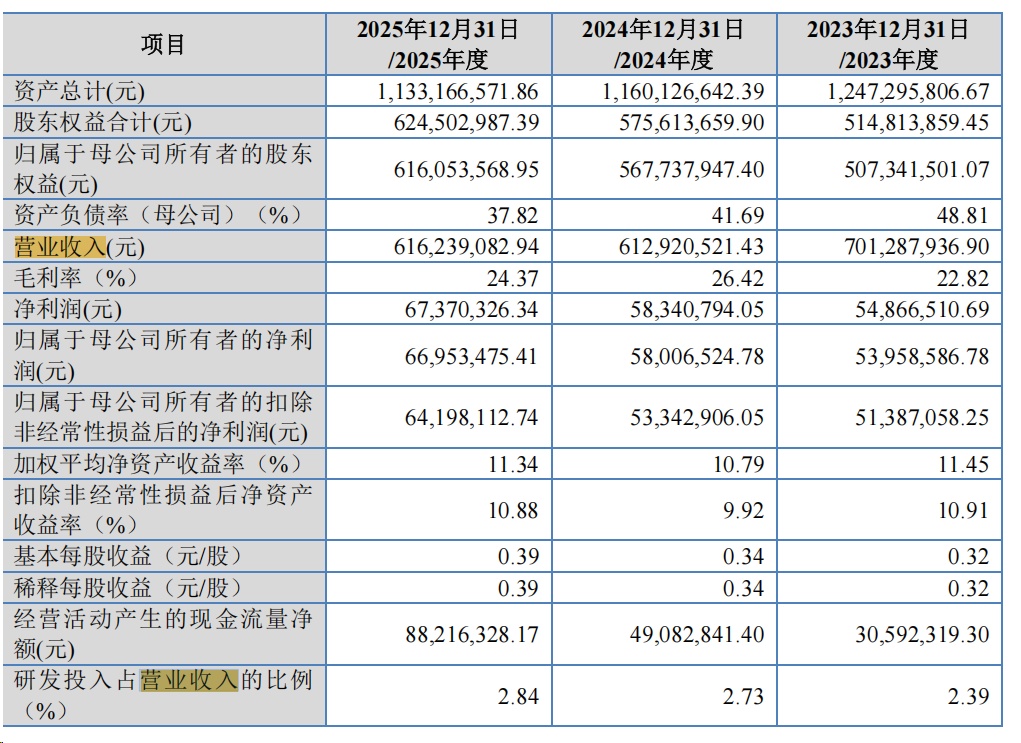
(The above chart shows core financial indicators, source: Prospectus)
Looking at the overall industry competitive landscape, core force-bearing components for suspension bridges belong to a 细分 blue ocean. A few enterprises such as Tianyuan Heavy Industry, Wuhan Marine Machinery, and OVM occupy the domestic super-large bridge market. Nine out of the top ten suspension bridges in China with the largest main spans use Tianyuan Heavy Industry's products. The high barriers of this track bring high returns, with gross margins significantly higher than those of the steel structure business.
The general steel structure field belongs to a fully competitive red ocean, presenting a tiered differentiation pattern.
As a second-tier manufacturer in the Southwest region, Tianyuan Heavy Industry has secured a foothold 凭借 regional project experience and cost control capabilities. However, the transportation radius of steel structure products is limited, and national expansion faces natural bottlenecks. It cannot compete with larger first-tier national leaders such as China Railway Baotou Bridge, China Railway Shanqiao, and Hangxiao Steel Structure.
In 2024 and 2025, the company's steel structure capacity utilization rates were only 66.84% and 67.16% respectively, reflecting the reality of fierce competition in the red ocean market and significant order volatility.
Overall, Tianyuan Heavy Industry holds a leading position in the high-barrier blue ocean track but is still struggling to break through in the fully competitive red ocean market.
Inquiry Focus: Sustainability of Performance and Rationality of Fundraising
From the first and second rounds of inquiries by the Beijing Stock Exchange, it can be seen that they pay very close attention to the sustainability of performance for bridge engineering equipment enterprises like Tianyuan Heavy Industry.
In the macro environment where infrastructure investment growth continues to weaken, was the company's previous growth dependent on industry dividends or did it traverse the cycle 凭借 its own core competitiveness?
If the support from large-scale infrastructure investment disappears, why expand new capacity through IPO fundraising under industry recession, leading to overcapacity?
Regarding capacity issues, the Beijing Stock Exchange asked particularly detailed questions.
The inquiry letter required the company to explain whether the fundraising investment projects belong to capacity expansion nature, conduct consolidated calculations of new capacity from built, under-construction, and fundraising projects, and analyze the necessity of expansion and risks of capacity digestion 结合 current capacity utilization, market demand, and industry trends.
The deep logic behind the inquiry lies in a set of contradictory data: one of the company's core businesses, bridge force-bearing components, has been operating at overload capacity for years.
During the reporting period, capacity utilization rates were as high as 132.65%, 109.38%, and 115.55% respectively. This means that while orders are sufficient, capacity is severely insufficient. A large number of orders cannot be digested in time, and the company even needs to rely on outsourced processing to make up for the capacity gap.
Another core business of the company, bridge steel structures, suffers from severe idle capacity.
In 2024, capacity utilization dropped to 66.84%, and in the first three quarters of 2025, it further declined to 52.58%. This means that nearly half of the capacity is idle.

For the same business line of the company, why is one side "bursting" while the other is "idle"? If the overall industry is in recession, why is the capacity utilization of force-bearing components consistently over 100%? If the industry still has demand, why is steel structure capacity largely idle? If the industry is truly in recession, is expanding capacity through fundraising necessary?
Tianyuan Heavy Industry's response is that capacity is not excessive, but mismatched.
The company emphasizes that the fundraising expansion is for bridge force-bearing components (capacity utilization exceeds 100%, raising 259 million yuan to add 9,000 tons of force-bearing component capacity), rather than steel structure capacity.
The "excess" of capacity is structural. Red ocean market capacity is idle, while the blue ocean market's force-bearing components have extremely high technical barriers and few qualified suppliers.
The company emphasizes that the domestic market for core force-bearing components such as suspension bridge saddles and clamps is highly concentrated, with Tianyuan Heavy Industry and Wuhan Marine Machinery forming a substantive "duopoly" pattern. Other participants basically do not have the ability to directly benchmark against them.
This is the industry background for Tianyuan Heavy Industry's force-bearing component capacity consistently exceeding 100% and the rationality of fundraising expansion.
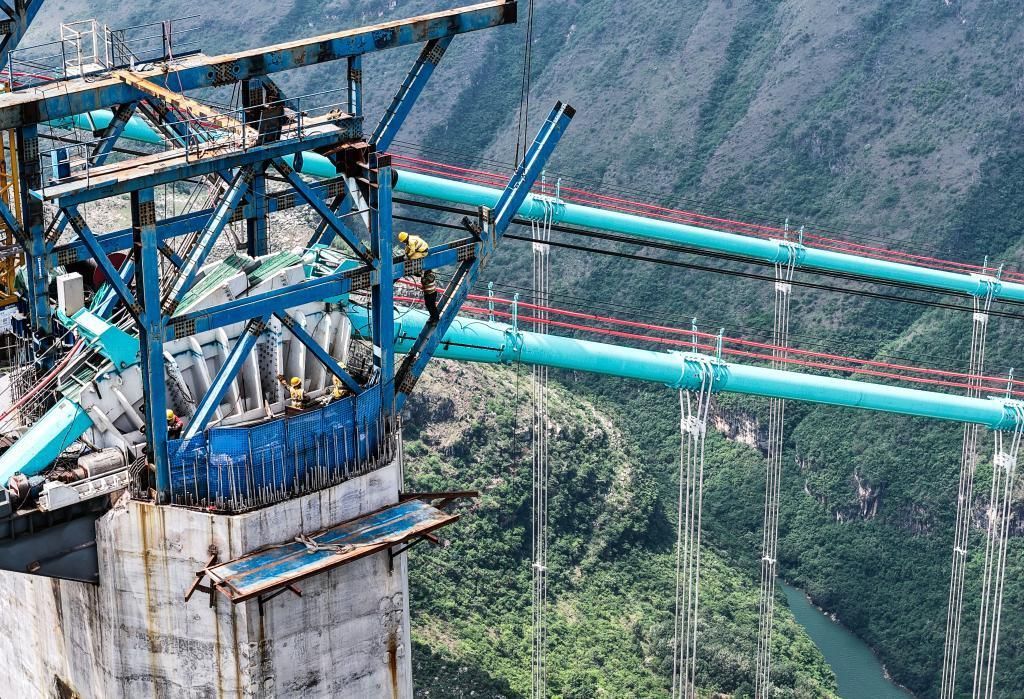
Moreover, the new capacity is supported by orders.
As of June 30, 2026, the company's orders on hand amounted to 1.1165365 billion yuan (tax included). After the fundraising investment project reaches production capacity, it is expected to add annual revenue of 225.2 million yuan and net profit of 32.7669 million yuan, with additional depreciation and amortization of 14.5159 million yuan. The benefits can cover the costs.
A question worth further probing is, can orders on hand continue? Will the market environment change when the project goes into production in 2028? Can the newly added 9,000 tons of capacity be effectively digested?
The company stated, If market expansion fails to meet expectations, there is a risk that the digestion of new capacity will fail to meet expectations.
Additionally, high customer concentration and continuously declining accounts receivable collection rates are also core challenges facing the operational stability of Tianyuan Heavy Industry.
During the reporting period, the proportion of sales revenue from the top five customers (merged 口径 under common control) was 82.89%, 75.38%, and 70.02% respectively. Although the proportion has decreased year by year, it has always maintained an extremely high level above 70%.
What does this concentration mean?
From the customer structure perspective, the top five customers are all large central state-owned enterprises such as China Railway, China Railway Construction, and China Communications Construction, as well as their subordinate units. In the context of continuous contraction in total infrastructure investment, if these large SOE customers reduce procurement, the company's performance will face a cliff-like decline.
The sharp decline in collection rates has also attracted high attention from regulators. The Beijing Stock Exchange specifically requested the company to quantitatively analyze the risk of accounts receivable collection and the adequacy of bad debt provisions.
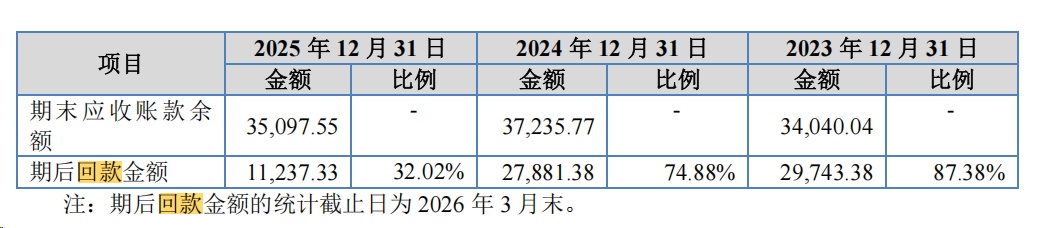
(The above chart shows changes in collection rates, source: Prospectus)
As of the end of March 2026, the post-period collection rates of accounts receivable at the end of each period were 87.38%, 74.88%, and 32.02% respectively. From January to September 2025, the post-period collection rate once dropped to 23.90%.
The proportion of long-age accounts receivable continues to rise. The proportion of accounts receivable aged over 3 years has exceeded 18%. The difficulty of recovering these funds and the risk of bad debts are significantly higher than those of receivables within normal aging periods.
Continuously declining collection rates usually mean that more funds are aging. The longer the aging, the higher the uncertainty of recovery. This risk does not exist in isolation; it 叠加 s with the problem of high concentration of central and state-owned enterprise customers, amplifying operational uncertainty.
Is the valuation expensive?
Calculated based on this issuance plan (fundraising 279.4688 million yuan ÷ issuing 57.1 million shares), the issue price is approximately 4.89 yuan/share. Based on the 2025 non-GAAP attributable net profit of 64.1981 million yuan, the P/E ratio is approximately 17.41 times.
Relevant benchmark enterprises can be divided into two categories:
Listed companies in the bridge steel structure sector (Haibo Heavy Industry, Baijia Technology) have generally faced pressure on performance in 2025 due to intensified industry competition. Haibo Heavy Industry's 2025 revenue was 234 million yuan, a year-on-year decrease of 44.29%, with attributable net profit of only 1.7808 million yuan; Baijia Technology's dynamic P/E ratio is negative.
The valuation range for bridge functional component enterprises (Times New Materials, Xin Zhu Shares) is relatively stable, with Times New Materials having a P/E ratio of about 24 times in 2025.
The company possesses both 细分 leader attributes (market share of about 70% in the field of suspension bridge saddles and clamps) and the drag of steel structure business. A 17x P/E valuation is in the middle of the industry median range, which is standard.
Whether this valuation can hold in the future depends on the realization rhythm of three curves:
Short-term looks at the conversion efficiency of orders on hand (1.1165365 billion yuan). If 650-700 million yuan in revenue is completed as scheduled in H2 2026, the current valuation will be supported;
Medium-term looks at the digestion progress of fundraising capacity. After going into production in 2028, the newly added 9,000 tons of capacity is equivalent to 69% of the existing capacity. Whether the new benefits can cover the new annual depreciation and amortization of 14.5159 million yuan is the key to whether the valuation can be revised upwards;
Long-term looks at how much of the incremental market dividends can be captured under the 5.5% CAGR of the suspension bridge equipment market.
Objectively speaking, Tianyuan Heavy Industry is an invisible champion in the field of core force-bearing components for ultra-large-span suspension bridges in China. Technical barriers and project resumes have built a solid moat.
In the macro environment where infrastructure investment growth continues to weaken, the company achieved 逆势 growth in 2026, with ample orders on hand, giving mid-term performance a certain margin of safety.
However, practical issues such as continuously declining accounts receivable collection rates, persistently high customer concentration, and structural contradictions in capacity constitute multiple tests on its operational stability.
The review on July 31 is the moment to centrally test the "quality of 逆势 growth" of this 细分 leader.
Source: Chaoyang Capital Theory
The copyright of this article belongs to the original author/organization.
The views expressed herein are solely those of the author and do not reflect the stance of the platform. The content is intended for investment reference purposes only and shall not be considered as investment advice. Please contact us if you have any questions or suggestions regarding the content services provided by the platform.
