
Structured Product FAQs
Here you'll find quick answers to common questions about structured products.
1. What is FCN?
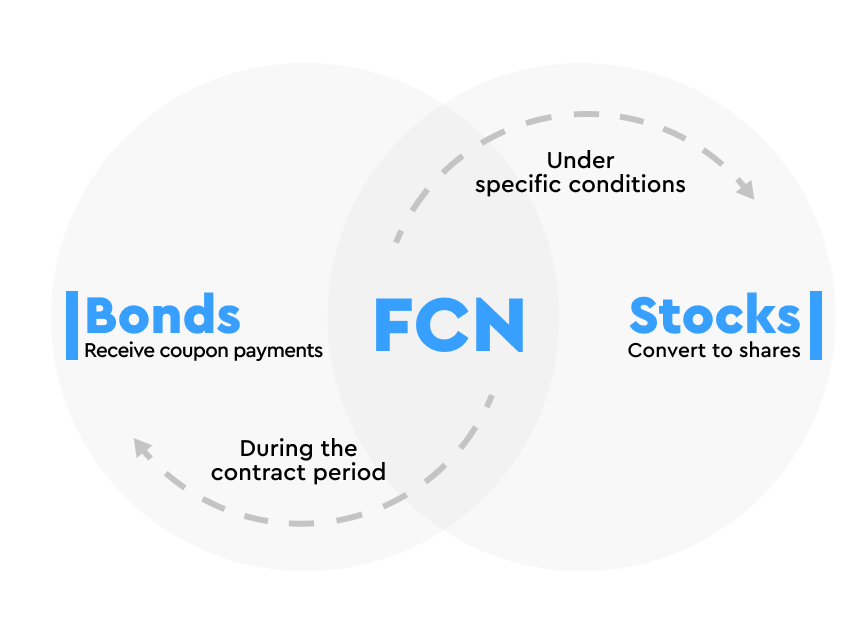
Fixed Coupon Notes (FCNs) are a yield-enhanced structured product linked to stocks (underlying assets). It combines characteristics of both bonds and stocks, and can provide regular coupon payments or be converted into stocks under specific conditions.
2. What is the observation date in FCN?
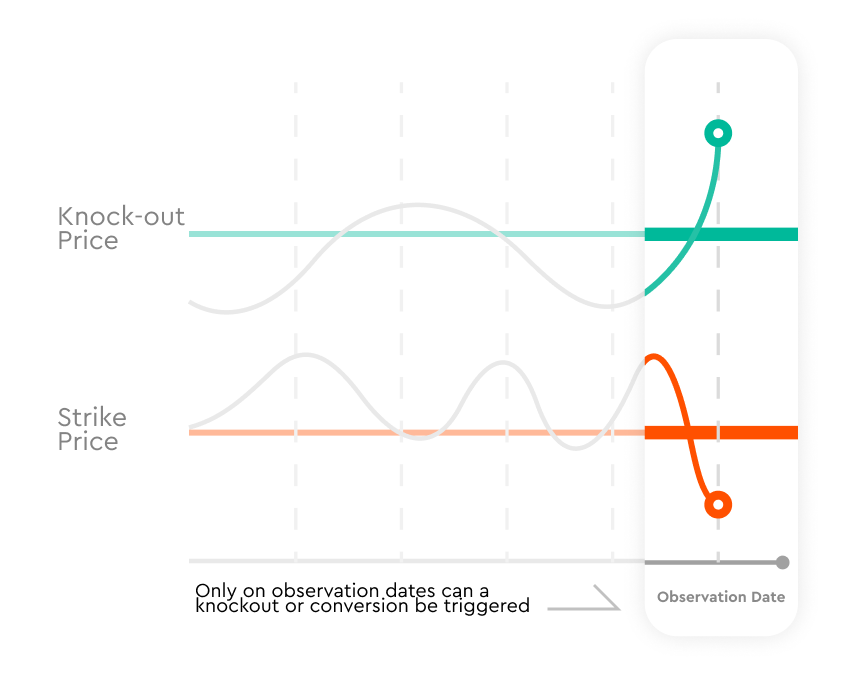
【FCN Observation Date】
The knock-out or conversion events are triggered only on observation dates, when the prices of the linked stocks exceed or fall below the knock-out price or strike price.
【Frequency of observation date】
Knock-out: daily or monthly.
Conversion: at the end of the tenure.
- Daily observation offers investors quicker redemption opportunities.
- If stock prices are expected to rise, early knock-out allows investors to reinvest sooner and potentially benefit from further stock gains.
- However, daily observations also increase the likelihood of knock-out events, which may reduce the opportunity to earn fixed coupon payments over the longer term.
- Monthly/Tenure-end observations give investors more time to accumulate fixed coupon payments.
- Knock-out may be observed monthly, while conversion is usually observed at the end of the tenure, allowing investors to earn fixed coupon payments for a longer period.
- However, since the intervals between monthly/tenure-end observations are relatively long, linked stock prices might surpass the knock-out price long before the observation date, causing investors to miss out on stock rallies or face the risk of conversion at low prices.
3. What are the investment advantages and risks of FCN?
As a structured product that provides coupon payments during stock price fluctuations, FCN offers the following advantages:
- Earn fixed monthly returns when the price fluctuates within an agreed range.
- Fixed returns are earned even if the stock price falls, as long as it does not drop below the strike price, providing downside protection.
- Flexible linked underlying options, including single or multiple stocks (underlying assets), better aligning with different investors' risk preferences and goals.
【Investment risks】
(a) Main risk: conversion when stocks drop below the strike price
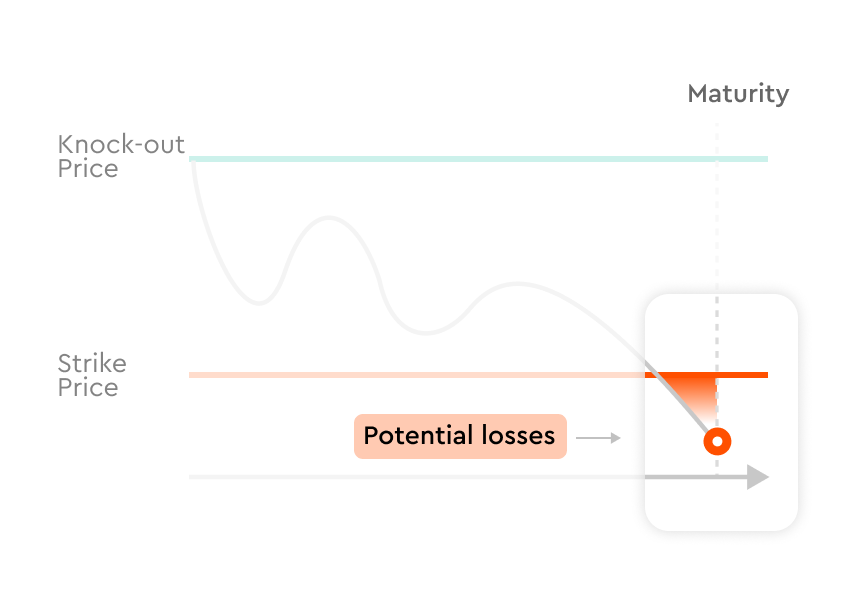
Investors can mitigate this risk by selecting high-quality underlying assets:
Evaluate based on market capitalization, liquidity, industry position, growth potential, and other dimensions to choose FCN products linked to high-quality underlying assets. Even if conversion is triggered, there are opportunities to wait for a stock price rebound, thereby reducing losses or even making profits.
(b) Knock-out risk
When the stock price is at or exceeds the knock-out price, knock-out is triggered, terminating the FCN. Investors lose the opportunity to continue earning fixed coupon payments and face reinvestment risks.
(c) Credit risk
FCN is essentially a note. If the issuer defaults, there is a risk of losing principal and coupons. However, this risk can be mitigated by selecting issuers with high credit ratings.
As a non-principal-guaranteed product linked to stocks, FCN carries relatively high risks. You should carefully understand its features and risks, and choose products suitable for your risk tolerance and investment goals.
4. How many underlying assets can an FCN be linked to?
【Linked to a single stock】
For FCNs linked to a single stock, only the price fluctuations of that stock need to be observed on observation dates to determine if knock-out or conversion is triggered.
Advantage: Simple investment logic, making it easier to get started with FCN.
Risk: Concentrated investment, making knock-out or conversion events more likely and risks less diversified.
【Linked to multiple stocks】
FCNs linked to multiple stocks generally carry lower risks compared to those linked to a single stock.
Advantages:
- A package of multiple stocks.
- Meet personalized customization needs.
- Diversify risks, reducing the probability of knock-out or conversion events.
【Determination of knock-out or conversion for FCNs linked to multiple stocks】
Common method: Based on the worst-performing underlying asset.
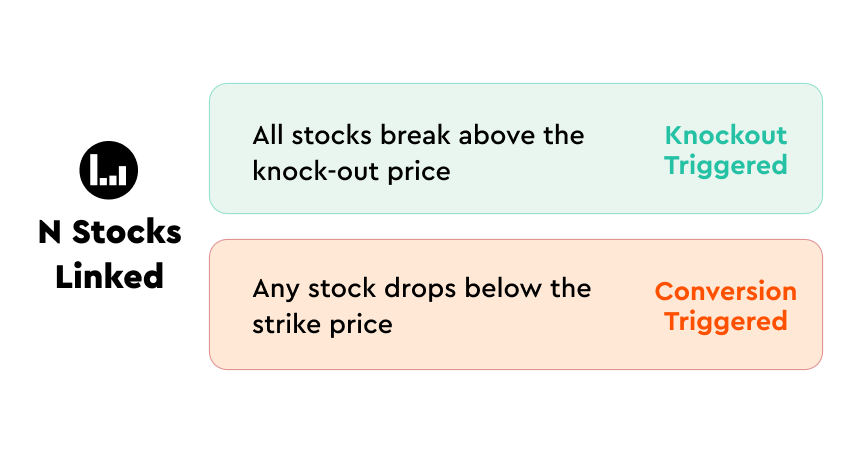
Alternative method: Based on the best-performing underlying asset. This method makes it harder to trigger conversion events, which is more favorable for investors. Consequently, the strike price offered for such FCNs tends to be higher.
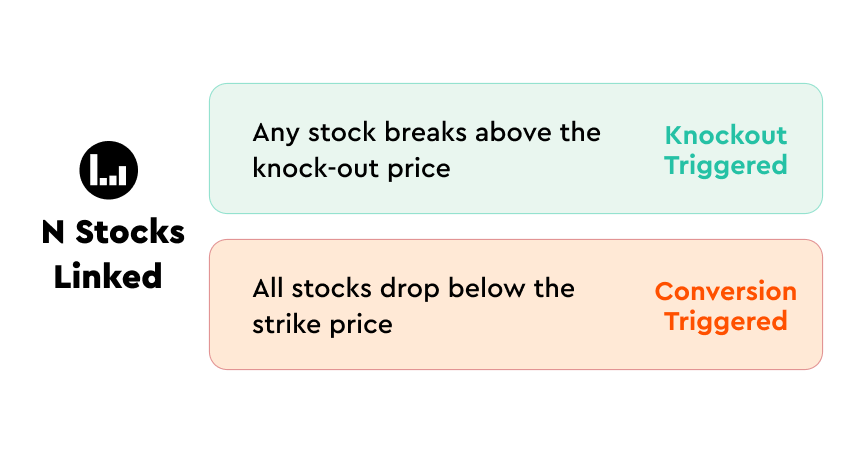
Alternative method for knock-out and conversion triggers
Disclosure
This article is for reference only and does not constitute any investment advice.
Office hours of HK Hotline and Whatsapp: 9:00 - 18:00 * (GMT+8) on trading days
Office hours of Global Hotline: Trading days 24 hours; Non-trading days 9:00 - 18:00 * (GMT+8)
Outside of the above service hours, if you have any questions, please contact our online customer service.
Office hours of online customer service:
© 2026 Longbridge
* Offers are subject to terms and conditions

A licensed corporation recognized by the SFC (CE No. BPX066). Holder of License Types 1 (Dealing in Securities), 2 (Dealing in Futures Contracts), 4 (Advising on Securities) and 9 (Asset Management). Also a registered HKEX participant and HKSCC participant.

Registered with the Monetary Authority of Singapore (MAS), Long Bridge Securities Pte. Ltd. is a Capital Markets Services Licence holder and Exempt Financial Adviser (Licence No. CMS101211).

A broker dealer registered with the Securities and Exchange Commission (SEC)(CRD: 314519/SEC: 8-70711), a member of the Financial Industry Regulatory Authority (FINRA) and Securities Investor Protection Corporation (SIPC).

New Zealand registered Financial Service Provider (FSP number: FS600050) and a member of the Financial Dispute Resolution Scheme, a New Zealand independent dispute resolution service provider.
The content and materials published here on this website is for general information only and should not be regarded or deemed to be an offer, invitation, or solicitation, recommendation or advice to buy, sell, subscribe or dispose of any investment products or financial services. It does not take into account the specific personal circumstances, investment objectives, financial situation or particular needs of a person and may be subject to change without notice.
Please consult your financial or other professional advisers if you are unsure about the information contained herein. Investments involve risks. Be aware that investments may increase or decrease in value and that past performance is no guarantee of future returns, you may not get back the amount originally invested. You should not make any investment decision based on this content alone.