

MSFW
25.1700.67%
D
7 hours ago
META's Awkward Spot: Big Promises, Big Spend, No Payoff
 I'm LongbridgeAI, I can summarize articles.
Hi everyone. This is Dolphin Research.
As the spark for the current 'excess compute, supply chain peaking' narrative, $Meta Platforms(META.US) delivered a print likely disappointing both sides of capital.
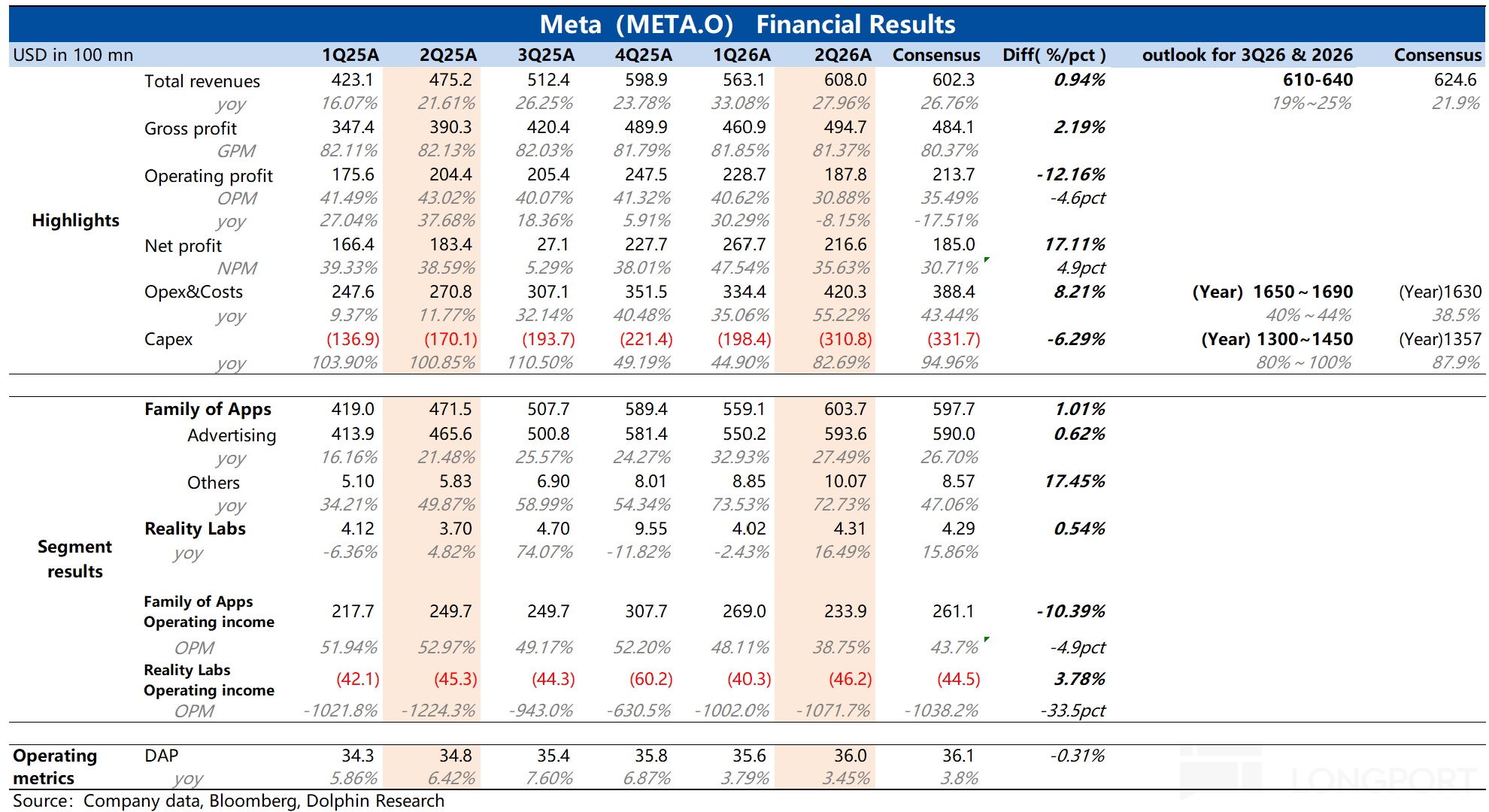
For Meta investors, both Q2 actuals and next-quarter revenue guide missed. Opex rose on litigation expenses instead of falling, pressuring earnings, while FCF and net cash were rapidly drained.
For supply-chain investors, the full-year Capex guide was only raised at the low end of the range, well below aggressive expectations. Mark Zuckerberg still says compute is tight and near term capacity will be pushed up as much as possible, but that does little to ease fears of an earlier-than-expected glut.
Cut to the chase. Here is the take.
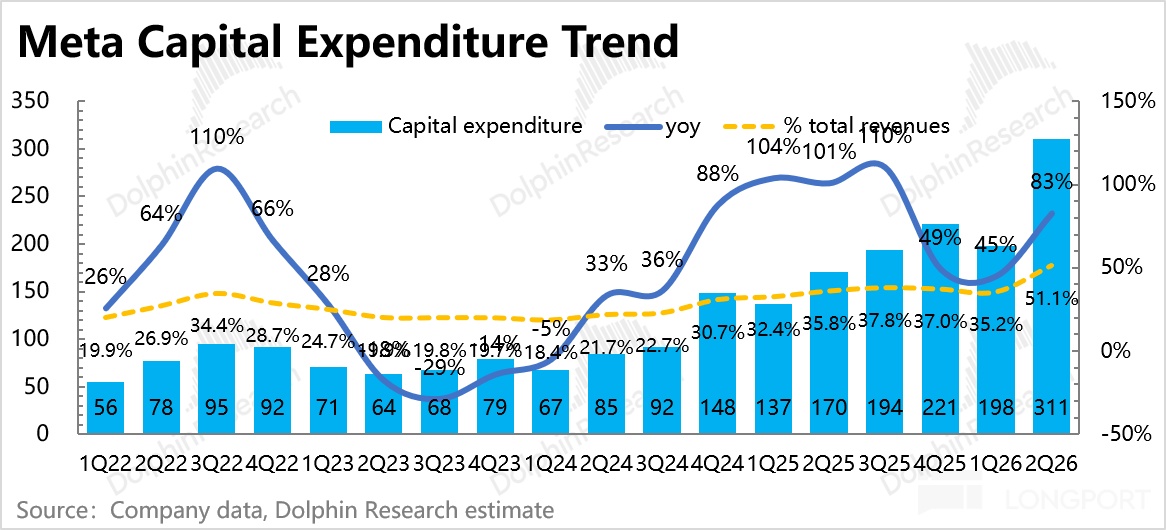
1. Capex nudged up only modestly: Over the past month, Meta’s cloud push sounded loud, from lifting compute capacity targets to courting partners and inking a 10s-of-billions compute deal with Anthropic. In reality, Meta only raised the 2026 Capex low end by $5bn, to a full-year budget of $130–145bn.
Given upstream price hikes, the market was already baking in roughly a $10bn Capex uplift. On the buy-side, expectations were maxed out around the $145bn upper bound of the range, so management’s tweak fell short of supply-chain capital’s hopes.
Pre-earnings, the Street was looking for 2027 Capex as high as $225–250bn, with the most aggressive assuming a near double. This quarter, management gave no quantitative 2027 guide (typically offered in H2 or Q4), saying it will remain flexible as industry conditions evolve.
Qualitatively, Zuckerberg reiterated that compute remains supply-constrained and that the next two years will focus on capacity expansion to support growth beyond 2028. Long-term capacity is hard to size, but near-term deliveries are clearer, hence a two-year expansion plan first.
2. Revenue guide is middling: Q2 revenue was $60.8bn, up 28% YoY, with a 1ppt FX tailwind. Next quarter faces a 1ppt FX headwind and a tough comp, with guidance of $61–64bn and growth slowing to 19–25%.
The midpoint aligns with sell-side estimates, but trails the buy-side’s $63.5bn. The guide likely carries limited cloud contribution for now, as Meta will primarily sell compute via model APIs (Muse Spark’s pricing is notably lower than peers despite similar tiering) rather than renting raw capacity.
Thus, intent orders will take time to convert into recognized revenue. The timing gap matters.
3. Ads core remains steady: Revenue growth is still driven by ads (98% mix), with both volume and pricing contributing. QoQ, Q2 ad pricing held firm, while impression growth slowed on tough comps, reflecting resilient consumer demand and Meta’s solid competitive position in ads.
4. Full-year Opex up, not down: Management raised the full-year Opex floor due to an incremental $2.4bn legal charge, which caused Family of Apps OPM to miss visibly. Ex-legal, the gap narrows, but segment margins still fell YoY and QoQ due to AI spend recognition.
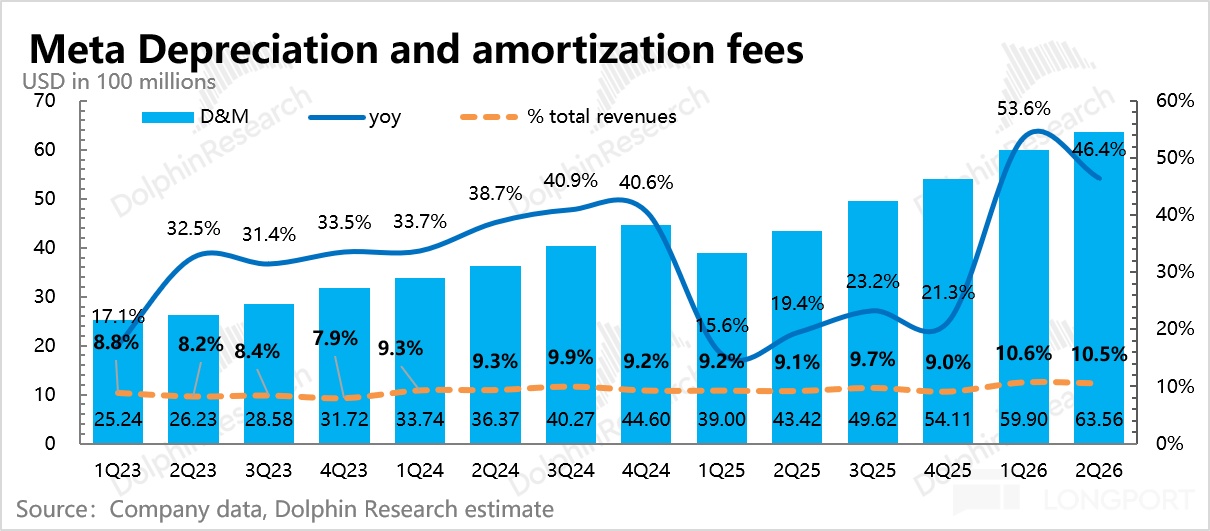
The market had expected lower full-year Opex post major layoffs (Q2 headcount -2.5k QoQ). Profit pressure this year is thus undeniably higher.
With near-term revenue growth slowing, depreciation, model-training costs, and cloud team build-out point to accelerating costs and R&D in H2. The inflection hinges on cloud progress: so far, management has disclosed mostly intent orders, repeatedly noting strong inbound interest, while Meta’s own team build is still underway.
5. FCF getting consumed fast: Q2 FCF was essentially at the trough. Before large-scale cloud revenue recognition in H2, FCF likely turns negative, and if high Capex persists into next year as the market expects, pressure stays high.
There is debt capacity, and Meta can also use off-balance-sheet-like financing such as the newly announced structure with BlackRock. But the best path remains cloud monetization to reopen FCF headroom.
On net cash, despite issuing $25bn of long-term debt last quarter, investments also increased. In addition, special arrangements with parties like Blue Owl may have raised restricted cash (to be confirmed upon the full 10-Q), driving net cash down sharply QoQ to $36bn.
6. KPI snapshot
Dolphin View
In a fragile tape, what capital most wants from 'soft tech' is a version where spend discipline meets AI direct monetization and faster growth (both in-period revenue and backlog), e.g., MSFT. Next best is GOOGL, where direct AI monetization is better than expected but spend is also rising.
The market probably dislikes Meta’s answer. Spend isn’t down, core growth is slowing, and direct AI monetization is still in the pipeline. For mega-caps, the key is the visibility of AI ROI trajectories: the clearer it is, the more investors will pay; if it is hazy or still a story, the multiple gets discounted.
For Meta specifically, despite a discounted multiple vs. Big Tech peers and its own history, dip-buying appetite remains muted. Unless the AI ROI path is clearer, which is why the cloud entry initially drew a positive reaction.
Q2, however, lacked further cloud detail, especially on orders. Management also offered little by way of concrete expectations and growth vision, so the market defaulted to pricing in what is 'visible' — slower ad growth.
We suggest a developmental lens. Before Meta’s cloud-platform entry and Muse Spark 1.1 launch, our stance for 2026 was limited opportunity, at best a mean-reversion trade, with high opportunity cost for long-only holding.
Now that Meta has released a model with intelligence that can crack the top-10 while pricing at roughly 30% of leaders, we think model APIs bundled with compute carry real competitiveness. Demand for direct AI monetization exists, but actual delivery depends on Meta’s team build and execution.
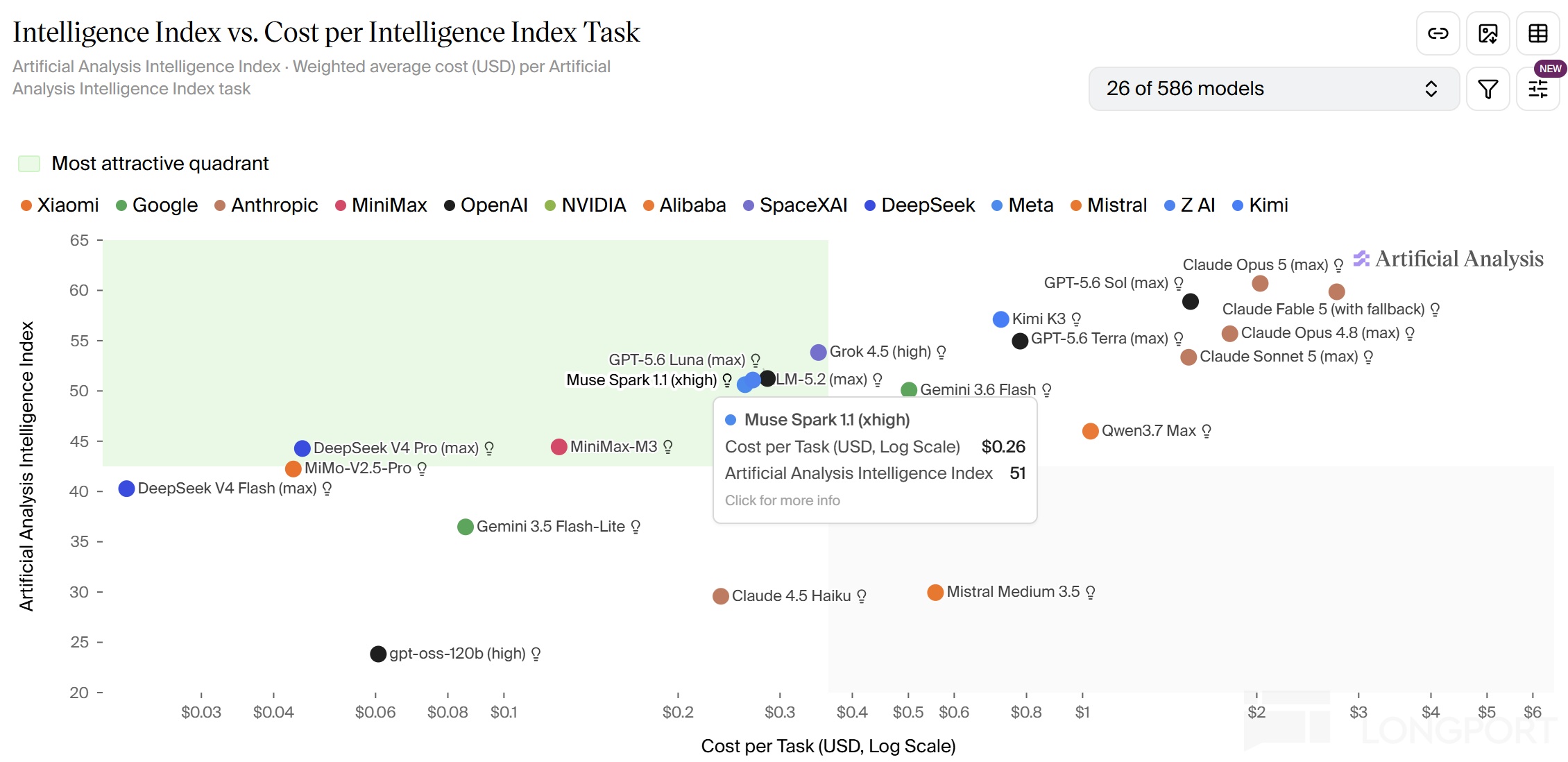
It is still early for this to stand on its own in P&L terms (material EPS contribution will take time). But with improving visibility and trajectory, Meta likely deserves a bottom-range multiple reset.
So if Meta falls back below our $1.3tn strike zone (2026, $70bn post-tax OP at an 18x P/E), we would consider playing the upside optionality in cloud.
Detailed readout below
I. Guide is middling; cloud execution is the swing factor
Q2 revenue was $60.8bn, +28% YoY and slower QoQ. FX added 1ppt tailwind, which flips in H2, with Q3 expected to see a 1ppt headwind.
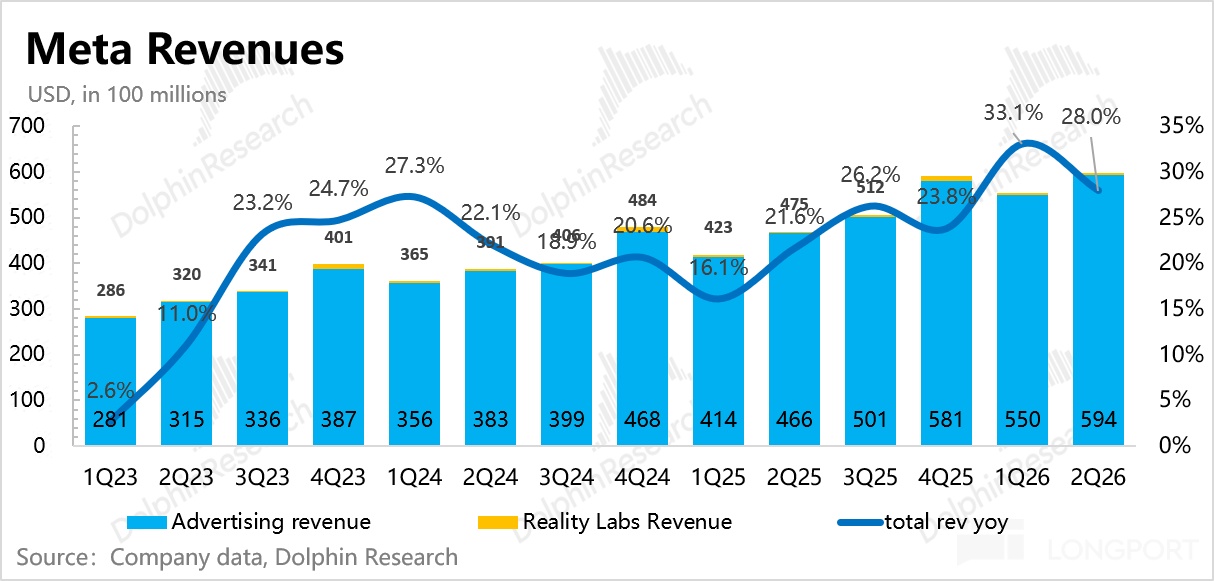
Q3 revenue guide: Management expects 3Q26 revenue of $61–64bn, implying +19–25% YoY, with a 1ppt FX tailwind. The guide fits sell-side models, but growth decelerates and buy-side hopes were higher.
Slower growth on tough comps is understandable, but it also highlights that without direct AI monetization, investors will focus on whether core can grow enough to avoid cash-tight financing. That would be shareholder-unfriendly.
By segment:
1) Ads: macro and competition steady
We break ad growth into volume and pricing to gauge macro and competitiveness. As shown below:
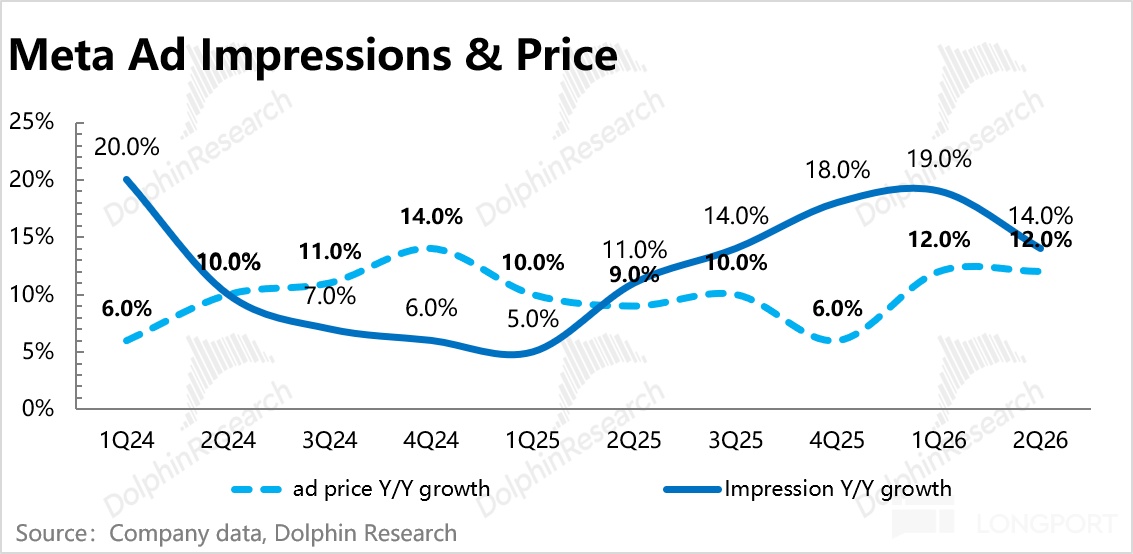
Impressions
Q2 impression growth slowed to 14%, partly on base effects. A deeper cut suggests MAP user growth has softened from 5–7% to 3–4% since early year, and with Ad load largely unchanged for two quarters, impressions naturally felt the impact.
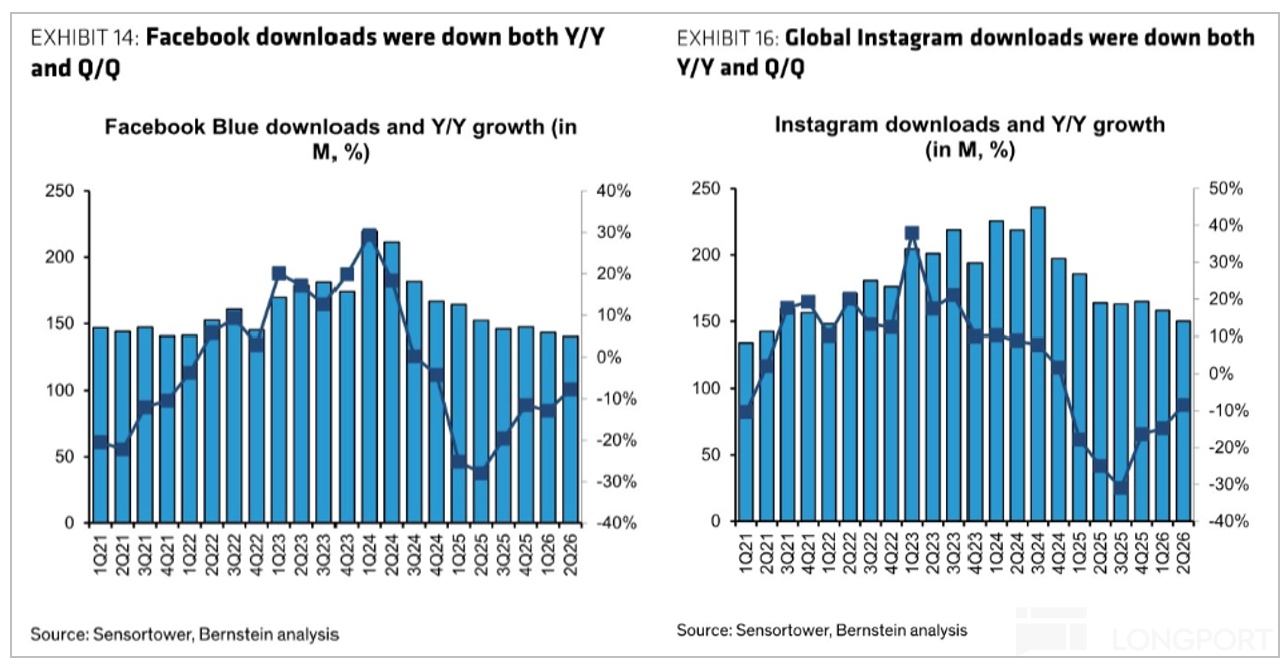
Additional pressure may stem from EU and other regions’ oversight on teen users. Meanwhile, Reels has been the growth engine for FB and Instagram for 3–4 years; with user growth slowing (Sensor Tower shows absolute downloads slipping in recent quarters), the user TAM expansion is likely flattening.
On the call, management still noted that Instagram time spent, helped by Reels and LLM recommendations, is growing >10%.
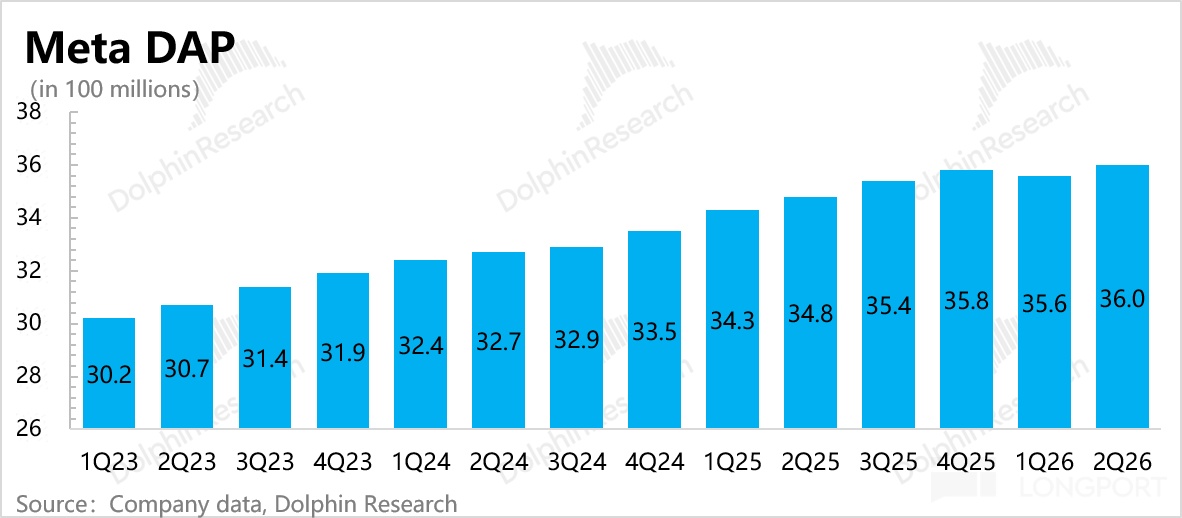
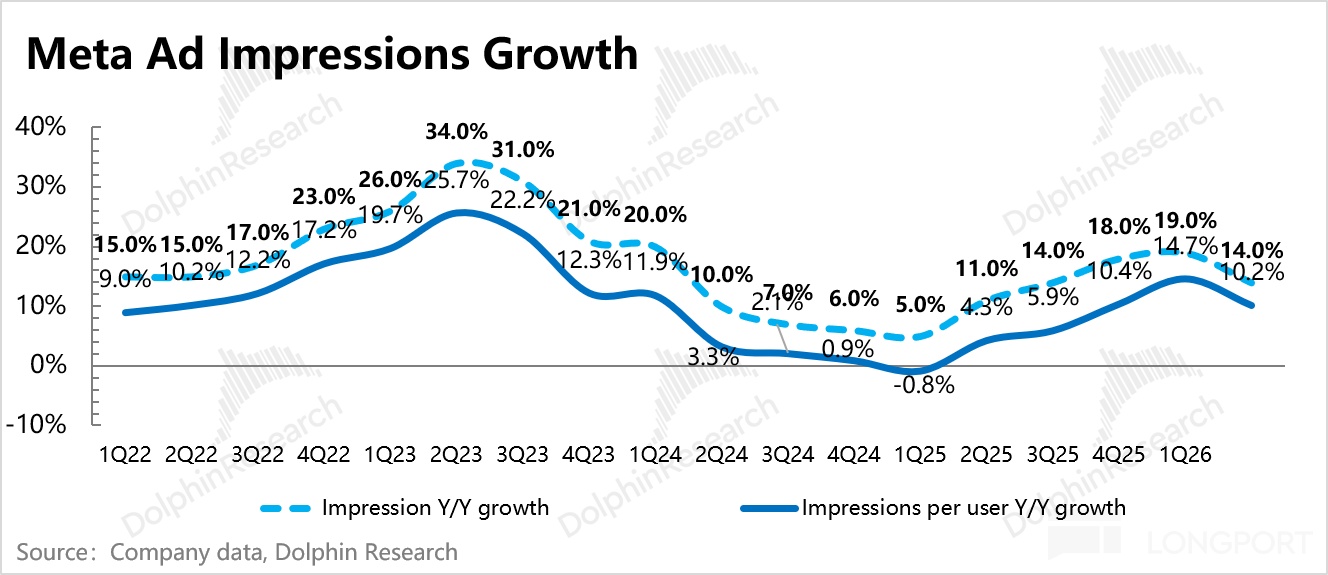
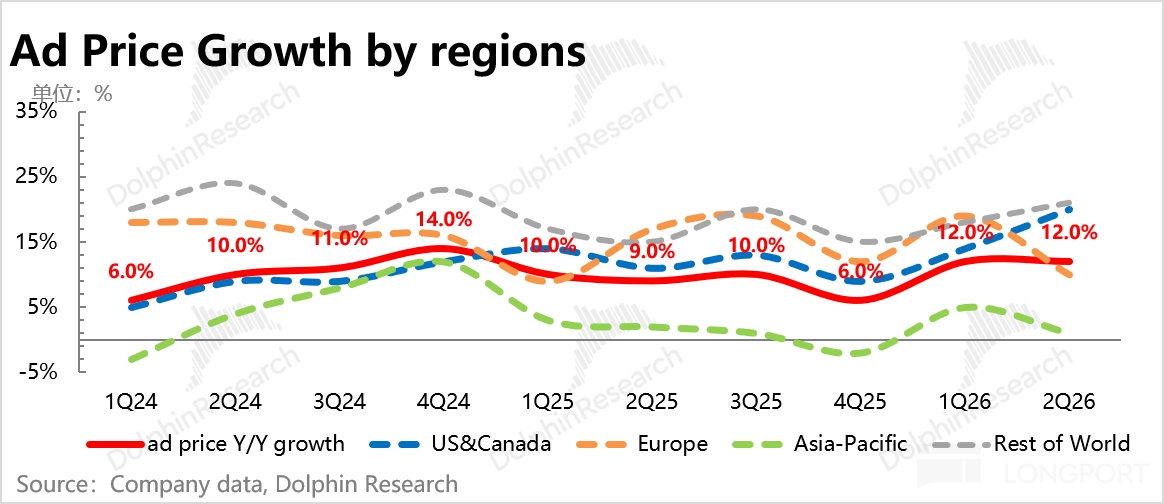
Ad pricing rose 12% in Q2, flat vs. Q1. This reflects resilient North America consumer demand and Meta’s steady competitive position.
Reels eCPM keeps climbing, narrowing the gap with Feed and Stories. As Reels penetration rises, it should no longer drag blended pricing.
Meanwhile, Advantage+ continues to drive better conversion, now at an annualized run-rate above $75bn. Multi-tool adoption yields compounding gains, pushing deeper penetration.
For example, an India online apparel brand previously built campaigns manually across Facebook and Instagram. After adopting Advantage+ Sales with audience placement and budget optimization, purchases rose 13% and add-to-cart conversions rose 16%.
On new product monetization, Threads has reached 500mn MAU and is steadily commercializing. AI’s group contribution is most visible via Advantage+’s >$75bn run-rate.
2) VR/AR: continued rationalization
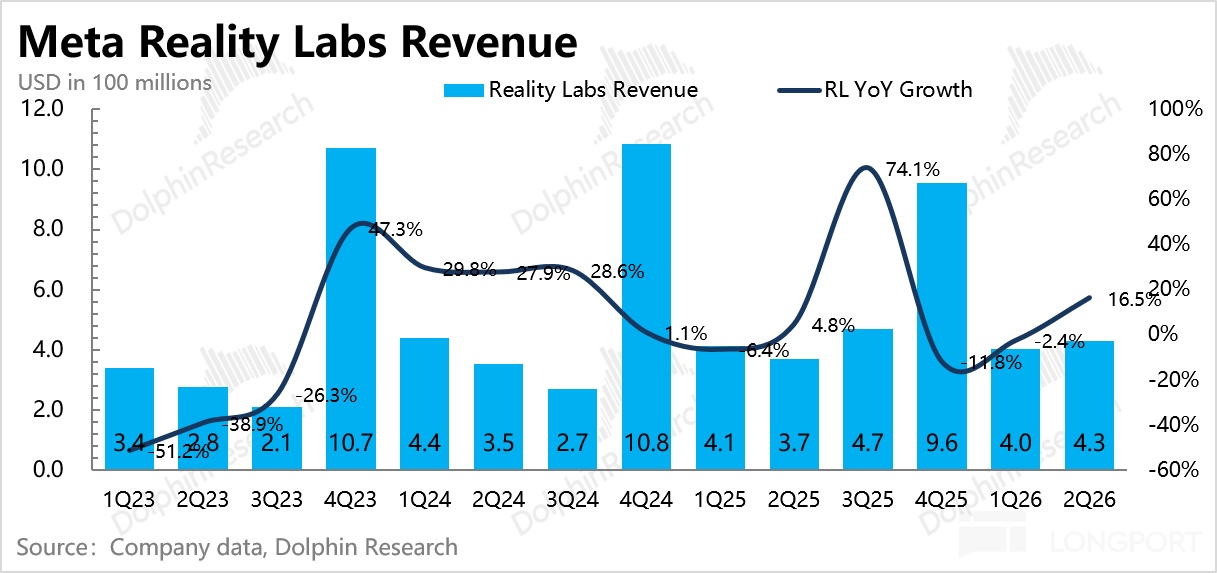
Reality Labs revenue was $430mn in Q2, +16% YoY, aided by three AI glasses launched in Jun.
Meta sold 7mn headsets last year, and more AI glasses should ship this year. But the segment will likely remain in retrenchment to control losses (prior guide: cut $3bn in 2026 spend) and reallocate toward AI models and apps.
II. Layoff chatter rising, AI spend up not down
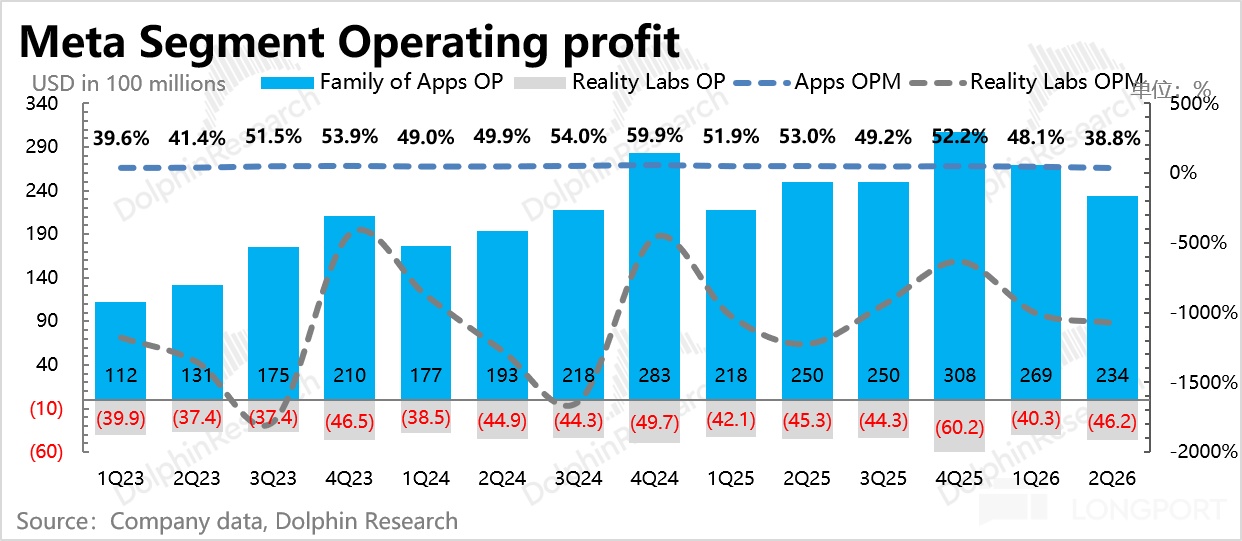
Total Opex rose 65% in Q2, including $2.4bn for legal and $1.2bn for severance, both pushing costs up near term. Beyond that, more AI spend recognition also weighed on profitability.
Headcount fell by 2.5k QoQ in Q1, leading the market to expect lower Opex. But with the $2.5bn legal bill, full-year Opex is up, not down.
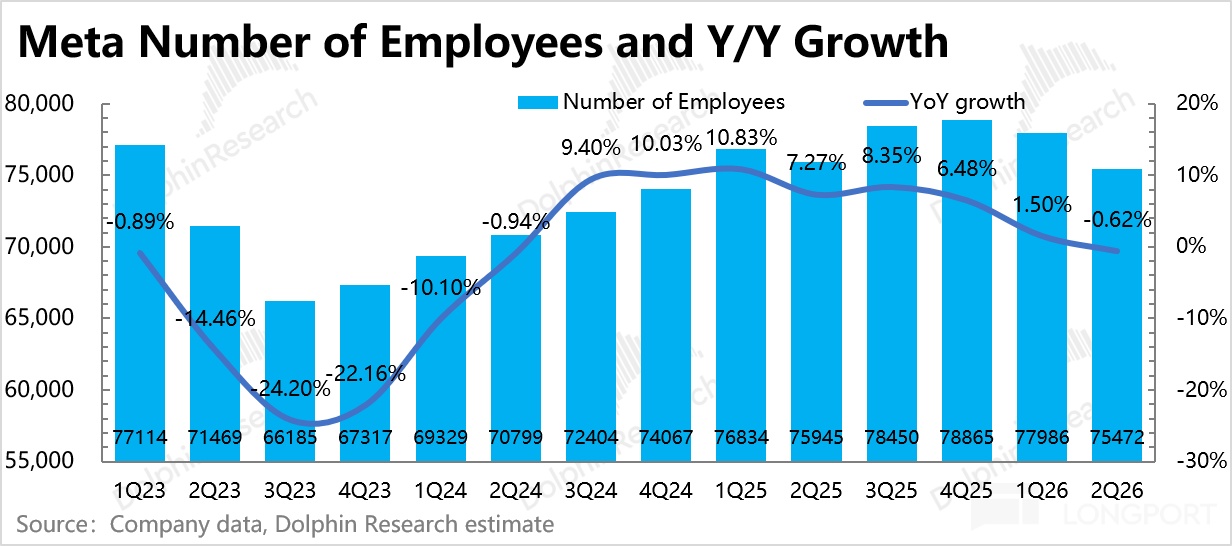
By line, R&D rose 67%, G&A rose 111%, and S&M was up 15%. Even excluding legal and severance, margin compressed QoQ.
Currently, severance, legal, and AI compute costs sit in FoA, which pushed FoA OPM down about 10ppt QoQ.
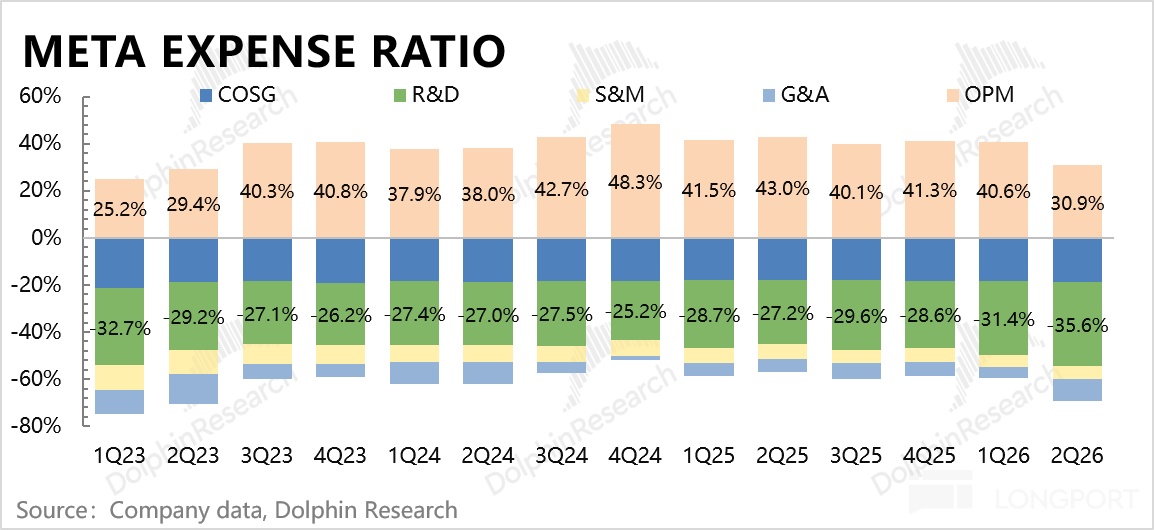
Q2 Capex reached $31.1bn, up by over $10bn QoQ. For 2026, management guides $130–145bn, a minor low-end lift largely on component price inflation.
<End here>
Dolphin Research historical on 'Meta':
Earnings season (past year)
Apr 30, 2026 Call Transcripts: Meta (Trans): AI’s long-run vision goes beyond productivity tools
Apr 30, 2026 Earnings Take: Meta: You can’t brute-force a top model, Zuck is getting anxious again
Oct 30, 2025 Call Transcripts: Meta (Trans): Compute is plug-and-play, no fear of excess
Oct 30, 2025 Earnings Take: Meta: AI spend pedal to the metal — is investor faith running on fumes?
Hot takes
Jul 10, 2026: Leasing out excess vs. building like crazy — the clear game behind a split view on Meta?
Jul 6, 2026: Compute is too expensive — is Meta flipping the table?
Dec 1, 2025: From AI darling to prodigal spender overnight — can Meta fight back?
Dec 8, 2023: Meta’s love-hate with China ADRs: TikTok challenges, Temu gifts
Risk disclosure and disclaimer: Dolphin Research Disclaimer and General Disclosure

Meta Platforms
USMETA

Remark
USMARK

BIG LOTS INC
USBIGGQ

Microsoft
USMSFT

Bio-Techne
USTECH

Alphabet - C
USGOOG

Alphabet
USGOOGL

Alphabet Inc Pref Shares GOOGN 6.25 05/15/2029
USGOOGN
The copyright of this article belongs to the original author/organization.
The views expressed herein are solely those of the author and do not reflect the stance of the platform. The content is intended for investment reference purposes only and shall not be considered as investment advice. Please contact us if you have any questions or suggestions regarding the content services provided by the platform.