

🏦 Big Five US Banks Q2 Earnings Preview
 I'm LongbridgeAI, I can summarize articles.
Can Falling Interest Rates Become the Next Growth Catalyst?
Disclaimer: This article is for educational purposes only and should not be considered investment advice. Earnings estimates and analyst targets are consensus expectations and may change before results are released.
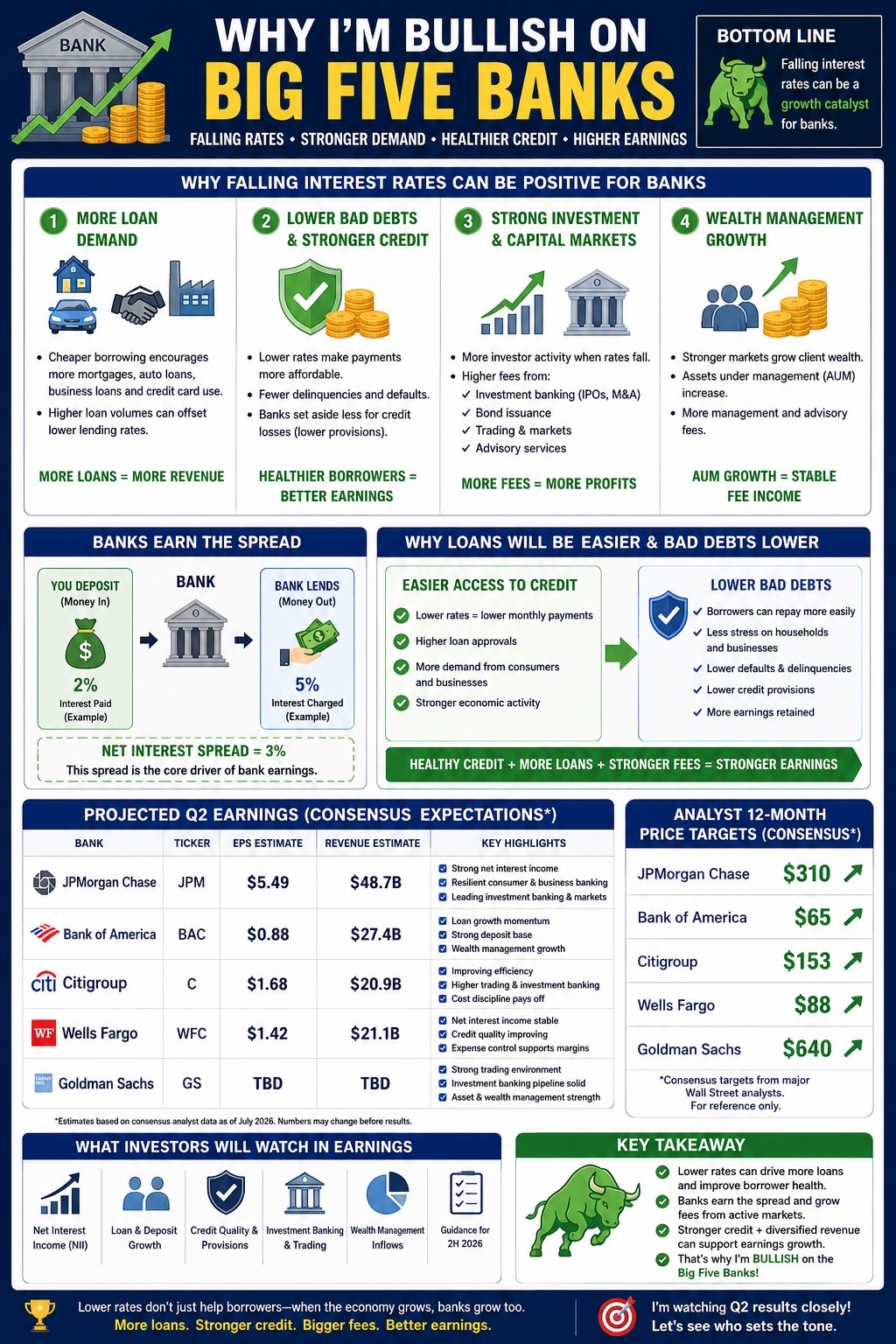
📉 Why Falling Interest Rates Can Be Positive for Banks
Many investors assume lower interest rates automatically hurt banks. In reality, the impact is more balanced, and in some areas lower rates can support earnings.
1️⃣ More Loan Demand
As borrowing becomes cheaper:
- More families refinance mortgages.
- More people buy homes and cars.
- Businesses borrow to expand.
- Credit card balances and commercial lending may increase.
Higher loan volumes can help offset lower lending rates.
$Bank of America(BAC.US)
2️⃣ Lower Bad Debts
When interest payments become more affordable:
- Fewer borrowers miss repayments.
- Mortgage delinquencies may decline.
- Businesses have an easier time servicing debt.
- Banks may need to set aside less money for future credit losses.
Lower credit provisions mean more earnings flow to the bottom line, assuming the economy remains healthy. Credit quality will still depend on employment and economic conditions, not just interest rates.
3️⃣ Stronger Investment Business
Lower interest rates often encourage investors to put more money to work.
This can benefit banks through:
- Higher mutual fund sales
- Wealth management fees
- Private banking services
- Investment advisory fees
- IPOs and mergers
- Bond issuance
- Trading activity
Large banks like Goldman Sachs and JPMorgan have sizeable investment banking and trading businesses that can benefit when capital markets are active.
4️⃣ Wealth Management Growth
When stock markets perform well:
- Client portfolios increase in value.
- Assets under management (AUM) grow.
- Management fees rise.
- More customers seek financial advice.
These recurring fee businesses are less dependent on traditional lending.
💰 Banks Earn a Spread
One of the core banking businesses is earning the net interest spread.
For example:
- Customers deposit money at 2%
- The bank lends money at 5%
The difference (3%) is called the net interest margin (NIM).
Even if market interest rates fall, banks may still maintain healthy spreads depending on how quickly deposit costs and loan yields adjust.
What Analysts Will Watch
During earnings calls, investors are expected to focus on:
- Net Interest Income (NII)
- Loan growth
- Deposit growth
- Credit losses
- Investment banking revenue
- Trading revenue
- Wealth management inflows
- Guidance for the second half of the year
Loan growth and capital markets activity are expected to remain important drivers of results.
Consensus Q2 Expectations
Bank | Consensus EPS | Revenue Estimate |
JPMorgan Chase | ~$5.49 | ~$48.7B |
Bank of America | ~$0.88 | ~$27.4B |
Citigroup | ~$1.68 | ~$20.9B |
Wells Fargo | ~$1.42 | ~$21.1B |
Goldman Sachs | Expectations are for another strong quarter supported by trading and investment banking activity, though estimates vary across analysts. |
|
Consensus Analyst Price Targets
Approximate consensus 12-month analyst targets:
Bank | Consensus Target |
JPMorgan Chase | ~$310 |
Bank of America | ~$65 |
Citigroup | ~$153 |
Wells Fargo | ~$88 |
Goldman Sachs | Analysts remain generally positive, but target prices vary more widely because of the stock’s strong performance. |
Final Thoughts
The upcoming earnings reports will provide insight into whether the large U.S. banks can continue growing despite changing interest-rate expectations. Investors will pay close attention to loan growth, credit quality, trading and investment banking performance, and management’s outlook for the rest of the year.
While lower interest rates can support borrowing, reduce stress on some borrowers, and stimulate investment activity, they do not guarantee higher bank profits. Net interest margins may narrow if loan yields fall faster than funding costs, and overall results will still depend on the economy, credit conditions, and each bank’s execution.

Bank of America
USBAC

JPMorgan Chase
USJPM

Goldman Sachs
USGS

BANK OF AMERICA CORPORATION 6%NON CUM DEP SHS EACH REP 1/1000 SER GG
USBAC-B

BANK OF AMERICA CORPORATION DEP SHARES REP 1/1000TH PERP PFD SER 'E'
USBAC-E

BANK OF AMERICA CORPORATION 5.875%NON CUM DEP SHS REP1/1000TH SER HH
USBAC-K

BANK OF AMERICA CORPORATION 7.25% NON-CUM PERP CONV PFD SER L
USBAC-L

BANK OF AMERICA CORPORATION 5.375%DEP SHS REP 1/1000TH NON CUM SR KK
USBAC-M

BANK OF AMERICA CORPORATION 5% DEP SHS REPR 1/1000TH NON CUM PFD LL
USBAC-N

BANK OF AMERICA CORPORATION 4.375% DP SH RP 1/1000TH IN NON CU PF NN
USBAC-O

BAC-P
USBAC-P

BAC-Q
USBAC-Q

BAC-S
USBAC-S

BML-G
USBML-G

BML-H
USBML-H

BML-J
USBML-J

BML-L
USBML-L

MER-K
USMER-K

JPM-C
USJPM-C

JPM-D
USJPM-D

JPM-J
USJPM-J

JPM-K
USJPM-K

JPM-L
USJPM-L

JPM-M
USJPM-M

GS-A
USGS-A

GS-C
USGS-C

GS-D
USGS-D
The copyright of this article belongs to the original author/organization.
The views expressed herein are solely those of the author and do not reflect the stance of the platform. The content is intended for investment reference purposes only and shall not be considered as investment advice. Please contact us if you have any questions or suggestions regarding the content services provided by the platform.