

 Disney Diamond Holder
 Disney
Part 3 beginner guide to OCBC how I analyse OCBC like a long-term investor.

📈 Beginner’s Guide to Investing in Dividend OCBC Bank
(Part 3)
🏦 How I Analyse OCBC Before Investing – Looking Beyond Dividends
Disclaimer: This article is for educational purposes only and reflects my personal investing process. It is not financial advice. All investments involve risk, and past performance does not guarantee future returns.
🌟 Introduction
In Parts 1 and 2, I shared why I like dividend investing, how dividend yield works, and why I believe patience is one of the biggest advantages an investor can have.
In Part 3, I want to go one step deeper.
When I analyse a company like OCBC, I don’t simply ask, “How much dividend does it pay?”
Instead, I ask a much more important question:
Can this business continue growing and paying dividends for many years?
To answer that question, I study the company’s financial statements, earnings, balance sheet, valuation and business quality.
💰 Earnings Per Share (EPS)
One of the first numbers I look at is Earnings Per Share, or EPS.
EPS tells me how much profit the company earns for each ordinary share outstanding.
Based on the information shown in my screenshots:
- EPS (TTM): 1.65 SGD
- EPS (Last Financial Year): 1.63 SGD
I like seeing stable or growing EPS because it usually means the business is generating more profits for shareholders.
Higher earnings also provide more flexibility to pay dividends while still reinvesting in the business.
For me, EPS is one of the clearest indicators of whether a company is becoming stronger over time.
📈 Revenue and Business Growth
Revenue tells me how much money the business generates before expenses.
For banks, revenue comes from several areas rather than selling physical products.
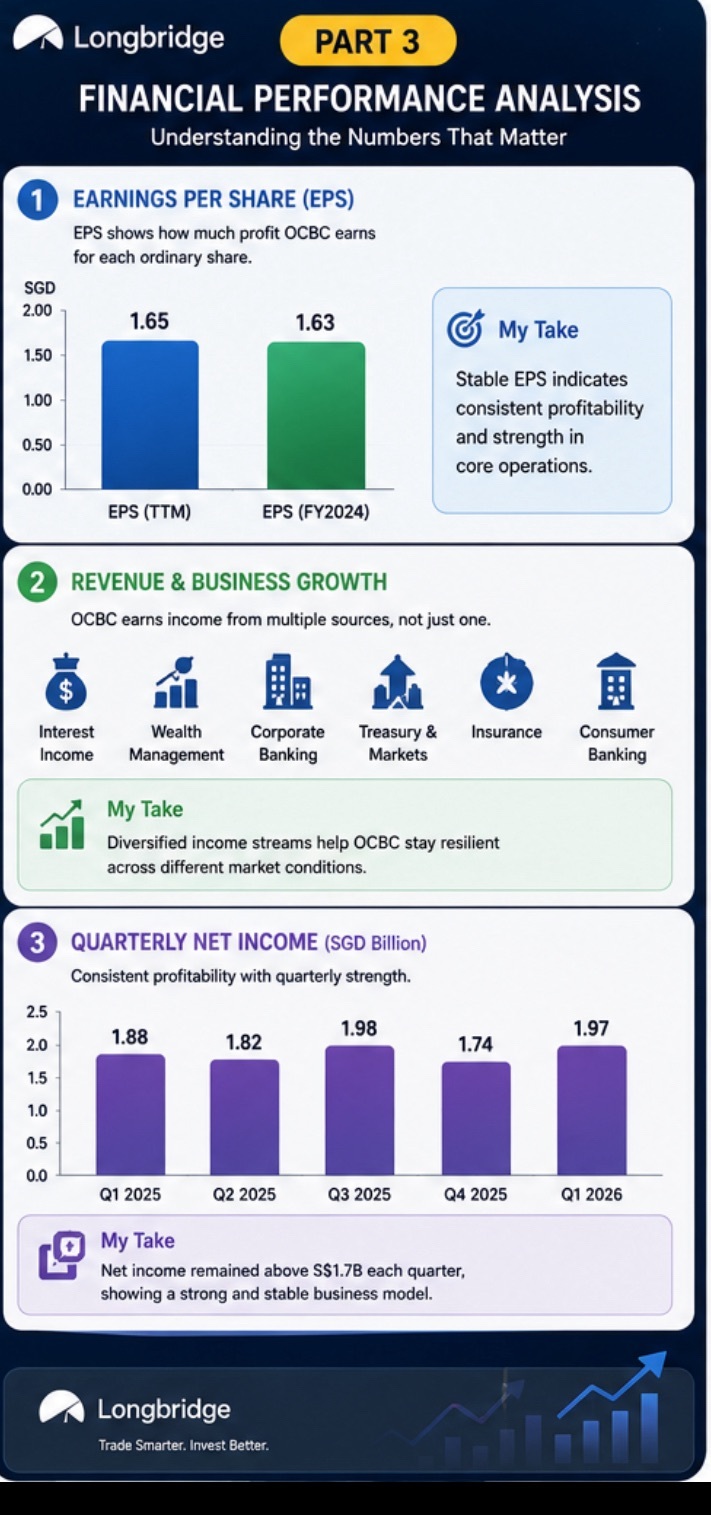
OCBC earns income from:
- Interest on loans
- Wealth management
- Corporate banking
- Treasury and markets
- Insurance
- Consumer banking
One reason I like OCBC is because it doesn’t rely on a single business.
If one segment slows down, another may continue performing well.
That diversification helps make earnings more resilient through different economic conditions.
🏦 Net Asset Value (NAV)
Another number I always pay attention to is the Net Asset Value, often referred to as shareholders’ equity or book value.
For banks, the balance sheet is especially important because they hold significant financial assets and liabilities.
A healthy and growing net asset value tells me the bank is continuing to build long-term value for shareholders.
Strong capital also gives the bank flexibility to expand, absorb losses during difficult periods, and continue supporting dividend payments.
📊 Price-to-Book (P/B) Ratio
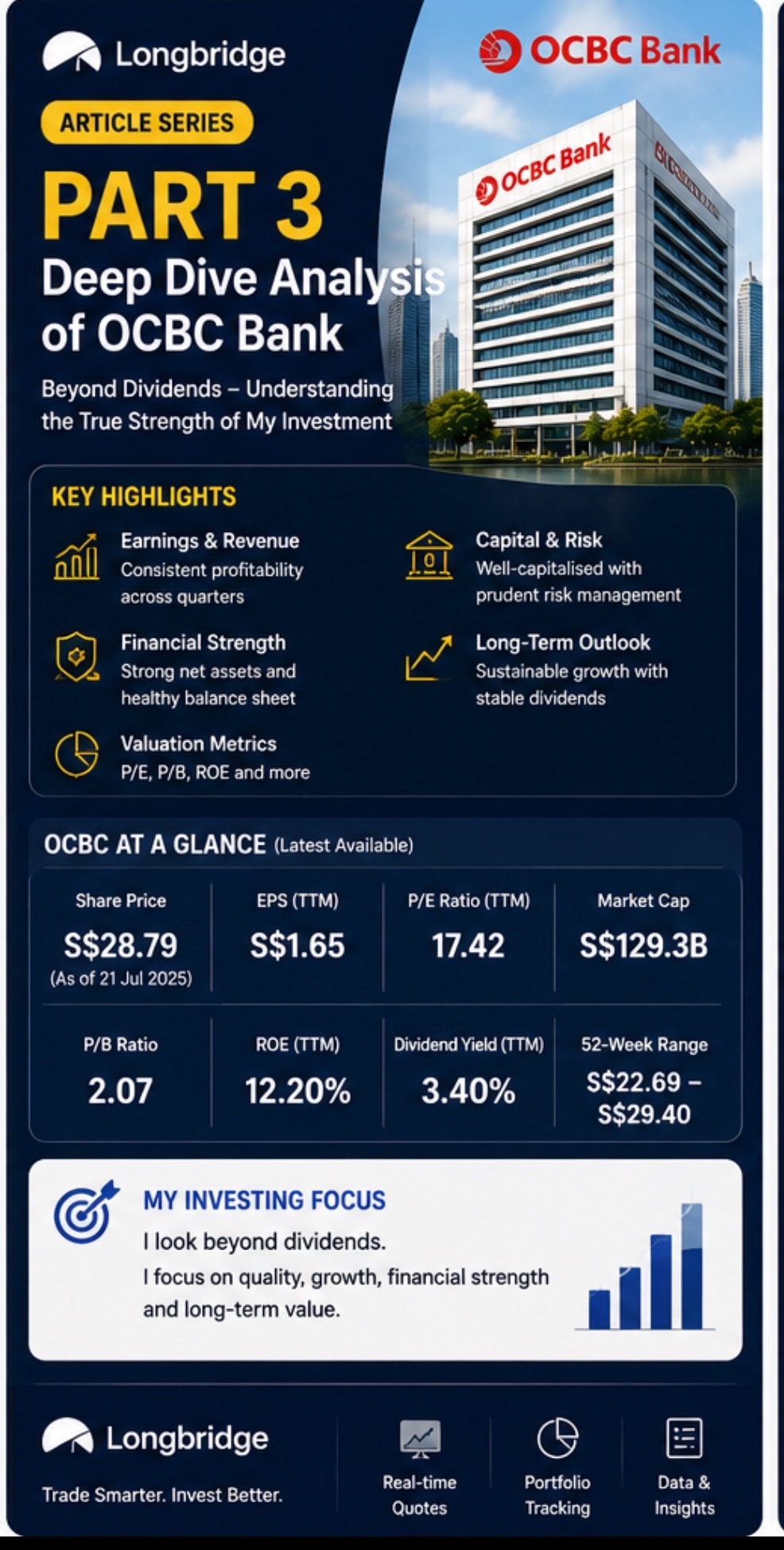
My screenshot shows a Price-to-Book ratio of around 2.07.
For banks, I believe the P/B ratio is one of the most useful valuation measures.
It compares the market price of the bank with its accounting book value.
A higher P/B ratio may indicate that investors are willing to pay a premium because they expect future growth and strong profitability.
However, I never judge a company based on one ratio alone.
I always compare valuation together with profitability, return on equity, earnings growth and dividend sustainability.
💵 Return on Equity (ROE)
The screenshot shows ROE of approximately 12.20%.
ROE measures how efficiently management uses shareholders’ capital to generate profits.
A consistently healthy ROE tells me the company is making good use of the money invested by shareholders.
While a higher ROE is generally positive, I also consider whether it is supported by sustainable earnings rather than excessive leverage.
⚖️ Debt and Financial Strength
Banks naturally carry significant liabilities because customer deposits are part of their business model.
Instead of looking only at debt, I focus on the bank’s overall financial strength.
Questions I ask include:
- Does the bank maintain adequate capital?
- Is it consistently profitable?
- Can it continue supporting lending activities?
- Is it generating sufficient earnings to strengthen its balance sheet?
A financially sound bank is generally better positioned to navigate economic downturns.
📊 Quarterly Net Income
The quarterly results shown in my screenshots demonstrate relatively stable profitability:
- Q1 2025: S$1.88 billion
- Q2 2025: S$1.82 billion
- Q3 2025: S$1.98 billion
- Q4 2025: S$1.74 billion
- Q1 2026: S$1.97 billion
Although quarterly earnings fluctuate, I like seeing consistent profitability above S$1.7 billion.
This gives me confidence that the business remains fundamentally strong.
💲 Valuation
Every great company still needs to be purchased at a sensible valuation.
From my screenshots:
- P/E Ratio (TTM): 17.42
- P/B Ratio: 2.07
- Market Capitalisation: S$129.3 billion
- Current Share Price: S$28.79
These figures help me understand how the market values the business today.
I don’t rely on one ratio. Instead, I combine valuation with earnings, profitability, dividend sustainability and business quality.
🏦 Why I Continue to Like OCBC
There are several reasons why OCBC remains one of the companies I enjoy following.
✔ Strong earnings
✔ Healthy Return on Equity
✔ Stable dividend payments
✔ Diversified banking businesses
✔ Large regional presence
✔ Conservative management
✔ Strong balance sheet
Most importantly, I believe the bank has the ability to continue creating long-term value if it maintains prudent lending, manages risk effectively and adapts to changing economic conditions.
🎯 My Final Thoughts
For me, investing is not about chasing the highest dividend yield or buying whatever stock is trending.
Instead, I want to own businesses that generate consistent profits, maintain strong financial positions and reward shareholders over many years.
When I analyse OCBC, I don’t focus on just one number.
I look at earnings per share, quarterly profits, revenue sources, return on equity, price-to-book ratio, market valuation and the overall quality of the business.
By looking at the complete picture instead of a single metric, I feel more confident making long-term investment decisions.
Although no investment is guaranteed, I believe disciplined research, patience and continuous learning give me the best opportunity to build wealth over time.
As I continue my investing journey, I will keep improving my knowledge, reviewing financial statements carefully and focusing on quality companies rather than short-term market noise.
That is the investing approach I intend to follow for many years to come.
$OCBC Bank(O39.SG)
The copyright of this article belongs to the original author/organization.
The views expressed herein are solely those of the author and do not reflect the stance of the platform. The content is intended for investment reference purposes only and shall not be considered as investment advice. Please contact us if you have any questions or suggestions regarding the content services provided by the platform.
