

Deepseek brings the wave of AI in China, why is Alibaba the leader?

On January 20, 2025, DeepSeek, which was almost unheard of before, released the R1 model, topping the global download charts on both Appstore and GooglePlay just six days after its launch.
Low cost, high performance, open-source, and made by a small Chinese company—these combined features quickly attracted worldwide attention upon DeepSeek's debut, prompting foreign investors to reassess the growth potential of Chinese tech stocks driven by AI, while also rapidly triggering a valuation rebound for the sector.
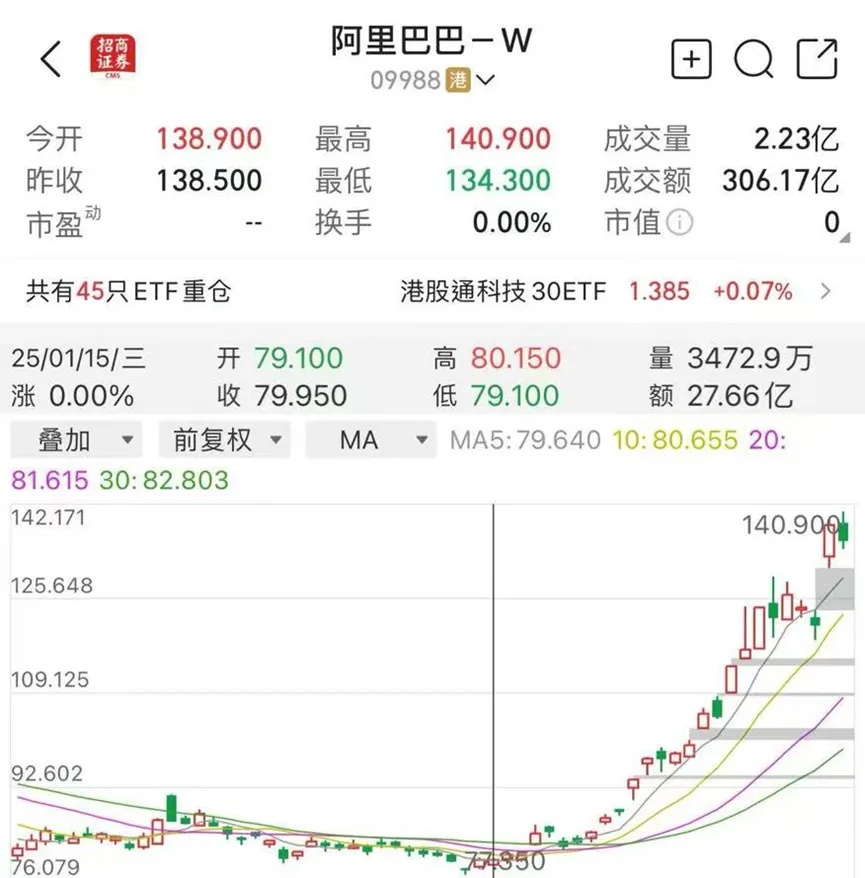
Among these, Alibaba has emerged as the leader in AI tech stocks based on stock price performance. From January 15, when the rally began, to February 24, its stock price has surged nearly 70%.
1. Why Alibaba?
After DeepSeek quickly captured attention, why did Alibaba become the biggest beneficiary and the most sought-after leader by capital?
This can be attributed to two key events during this period:
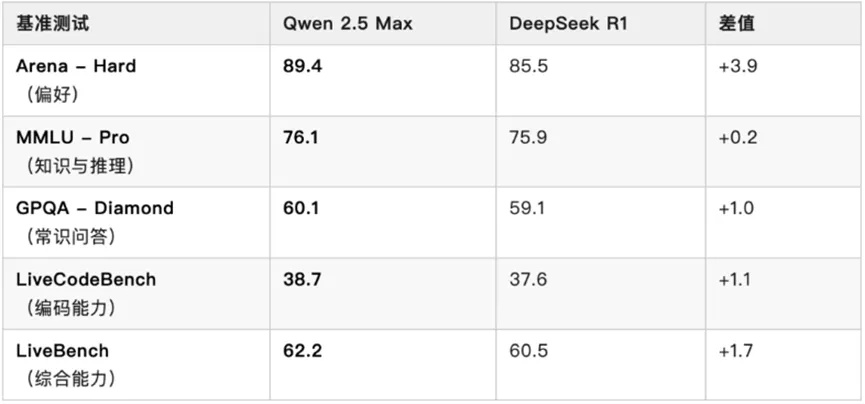
First, at the end of January, Alibaba released its flagship large model Qwen2.5-Max, which achieved world-leading performance in multiple authoritative benchmarks, surpassing DeepSeek.
DeepSeek's emergence highlighted the potential of open-source large models, but among China's open-source models, Alibaba's Tongyi Qianwen remains the leading pioneer.
On February 6, Professor Fei-Fei Li's team at Stanford University announced the successful training of an AI reasoning model named s1 for less than $50. The team stated that s1 performs on par with top models like OpenAI's o1 and DeepSeek's R1 in math and coding tests. Behind s1 is Alibaba's Tongyi Qianwen model.
Second, on February 12, media reported that Apple and Alibaba were collaborating to launch Apple Intelligence in China. The next day, Alibaba's Chairman Joseph Tsai publicly confirmed the news.
Overseas, Apple's AI partner is OpenAI, which effectively positions Alibaba as OpenAI's counterpart in China. This reflects recognition of Alibaba's cloud hybrid capabilities, customer service, and multimodal large model expertise—solidifying its leading position in the AI industry.
2. Alibaba's AI Strategy
Once seen by Charlie Munger as "that damn retailer" and valued purely as an e-commerce company, Alibaba has undergone a transformation.
This shift was evident in Alibaba's latest earnings report on February 20 and the subsequent earnings call, where AI replaced e-commerce as the hottest topic. Management disclosed more details about its AI initiatives to investors.
What exactly is Alibaba's AI strategy, and how might it contribute to the company's future?
Group CEO Eddie Wu outlined three key areas where Alibaba will focus its AI investments over the next three years:
1) AI and cloud computing infrastructure;
This is the most certain part of Alibaba's AI strategy and the underlying reason for its gains after DeepSeek's emergence.
Eddie Wu's analogy during the call explains the logic: "If AI is the electricity of the new era, then Alibaba Cloud is the power grid delivering it."
If AGI is achieved, it could replace 50% of global GDP. Such massive computational demands will only be efficiently met via cloud networks. DeepSeek's rise has demonstrated the possibility of low-cost, high-performance models, driving further exploration in this direction—all of which relies on cloud computing support.
Alibaba Cloud ranks fourth globally and first in Asia, with leading models, technology, and network effects, making it the go-to choice. For example, five of China's top six large model developers—Zhipu, MiniMax, Moonshot AI, Baichuan, and 01.AI—train their models on Alibaba Cloud. This creates a virtuous cycle where Alibaba Cloud grows stronger.
On February 24, Eddie Wu announced that Alibaba will invest over 380 billion yuan in cloud and AI hardware infrastructure over the next three years—exceeding its total investments in the past decade. This massive commitment reflects high confidence in this direction.
2) AI foundational model platform and native applications;
Here, Alibaba currently holds a technological lead. Its future goals are:
First, maintaining this lead.
As mentioned earlier, Alibaba's Tongyi Qianwen surpasses DeepSeek in global benchmarks.
However, AI is still in its early, rapidly evolving stages. Just as few predicted DeepSeek's rise in early 2025, the final market landscape remains uncertain. Still, Alibaba's models have a higher probability of sustained success.
Second, increasing monetization.
Since Tongyi Qianwen is open-source, revenue is primarily generated through API access, which remains relatively low. As model capabilities improve, pricing may rise.
More importantly, Alibaba's models and cloud services can reinforce each other: developers using Tongyi Qianwen's API are more likely to deploy on Alibaba Cloud, boosting cloud revenue. Alibaba can also cross-sell other cloud-based products to these developers.
3) AI-driven transformation of existing businesses;
Alibaba's latest earnings show its Cloud Intelligence Group returning to double-digit growth, with revenue up 13.1% to 31.742 billion yuan. AI-related products have now delivered triple-digit growth for six consecutive quarters—an encouraging sign.
However, cloud revenue still only accounts for 11.33% of Alibaba's total. For AI to significantly impact performance, it must transform core businesses:
i) E-commerce as a lifestyle hub: For example, Taobao will use AI to enhance engagement and transaction efficiency, while introducing new AI-driven value.
ii) AI for consumers: Mainly through Quark and Tongyi apps. Quark, China's top AI search product, will further integrate AI to improve search, productivity, and efficiency.
iii) AI for businesses: DingTalk is redefining enterprise collaboration with AI, while Amap, with 170 million daily active users in China, aims to become a lifestyle and local services gateway through deeper AI integration.
3. Can Alibaba Succeed in Going All-In on AI?
A 70% surge from lows primarily reflects valuation expansion due to shifting expectations—not earnings growth (though e-commerce did show positive trends in the latest quarter).
These expectations stem from AI-driven growth potential.
Before DeepSeek, Chinese internet firms faced a similar dilemma: cost-cutting boosted profits, and strong cash flows supported buybacks, but weak growth prospects were a consensus concern.
DeepSeek's arrival revealed that high-performance AI could be achieved at much lower costs: "We once thought AI was a mountain everyone was climbing. Now, we see it as an ocean—full of exploration opportunities."
This quote captures China's internet landscape. Unlike the past, where only giants could afford AI R&D, now even small firms and individuals are diving into AI—reviving investor expectations for growth and returning to an era of "growth through investment."
As a leader, Alibaba has elevated AI to unprecedented importance, almost going "all-in." Behind this:
First, its leading open-source models are more likely to sustain success.
Second, even if its models falter, more companies adopting AI will fuel demand for Alibaba Cloud—the "power grid"—ensuring high-growth certainty.
$Alibaba(BABA.US) $Invesco Golden Dragon China(PGJ.US) $BABA-W(09988.HK)
The copyright of this article belongs to the original author/organization.
The views expressed herein are solely those of the author and do not reflect the stance of the platform. The content is intended for investment reference purposes only and shall not be considered as investment advice. Please contact us if you have any questions or suggestions regarding the content services provided by the platform.
