

Xiaomi's massive placement, Lei Jun is playing a bigger game...

As a long-term shareholder who has witnessed Xiaomi's multiple capital operations, when I saw the news that Xiaomi Group was seeking to raise $5.3 billion through a top-up placement, I felt like I was seeing myself being beaten by the market six years ago after the placement at HKD 26. But this time, it's different.
The top-up placement model means that Xiaomi first buys shares from major shareholders and then sells them to institutions at a discounted price of HKD 53.7, $XIAOMI-W(01810.HK) $Xiaomi Corporation(XIACY.US), and then issues new shares to return to these major shareholders. The share capital increases, and the shares of existing shareholders will be diluted. Tesla was forced to issue new shares at $215 in 2016 during the Model 3 production hell. In contrast, Xiaomi now has a cash reserve of 140 billion yuan but still chooses to raise funds at a high valuation. Clearly, Lei Jun is playing a bigger game.
I have been holding Xiaomi shares since 2020, and it has been five years now. I have always been bullish on Xiaomi. Although I was trapped for four out of these five years, it doesn’t affect my confidence in Xiaomi. Xiaomi actually conducted a top-up placement back in 2020, and I remember it vividly. At that time, the stock price was around HKD 24, and after the placement, it surged to HKD 32. I thought if it could reach HKD 40, I would sell all my shares. As we all know, the stock price plummeted afterward, hitting single digits at its lowest, and only recovered this January.
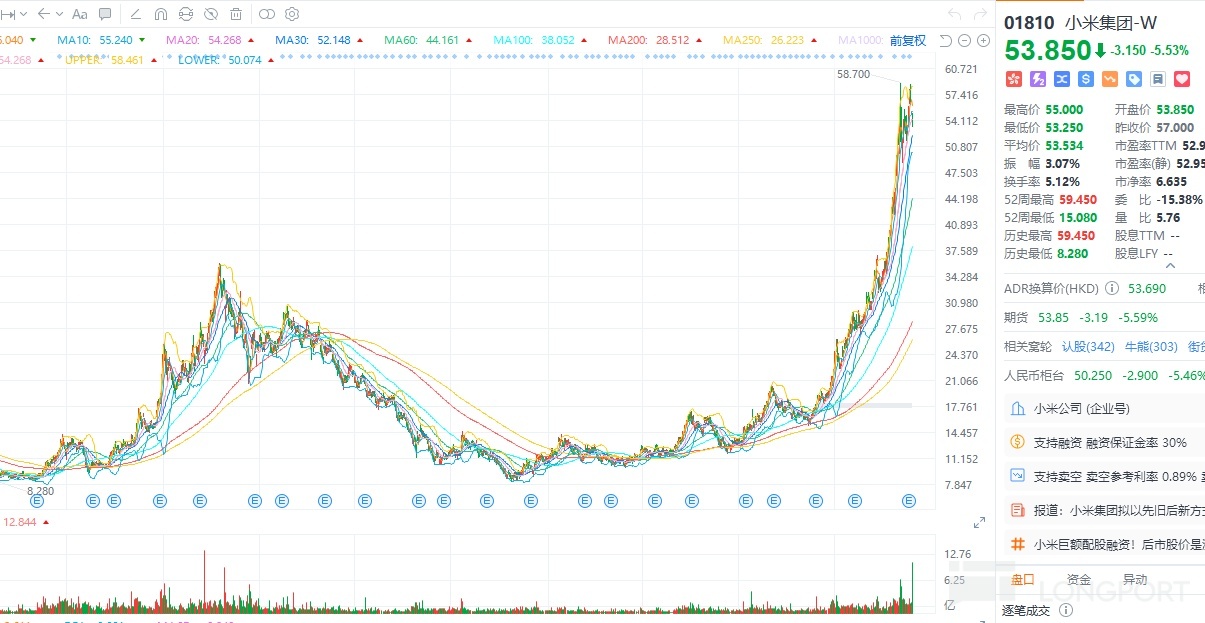
Back then, Xiaomi raised funds to push into the high-end market, requiring substantial capital for global expansion and 5G R&D. Many investors doubted Xiaomi's high-end strategy, thinking it was unreliable and felt betrayed. But now, looking back, Xiaomi has become the world's second-largest smartphone vendor by market share, and its stock price has not only rebounded but also hit new highs. This proves that Xiaomi was on the right path.
This time, Xiaomi's placement might be driven by several factors. First, its new energy vehicle, the SU7, has seen explosive demand, with 350,000 units scheduled for delivery in 2025. Expanding the Wuhan factory will require significant investment. Second, Xiaomi aims to make a mark in AI, investing in large models and robotics, with plans to spend 100 billion yuan over the next five years. Third, Xiaomi plans to expand its new energy vehicles globally, requiring substantial supply chain funding. Currently, Xiaomi loses 45,000 yuan on every car produced and will need continuous capital infusion.
Xiaomi is currently riding high, with its stock price at a peak and substantial cash reserves. The sudden placement has angered shareholders, who feel the company is being unfair. However, as an investor, the most important thing is long-term vision. Stocks are bought based on expectations, so from a strategic perspective, this placement makes sense. The tech industry is cyclical, and raising funds when the stock price is high avoids the need to sell assets at a discount during downturns. Tesla's 2016 placement during its production crisis was a forced move.
In the short term, the placement is bearish for the stock price. Institutions getting shares at HKD 53.7 will likely create selling pressure. After the 2020 placement, Xiaomi's stock price dropped over 10% the same day. But in the long run, if car production and deliveries meet expectations, AI R&D breakthroughs occur, and Xiaomi's IoT ecosystem drives revenue growth, the stock could rally again. Referencing the 2020 placement, where the stock surged from HKD 26 to HKD 33 shortly after, Xiaomi might see a similar short-term bounce.
However, two variables warrant caution: First, SU7's delivery promise—if the 350,000-unit target is missed, the market will react harshly. Second, the 45,000-yuan loss per car means monthly cash burn exceeding 1.3 billion yuan at current delivery rates, testing Xiaomi's ecosystem profitability. For Xiaomi, the decisive moment is 2026. If the car business turns profitable as planned, current valuations are just the beginning. But if AI models fail to materialize, trillion-yuan market cap could lose 30% overnight.
From a capital structure perspective, this placement essentially trades a 5.8% short-term discount for strategic flexibility over the next three years. Tesla's 2016 placement happened with an 85% debt-to-asset ratio, while Xiaomi's cash reserves now account for 35% of total assets. Raising funds at a trillion-yuan valuation is Lei Jun's calculated move. With the YU7 pure-electric SUV (a Model Y competitor) launching soon, replicating SU7's success (135,000 deliveries in nine months) and expanding into Southeast Asia could create another growth engine.
Lei Jun's strategy is to use capital markets to bet on the convergence of smart cars and AI. Just as he once gambled on high-end phones, he's now betting on the ultimate integration of human-car-home ecosystems.
The copyright of this article belongs to the original author/organization.
The views expressed herein are solely those of the author and do not reflect the stance of the platform. The content is intended for investment reference purposes only and shall not be considered as investment advice. Please contact us if you have any questions or suggestions regarding the content services provided by the platform.
