

Trump's reciprocal tariffs are essentially a prisoner's dilemma (viewing tariff issues from game theory perspective)

In the previously published article "Others laugh at me for being too crazy, I laugh at them for not seeing through! On Trump," it was written that Trump likely adopted the strategy of befriending the distant and attacking the near.
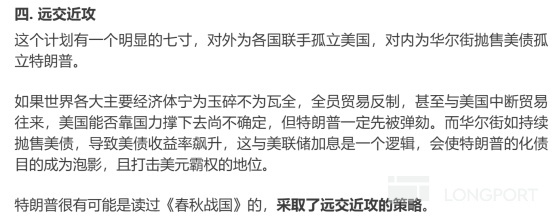
In reality, this perspective isn’t wrong, but there’s one issue: he didn’t "befriend" the EU, Japan, South Korea, etc. Instead, he treated all founding members equally, though some were given a band-aid and a pat on the shoulder after creation.
Therefore, perhaps the Prisoners’ Dilemma is a more appropriate framework to explain the current situation.
1. What is the Prisoners’ Dilemma?
The Prisoners’ Dilemma is a classic non-zero-sum game model in game theory, illustrating the basic logic of Nash Equilibrium. The scenario is as follows: two accomplices in crime are interrogated separately and face the choice of remaining silent or betraying the other.
1. If both remain silent, due to insufficient evidence, each serves 1 year;
2. If one betrays while the other remains silent, the betrayer goes free, and the silent one serves 10 years;
3. If both betray, each serves 5 years.
From an individual’s self-interest, betrayal is the optimal strategy regardless of the other’s choice—if the other remains silent, betrayal leads to freedom; if the other betrays, silence results in a harsher penalty. This individual rationality leads both to betray, resulting in a collective irrational outcome where both serve 5 years, worse than if both had remained silent.
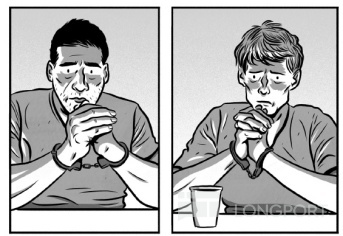
1. The "Prisoners’ Dilemma" Between Trump and Other Nations
In the tariff issue, Trump plays the role of the "police," while other nations act as "prisoners." We can observe that after Trump unveiled his Excel tariff list, he consistently offered "carrots," signaling "those who submit will prosper, those who resist will perish." First, he exempted tariffs for 75 countries for 90 days, then claimed progress with Japan, and now asserts a 100% chance of reaching a deal with the EU.
What is he afraid of? He fears major economies uniting to resist the U.S. and Trump. Thus, he aims to divide and conquer, pulling some closer while targeting others.
In the classic Prisoners’ Dilemma, the payoffs for the three scenarios are -1, 10, and -5. If this were the case, other nations might have no chance of victory. Fortunately, reality is different.
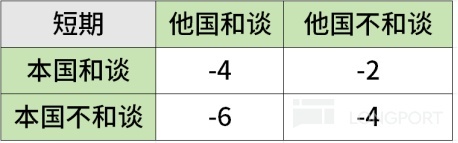
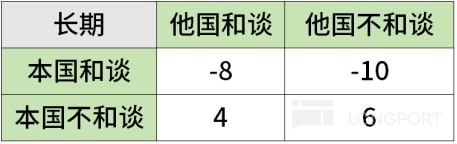
1. If all nations resist U.S. tariff policies and support each other without negotiation, they may face short-term U.S. sanctions but can export to allied nations (payoff: -4). Long-term, if they succeed in dismantling U.S. hegemony and attract the outflow of U.S. advanced technology, they will significantly benefit (payoff: 6).
2. If some nations yield and negotiate with the U.S., they may suffer short-term losses (payoff: -2) but avoid severe blows. However, long-term subjugation to the U.S. would be inevitable, akin to Japan’s "Plaza Accord" (yen appreciation, trade competitiveness decline, and 30 years of economic stagnation; payoff: -10). For nations resisting negotiation, short-term trade sanctions (payoff: -6) would be offset by long-term independence and industrial localization (payoff: 4).
3. If all nations negotiate, they lose bargaining power, suffering short-term exploitation (payoff: -4) and long-term consolidation of U.S. hegemony, reducing them to "granaries" for U.S. exploitation—the worst outcome (payoff: -8).
In summary, from a short-term perspective, choosing negotiation yields higher payoffs regardless of others’ choices, leading to a Nash Equilibrium where all nations negotiate—precisely what the U.S. desires.
However, from a long-term perspective, resisting negotiation yields better payoffs regardless of others’ choices. A Nash Equilibrium where all nations resist and unite against the U.S. would maximize collective benefits—Trump’s nightmare.
3. Short-Term Gains or Long-Term Development?
The dilemma arises: short-term logic favors negotiation, while long-term logic favors resistance. The question boils down to whether nations prioritize immediate gains or future development. Under the assumed data, if nations weigh short-term outcomes over 60% (long-term under 40%), they will negotiate; otherwise, they will resist.
As Lu Xun once said: "If you don’t erupt in silence, you perish in silence."
Today, feudal hereditary systems have vanished, and leaders/officials typically serve only a decade or so. From self-interest, ensuring a smooth tenure is paramount—future consequences are irrelevant. Thus, most nations choose negotiation, except one Eastern power that understands "a single punch now avoids a hundred later" and resists to the end.
Of course, reality is far more complex. For example, some small nations rely on the U.S. for economic survival, or collective resistance requires subsidizing weaker allies. But the broader direction holds.
To conclude, I’d like to dedicate a song to all nations suffering U.S. tariff pressure:
"Arise..."
$NASDAQ Composite Index(.IXIC.US) $Apple(AAPL.US) $NVIDIA(NVDA.US) $Dow Jones Industrial Average(.DJI.US) $Tesla(TSLA.US) $2x Long VIX Futures ETF(UVIX.US)
The copyright of this article belongs to the original author/organization.
The views expressed herein are solely those of the author and do not reflect the stance of the platform. The content is intended for investment reference purposes only and shall not be considered as investment advice. Please contact us if you have any questions or suggestions regarding the content services provided by the platform.
