

The lie of 'stability'? Can stablecoins bear the weight of the future monetary system?

Recently, stablecoins have been gaining significant attention, and their performance has indeed been impressive. Some even see them as the prototype of "future currency." However, just as everyone was optimistic about their prospects, the Bank for International Settlements (BIS) poured cold water on the idea. In the special chapter "The Future Monetary and Financial System" of its latest annual report, BIS clearly indicated: Stablecoins are not the pillar of the future monetary and financial system.
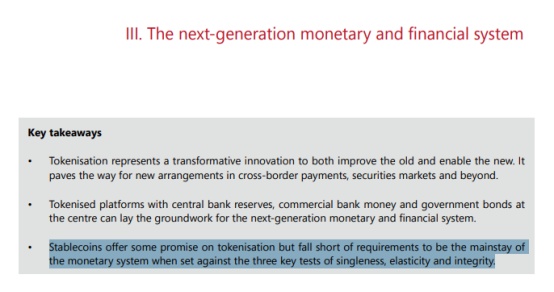
To be honest, this view is completely contrary to market sentiment. BIS's stance is straightforward: It acknowledges the utility of tokenization technology but argues that the real backbone of the financial system should be central bank reserves, bank deposits, and government bonds. As for stablecoins? Because they fail the three key tests of money—singularity, resilience, and financial integrity—BIS believes they simply don’t qualify.
Of course, it’s natural for BIS, as a central bank, to hold this view. As investors, we may have different perspectives, and that’s not contradictory. Today, I’d like to share my thoughts.
Why BIS Believes Stablecoins Are Not the Pillar of the Future Monetary and Financial System
In summary, BIS argues that stablecoins lack the credit backing of central banks, cannot expand like traditional banks, and operate in a regulatory gray area. Simply put, BIS sees stablecoins more as digital financial assets rather than universally accepted, genuine currency. Additionally, it raises concerns about redemption risks and the potential impact on sovereign currencies. Overall, BIS does not believe stablecoins can serve as the pillar of the monetary and financial system.
Having shared BIS’s perspective, I’d like to offer my own view: Stablecoins may not be the sole pillar, but they will undoubtedly play an indispensable role.
Why? The answer boils down to one word—demand. In certain areas, stablecoins already serve irreplaceable functions, such as cross-border payments, DeFi transactions, and pricing crypto assets. These applications are nearly impossible without stablecoins, not to mention their role as a "lifeline" for countries with high inflation.
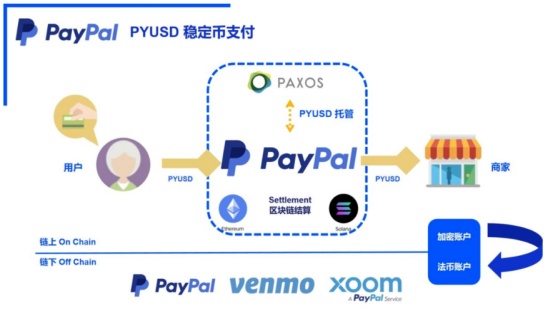
For example, $Visa(V.US) and $Mastercard(MA.US) have begun supporting USDC as a payment method, while U.S.-based $Paypal(PYPL.US) has its own stablecoin, PYUSD. This shows that mainstream financial institutions are not resistant to stablecoins but are, in fact, embracing them.
More realistically, $Circle(CRCL.US)’s USDC and Tether’s USDT have become the "de facto currency" for cross-border payments, asset hedging, and even gray-market transactions in many countries. Their usage and acceptance far exceed the expectations of traditional financial institutions. What does this mean? The market is clearly signaling that, regardless of official recognition, stablecoins have already functionally replaced traditional money in certain contexts.
But if you think this will quickly overturn the traditional banking system, I believe it won’t happen that fast. At their core, stablecoins are still pegged to the U.S. dollar, rely on centralized institutions for credibility, and often operate in regulatory gray areas.
Therefore, I see stablecoins more as a bridging tool—not the end goal but a critical transitional bridge between traditional fiat and digital finance.
Conclusion: Stablecoins Are Not the Pillar, But They Are Undoubtedly Part of the Framework
In summary, my view is clear: Stablecoins may not become the core pillar of the entire financial system—that role likely still belongs to central bank money, commercial banks, and bonds, the "orthodox players." However, their presence and importance far exceed that of a "supporting role." Especially in the context of global payments, asset digitization, and financial infrastructure transformation, stablecoins act as a key "connector"—they may not be the foundation, but they are certainly part of the supporting framework.
So, stablecoins don’t need to "win everything." As long as they can firmly secure their place, that alone is a significant victory.
$Tesla(TSLA.US) $Apple(AAPL.US) $Coinbase(COIN.US) $AMD(AMD.US) $NVIDIA(NVDA.US) $Micron Tech(MU.US)
The copyright of this article belongs to the original author/organization.
The views expressed herein are solely those of the author and do not reflect the stance of the platform. The content is intended for investment reference purposes only and shall not be considered as investment advice. Please contact us if you have any questions or suggestions regarding the content services provided by the platform.
