
财

Jul 15, 2025 at 09:51 PM
圆圈。
 I'm LongbridgeAI, I can summarize articles.
Shelly previously mentioned several major trends in U.S. stocks (including artificial intelligence, cryptocurrencies, rare earths, and innovative drugs) and recommended related concept stocks. Many friends wanted to learn more about stablecoins, so today Shelly will discuss them.
Background of Stablecoins.
Since May, driven by legislative progress in Hong Kong, the stablecoin sector has seen a global surge. In June, the U.S. Senate formally passed stablecoin legislation, establishing regulatory rules for cryptocurrencies pegged to the U.S. dollar, marking a milestone victory for the crypto community. On July 14, China Merchants International was approved for a virtual asset license, becoming the first Chinese securities firm in Hong Kong to obtain such a license. Today, China Merchants Bank's stock opened 15% higher. Currently, over 40 companies in Hong Kong are preparing to apply for virtual asset licenses.
Cost savings are the most direct motivation for retail giants to join the stablecoin wave. Under the existing payment system, merchants must pay a certain percentage of fees for every transaction completed through third-party payment platforms. As a result, domestic and international giants have begun targeting stablecoins. $Amazon(AMZN.US), $Walmart(WMT.US), two major retailers, plan to launch their own stablecoins, which could save them billions annually. Ant Group has announced plans to apply for stablecoin licenses in Hong Kong and Singapore. $JD.com(JD.US) will issue a public blockchain-based stablecoin in Hong Kong. $STANCHART(02888.HK) has also officially submitted an application for a Hong Kong dollar stablecoin license.
What are stablecoins?
Stablecoins, a type of cryptocurrency, are called "stable" because their value is relatively stable compared to fiat currencies. For example, dollar-pegged stablecoins like USDT and USDC maintain a 1:1 ratio with the U.S. dollar. Stablecoins inherit the properties of cryptocurrencies while avoiding the volatility of other coins, making them better suited as payment methods within the crypto ecosystem. Their 1:1 peg to the dollar ensures that any deviations in price create arbitrage opportunities that self-correct.
How about Circle?
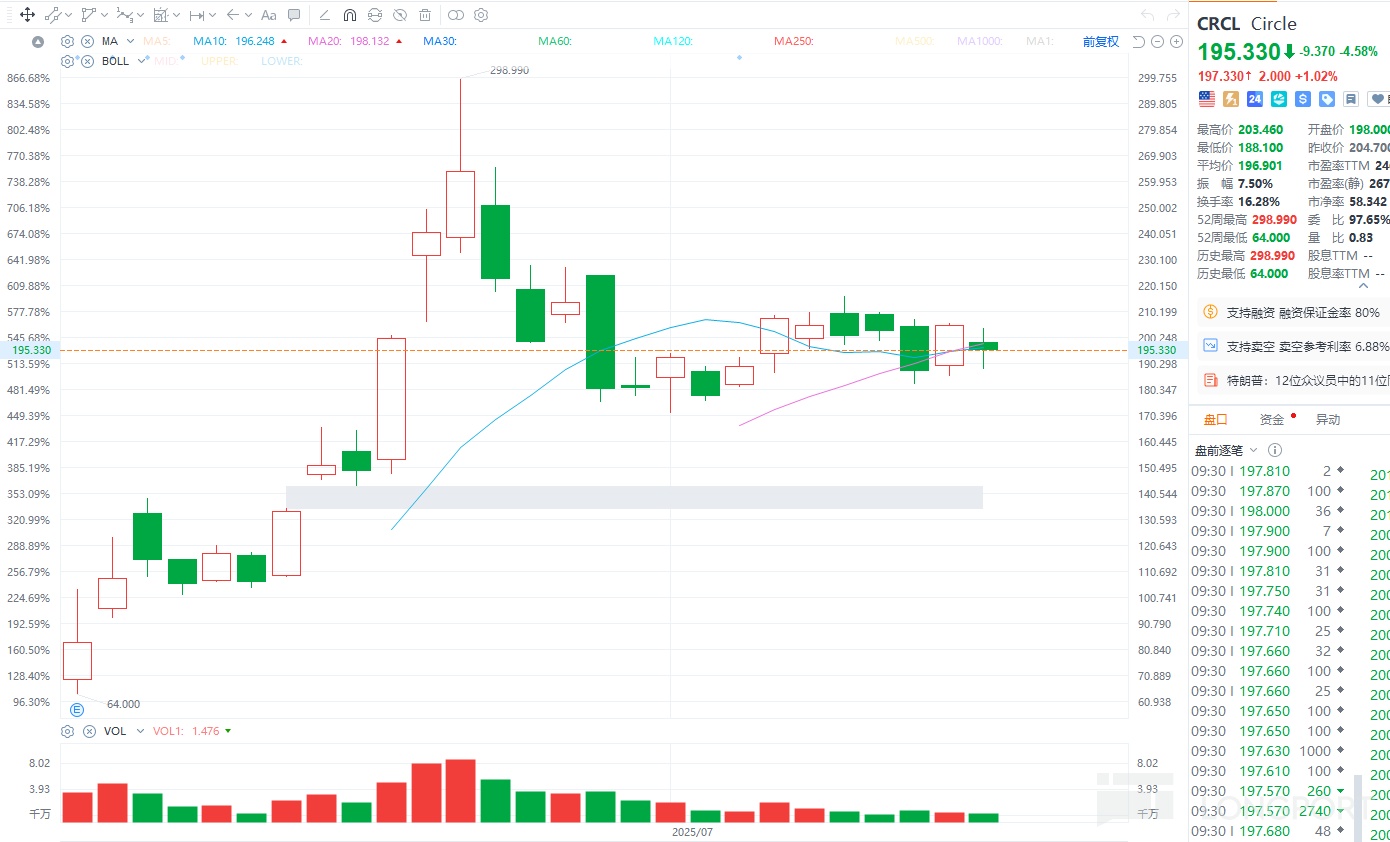
On June 5, Circle's stock CRCL went public. Within ten days, its price surged from the IPO price of $31 to a high of $298.99, a tenfold increase. Last night, it rose another 33.82%. Citigroup predicts that, driven by regulatory support and institutional adoption, the stablecoin market could reach $3.7 trillion by 2030 under optimistic scenarios.
Circle issues stablecoins and receives U.S. dollars in return, which generate interest income. However, the issued stablecoins do not require interest payments, creating a spread income. With U.S. interest rates still relatively high (overnight rate at 4.25%-4.5%), interest income is a major revenue source for stablecoin issuers. Essentially, Circle uses user dollars to buy U.S. Treasuries, earning stable interest—its primary income stream. Thus, its revenue scales almost linearly with issuance size (or market demand).
In 2024 data, only $150 million of its $1.6 billion revenue was profit, due to high distribution costs of $1.1 billion. Coinbase alone accounted for $900 million of these costs, as USDC was initially co-issued by Circle and Coinbase. Although Circle later acquired Coinbase's shares, a new distribution agreement was signed, stipulating that 100% of interest income from USDC held on Coinbase goes to Coinbase. This agreement, signed in 2023, renews every three years. If renegotiated next year to reduce distribution costs from 60% to 30%, Circle's profit margin could significantly improve.
Is CRCL overvalued now?
CRCL's current P/E ratio is 150x, on par with Tesla, while Coinbase and NVDA are only around 40x. For a company with linear revenue and thin margins, such a high valuation raises questions. But Circle's future is more complex. Its valuation hinges on future scale expansion; long-term, its P/E may not be high.
Should you invest in CRCL?
Investment success requires outperforming expectations. If expectations are merely met, no matter how good the asset, gains are limited because future returns are already priced in. If the U.S. or Europe pass stablecoin laws, adopt them widely, tokenize Treasury bonds on-chain, or if global banks integrate stablecoins, USDC and USDT—as first movers—could become global financial infrastructure like SWIFT or payment networks like VISA. This would not only generate hefty fees but also boost demand for USDC, vastly increasing its managed assets and wealth management income. By then, Circle could transform from a modest profit-maker into a behemoth over the next 5-10 years.
Circle's potential is rare, meeting these criteria:
1. Relatively low market cap;
2. High certainty of future trends;
3. Potential for massive upside surprises;
4. First-mover advantage.
What's the entry point for CRCL?
The stock is currently testing the 10- and 20-day moving averages in a narrow range. A gap below between 134-143 needs filling, but the required pullback is significant. To avoid missing out, consider adding at 153.
Thus, Circle's current P/E is meaningless—its future holds too many potential surprises. Investing isn't about the present but assessing probabilities of the unknown.
Regardless of Circle's P/E or market views, I'll keep adding—it's my vote for the future.$IFBH(06603.HK) $NVIDIA(NVDA.US) $Tesla(TSLA.US) $Invesco QQQ Trust(QQQ.US) $SPDR S&P 500(SPY.US)


The copyright of this article belongs to the original author/organization.
The views expressed herein are solely those of the author and do not reflect the stance of the platform. The content is intended for investment reference purposes only and shall not be considered as investment advice. Please contact us if you have any questions or suggestions regarding the content services provided by the platform.