


Oriental Selection's 25% surge turned into a 21% plunge, Nvidia aims for 5 trillion: Should we chase in the short term or wait for a pullback?
 I'm LongbridgeAI, I can summarize articles.
The stock price of Oriental Selection has surged nearly 300% in the past year, with the core logic being the successful strategic transformation from 'anchor-driven' to 'product-driven.' After reducing reliance on top anchors like Dong Yuhui, the company has built a new growth engine through its self-operated product system: SKUs exceeded 600, with bestsellers like sanitary napkins selling out 180,000 units in 48 hours. Self-operated GMV rose to 39%, and gross margin jumped from 10% to 21%. Membership economics also showed significant results, with 250,000 paying members (annual fee of 199 yuan) contributing an 86% repurchase rate, while the private domain ecosystem reduced traffic costs. Profitability improved markedly, with operating margin rising from 3% to 7%, further boosted by the 'substitute' expectations from Sam's Club's trust crisis and the overall strength of the consumer sector.
However, concerns remain: reliance on third-party logistics for supply chain, weaker heavy-asset investment compared to Sam's Club, and the risk of quality control amplification as SKUs expand under a single brand. The membership size (250,000) lags far behind Sam's Club (9 million). Whether it can truly become the 'online Sam's Club' depends on its ability to balance expansion with refined operations and convert user trust in anchors into loyalty to the product system. In the end, retail belongs to productists.
Today's market movement was a real rollercoaster—soaring nearly 25% in the morning, only to plunge by 21% in the afternoon. Up 20%, down 20%, not easy!
After the market closed, Yu Minhong came out to debunk rumors.
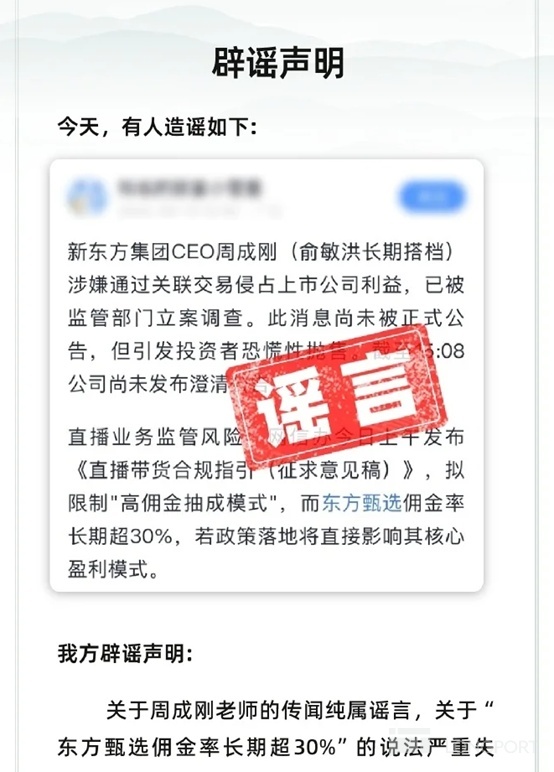
Tomorrow, driven by news, it should open higher. Those who got on board this morning and exited in the afternoon will likely regret seeing the surge tomorrow.
Now, let's look at NVIDIA. Last Friday, its market cap surpassed $4.4 trillion. I revisited NVIDIA's core logic—it serves as the 'exclusive infrastructure supplier' in the global AI computing wave. Currently, almost all tech giants (e.g., Microsoft, Google, Meta) rely on NVIDIA's GPU chips and proprietary CUDA software platform for generative AI training. This technological monopoly grants it pricing power, achieving a gross margin as high as 75%, far exceeding peers like Apple (45%). The global AI arms race directly fuels its performance—giants plan to invest nearly $400 billion in AI infrastructure this year, most of which translates into NVIDIA's orders, driving its stock price up 20-fold in three years while maintaining a P/E of 38.
Whether its market cap can break $5 trillion depends on two key factors:
- Short-term: The sustainability of AI giants' investments. If companies like OpenAI fail to monetize AI applications, the current hardware investment boom may fade.
- Long-term: Whether NVIDIA can replicate its monopoly in the 'physical AI' era (autonomous driving/humanoid robots). It already holds a 70% share in the autonomous driving chip market and is expanding into robotics via Jetson chips. If humanoid robots achieve 'cost-effectiveness reversal' by 2025 (e.g., task cost dropping from $300 to human labor levels) or autonomous driving software subscriptions surpass $10 billion, its valuation will gain new support. Conversely, delayed tech adoption or geopolitical risks (e.g., escalated chip bans on China) could trigger a deep correction.
Historically, hardware firms face tougher transitions than software (e.g., Intel's market cap shrinking from $500 billion to $100 billion), and markets often overprice terminal valuations during high-growth phases (e.g., CATL's 20x profit growth without market cap change). The current $4.4 trillion valuation essentially prices in the AI revolution's endgame—it remains the 'water seller in a gold rush.' Whether it's worth this price depends on how long the gold rush lasts and when the next gold mine emerges.
For such long-term bullish stocks, wait for a pullback before entering—no stock rises forever. Short-term, the sideways movement these days allows for adding positions, but the reward ratio won't be as high.
Follow me for investment insights!
$XIAOMI-W(01810.HK) $BABA-W(09988.HK) $MEITUAN(03690.HK) $EAST BUY(01797.HK) $NVIDIA(NVDA.US) $XIAOMI-W(01810.HK) $Invesco QQQ Trust(QQQ.US) $SPDR S&P 500(SPY.US) $SICC(02631.HK)













The copyright of this article belongs to the original author/organization.
The views expressed herein are solely those of the author and do not reflect the stance of the platform. The content is intended for investment reference purposes only and shall not be considered as investment advice. Please contact us if you have any questions or suggestions regarding the content services provided by the platform.