

 Likes Received
Building a U.S. Rare Earth Independence Chain: Technology Roadmaps and Competitive Strategies of Four Companies

Overview
The four companies show significant differences in technology routes, production capacity, raw material procurement, and commercialization paths:
MP Materials (MP): Short-to-medium-term strongest mass production capability, already capable of batch delivery; collaboration with defense/government ensures stable capacity and revenue.
Energy Fuels (UUUU): Utilizes existing White Mesa uranium/mineral processing plant retrofitting + solvent extraction (SX) route, achieving sample and small-batch production, while expanding towards large-scale heavy rare earths (Dy/Tb).
ReElement / American Resources (AREC): Focuses on multi-source feedstock (coal waste, tailings, end-of-life magnets, battery black mass) + chromatography/continuous ion exchange processes, with short-term low output but expansion targets (Marion Phase-1) at 2,500–3,500 tpa, representing a "midstream diversification strategy."
USA Rare Earth (USAR): Centered on the Round Top large-scale resource, recently enhancing "mine-to-alloy/magnet" integration (via LCM acquisition), targeting upstream reserves + midstream metallurgical integration. Short-term reliance on exploration/demonstration and midstream capacity building.
I. Capacity Comparison (Current / Near-Term / Mid-Term Targets)
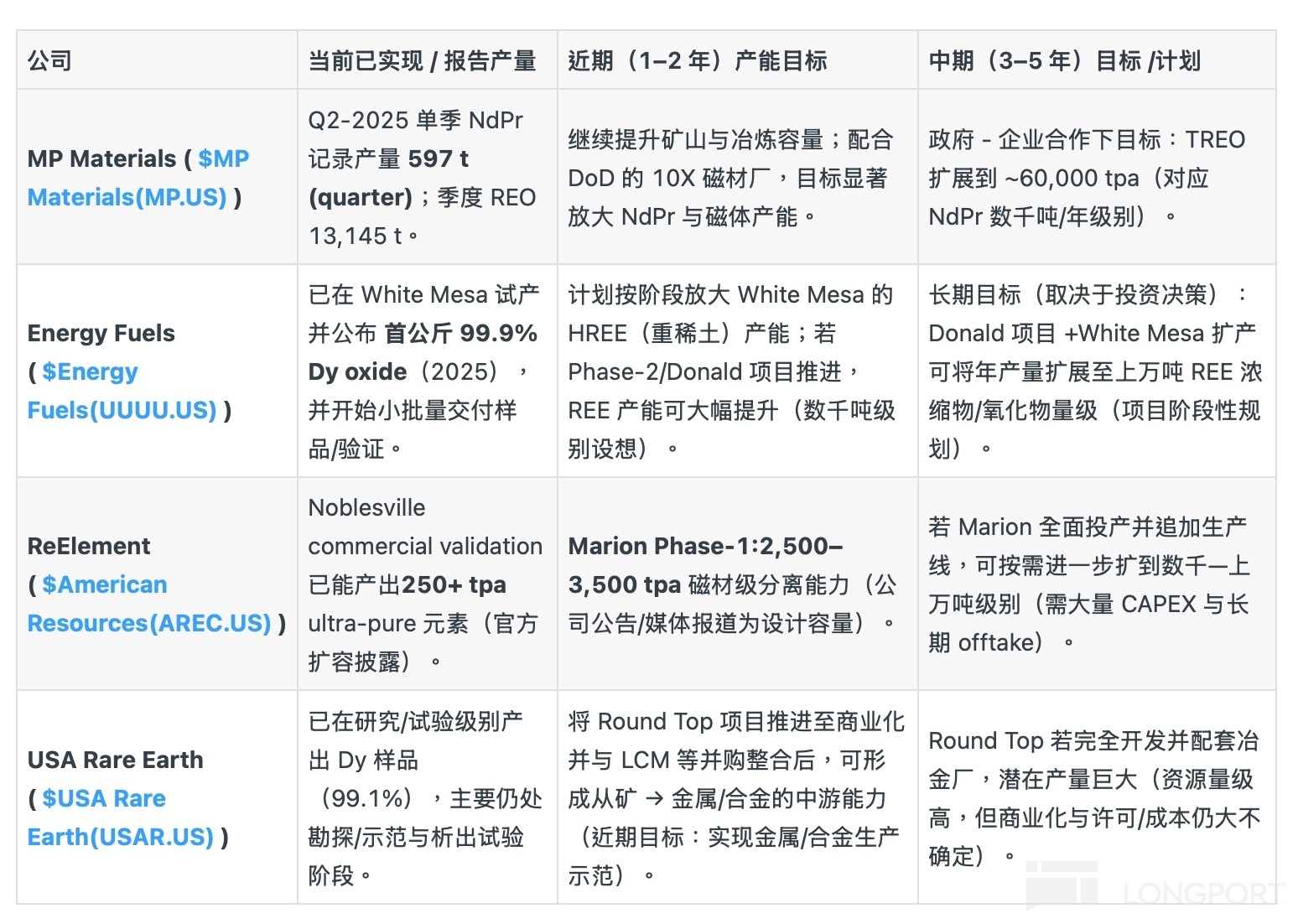
Key Points: MP leads in "achieved volume"; ReElement’s Marion design target is at a "quantifiable but needs validation" stage; Energy Fuels’ White Mesa has entered heavy rare earth trial production and is moving towards industrialization; USAR emphasizes resource reserves and midstream M&A integration, with quantifiable capacity dependent on project progress.
(Key capacity data references: MP Q2 output, ReElement Marion, Energy Fuels Dy samples.)
II. Technology Routes & Process Differences (Core Comparison)
MP Materials
Primary route: Traditional ore mining → mineral separation → solvent extraction (SX) → REO (rare earth oxides) → metal/alloy/magnet manufacturing. MP has a mature mine-concentration-separation chain at Mountain Pass and is advancing downstream magnet integration (10X magnet plant). SX has clear advantages in industrialization, scalability, and cost dilution.
Energy Fuels
Primary route: Retrofits existing White Mesa Mill (uranium plant) + solvent extraction (SX), chemically separating monazite/other ores or alternative feedstock, with recent focus on heavy rare earth (Dy/Tb) capability. White Mesa’s existing permits and facilities shorten commercialization time.
ReElement
Primary route: Multi-source feedstock (coal waste, tailings, end-of-life magnets, black mass) → mechanical pre-processing (EMC) → chromatography / continuous ion exchange / column separation for high-selectivity processes → high-purity REO or specific elements. This route has inherent advantages in handling complex impurities and recycled materials, but industrial scaling, resin/column lifespan, regeneration, and energy consumption are key engineering challenges.
USA Rare Earth
Primary route: Based on Round Top (silicate/volcanic rock-type) resources, pursuing a "mine → concentration → chemical separation → metal/alloy (via M&A like LCM)" Mine-to-Magnet path. Technically combines conventional chemical separation with backend smelting/alloy manufacturing.
Comparison Highlights:
Scalability & mass production: SX (MP, Energy Fuels) is a "proven scalable" route;
Feedstock flexibility & environmental potential: Chromatography/CIX (ReElement) is more adaptable to complex/recycled feedstock and potentially reduces organic extractant use;
Full-chain integration: USAR/MP’s Mine→Metal→Magnet strategy, if successful, could form a complete value chain, but with extremely high capital costs.
III. Unit Costs / Profitability
Market Costs
MP’s "price floor" mechanism: DoD’s 10-year NdPr price floor at $110/kg (as revenue guarantee) supports MP’s profit stability (ensuring minimum income even amid market fluctuations).
Energy Fuels / White Mesa: High-purity Dy output confirms technical readiness for "sample sales/pricing," but unit costs pre-mass production depend on feedstock processing, tailings management, and energy consumption. Quarterly reports highlight uranium costs (not direct REE), but retrofitting existing plants saves CAPEX time.
ReElement / AREC: Using recycled/tailings theoretically lowers feedstock costs (waste/tailings are cheaper or subsidized), but scaling introduces OPEX from column replacement, solvents/reagents, energy, and waste treatment. Short-term profitability relies on scale and long-term offtake. Recent financing and 12b-25 disclosures indicate ongoing cash flow pressures.
Profitability Conclusions (Qualitative)
Most likely near-term profitability/positive cash flow: MP (due to scale + government price support + existing clients).
Mid-term profitability potential (depends on expansion/contracts): Energy Fuels (if White Mesa expands and secures long-term clients) and ReElement (if Marion goes live with long-term offtake and financing).
Highest risk / reward: USAR (massive resources but long exploration-to-commercialization cycles, high CAPEX).
IV. Future Trends (Strategic Outlook, 3–7 Years)
Short-term (0–24 months): MP will dominate "deliverable volume," Energy Fuels leverages White Mesa for heavy rare earth samples, ReElement focuses on domestic recycling/midstream differentiation, and USAR advances Round Top demonstration and midstream M&A.
Mid-term (2–5 years): If ** government funding (DoD/DOE/EXIM) materializes and the market premiums "localization, secure supply" (policy-driven), three parallel growth paths emerge:
Scaled SX path (MP / Energy Fuels) expands to become a primary source;
Multi-source recycling/chromatography (ReElement), if industrially scaled and cost-competitive, could carve niches (recycling, rare earth alternatives, defense-grade purity);
Mine-to-Magnet (USAR), if Round Top and LCM integrate successfully with financing, would form a local supply chain from resources to alloys, but with the highest execution risk.
Long-term (5–10 years): Global supply chains may become "multipolar"—China retains short-term scale/cost advantages, but if the US/allies establish multiple alternative mid/downstream nodes (MP, Energy Fuels, ReElement, USAR, etc.), strategic vulnerability would reduce. Technologically, chromatography/continuous ion exchange could achieve long-term advantages in eco-friendliness and complex feedstock handling if industrial-scale cost/consistency is proven (but surpassing China’s scaled SX depends on funding/time).$American Resources(AREC.US) $MP Materials(MP.US) $Energy Fuels(UUUU.US) $USA Rare Earth(USAR.US)
The copyright of this article belongs to the original author/organization.
The views expressed herein are solely those of the author and do not reflect the stance of the platform. The content is intended for investment reference purposes only and shall not be considered as investment advice. Please contact us if you have any questions or suggestions regarding the content services provided by the platform.
