

Market sentiment cautious! Bank bad debts raise financial risk concerns + analysis of several hot stocks

Monday is here, and a lot happened last Friday.
ZION and WAL, two U.S. regional banks, disclosed on Thursday that borrowers had failed to repay loans, forcing them to be written off as bad debts and treated as losses. This will affect profitability. Although these are just two regional banks, they have raised market concerns, with all three major indices falling. However, based on the situation in 2024, the losses of these two banks can be absorbed by profits, with minimal impact on capital adequacy ratios. Moving forward, the two banks' financial reports will be released today and tomorrow, and attention can be paid to the impact of these bad debts on the Q3 earnings. However, this is essentially non-systemic risk from companies affecting regional banks, and the situation of these two banks has a relatively small impact on the U.S. banking sector. This may only trigger a short-term market reaction, as seen in the quick recovery this time.
However, the market's rapid response reflects a "once bitten, twice shy" mentality. Coupled with recent events like tariff negotiations, "ongoing U.S. government shutdown," and the AI tech bubble, as well as the "cockroach" warning—investors fear that localized issues may reflect broader problems, forcing the market to "overreact." The two regional banks have little overall effect, but the underlying issues involve the auto industry's bankruptcy and tariff impacts, raising questions about whether the entire banking sector faces similar problems. Attention should be paid to tail risks, and the market may remain cautious.
However, this could strengthen expectations for further interest rate cuts, which would lower borrowers' repayment costs, reduce corporate default risks, and ease banks' bad debt pressure. This banking credit event may have some transmission effect on pushing up gold prices, while rate-cut expectations could further support gold.
Speaking of tariffs, the current U.S.-China negotiations appear to be progressing smoothly, which is undoubtedly positive for the market. Continued attention should be paid to further developments.
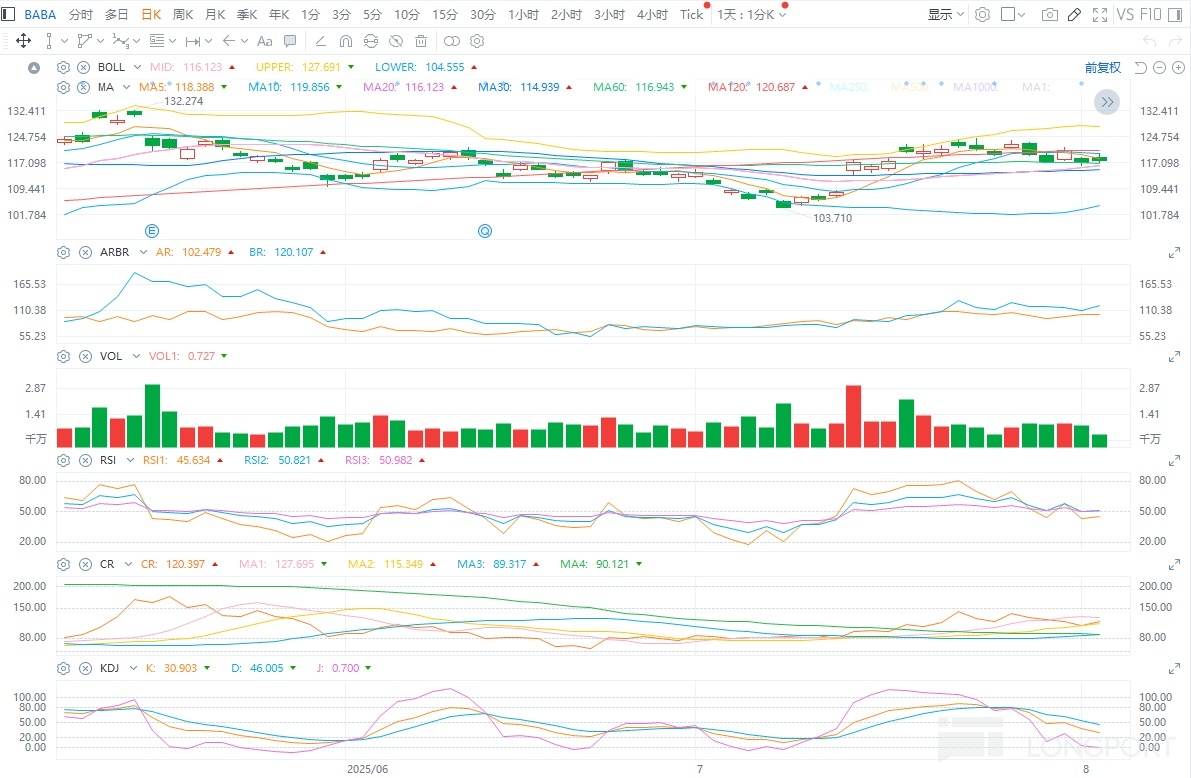
$Alibaba(BABA.US) showed a trend of opening low and rising high on the 17th, reaching a high of 169 and closing up 1.19%.
Double 11 has already started accelerating in the past two days. Tongyi Qianwen is gradually making inroads into the market, and Decoder noticed its ads have even reached the Canton Fair. Observing its future usage and spread. As for stablecoins, this isn't the main business—if they're really suspended, everyone suspends them, so the impact is minimal.
MA5 crossed below MA10, forming a death cross, with a brief sideways trend. If volume increases to test 171, it may break resistance and reach the upper Bollinger Band.
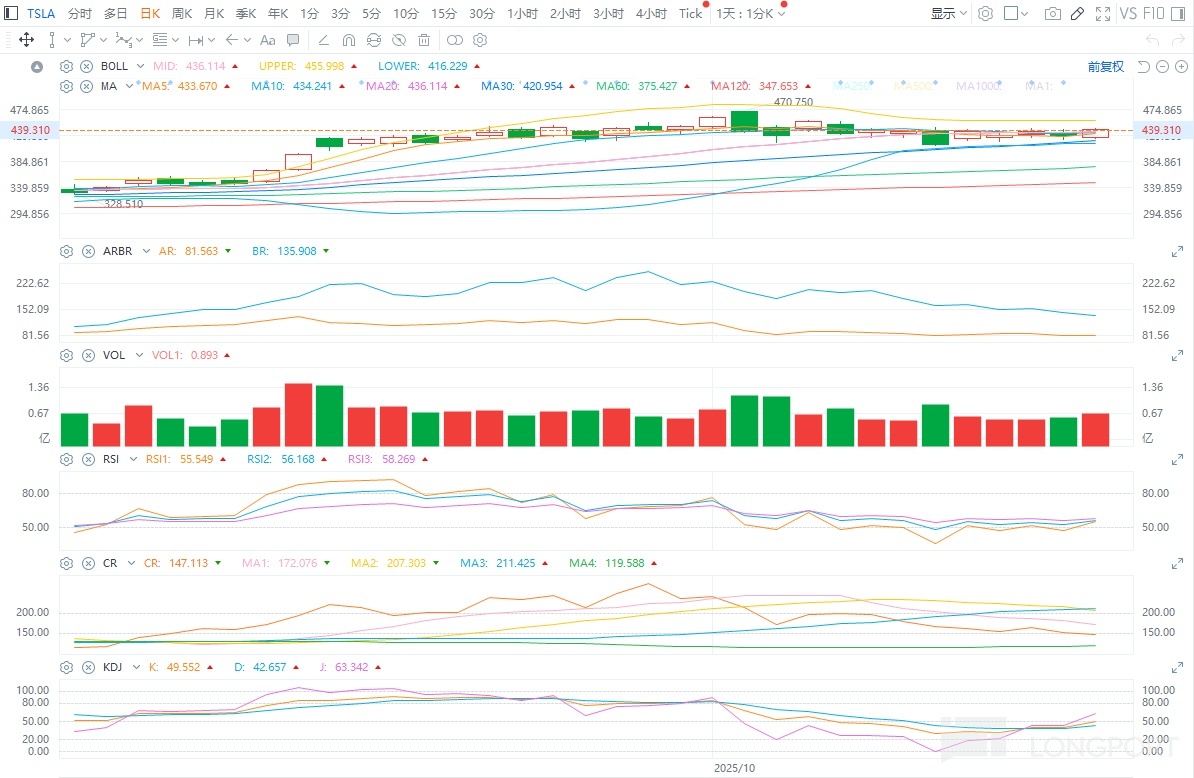
$Tesla(TSLA.US) surged and then retreated in early trading on the 17th, testing 440 before falling back to 430. It then formed a small V-shape to 437, oscillating upward. It closed up 2.46%.
It has shown a trend of fitting the midline of the Bollinger Bands for a week, consolidating sideways to build momentum ahead of the post-market earnings release on the 22nd. Attention should be paid to the boost from EV tax credits on this quarter's sales, which may lead to a decline in Q4 demand. Also, watch for Tesla's Q4 outlook, progress in autonomous driving and AI, and Model Y L sales and deliveries in China. Bullish on this earnings report.
Either it continues to oscillate—watch the 415 support level, with appropriate stop-loss if broken—or it rallies on earnings, with resistance at 450.
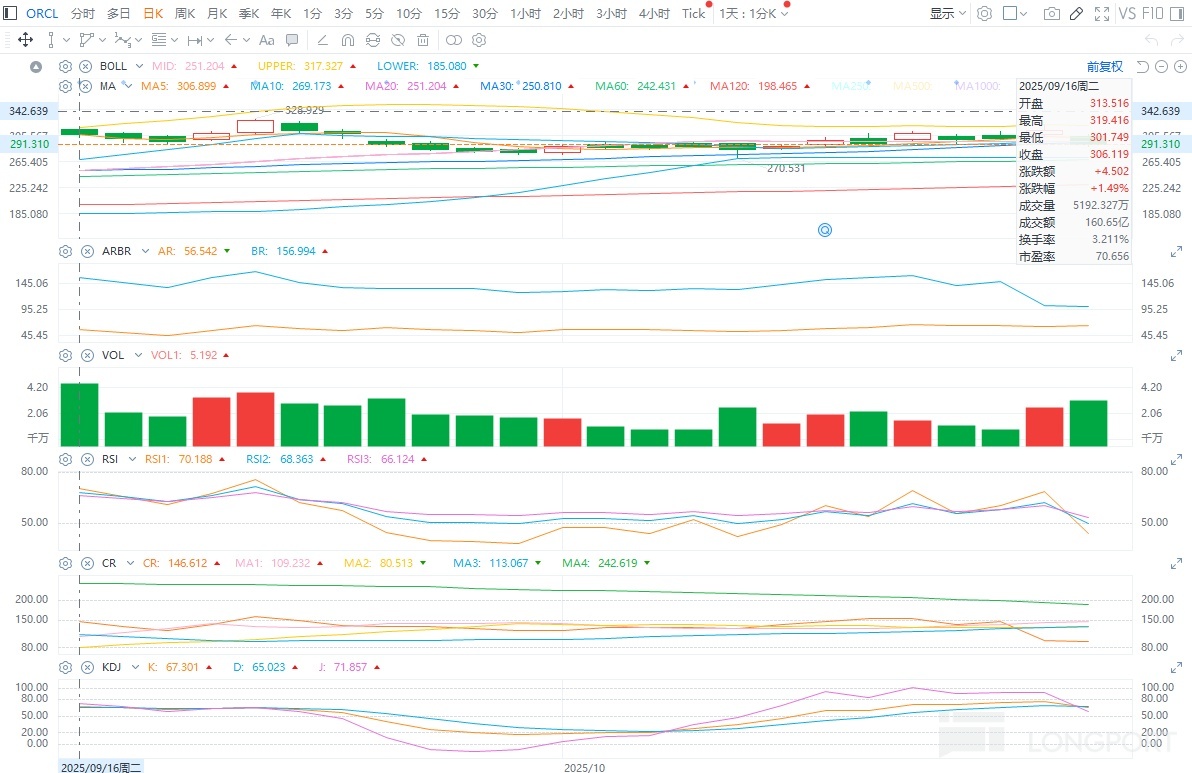
$Oracle(ORCL.US) was completely dominated by bears on the 17th, closing down 6.93%.
The market is skeptical about Oracle's current contradictory situation—its long-term financial targets have been significantly raised, but recent growth has fallen short of expectations. Ambition doesn't match current performance—should one exit or hold? Oracle's nearly 7% drop reflects the market digesting this situation.
AI giants are forming strong alliances; this circle is tightly bound, and to exaggerate, they rise and fall together. Regarding Oracle's late start in cloud services, Decoder has said low margins are normal. Moreover, cloud servers are now driven by AI transformation, and Oracle started late, lacking the deep pockets of other cloud server providers while competing in this capital-intensive AI race. Decoder has also noted that low margins are normal, but this also indicates significant growth potential for Oracle's cloud business amid strong AI demand. For now, it's about watching its execution, debt repayment, and market share capture...
If investors continue to digest this, consider buying in batches at 275-280.
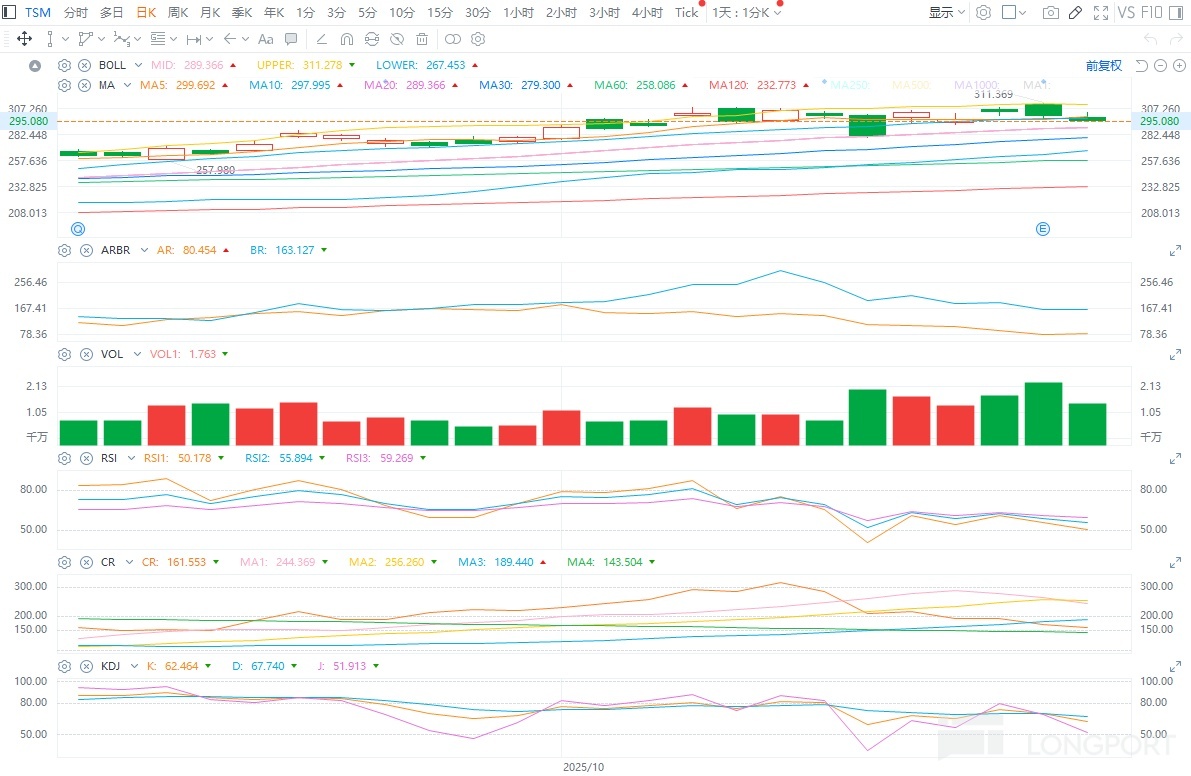
$Taiwan Semiconductor(TSM.US) was in focus last week. On earnings day, it surged to a historical high of 311 before many took profits. Revenue was strong, far exceeding expectations, and it's now in a pullback phase after digestion. A deep pullback to 260-267—consider adding positions after stabilizing above MA60.
The copyright of this article belongs to the original author/organization.
The views expressed herein are solely those of the author and do not reflect the stance of the platform. The content is intended for investment reference purposes only and shall not be considered as investment advice. Please contact us if you have any questions or suggestions regarding the content services provided by the platform.
