

Food delivery war peaks, AI war heats up: Alibaba and Meituan's financial reports reveal new narratives for Chinese concept stocks

Following the release of earnings by giants like JD.com and Pinduoduo, their stock prices collectively came under pressure—JD's Q3 revenue exceeded expectations but profit margins declined, while Pinduoduo's Temu faced high overseas expansion costs, compressing gross margins—market attention quickly shifted to Alibaba and Meituan.
Alibaba will announce its Q2 FY2026 earnings after the market closes on November 25, followed by Meituan on the 28th. The focus is on two key points: whether the inflection point for profitability in the food delivery business has arrived, and whether the monetization path of AI investments can spark a valuation reassessment. Currently, food delivery competition shows signs of "peaking," with the subsidy war shifting from "burning cash to gain market share" to "refined operations" (Decoder noticed fewer discounts recently, but the AI sector remains a compelling "black swan").
If we must pick a winner, Decoder would bet on Alibaba.
The earnings season for Chinese internet stocks is already overshadowed by weak consumption and geopolitical uncertainties, with food delivery being the "pain point of pain points." The overall profit of China's internet sector is expected to decline by 31% quarter-on-quarter, with the subsidy war leading to losses of RMB 36 billion for Alibaba, RMB 20 billion for Meituan, and RMB 13 billion for JD.com. This round of price wars, since Alibaba's Ele.me and JD.com's Jingxi entered the fray, has evolved from a "zero-sum game" to a "three-way battle": order volumes have surged, while rider subsidies and merchant rebate rates have soared to historic highs, squeezing profit margins across the entire industry chain.
Market consensus suggests that food delivery penetration is nearing saturation, with early signs of competition "peaking": subsidy intensity is marginally weakening, and algorithm optimization is shifting toward "user retention + merchant loyalty." But how many discount-hunting users will stick around? The conversion rate is likely low.
This earnings season may reveal a "glimmer of peace"—if Alibaba and Meituan can demonstrate that "peak subsidies are over," the probability of a stock rebound is at least 30%. Today, Alibaba-W (09988) and Meituan-W (03690) have already risen over 1%. However, profit recovery will still require time in the short term.
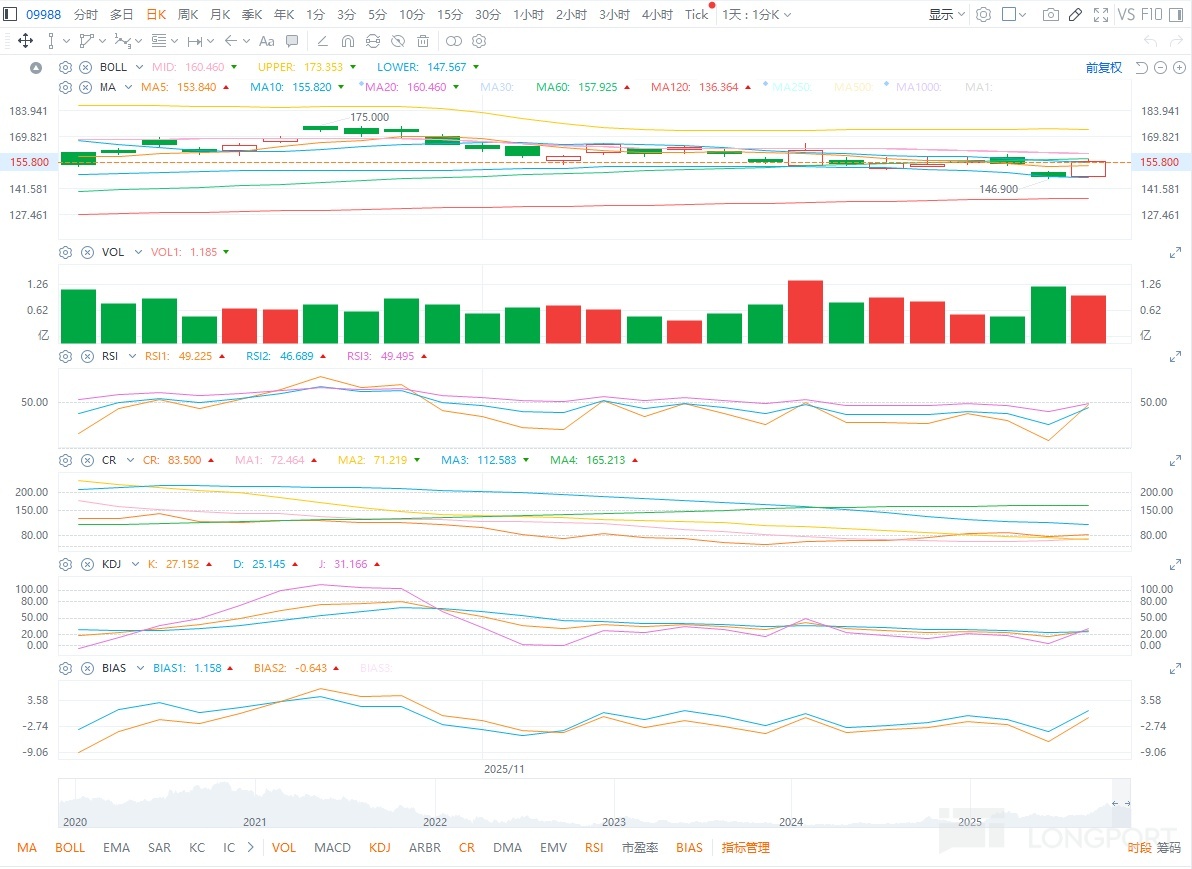
Alibaba's Q2 earnings expectations are neutral to weak. Wall Street consensus EPS is $0.85, down 29% year-on-year, with revenue at $3.43 billion, up 2.6% year-on-year, and core e-commerce GMV growth slowing to 8-10%. While Taobao/Tmall's Double 11 season contributed strongly, international e-commerce growth fell short of expectations, compounded by weak domestic consumption, pressuring margins to 18.6% with limited growth space.
However, Alibaba's "bright spot" lies in the "dual engines" of AI and cloud services. Since 2025, Alibaba Cloud's AI product revenue has achieved triple-digit growth, with the Tongyi Qianwen model iterating to version 3.0, already deployed in e-commerce recommendations and customer service automation. Alibaba is "leveraging China's AI strategy to overtake on the curve." If the earnings call reveals AI ROI exceeding expectations—such as a rebound in cloud gross margins—it could directly ignite the "second takeoff" narrative.
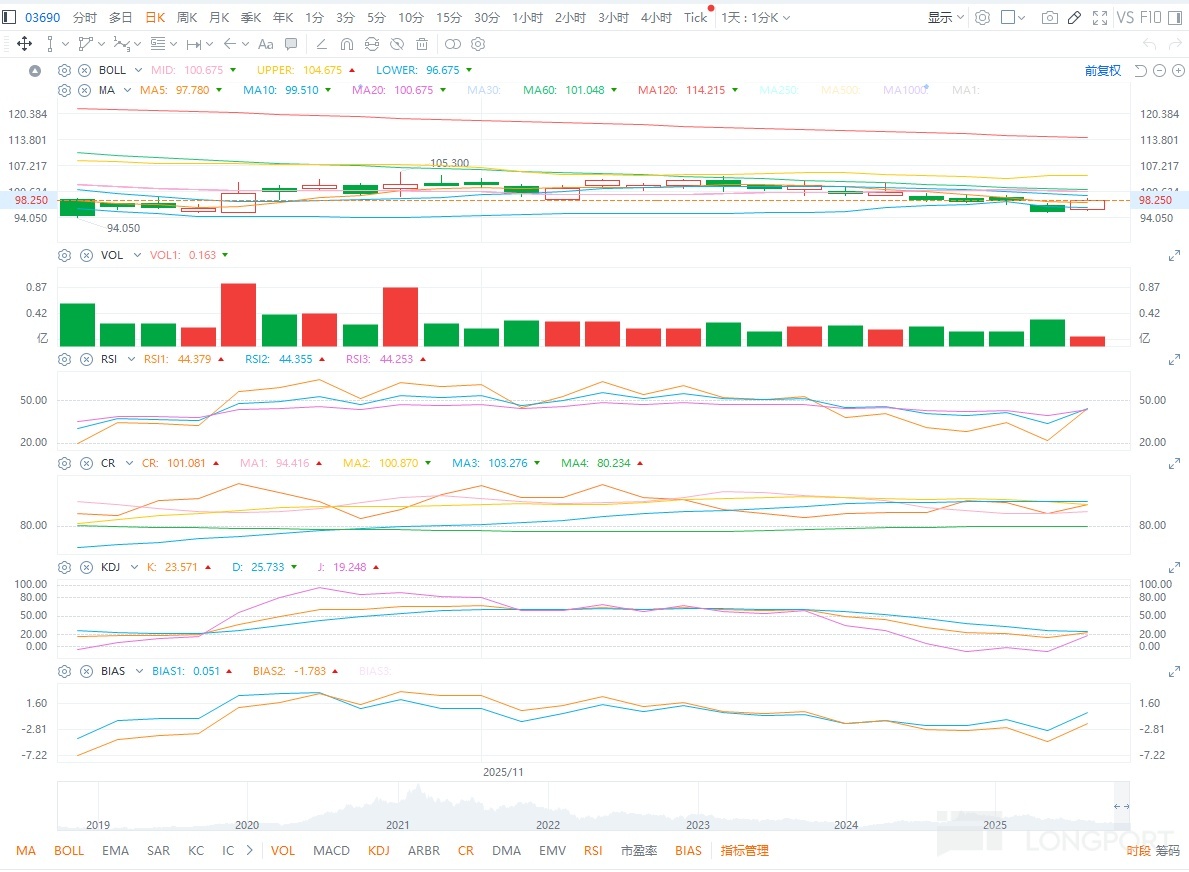
Compared to Alibaba, Meituan's Q3 outlook is more severe. Core local commerce order volume hit a record high, averaging 150 million daily, with MAU surpassing 600 million. But "irrational competition" is expected to cause adjusted operating profit to plummet 87% to RMB 1.84 billion.
Meituan's chances of a "comeback" are limited: while its "Instashopping" business grew 18.1%, AI investments are only one-third of Alibaba's, making it difficult to offset the food delivery quagmire. The losses from the food delivery war will haunt Meituan for several quarters.
If earnings confirm that subsidies have "peaked" and disclose a recovery in hotels/travel, the stock may rebound; otherwise, declines could continue. However, current price trends hint at "buying the rumor," with slight rebounds today amid pressure, indicating market anticipation for earnings.
Quantitatively, Alibaba Cloud's AI revenue growth far outpaces Meituan's local commerce, justifying its valuation premium. For those favoring the AI narrative, the recommended play is "buy Alibaba, sell Meituan." If Alibaba's AI ROI exceeds expectations, its stock could take off again, lifting the broader Chinese internet index; Meituan, meanwhile, needs confirmation of a "subsidy cliff" to stage a comeback. If post-earnings subsidy noise subsides, consider adding Alibaba positions. Alibaba's AI strategy isn't just a "cash-burning game" but an "ecosystem loop"—from model training to monetization—potentially setting a benchmark for Chinese internet stocks' "moats."
Food delivery competition peaking may reassure investors temporarily and ease short-term pain, but the "long-tail effect" of AI investments will be the watershed—Alibaba could soar, reshaping its "cloud empire," while Meituan, if stuck in the mud, must accelerate diversification to break free. Investors should "buy the dip" on Alibaba's AI ecosystem and remain wary of Meituan's volatility. The winner isn't just about earnings but strategic vision—"AI + local services" is the breakthrough point for these two companies in combining new tech with lifestyle services.
$Alibaba(BABA.US) $BABA-W(09988.HK) $MEITUAN(03690.HK)
The copyright of this article belongs to the original author/organization.
The views expressed herein are solely those of the author and do not reflect the stance of the platform. The content is intended for investment reference purposes only and shall not be considered as investment advice. Please contact us if you have any questions or suggestions regarding the content services provided by the platform.
