

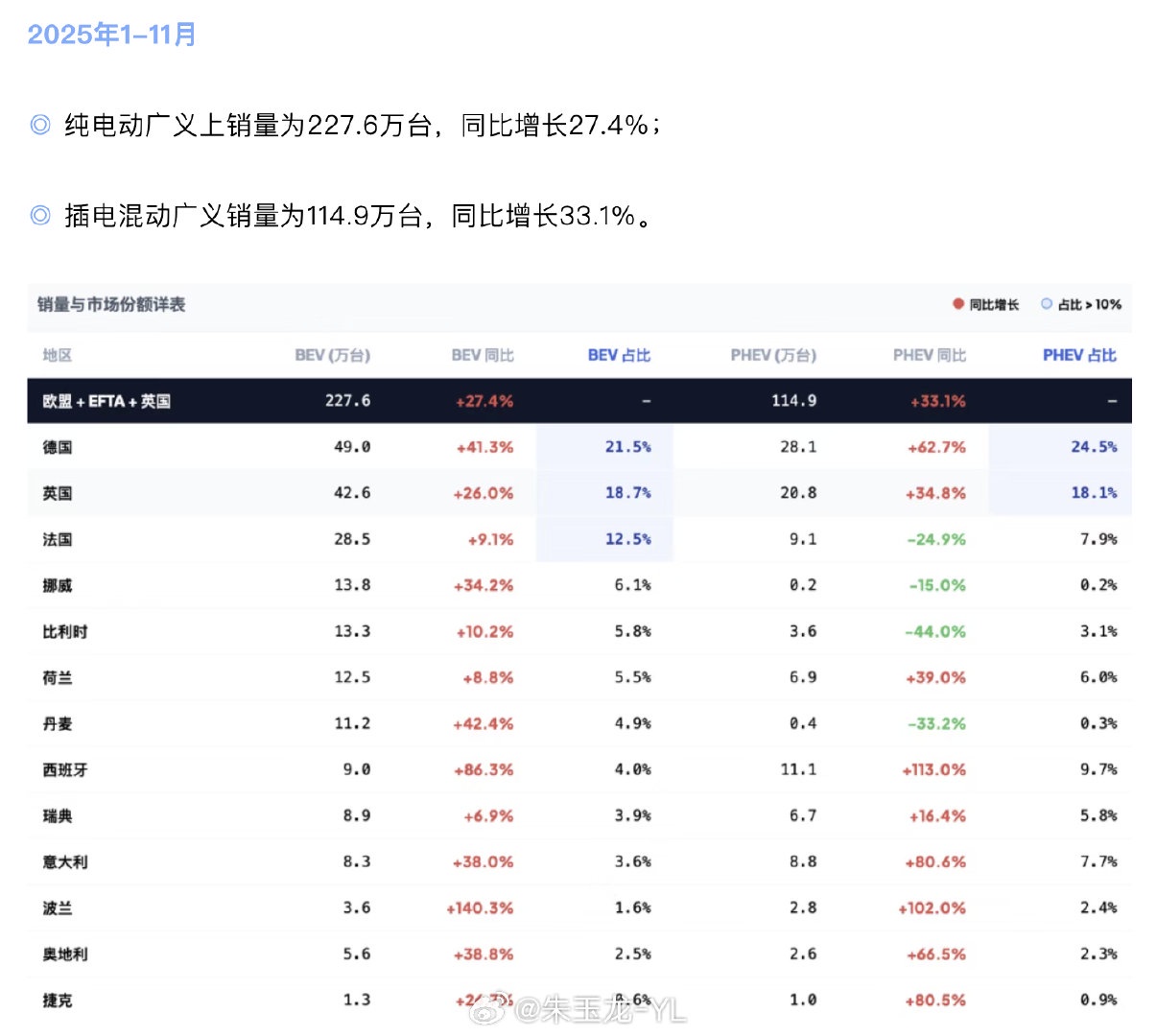
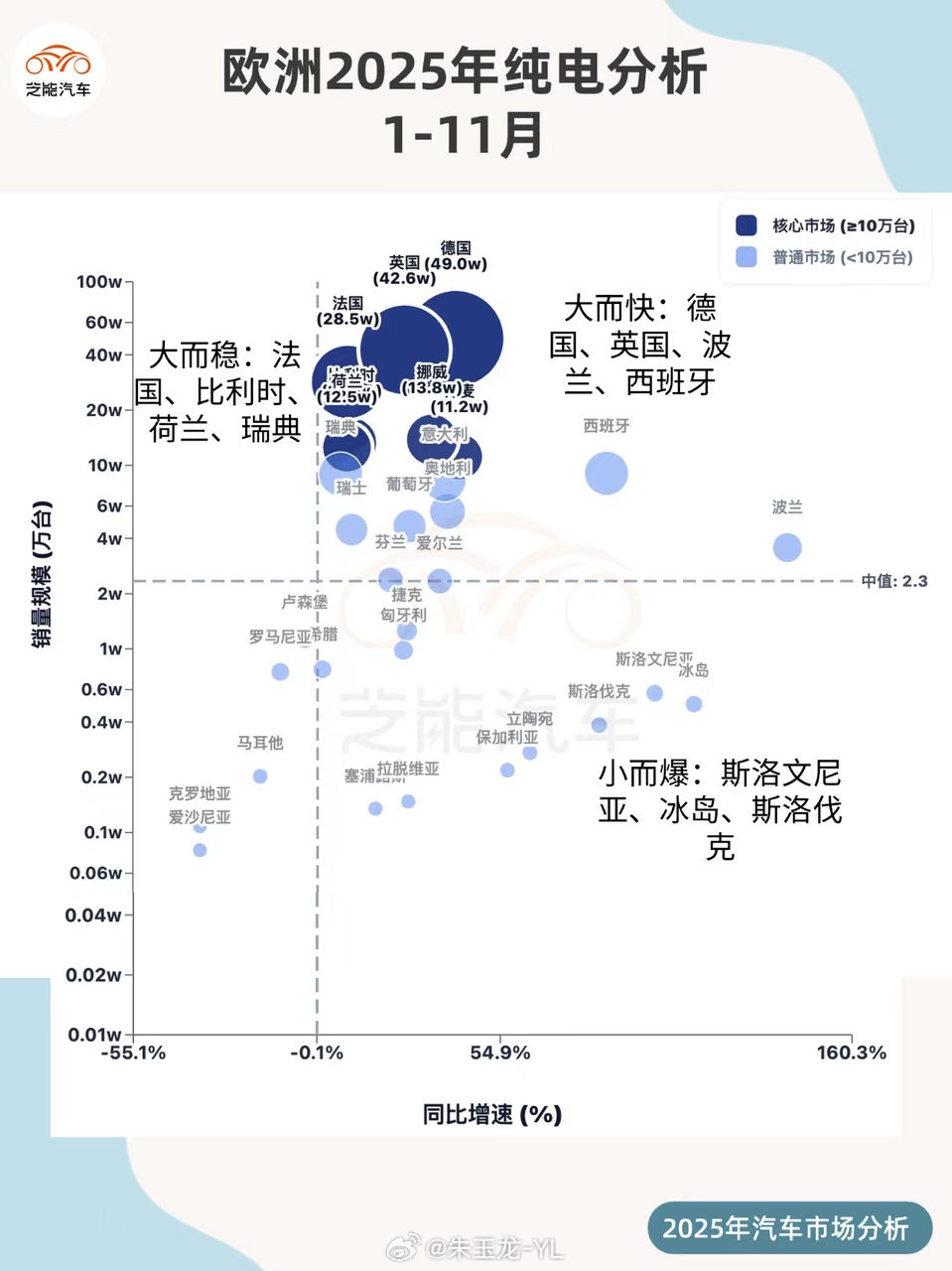
The latest data from the European Automobile Manufacturers' Association (ACEA) for the first 11 months of 2025 is out. Currently, the main destination for China's power battery exports is Europe, so the data here can be correlated. The demand for nearly 4 million units, including 2.27 million pure electric and 1.15 million plug-in hybrid vehicles from January to November, is mostly met by batteries imported from China, with only a small portion being locally sourced. The European automotive market shows a moderate recovery. The total new car registrations in the EU reached 9.86 million, a year-on-year increase of 1.4%. Including Norway, Switzerland, Iceland, and the UK, the total registrations in the broader European market were 12.099 million, up 1.9% year-on-year. From January to November 2025: ◎ Pure electric vehicle sales in the broader sense reached 2.276 million, up 27.4% year-on-year; ◎ Plug-in hybrid sales in the broader sense were 1.149 million, up 33.1% year-on-year. Battery Electric Vehicles (BEV): In the first 11 months of 2025, EU BEV registrations totaled 1.662 million, up 27.6% year-on-year, with market share rising to 16.9%. The broader European market (EU+EFTA+UK) saw 2.276 million BEV registrations, up 27.4% year-on-year. ◎ Germany led the market with 490,000 registrations, up 41.3% year-on-year. ◎ The UK registered 426,000 units, up 26.0% year-on-year. ◎ Spain saw the fastest growth, with 90,000 registrations, up 86.3% year-on-year. ◎ Norway, as a BEV leader, registered 138,000 units, up 34.2% year-on-year, with a penetration rate exceeding 90%. ◎ Eastern European countries like Poland (36,000 units, +140.3%) and Slovenia (6,000 units, +100.7%) doubled their growth rates, while Romania (7,000 units, -11.1%) and Estonia (1,000 units, -35.1%) declined. We can categorize them as: ◎ First part: Large and fast—Germany, the UK, Poland, Spain (Poland's 140.3% growth rate is the highest in Europe). ◎ Second part: Large and stable—France, Belgium, the Netherlands, Sweden (growth <10%, mature markets). Small markets are divided into small but explosive—Slovenia, Iceland, Slovakia (growth >80%, small size with high potential), and risk zones to avoid—Croatia, Estonia, Malta (sales <2,000 units + negative growth).
The copyright of this article belongs to the original author/organization.
The views expressed herein are solely those of the author and do not reflect the stance of the platform. The content is intended for investment reference purposes only and shall not be considered as investment advice. Please contact us if you have any questions or suggestions regarding the content services provided by the platform.
