
FSD, Musk is re-evaluating its value Elon just posted an X, the tweet was simple, but there's a lot to unpack behind it.…
FSD, Musk is re-evaluating its value
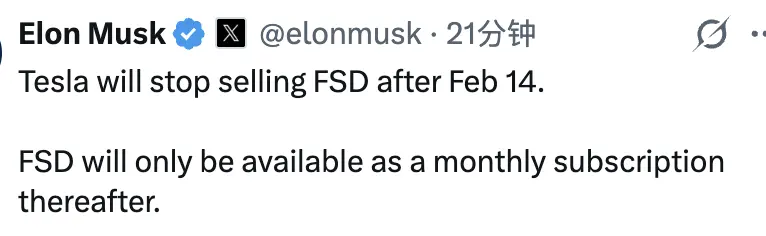
Elon just posted an X, the tweet was simple, but there's a lot to unpack behind it.
1. Financially, converting volatile hardware profits into stable, high-margin recurring revenue. Tesla is essentially an AI and robotics company, not a traditional manufacturer. A one-time purchase is a single transaction, while a subscription turns the vehicle into a terminal that continuously generates cash flow. A one-time purchase creates a psychological account where the value of FSD is fixed. Ending one-time purchases means no longer treating FSD as an "accessory" but defining it as a "utility service" or "operating system license."
2. Lowering the barrier to accelerate the network effects of the "data flywheel." The key to winning in autonomous driving isn’t the sophistication of the algorithm but the scale of training data. More subscribers → more miles driven → more edge-case data → stronger algorithms → attracting more subscribers. A single fatal edge case in autonomous driving could destroy a physical AI company.
3. Paving the way for Robotaxi. If cars can achieve true full self-driving, vehicle ownership will become less important—what matters is the car + FSD. Are taxis expensive, or are drivers expensive? If drivers are expensive, then FSD is expensive, meaning FSD brings you more income, making it more feasible to add your car to Robotaxi. More people using Robotaxi → owners/carmakers profit → more owners join → more FSD cars available → more people willing to hail Robotaxi.
If you can buy it outright, just buy FSD!

The copyright of this article belongs to the original author/organization.
The views expressed herein are solely those of the author and do not reflect the stance of the platform. The content is intended for investment reference purposes only and shall not be considered as investment advice. Please contact us if you have any questions or suggestions regarding the content services provided by the platform.
Author's posts
View moreBehavioral Economics Opportunities Brought by Longbridge Skills (Real Cases)
Hedge funds spend hundreds of thousands of dollars on alternative data, and what they do essentially boils down to one thing: trading in the opposite direction when retail investor sentiment reaches extremes. The core barrier in this business isn't how complex the model is; it's the inability to access data sources. Reddit posts need to be scraped, StockTwits sentiment needs to be purchased, and Twitter's firehose requires payment. Retail investors want to do it themselves? No way. But Longbridge Skills has opened up the community API. What does this mean? It means a retail investor...
Longbridge Skills vs. Futu Skills: The Battle for Broker Infrastructure in the AI Era — One Is Moving with the Times, the Other Still Ships an Installer
In 2026, AI agents are no longer a buzzword. Claude Code, Cursor, Gemini CLI — developers and investors are now using natural language to pull market data, place orders, and parse earnings reports. A broker's API is no longer just a tool for quant teams; it's become the last-mile nerve ending connecting every AI tool to the financial world. Both Longbridge and Futu have stepped up with their own Skills offerings — but their architectural philosophies diverge from the very first line of code...
SpaceX offering 30% of shares to retail investors: a benefit or a trade-off?
The whole internet is hyping: Musk is kind-hearted, SpaceX is reserving 30% of its IPO shares for retail investors. This narrative is completely wrong from start to finish. It's not the conclusion that's wrong, it's the framework. The essence of IPO allocation: who sets the price, who takes the shares, let's first clarify a basic logic. IPO allocation is essentially a distribution of pricing power. Institutions get shares, obtaining the arbitrage right to "buy at a low price and sell in the secondary market." Retail investors get shares, usually the leftovers after institutions have picked. In US IPO conventions, retail investors only get 5%-10%. Why? Because underwriters need institutions to "discover the price"...