D
Feb 27 at 09:13 AM
Block (Trans): Layoff tailwinds to kick in Q2, margins to trend higher ---
Below is Dolphin Research’s transcript summary of $Block(SQ.US) FY25 Q4 earnings call. For our take on the print, see:《Block: US Alipay Cuts 40% Headcount — Is Compute Replacing Labor?》
I. Key Financial Highlights
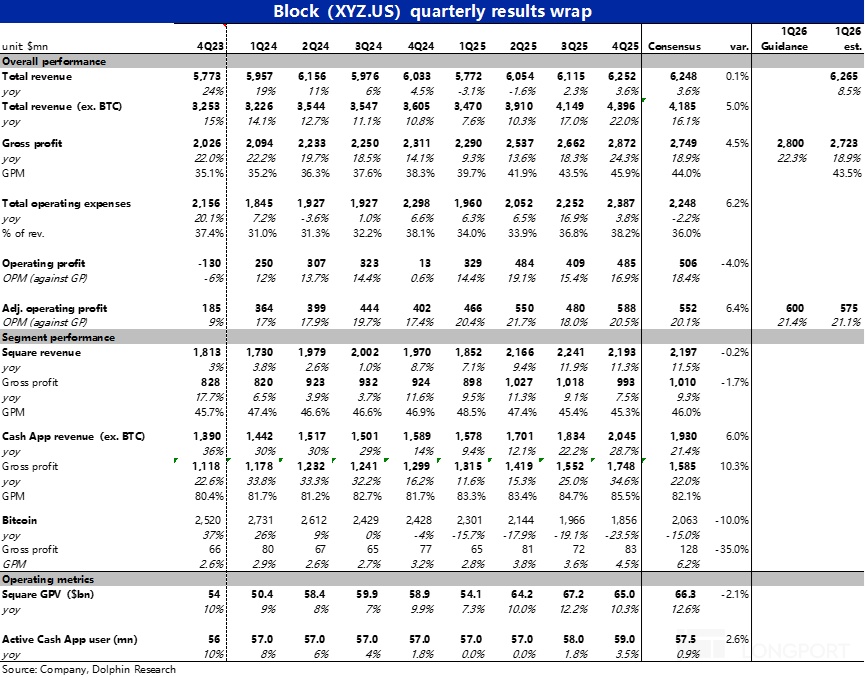
II. Call Details
2.1 Management Key Messages
1) Strategy and Direction
Why the org reset: Despite a strong 2025, Block will right-size headcount from 10k+ to just under 6k. The core thesis is that ‘intelligent tools’ are changing how we operate. Smaller teams using these tools can do more, and do it better.
Forward view: Most companies will be slow to react to the impact of intelligent tools. Block chose to move first with structural changes, proactively and transparently.
2) Operating model going forward
Intelligence at the core: Intelligence will permeate decisioning, risk, product build, and customer service. Over time, customers will be able to build directly on Block’s capabilities.
Extreme focus — four priorities: customer capabilities; interfaces that compose and deliver capabilities; forward-looking intelligence grounded in deep understanding and real-time data; and an intelligent model that orchestrates company ops end to end.
Speed: A smaller footprint enables faster decisions, delivery, and learning.
2) Biz updates and outlook
Cash App
Ecosystem growth and engagement: Monthly Actives returned to growth in 2H25, exiting the year at 59 mn. Deepen-engagement playbook is working, with Primary Banking Actives up 22% YoY in Dec to 9.3 mn, generating GP nearly 10x that of P2P-only users.
Product performance:
Commerce: Q4 TPV rose 17% YoY, driven by Cash App Card and retention/volume uplift from Cash App Green.
Borrow: Q4 originations were up over 3x YoY, increasing cross-product engagement across Cash App.
Risk and credit: Q4 loss rates increased as Block expanded to new user cohorts. By mid-Feb, loss trends for all 2026 vintages are below targets, evidencing sound risk calibration.
Outlook: Expect low-single-digit active user growth in 2026 and over the long term.
Key pushes: Scale Cash App Green, roll out MoneyBot to all customers, expand Afterpay Pre-purchase and P2P Pay-in-Four, while holding loss rates healthy.
Square
Momentum: 2025 was the strongest year ever for New Volume Added (NVA), up 17%. Q4 NVA grew 29% YoY, with sales-led NVA up 62%. Block signed with 100+ ISOs.
GPV: Q4 GPV grew 10.3% YoY. Quarter-to-date through Feb 24, GPV growth re-accelerated to 12%+ YoY.
GP: Q4 Square GP rose 7.5% YoY on financial solutions. Hardware costs and higher processing costs each created a 200 bps headwind to GP growth, in line with expectations.
Outlook: In 2H, Square GP growth should broadly track GPV; in 1H, hardware cost and the pace of mix-shift upmarket will keep GP growing below GPV. Ex-hardware GP is a cleaner core profitability indicator.
Key pushes: Self-serve onboarding, sales and partner channels; focus on Food & Bev, with faster product velocity in other verticals; scale Square AI and Manager Bot; scale Communities/Blocks (CxB), move merchant acquisition to auto-enroll, and add in-store redemption.
Other — Proto
Mining rigs have begun shipping. Q4 GP reached scale.
3) Guidance
FY26
GP: +18% YoY to $12.2 bn (raised vs. Investor Day).
Adj. OP: raised to $3.2 bn, implying +54% YoY and +600 bps OPM expansion.
Adj. diluted EPS: raised to $3.66, +54% YoY.
Color:
The new org will materially benefit Adj. OP starting in Q2, with a larger profitability step-up in 2H. Slightly under 60% of full-year Adj. OP is expected in 2H.
Adj. OPM to expand sequentially from Q1 (21%), with faster expansion in Q3–Q4 than in Q2.
Credit loss expense will be higher in 1H on strong Borrow growth.
FY net interest expense is expected at approx. $200 mn (slightly higher vs. prior).
Non-GAAP effective tax rate for 2026 is expected in the mid-20% range.
Q1 2026
GP: +22% YoY to $2.8 bn.
Adj. OP: $600 mn, +29% YoY.
Adj. diluted EPS: $0.67, +20% YoY.
Net interest expense: approx. $60 mn.
2.2 Q&A
Q: Why the layoffs now (just three months after Investor Day)? Why this magnitude?
A: Several factors compounded. We have been functionalizing, integrating our two internal platforms and removing duplication, giving us confidence to move faster. Also, in Dec last year, AI model capabilities improved by an order of magnitude, enabling AI across almost everything. The remaining gap is execution.
We are confident AI tools can be applied across most of the org to deliver faster, explore more broadly, and test more precisely. These tools will change how every company operates and grows, and we want to be ahead of the market and customer expectations. Beyond delivering intelligence to customers (ManagerBot, MoneyBot), the goal is to let customers build their own features and visualizations on top of our capabilities.
Q: With fewer people, how do you sustain growth in Cash App and Square and hit guidance?
A: We have high confidence in sustaining these durable growth rates. Structurally, smaller, more agile teams move faster and ship faster, and today’s changes remove organizational debt and raise talent density across the org, including engineering. At the same time, AI tools and base model improvements permeate all work, especially software development, letting us execute faster and more precisely.
On the roadmap, we are confident in the path to GP growth, as reflected in our raised GP guide today. Growth drivers include: core network expansion in Cash App and Square, such as actives growth, inflows per active, net volume retention, and GTV growth. We also have key launches across the next few months, including improvements to Cash App Green, expanded Cash App Card features, Cash App Pay growth, Bitcoin upgrades, and Afterpay’s Pre-purchase on Cash Card now live to the first cohort with very encouraging early data. Square has shipped multiple Food & Bev excellence features, with more coming, alongside ongoing pricing and packaging optimization.
We are also placing bigger bets such as neighborhoods at scale, MoneyBot, ManagerBot, and Cash App Credit Score. These represent the future of Block’s interface-led product experience and should drive GP growth this year and beyond. Overall, we are confident in maintaining healthy growth rates.
Q: How does today’s org change affect this year and beyond financially? What about FY26 Adj. OP exit rate, FCF implications, and capital re-allocation?
A: We raised FY26 GP growth to 18% (vs. 17% at Investor Day) and meaningfully raised Adj. OP. GP should grow 22% in Q1 and stay strong through the year, exiting in the mid-teens, aligning with our long-term outlook from Investor Day. On profitability, Q1 Adj. OP grows nearly 30%, with OPM starting at 21% in Q1 and expanding each quarter.
OPM expansion reflects: strong unit economics driving incremental margin; timing of cost structure changes (limited in Q1, with Q2 still impacted by notice periods for certain overseas employees). Sales & marketing timing (a notable step-up from Q1 to Q2 to drive attractive long-term returns); and higher credit provisions in 1H on strong Borrow growth. Slightly under 60% of the full-year $3.2 bn Adj. OP should land in 2H, with a similar EPS cadence.
On investments, beyond ongoing product innovation and market expansion, we will focus on three areas: talent, hiring more senior AI engineers to elevate engineering and product; market expansion to scale customer acquisition; and continued AI infra build-out, including tools and capabilities required for a world-class org.
Q: Primary Banking Actives (PBA) surged in Q4, up 1 mn and accelerating to ~23% growth, with per-user profits 10x+ P2P-only. What drove this, and what is the long-term potential?
A: We are excited about Q4 PBA. In Nov, via Cash App Releases, we launched Cash App Green to broaden access to banking benefits. Previously, benefits were tied to direct deposit actives. Now, customers who spend $500+ per month on Cash App Card qualify for Green and its benefits.
Results have been strong. PBAs reached 9.3 mn in Dec, +22% YoY and up ~1 mn vs. Sep, with much deeper engagement — GP per PBA is nearly 10x P2P-only. Since launch, PBA cohort retention improved, with incremental engagement across Borrow, Cash App Card, and Instant Deposit. Green incentives bring more of customers’ financial lives onto Cash App.
A good example is personalized Boosts: for Green customers, personalized instant discounts on Cash App Card saw attach move from ~2% pre-launch to ~14% post-launch. This is a major behavioral shift. This supports a broader strategy around the modern earner — a large, growing US segment under-served by traditional finance, including hourly, gig, freelancers, and entrepreneurs.
We believe Cash App leads here and will keep leading. This is only the first iteration of Green — the starting point for driving more PBAs. It is an encouraging early signal.
Q: GPV has re-accelerated to 12% QTD in Q1 despite weather and an easy comp. How is visibility for the full-year guide of low-to-mid teens, and how are verticals trending?
A: Square’s product and go-to-market shifts are working. While Q4 slowed vs. Q3, year-to-date growth has re-accelerated to 12%+, with the US above 7.5%. Key verticals are strong: Food & Bev GPV rose 16% YoY, and mid-market sellers were resilient in Q4. We now have an opportunity to extend the successful Food & Bev playbook from the last 12–18 months to other Square verticals.
We are confident GPV will further accelerate in 2026 vs. 2025, supported by continued NVA momentum. As NVA compounds and accelerated in 2025, it will build cohort curves and contribute more meaningfully to 2026 GPV growth. We had 15 US field reps in Q1 and will exceed 140 by year-end, and we closed our first field deals in Australia and the UK.
In Q4, 50%+ of field inbound was partner-sourced. Our strategic relationship with Cisco strengthened, with referrals up 80% QoQ. Into 2026, existing reps will ramp with tenure, ISO partners have expanded to 100+, complementing direct sales and expanding across regions.
2025 was the strongest NVA year on record, driven by the transformed GTM motion. We expect this momentum to compound into 2026.
Q: MAU growth outperformed expectations and is broadly in line with Investor Day commentary. Any color on Cash App’s MAU growth algorithm?
A: We were pleased with active growth in 2H25, especially Dec, with MAU at 59 mn vs. 58 mn in Sep. Multiple efforts contributed: multi-person money key launches, including P2P on web, a new core payments flow rolling out and tied to MoneyBot, designed to support stablecoins. We launched payment links to make it easier to receive via Cash App, and we continue evergreen network simplification to reduce friction and keep the app simple.
We are investing in teens and families, expanding access to Cash App Card and Savings for ages 6–12 (vs. 13–17 previously) after strong results with teens. On marketing, we stay full-funnel and omnichannel, with thoughtful incentives and rewards design. Crucially, it is not just the quantity of actives but quality — new active engagement and attach are improving. For example, 21% of new actives in Dec attached to a banking product, significantly higher YoY.
We like the growth algorithm and see multiple drivers supporting low-single-digit YoY active growth guidance. Monthly or quarterly volatility can occur, but the setup feels good, and we will strive to outperform.
Q: Cash App Credit Score is now available as a service to third-party lenders for underwriting. What are the revenue opportunities and pricing approach?
A: In the US, many consumers, especially younger ones, are shifting away from credit cards. A large share is effectively anonymous to traditional bureaus yet contributes more to the economy and remains excluded from legacy credit models. In Q4, we originated $18.5 bn to consumers, up nearly 70% YoY, and did so profitably. Our differentiated customer data enables a unique Cash App Credit Score for each customer, and we are exploring its usage.
Step one is showing customers their score to build transparency and trust, and potentially influence behavior as customers use Cash App more to improve their score. Step two is selected third-party partnerships to allow purchasing score data. Since Investor Day, demand has been strong, and we have had many conversations. Given its importance, we will be thoughtful on program design, monetization, and partner selection.
Beyond data sales, we can connect customers to credit products inside Cash App’s interface. Even if we do not offer those products, our data can increase access and lower costs. We have long known the score’s value — it underpins profitable underwriting at scale — and we now see its value to consumers and other lenders more clearly.
Most importantly, this reinforces how critical Borrow and lending are to the Cash App ecosystem. There is an opportunity to build high-GP products and profit streams here. This exists because of Borrow, Cash App Afterpay, and other lending products that expand access within the ecosystem.
Q: How did BNPL perform in Q4, and what is the 2026 outlook across core Afterpay, post-purchase, and new products?
A: We view BNPL through a ‘commerce network’ lens that better reflects reality — not just payments, but integrated merchant relationships, Afterpay on Cash App Card, and monthly installments. We have focused on disciplined, profitable growth, with GPV and commerce volume up 17%, and consumer originations up 69% YoY, while managing risk and expanding the right way. We added partners like Fanatics and Australia’s largest liquor retailer Endeavour Group. Post-purchase BNPL continues to gain traction and is among the fastest-growing products, bringing many new customers to Afterpay.
We began rolling out Pre-purchase on Cash App Card in Feb, offering financing to eligible actives. Cash App Pay keeps growing rapidly (+55% YoY), with 8 mn+ active users in Q4. On distribution, partners like Instacart and Target provide unique, simple access paths for future Afterpay growth.
Looking to 2026, TAM remains large and expanding, with 90 mn US BNPL users expected in 2026 and volume doubling by 2031. Cash App’s scaled base — especially Cash App Card — is a differentiated owned advantage, and we are excited to keep pushing into the market.
Q: What is the 2026 outlook for Cash App Borrow growth, and how are loss rates trending for Borrow and BNPL?
A: Borrow had a tremendous Q4, and we are excited about the 2026 trajectory. Growth should be stronger in 1H than 2H, with variable margins remaining robust — Q4 originations were +223% YoY and +50% QoQ, while vintage variable margins stayed within targets. Two drivers: Borrow originations have transitioned to Square Financial Services, which now fully underwrites Borrow, improving unit economics and enabling expansion into new states. That expansion is underway and was a key driver for Q4 and 2026.
The second driver is deep integration with the Cash App ecosystem, especially Green. We leaned in during Q4, and customers responded positively to first-time Borrow access or higher limits. Borrow is vital for modern earners to handle income volatility. Customers seek flexibility between paychecks, which is why product-market fit is so strong.
As we scale quickly, product design attributes, 15 years of underwriting models, and strength across both lending businesses enable responsible growth. Loss rate trends remain aligned with targets.
Q: Is AI a new competitive vector, and can Block reshape the landscape? What is Block’s AI edge?
A: Yes — AI is a new vector. It maps to our four focus areas. First, our hard-won capabilities — network, P2P, issuing, acquiring, and lending to merchants and individuals — are difficult to build and maintain and anchor the customer use-cases we serve. Second, our large installed interfaces — Square with merchants, Cash App via app and web — let us flexibly compose and deliver capabilities in real time and personalize them so customers feel they can build themselves.
Our biggest edge is understanding customers through real-time transaction data from both sides of the network and connecting merchants and consumers. We can proactively serve customers, surface the right prompts at the right time, and help protect businesses and personal finances and achieve goals. Finally, we can use this intelligence to build a world model to orchestrate our own operations, lifting productivity and ship velocity.
Together, these set us apart. Today’s changes position us to get ahead of customer expectations and the market curve.
Q: FY26 guidance is above Investor Day targets. What does that imply for 2028 targets of $15.5 bn GP, $5.50 Adj. EPS, and $4.0 bn FCF? What else is needed?
A: Our message is that we can accelerate execution against the Investor Day strategy. We meaningfully raised FY26, not just Adj. OP but also GP, and still expect to exit the year in the mid-teens growth range. That matters for 2027–2028. Strong unit economics and incremental profitability support compounding profit growth above GP growth.
While we are not updating 2027–2028 targets, we have shown a credible, profitable path to meaningful scale compounding in 2027 and 2028. Execution remains the key lever.
Login to unlock17,218characters for free
This content is only available to signed-in users. Sign in to your Longbridge account to read the full post.