

 Feed Explorer
 Rising Creator
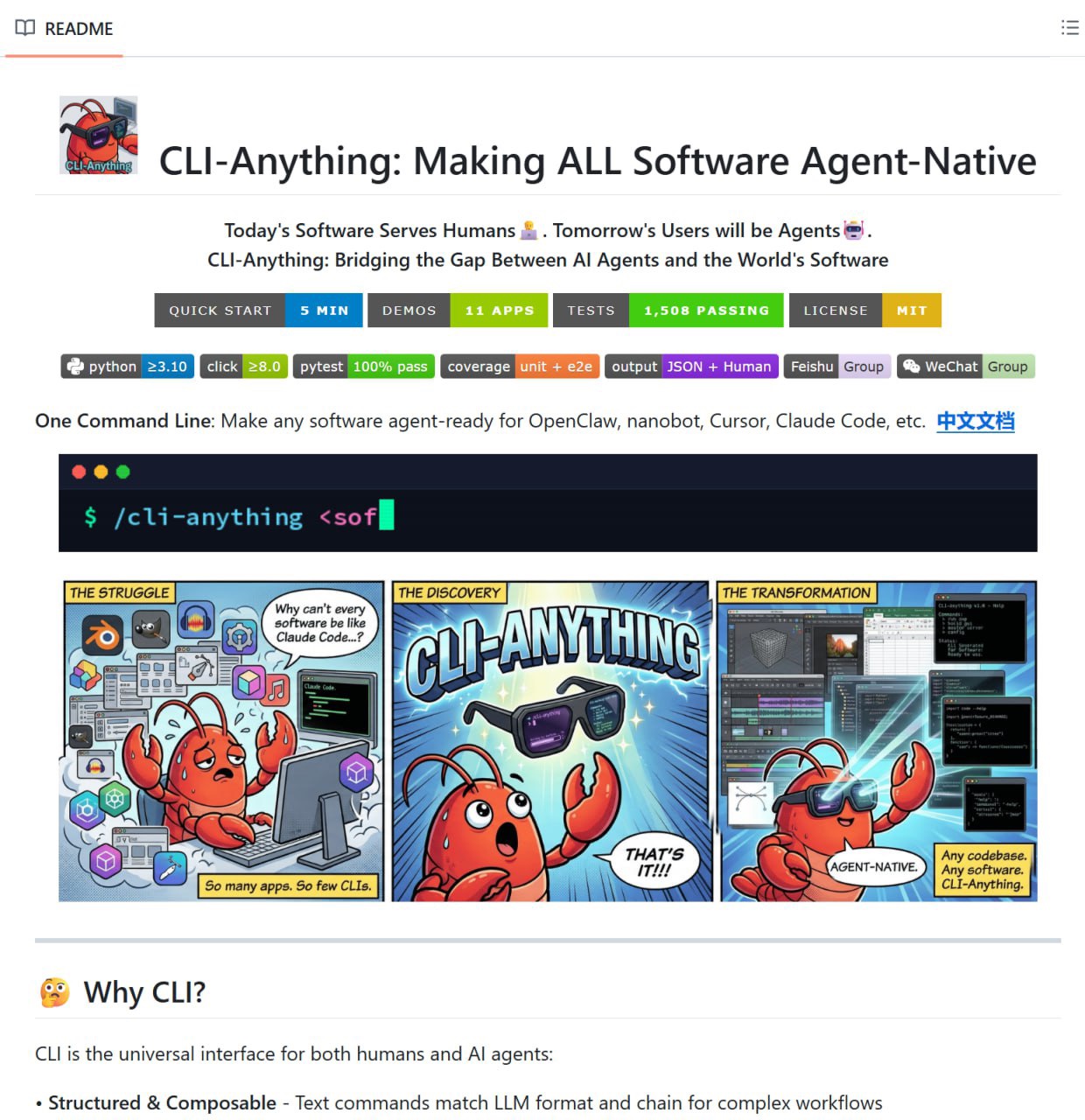
Recently noticed a very interesting GitHub trending project: Hong Kong University's cli-anything. Simply put, it's "everything can be CLI." This is quite intriguing because the path of technical interaction seems to have come full circle: from the earliest CLI, which is command-line operation, to GUI graphical interfaces, and now back to CLI.
CLI in the past was mainly for human use, emphasizing efficiency, but the barrier to entry was high. Later, GUI emerged, essentially to reduce the cost of use for ordinary users. The CLI being pushed back to the forefront today is more like an interface layer prepared for AI. For humans, graphical interfaces are more intuitive; but for AI, the clearly structured, well-defined, programmable, and callable form of the command line is actually more suitable as an execution entry point.
This is also why "everything can be CLI" has become attractive again today. It's not negating the value of GUI, but rather redefining what is a more efficient interaction method after AI gradually becomes the main operator.
Let's talk about the highly popular "Lobster" recently. If you only look at surface-level discussions, it's easy to understand it as a leap in capability. But my own judgment is that it hasn't brought about any particularly significant capability evolution; in fact, its performance on some tasks is even worse than mature agent workflows.
The real value of Lobster might not lie in being "stronger," but in being "easier to get started with." In the past, workflow tools like n8n weren't weak in capability; the problem was they always had a certain barrier to entry. You need to understand nodes, processes, triggers, and upstream-downstream relationships. Many ordinary users see this complexity and often give up before even starting. What Lobster does is more like lowering that barrier a bit, allowing people who originally wouldn't touch workflows to at least get a process running.
What Lobster solves might not be a capability issue, but rather a productization and popularization issue. It lets more people truly experience for the first time what agent workflows can do, and that in itself is already very important.
Looking further ahead, this path might become increasingly clear: on one end is the GUI for humans, on the other end is the CLI for AI, with lower-barrier workflow packaging layered in between. The form of the tools is changing, but the core logic remains the same—whoever can deliver complex capabilities at a lower cost will more easily capture the next round of entry points.
Project address: https://github.com/HKUDS/CLI-Anything
$NVIDIA(NVDA.US)$Meta Platforms(META.US)$Alphabet(GOOGL.US)
The copyright of this article belongs to the original author/organization.
The views expressed herein are solely those of the author and do not reflect the stance of the platform. The content is intended for investment reference purposes only and shall not be considered as investment advice. Please contact us if you have any questions or suggestions regarding the content services provided by the platform.
