D
Mar 27 at 11:50 AM
Meitu (Trans): Models to Power Apps Long Term
Below is Dolphin Research's curated Trans of$MEITU(01357.HK) FY2025 earnings call. For our take on the results, see'Meitu: In the AI Agent era, is there room for small, nice-to-have SaaS?'
I. Key financial highlights recap
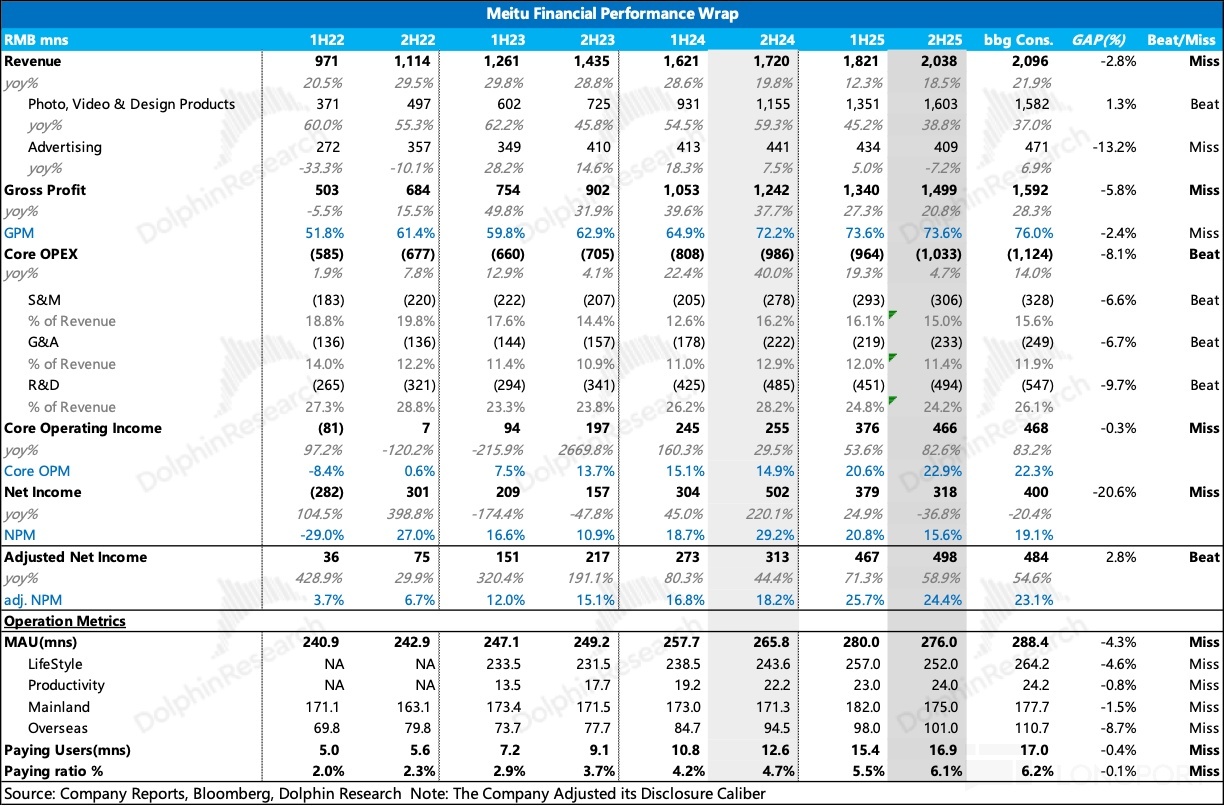
1. Shareholder returns: Announced a HKD 300mn buyback, with management stating the shares are undervalued. The dividend payout ratio remains ~40%, and combined with buybacks, operating cash return is ~60%–70%.
2. Outlook: Revenue growth in 2026 should be broadly in line with 2025, with a greater contribution from global productivity products. Adj. attributable NP is set to grow rapidly, and GPM should stay above 70% in 2026.
3. Key metrics: Total revenue rose 28.8% YoY to RMB 3.86bn in 2025; imaging & design revenue grew 41.6% YoY to RMB 2.95bn; Adj. attributable NP increased 64.7% YoY to RMB 970mn; GPM was 73.6% (down ~200bps on a like-for-like basis, mainly on lower ad mix and higher compute costs). IFRS NP attributable to shareholders from continuing ops was approx. RMB 700mn (vs. RMB 800mn in 2024), driven by the absence of a one-off RMB 640mn crypto gain in 2024 and a ~RMB 510mn non-cash expense from the 2025 CB issuance to Alibaba.
4. Costs & expenses: S&M was RMB 600mn (+25.5%), steady at ~16% of imaging & design + ad revenue; R&D was RMB 950mn (+3.8%), or +14.5% ex large-model training; G&A was RMB 450mn (+14%). COGS was RMB 1.02bn (+42%), including channel fees of RMB 620mn (+43.5%), compute & cloud costs of RMB 230mn (+16.4%), and third-party API costs at a mid-single-digit % of COGS.
II. Earnings call details
2.1 Management remarks
1. Positioning & AI strategy
a. Meitu is positioned as an AI applications company focused on imaging. Its tech roadmap is evolving from a single-model approach to a model container, product form from tools to AI agents, and monetization from subscriptions to token-based consumption.
b. It focuses AI capabilities on high-value verticals, building industry-specific AI teams for users. These teams comprise multiple role-based agents that execute standardized and repeatable tasks.
c. Imaging models each have strengths, and no single model covers all scenarios. It will become increasingly common for vertical app companies to combine different models to maximize product performance.
2. AI team product approach
a. E-commerce asset creation: the goal is not just a design tool, but product images that truly lift conversion. The e-commerce design agent team brings in market analysis, data analytics, user research, copywriting, and other expert roles.
b. Social commerce videos: build AI ops (short-video trend research, account diagnostics, content strategy), AI photography (digital avatars, shooting), and AI editing teams (rough/precision cuts, thumbnail design), orchestrated by an AI director agent.
c. Agent capabilities are live: Meitu Design Studio has deployed AI agents for design, try-on, posters, and video. On the web, its e-commerce agent delivers 1 shelf-ready image on Avg. every 2 generated; the 'Kaipai' agent user penetration has risen to 11%.
3. AI-native products & open platform
a. RoboNeo has topped the overall and category app charts in 20+ countries and regions worldwide.
b. Launched the new Meitu CLI, with the first batch of AI Skills integrated into the OpenClaw ecosystem. Core imaging and design capabilities are packaged as callable, composable, and reusable Skills.
4. Operating data
a. As of Dec-2025, MAU rose 3.8% YoY to 276mn; paid subscribers rose 34.1% YoY to 16.91mn.
b. Productivity paid subs grew 67.4% YoY, with Intl paid subs doubling. Productivity subscription penetration reached 9%, up 3.1ppt YoY.
c. Overall subscription penetration increased to 6.1%.
5. Globalization
a. Intl revenue grew 37.4% YoY, outpacing Mainland China, to 38% of total (+2ppt YoY).
b. In 2H, launched viral features such as 3D figurines, AI group photos, and AI panoramas. AI group photos drove Meitu Xiuxiu MAU to a record high, adding 3mn+ users in Europe, and Xiuxiu topped the US iOS category chart for the first time.
c. Meitu Xiuxiu has cumulatively topped overall charts in 52 countries and category charts in 110+ countries.
d. In a16z's global Top 50 AI Generator mobile apps, Meitu ranked No.1 across imaging, video, and design categories with four apps selected.
6. Alibaba strategic partnership
a. Multi-pronged cooperation across foundation models, e-commerce asset scenarios, and cloud compute capacity.
b. Alibaba's open-source models have been deeply applied in image editing and video generation, with close collaboration on training techniques.
7. Disclosure upgrades: Starting this year, in addition to two earnings events, Meitu will update core operating metrics quarterly.
2.2 Q&A
Q: MAU and paid users slowed HoH in 2H. Was this due to user traffic being siphoned off by foundation models?
A: We do not think so. The biggest positive from stronger model capabilities in 2H was enabling rapid productization in new verticals. For example, after Meitu Design Studio launched AI agents, they quickly became the top revenue contributor, 'Kaipai' subscription penetration is already very high, and Intl ARPU is rising fast. So operationally and for the long term, the impact is very positive. As for Dec MAU being lower than Jun, that has happened in past years too, as MAU is a single-month snapshot and our viral features launched in different months last year; Dec simply had no new hit. The slower growth in paid users is not because of models or AI, but because life-scene products in China are maturing, so the percentage growth naturally decelerates. This is actually positive, as productivity products, especially global ones, are growing very fast and are still early in their lifecycle. The third curve has begun to replace the second, and productivity tools have much larger ARPU and subscription penetration potential than life-scene products. Some recent tests already show ARPU at $50/month, equivalent to more than a year of Avg. revenue from Meitu Xiuxiu. From an operating standpoint, positives far outweigh negatives.
Q: How should we think about 2026?
A: We cannot share precise numbers, but revenue growth should be broadly similar to 2025, with more support from global productivity products. In subsequent years we may see acceleration as the second curve matures and the third ramps. Adj. attributable NP will continue to grow at a very fast pace. Costs should be well controlled, as most opex is personnel-related, and we are aggressively lifting per-capita output via AI so the business can scale without adding much headcount.
Q: How much do agents lift conversion and ARPU?
A: Embedding agents addresses a lot of long-tail user needs, which is very exciting for the team. Take e-commerce as an example: traditional cutouts or AI product images mostly swap backgrounds; a grill could only be placed in an outdoor scene. But real demand includes food on the grill, smoke, flames, etc. The agent paradigm lets users specify granular needs in natural language, then fine-tune in the editor, which is far more efficient than using a raw model alone. That is why our products will not be disrupted by general models. Models meet basic needs, but we emphasize ease of use, and the agent-plus-editor approach enables targeted edits and conversion-oriented workflows in verticals. Meitu Design Studio's agents are now the No.1 paid feature because many previously unaddressed needs are now possible.
Q: How do agent features affect ARPU? Will you price by verticals?
A: We will not disclose specific data yet, but note that Meitu Design Studio already offers an RMB 88 tier (vs. prior max ~RMB 35), because user consumption has reached that level. Token usage driven by agents will become more visible across many products, and higher-priced subscription tiers will roll out across the portfolio. On pricing, we will have several base subscription tiers, but vertical differentiation will mainly appear via token consumption. It is similar to consulting: industry barriers differ, so consulting fees differ. Our 'Meta Pro + Skills' essentially embeds deep domain know-how from seasoned practitioners (including how to differentiate in commoditized competition) into the product. Ultimately, pricing will reflect the commercial value created in each vertical.
Q: What could productivity contribute in 3–5 years?
A: We do not have a precise figure, but in five years productivity will exceed life-scene revenue, potentially by a wide margin. We started scaling productivity tools in 2023, so it has been ~2.5 years, now ~19% of revenue. The scenarios that truly help industries only started with the advent of agents, which embed industry know-how into products, so growth over the next three years should outpace the last three.
Q: GPM outlook?
A: Although GPM fell about 200bps this year, the main reason was mix, as ads are near 100% margin and their share is shrinking. Ads may decline further next year but they are already small, so the impact on margins is limited. In addition, Apple lowered channel fees in China this year, which helps overall GPM. As for API usage compressing margins, third-party API is only a single-digit share today, so the impact is minor. Overall, keeping GPM above 70% in 2026 should not be an issue.
Q: Phones are adding AI features at the life-scene entry point. How do you see that? And can foundation models extend into verticals like e-commerce?
A: Meitu has a strong distribution advantage with 280mn MAUs, which has enabled low-CAC scaling for new products in recent years. Big tech and OEMs will keep trying new imaging plays, which is both a challenge and a complement for us, and it is hard for any one firm to serve all needs well. This is a marathon of innovation, with different ecological niches for models and apps. Models do not fully cover applications; over the long run, models empower applications. The competition raises our sense of urgency and fighting spirit.
Q: SaaS is shifting from seat-based subscriptions to outcome delivery. How do you think about that?
A: We do see this trend. Our AI teams are built to deliver high-quality outcomes, and our model extends from subscription to token consumption. Delivering outcomes will naturally consume more tokens, which is a big opportunity for us. For some high-bar productivity products, users are still willing to pay for outcomes, and ARPU is rising quickly. At our Imaging Festival in Jun, we will showcase upgrades and new launches focused on building AI teams and delivering high-quality outcomes. As a sidenote, many SaaS tools charge by seats even if users do not use them 90% of the time, which is overpaying. We have always charged on usage, so you do not see paid-but-unused subscriptions. While we are labeled a SaaS company, there is a fundamental difference: token economics will still include a subscription component, but instead of paying for a toolset, you pay for a token allowance and upgrade when consumed. Subscription and token consumption are a combination, not substitutes.
Q: Which new productivity verticals will you target overseas by 2026? Any user habit differences vs. China?
A: We are indeed expanding vertical scenarios. Beyond offline F&B, we see many ultra-vertical opportunities that no one serves well today. These are traditionally expensive to serve (e.g., tens of thousands of USD), whereas AI tools can deliver equal or better outcomes at ~1% of the cost. We will avoid big-tech core paths and target markets they are not prioritizing, as this is still a land-grab phase with abundant opportunities; we generally do not chase the hottest fields. User habits vary widely overseas: in Brazil and South America, social sharing demand is very strong with different playbooks than Asia. Visual tastes differ by country: Chinese users like copy-heavy, high-impact visuals; US users prefer cleaner, more refined materials; Brazilian users like brighter colors. We have made extensive adaptations across major regions. Paying habits also differ: Chinese users are price-sensitive and prefer weekly subs over monthly, while North American users favor monthly as they need longer to evaluate value; they are less price-sensitive and care more about value creation. Instead of radiating globally from China, we now take a global-first view to build products that score 90 in China and 90 globally as well.
Q: What drives ARPU up? Why will third-party API spend stay low?
A: The primary ARPU driver is agents introducing outcome delivery via token consumption. As usage rises, users upgrade to higher-priced tiers, and because results are strong, they do not mind. We pick arenas where AI solves problems at one-tenth or less the traditional cost, so even a doubling in ARPU is still cheap for users. ARPU gains are mainly from productivity use cases; life-scene ARPU will not rise much, though mix will lift ARPU as the Intl share increases. On APIs, we are very different. Meitu's 200+ designer center evaluates effects across all products, and design and engineering act as checks and balances — if designers say the quality is not good enough, it does not ship. For new scenarios, the design center benchmarks all available models. If an external model meets expectations, we use its API; if none meet our aesthetic bar, we invest to build. External APIs and internal R&D are complementary, with the end goal of best-in-class product outcomes.
Q: How do overseas products differentiate vs. competitors?
A: Competition in most verticals is far from saturated. Whether talking videos or e-commerce design, there are many vertical angles to differentiate. Versus standalone AI startups, Meitu benefits from years of aesthetic investment that boosts product competitiveness, and from scaled tech investment that builds a powerful imaging platform to ship and iterate faster. Competition may heat up in the next 2–3 years, so we must use this window to build a strong moat.
Q: Update on ZAWA? Any difference in willingness to pay between domestic and overseas users?
A: ZAWA primarily targets offline F&B stores in Europe and the US, where brand visuals, space design, menus/posters, and food photography have been very costly. We can deliver equal or better outcomes at a fraction of the cost, so willingness to pay should be solid. Our strategy is to validate PMF in target markets first, collect feedback, and expand after we reach certain satisfaction and product maturity. We are more optimistic about overseas willingness to pay. Imaging and design are far costlier overseas — materials can cost thousands of USD, while in China you can do it cheaply at a local print shop. China will keep growing, but the bigger opportunity is overseas, where tools can replace outsourced design at scale.
Q: Will the Imaging Festival be held as scheduled? Any new launches?
A: The festival will be held on Jun 17, focusing on AI teams, including major upgrades to existing products and potentially new products. Please stay tuned for Jun 17.
Q: How do you balance C-end experience and B-end monetization? How to build a sustainable AI revenue model?
A: Most Meitu products are still consumer-facing. Productivity does not automatically mean B2B — many bloggers and e-commerce sellers use our products individually, which is essentially consumer. The line between C and B is blurring in imaging, which helps us build standard products serving both. A sustainable AI monetization model is a mix of subscription and token consumption. The most durable model in the AI era is charging for delivered outcomes, not seat-based, low-end SaaS that charges regardless of usage.
Q: Background and features of Meitu CLI and AI Skills integration with OpenClaw? Any results?
A: This stems from observing global users. There are many one-person studios and tiny teams overseas, forming an extreme long tail. OpenClaw greatly improves these OPCs (one person company), who can now 'hire' an AI team with a few PCs or cloud VMs. Many have imaging needs, like independent sellers with a dedicated image-replacement SOP. With OPC prevalent and MCP ecosystems becoming key assistants for one-person studios, Meitu opening Skills can serve their imaging needs well. Strategically, users do not have to operate within Meitu apps: those with basic needs can call Meitu Skills in the MCP ecosystem; those with deeper needs can use Meitu products. We will differentiate: Meitu products will target high-value scenarios with deeper industry performance, while Skills will serve more basic needs — each aimed at different pay points.
Q: In a 'token explosion' world, how will Meitu control token costs and improve inference efficiency?
A: Internet companies will likely set their own token KPIs. In the land-grab phase, sheer token volume may look good, but inflating it is easy — turning a 3-turn task into 10 turns. The key is what token count is reasonable for the same delivered value. Good products should minimize tokens while delivering the task, then price tokens by the commercial value delivered by industry. In future, a company's AI credentials will be judged less by billions of tokens consumed and more by the commercial value those tokens created.
Q: How can you prove Meitu will not be swallowed by AI? What is the moat?
A: The idea that models swallow apps does not hold well. In the AI stack, models and apps occupy different niches and are not fully overlapping. General models do not serve many vertical scenarios well, which is the opportunity for application developers. Model progress actually raises the bar for application-layer integration of complex capabilities, outcome delivery, vertical intimacy, and value capture. The relationship is complementary.
Q: 2026 overseas growth potential? Key markets? How to control CAC?
A: Overseas growth is faster, and we focus on several markets. Asia is our 13-year home turf with solid share; in South America, we topped photo/photography charts across 15 countries led by Brazil a month ago, reflecting more localization investment; we also topped charts in multiple European and US markets last year. Imaging productivity tools have global commonality and are naturally suited to serve users across cultures, so the runway is large. For CAC, besides cross-promotion in our own apps, we lean on social media marketing. We first validate PMF via social, then scale spend to amplify reach, and only ramp paid user acquisition once the model and product maturity meet thresholds — a stepwise approach.
Q: Are business boundaries set? How will token economics change profitability? Model strategy?
A: Our core boundary remains imaging, which is large enough. Over the past year, many giants and startups have entered, expanding the track by 2–3x in a short time, and we are confident in sustaining competitiveness. Our model evolved from traffic, to subscriptions, to token consumption — all complementary, not replacements. Token share is rising and is a clear ARPU driver. On models, we will persist with self-developed vertical models because general models cannot meet many needs well, including in fine-tuning and cost. But self-developed models cannot serve all use cases, so we will use a model-container strategy that blends external open-source models and vendor APIs, scheduling and routing across models to maximize fulfillment and product strength.
Q: Progress on internal AI entrepreneurship and the product challenge? Any promising ideas?
A: We have two internal innovation tracks. One is the AI Innovation Studio that follows internal approval and deploys a RMB 10mn innovation fund to validate ideas. The second is the Meitu Product Challenge launched in Jan, open to all staff with teams capped at three members: 207 teams registered, ~130 competed, 15 reached the finals with seed budgets for online PMF tests, and the finals will be in early Apr. An interesting observation: most general-purpose ideas (e.g., generic AI short dramas, AI comics) were eliminated, and finalists targeted very specific verticals. One team focused on recipe sharing and food presentation for food bloggers; another helps local blue-collar service workers overseas do online marketing. The winners tend to be teams that deeply empathize with a vertical user's needs. We will further support winning products with funding, marketing, and tech to validate PMF quickly in global markets.
Q: You guided to a 2H surge in productivity tools last year. Is that still valid?
A: Meitu Design Studio, 'Kaipai' and other productivity products are showing strong momentum, and we have introduced higher-priced SKUs, which bodes well for a 2H ramp. Meitu has always focused on products and user experience; the 2H26 surge was not a hard target but a projection based on then-current judgment. It looks on track; please watch our current products and potential new launches at the Imaging Festival.
Q: Progress on HarmonyOS versions of Meitu apps?
A: We have completed HarmonyOS versions of Meitu Xiuxiu and BeautyCam, and Wink's HarmonyOS version will go live soon. We work closely with Huawei, which provides substantial tech and resource support. We will embrace the HarmonyOS ecosystem further as resources allow to unlock more growth.
<End of transcript>
Risk disclosure & statement:Dolphin Research Disclaimer and General Disclosure
Login to unlock21,319characters for free
This content is only available to signed-in users. Sign in to your Longbridge account to read the full post.